


Executive Overview
Enter Eigen Labs and their disruptive model of crowdsourced, iterative autoresearch.
On Wednesday, August 5, 2026, Eigen Labs launched its latest high-stakes autoresearch challenge, focusing its collective lens on Lighter, a high-performance decentralized exchange. The objective? To radically improve Lighter’s Zero-Knowledge (ZK) prover—the critical system component responsible for generating the cryptographic proofs that dictate the exchange’s maximum transaction throughput.
The results have stunned even seasoned industry observers. Within a mere 72 hours, a global swarm of independent developers and automated agent systems collaborated, competed, and iterated on Lighter’s codebase to achieve an astonishing 5.27x increase in prover throughput.
What began as a baseline capability of roughly 9,500 to 10,000 transactions per second (TPS) has, through the compounding magic of crowdsourced optimization, surged past 50,000 TPS while maintaining absolute cryptographic integrity and valid proof generation.
This article explores the mechanics of Eigen Labs’ latest challenge, the broader trajectory of these autoresearch experiments, the economic incentives driving the developer swarm, and what this paradigm shift means for the future of cryptographic engineering and distributed systems.
Detailed Chronology: 72 Hours of Hyper-Acceleration
To understand the magnitude of the achievement, one must trace the rapid timeline of the challenge since its kickoff. Eigen Labs structured the event as a dynamic, public performance race designed to harness the "wisdom of the crowds" via GitHub integration and automated benchmarking dashboards.

Day One: Setting the Baseline and Initial Swarm Entry
As the challenge doors opened on Wednesday morning, participating developers and AI-driven coding agents were given access to Lighter’s core ZK prover repository. At this starting line, the software operated at a respectable benchmark of 9,500 to 10,000 TPS. While adequate for standard exchange operations, it represented a bottleneck for Lighter’s long-term vision of hyper-scalable, institutional-grade throughput.
Within hours of the repository going live, developers began forking the codebase, analyzing bottlenecks in the arithmetic circuit constraints, and testing memory-pooling optimizations. The structural rules of the challenge dictated a compounding environment: whenever a participant submitted a successful optimization that surpassed the current record, that new iteration instantly became the de facto baseline for all subsequent entries.
This rule transformed the competition from a traditional static race into an escalating collaborative relay. Solvers were not just competing against the original code; they were building directly upon the micro-breakthroughs discovered by their rivals hours earlier.
Day Two: Exponential Compound Gains
By Thursday, the compounding effect was in full swing. Independent submissions began introducing clever algorithmic adjustments, optimizing multi-scalar multiplication (MSM) routines, and streamlining polynomial commitment evaluations.
Because the platform allowed developers to deploy autonomous AI agents alongside human oversight, the iteration cycle accelerated exponentially. While human engineers slept, agents continuously tested, benchmarked, pushed, and pruned code variations.
By the end of the second day, the baseline had already shattered previous architectural assumptions. Throughput figures crossed the 30,000 TPS threshold, leaving the original performance metrics deep in the dust. The competitive pool—incentivized by a prize pool featuring 15,000 LIT tokens (valued at approximately $35,400 at the time of launch)—saw a surge in submissions as elite cryptography and systems engineering talent rushed to claim top placement on the public leaderboard.
Day Three: Crossing the 5x Threshold
By Friday, the challenge reached its current pinnacle. The leading submission successfully cleared 50,315 TPS while continuing to output mathematically sound, valid zero-knowledge proofs.

Achieving a 5.27x performance multiplication in three days defies traditional software development cycles. For Lighter, this breakthrough means that engineering teams do not need to spend the next six to twelve months guessing at optimization pathways. Instead, they can simply pull the battle-tested, community-optimized code directly into their production pipeline, fundamentally altering the exchange’s technical capacity overnight.
Supporting Context & Metrics: The Evolution of Autoresearch
To contextualize this week’s triumph at Lighter, one must look at the broader lineage of Eigen Labs’ autoresearch challenge series. This recent event marks the fifth major challenge in an ongoing series that has quietly revolutionized how the Web3 ecosystem tackles intractable computational problems.
The Inception: Google’s Quantum Circuit Challenge
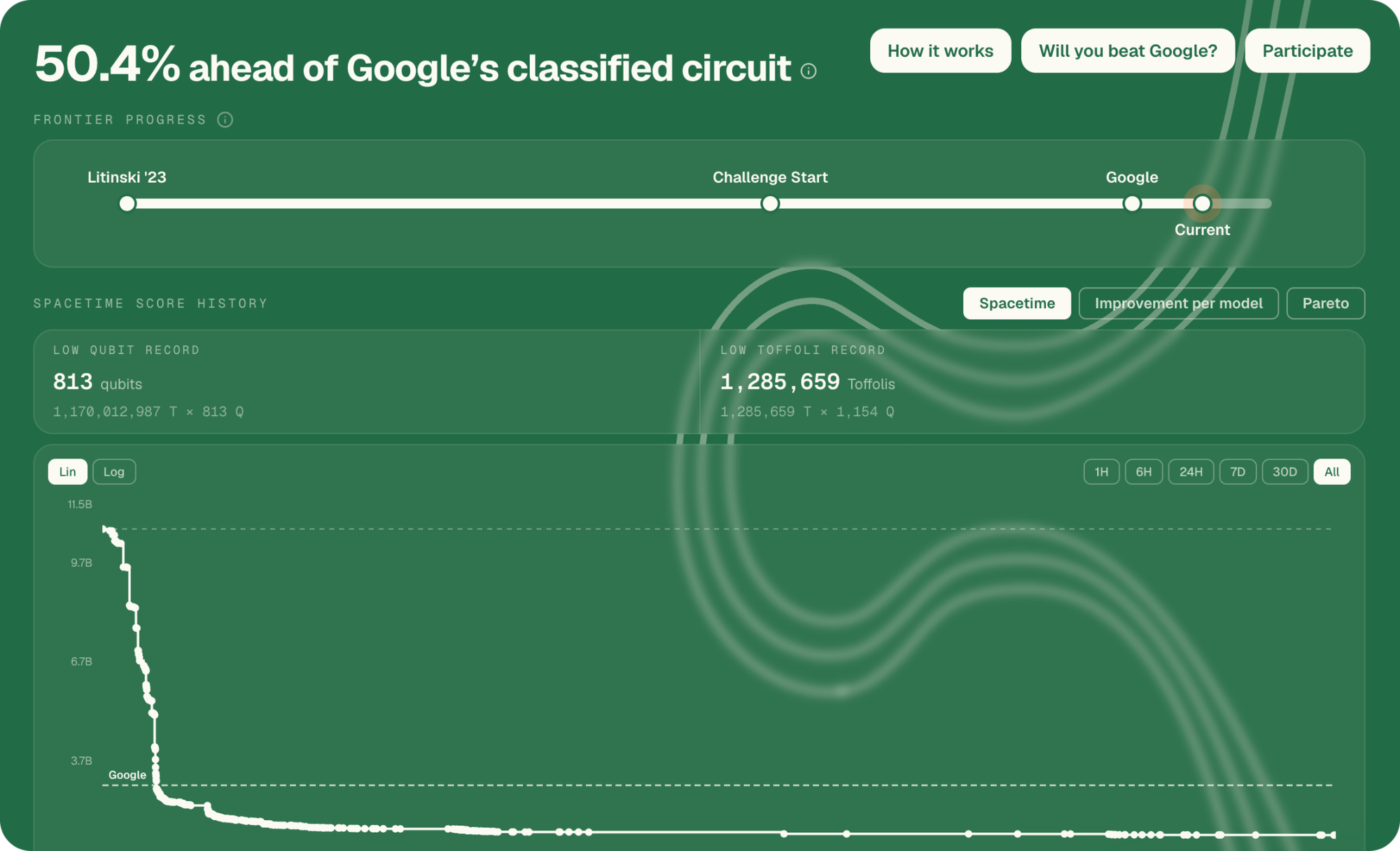
The experiment series kicked off in early June with an ambitious project centered around quantum circuit work. Developers and AI agents were tasked with iterating upon and improving Google’s landmark research concerning quantum resistance and elliptic curve cryptography (specifically targeting ECDSA signatures foundational to Bitcoin and Ethereum).
The inaugural challenge drew over 100 dedicated solvers and hundreds of high-performance submissions. The results were nothing short of historic: the open network’s crowdsourced configurations ultimately pushed performance roughly 50% ahead of Google’s benchmark system. More critically, the challenge successfully identified methodologies that dramatically lowered the estimated quantum computing resources required to threaten Bitcoin and Ethereum signature schemes—serving as a massive cryptographic wake-up call regarding the speed of quantum vulnerability advancement.
The Structural Blueprint
Encouraged by the success of the June quantum experiments, Eigen Labs refined its operational playbook into a standardized, highly repeatable format:
- Public Infrastructure & Dashboards: A transparent leaderboard where developers connect GitHub accounts, fork target repositories, and view real-time benchmarking metrics.
- Dynamic Baselines: Each newly verified performance record automatically becomes the new baseline, forcing subsequent competitors to leapfrog over the latest industry-best standard rather than the original legacy code.
- Human-AI Synergy: Allowing both human systems architects and autonomous AI coding agents to collaborate and compete simultaneously.
- Token-Based Incentive Design: Rewarding top-performing contributors with native token allocations (such as the 15,000 LIT pool for the Lighter challenge).
Following the June quantum circuit challenge, Eigen Labs successfully deployed this methodology across three intermediate domains before turning its focus to Lighter’s ZK infrastructure this week.
Economic Incentives and Value Realization
A critical takeaway from the Lighter ZK prover challenge lies in the sheer asymmetry between the cost of the incentives and the immense value of the engineering output.
At the time of writing, the total prize pool stood at 15,000 LIT (roughly $35,400), distributed across top-ranking submissions. When evaluating the economic reality of this reward structure against the delivered outcome—a 5.27x throughput increase for a decentralized exchange—observers are left marveling at the cost-efficiency of crowdsourced R&D.
Building a prover capable of handling over 50,000 TPS would traditionally demand hundreds of thousands of dollars in specialized engineering salaries, months of compute testing, and significant opportunity costs. By decentralizing the problem and offering a transparent, gamified bounty structure, Lighter and Eigen Labs tapped into a global talent pool far broader than any single corporate entity could ever hope to employ internally.
Furthermore, industry analysts predict that as the efficacy of these challenges becomes undeniably clear, future iterations will likely feature substantially larger, multi-asset prize pools. The structural framework has already proven versatile enough to transcend pure blockchain scaling, opening doors for applications across decentralized finance (DeFi), complex scientific simulations, artificial intelligence training optimization, and hardware-software co-design.
Future Outlook: A New Paradigm for Open-Source Innovation
Autoresearch challenges occupy a fascinating intersection in modern technology, bearing a striking conceptual resemblance to prediction markets.
- Prediction markets aggregate decentralized sentiment to distill accurate probability signals about future real-world events.
- Autoresearch challenges aggregate decentralized engineering talent and machine intelligence to distill optimal code configurations and breakthrough algorithmic signals.
In many ways, this model represents the purest expression of the Web3 ethos: take a hard technical problem, strip away institutional secrecy, place the codebase in the public square, offer robust economic incentives for improvement, and let the compounding collective intelligence of global solvers build a better future.
As protocols increasingly adopt this methodology, the traditional software development lifecycle—characterized by closed-door corporate roadmaps and linear progress—may face obsolescence. If a community can achieve a 5x performance multiplier in 72 hours through a public GitHub challenge, protocols failing to embrace crowdsourced autoresearch risk being left far behind in the dust of exponential innovation.
We can only hope that more foundational protocols take up the mantle.