rifanmuazin is a reporter for DeBitcoin covering CBDCs & Sovereign Digital Currencies. She/He is based in Indonesia.
23 August 2026 • 8 min read
As the global economy marches deeper into the digital age, a high-stakes turf war is unfolding across Europe. At the center of the storm is one of the most polarizing financial initiatives in the history of the European Union: the digital euro.
To its architects at the European Central Bank (ECB) and Brussels policy desks, a Central Bank Digital Currency (CBDC) is an essential geopolitical and economic shield. They frame it as a necessary evolution to preserve Europe’s monetary sovereignty, counter total reliance on foreign payment giants, and secure central bank money in an online economy increasingly saturated by dollar-pegged stablecoins.
Yet, to a vocal coalition of privacy advocates, crypto enthusiasts, free-market economists, and even traditional commercial bankers, the digital euro represents something far more ominous. Critics warn of a dystopian financial panopticon—a supranational "digital cage" that could grant centralized authorities unprecedented capabilities to track, monitor, and selectively restrict the financial lives of everyday citizens.
With high-level legislative negotiations currently underway and a definitive ECB decision looming, the digital euro has evolved far beyond a technical upgrade. It has become a philosophical battleground over who controls the future of money: the state or the individual.
Executive Overview: What Is the Digital Euro?
At its core, the digital euro is a proposed Central Bank Digital Currency (CBDC) issued directly by the ECB. Unlike physical banknotes and coins that citizens hold inside their physical wallets, a digital euro would live in electronic wallets, enabling peer-to-peer transactions, online purchases, and in-store checkouts.
Crucially, the underlying money would remain a direct liability of the ECB rather than a commercial bank. Supporters argue this provides the same sovereign backing as cash, removing credit risk tied to commercial deposit holdings.
However, the acronym "CBDC" routinely triggers alarm bells across the privacy community, evoking Orwellian visions of government surveillance. These concerns are not isolated to European borders. In January, United States President Donald Trump signed an executive order explicitly banning CBDCs in the US, citing severe risks to individual privacy, financial system stability, and national sovereignty—a stance later codified into housing legislation through a ban extending to 2030.
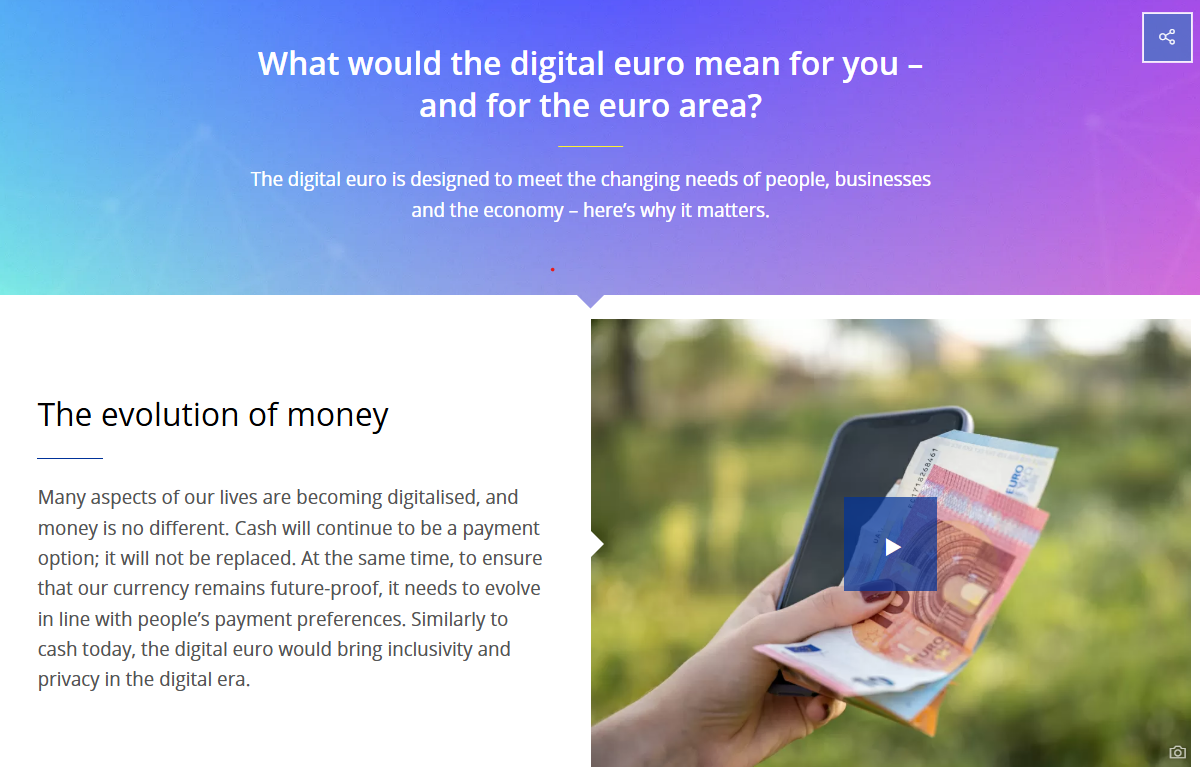
Despite America’s hard pivot against state-issued digital currencies, European leadership remains steadfast. The ECB insists that the digital euro will complement—not replace—physical cash, offering a secure alternative as digital transactions continue to displace traditional paper currency.
"The main reason for issuing a digital euro is to preserve the benefits of cash in the digital era," asserted Piero Cipollone, a member of the ECB’s executive board.
Yet critics counter that this promise rings hollow. As Spanish financial commentator José Vizner points out, "They promise privacy… but it’s money that’s trackable by design."
Detailed Chronology: The Path to the Digital Euro
The trajectory of the digital euro has been characterized by escalating debate, rigorous pushback, and a protracted regulatory timeline.
2020–2021 (The Global Awakening): While central banks worldwide began exploring CBDCs following China’s early e-CNY pilots, the ECB initiated formal research into a digital version of the single currency, aiming to study technical feasibility and economic impacts.
October 2023 (The Privacy Clash): The European Data Protection Supervisor (EDPS) and the European Data Protection Board (EDPB) released a joint opinion emphasizing that high-level data protection and privacy safeguards are mandatory for the project to ever command public trust.
2025 (Geopolitical Realities): Amid growing friction over international payment infrastructure dominance, ECB President Christine Lagarde underscored Europe’s vulnerability, noting that critical debit and credit frameworks rely entirely on non-European solutions. Simultaneously, the US moved to permanently ban CBDCs, creating a stark transatlantic divide.
Early 2026 (Cost Revelations): Financial impact estimates revealed a staggering economic burden. The ECB projected implementation costs for the European banking sector alone to land between €4.6 billion ($4.9 billion) and €6.9 billion ($7.5 billion), triggering widespread pushback from commercial financial institutions.
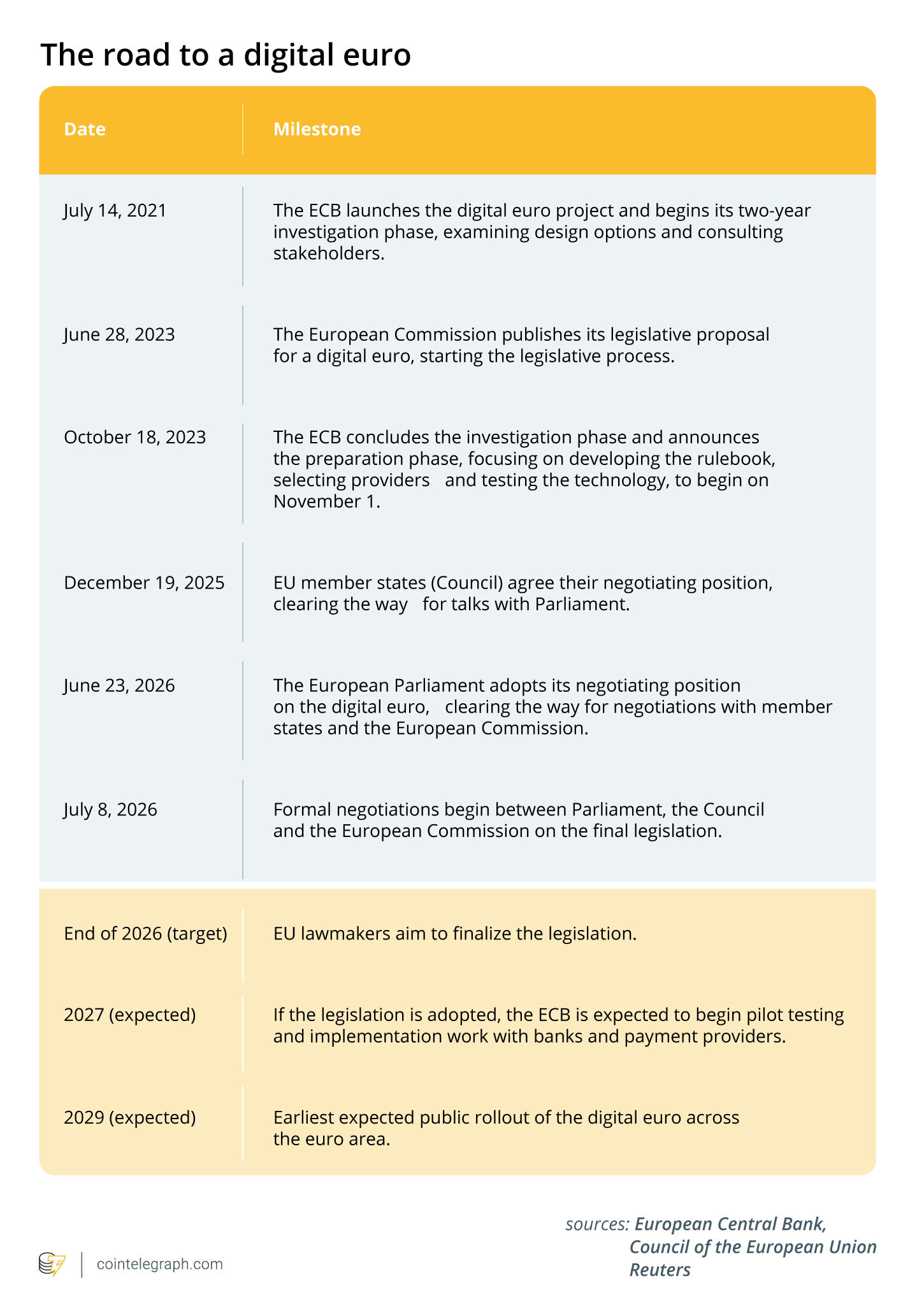
Late 2026 (Legislative Crunch Time): Lawmakers across the European Parliament, member states, and the European Commission accelerated negotiations on the final legislative framework, targeting a comprehensive political agreement within a six-month window.
2027–2029 and Beyond (The Horizon): If final legislative text clears EU hurdles by the end of 2027, the ECB’s Governing Council will formally decide whether to greenlight issuance. Industry experts agree that European citizens are unlikely to interact with a live digital euro in daily commerce before 2029.
Supporting Context & Metrics: Costs, Infrastructure, and Adoption Precedents
Implementing a continent-wide digital currency is an astronomical logistical and financial undertaking. According to ECB models, setting up the digital euro infrastructure will demand initial investments of roughly €1.3 billion ($1.5 billion), accompanied by ongoing annual operating expenditures of €320 million ($370 million).
When factoring in the necessary upgrades for commercial banks and payment service providers to integrate the network, total industry implementation costs are estimated to scale up to €6.9 billion over a four-year period.
Learning From Global Precedents
Europe is not operating in a vacuum. Over 100 countries have explored CBDCs over the past half-decade, yielding mixed results that offer cautionary tales for Brussels:
China (e-CNY): Launched via extensive pilots in 2019, the digital yuan has processed trillions of yuan in transaction volume. However, despite heavy state backing, widespread organic adoption has faltered, with ordinary consumers overwhelmingly preferring established private fintech apps like WeChat Pay and Alipay.
The Bahamas (Sand Dollar): Launched in 2020 as the world’s first nationwide retail CBDC to bolster financial inclusion, the project suffered from sluggish adoption, forcing authorities to lean heavily on commercial banks to force distribution.
Nigeria (eNaira): Introduced in 2021, the eNaira struggled immensely to secure traction among everyday citizens despite aggressive government promotional campaigns.
Brazil (Drex): In November 2025, Brazil’s central bank abruptly shut down its Drex CBDC platform, explicitly citing insurmountable cost hurdles and acute privacy concerns, clearing a path for stablecoin integration instead.
These global hurdles prompted the Bank for International Settlements (BIS) to conclude plainly that a retail CBDC remains an exceptionally complex undertaking, fraught with structural hurdles for both central and commercial banks.
Official Statements: The Great Divide
The gulf between institutional defenders of the digital euro and its fierce detractors highlights a profound ideological split over the nature of money.
The Institutional Case: Sovereignty and Inclusion
Proponents maintain that Europe must innovate or risk becoming economically subordinate to foreign corporate and sovereign payment rails.
"The digital euro will reduce Europe’s excessive dependence on non-European providers. It will ensure that Europeans can pay with their money — the sovereign money issued by their central bank — in the digital economy,"
— Piero Cipollone, ECB Executive Board Member
Complementing this view, European leaders argue that infrastructure autonomy is paramount. ECB President Christine Lagarde emphasized this vulnerability in 2025:
"The entire infrastructure mechanism that allows for payment, credit and debit, is not a European solution… We need to make sure there is a European offer, just in case."
Consumer groups have echoed cautious optimism. Andrew Canning, deputy head of communications for the European Consumer Organization (BEUC), noted that the digital euro could deliver a "secure and inclusive" option complementing existing tools, particularly for demographics facing structural hurdles with private digital payment methods.
The Libertarian & Banking Counter-Perspective: Surveillance and Instability
Critics, however, view these promises as a rhetorical veil masking an unprecedented expansion of state oversight.
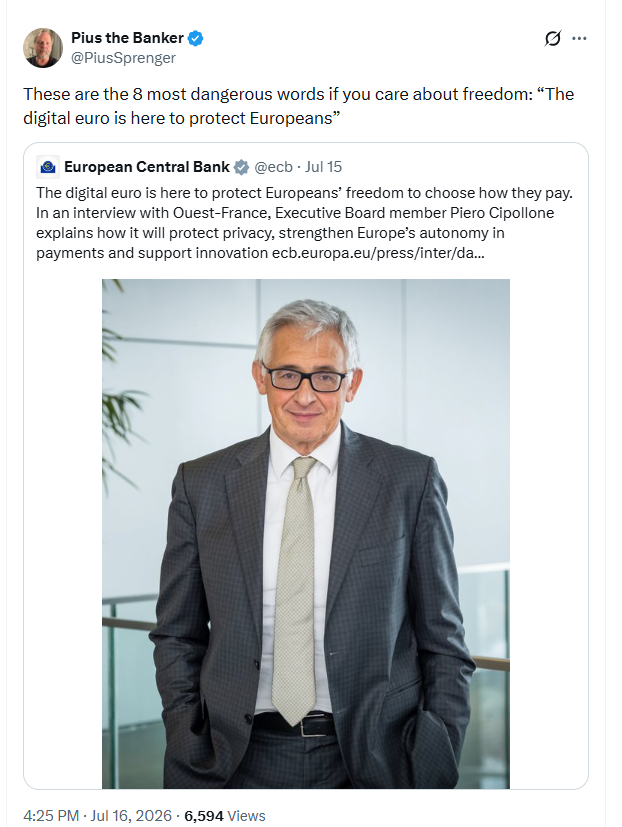
"These are the 8 most dangerous words if you care about freedom: ‘The digital euro is here to protect Europeans,’"
— Pius Sprenger, Former Deutsche Bank Managing Director
Financial commentator José Vizner went further, warning television and digital audiences:
"This is how they will be able to control EVERY euro you spend. Goodbye money. The ECB will decide how much digital money you can have."
Tech entrepreneur and privacy advocate Efrat Fenigson warned that the currency could lay the foundational infrastructure for "programmable money, programmable identity, and programmable behavior," noting that freedom rarely disappears overnight—it vanishes one permission at a time.
These fears are not purely hypothetical. During Canada’s 2022 Freedom Convoy protests, emergency powers were invoked to compel banks and crowdfunding platforms to freeze financial accounts tied to civil demonstrations, illustrating how easily existing financial channels can be weaponized by authorities.
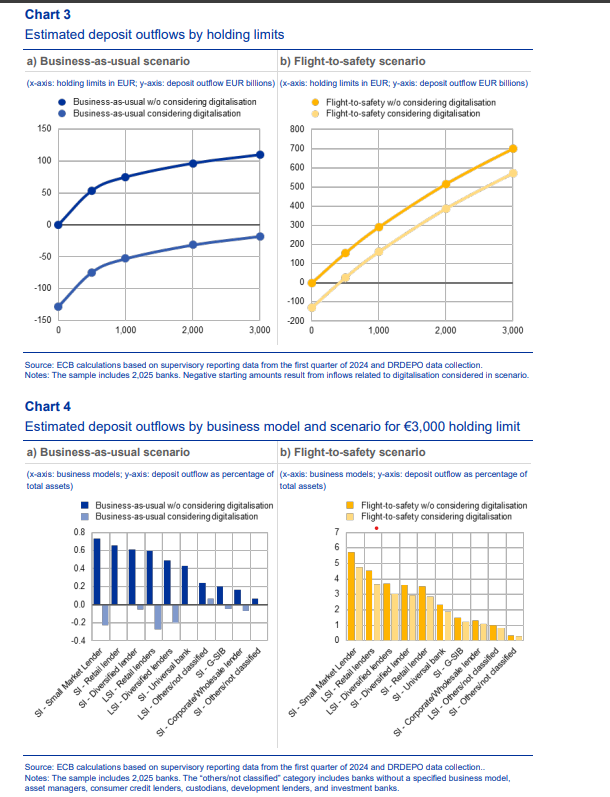
Intriguingly, the anti-CBDC camp has found unexpected bedfellows within the traditional banking sector. Commercial lenders fear that a shift toward central bank-backed digital accounts will drain valuable commercial deposits, starving banks of capital needed to issue loans to businesses and consumers. Lorenzo Bini Smaghi, an Italian economist and former ECB executive board member, warned of a "high risk of financial instability, with strong repercussions for the real economy."
To mitigate deposit flight, the ECB has proposed strict holding limits—restricting the maximum amount of digital euros an individual can hold at any given time—and confirmed that no interest will be paid on digital euro holdings, mirroring physical cash.
Future Outlook: Will Europe Take the Plunge?
As the European Parliament and member states navigate the final legislative drafts, the ultimate fate of the project hangs in the balance.
If lawmakers successfully hammer out a political consensus before the end of the year, the decision will land squarely on the desk of the ECB’s Governing Council in 2027. Should they grant final approval, Europeans will still face a multi-year integration phase, making a public rollout unlikely before 2029.
Whether the digital euro ultimately serves as a triumph of European monetary sovereignty or a cautionary monument to overreaching state surveillance will depend entirely on the final implementation of privacy safeguards—and whether European citizens ultimately trust Brussels to keep its hands out of their digital wallets.