

Executive Overview
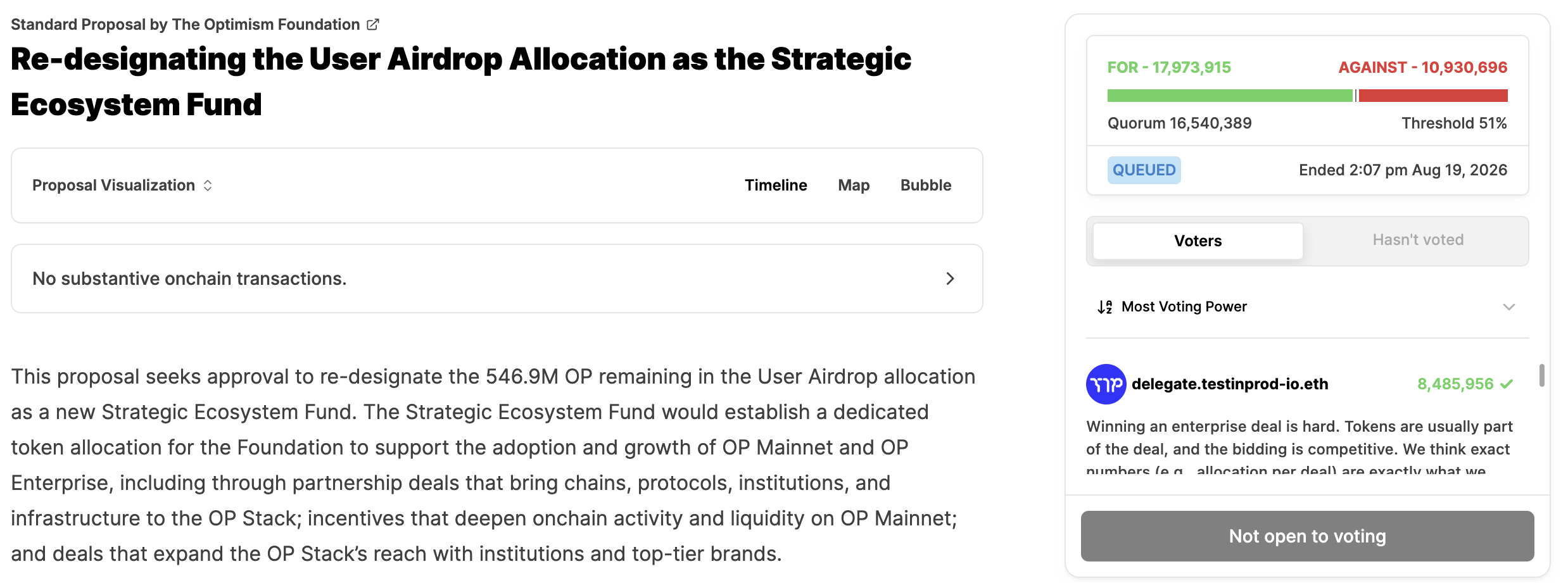
The pivot marks a definitive shift in Optimism’s overarching trajectory—moving away from broad-based retail user acquisition campaigns and pivoting aggressively toward institutional adoption, enterprise-grade partnerships, and deep cross-chain liquidity. According to data from CoinGecko, the newly reallocated token pool represents a staggering financial weight. At current market valuations, where OP trades around $0.09 with a circulating supply of roughly 2.29 billion tokens and a total market capitalization hovering near $214 million, the 546.9 million tokens account for roughly $50 million—representing nearly a quarter of the network’s entire market cap.
While proponents of the governance proposal hailed the move as a necessary and aggressive tactical maneuver required to compete for lucrative enterprise deals and secure the network’s long-term dominance, the decision did not arrive without friction. Several delegates strongly pushed back, arguing that the tokens had been implicitly promised to the community as future loyalty rewards. Skeptics also questioned the transparency and accountability mechanisms of the foundation, specifically demanding clarity on how the return on investment (ROI) from the Strategic Ecosystem Fund will be measured.
Nevertheless, with five prior airdrop rounds having already distributed 269.1 million OP tokens, Optimism leadership has drawn a firm line in the sand: retail-focused airdrops have served their purpose in bootstrapping the early network, and the protocol must now scale its ambitions upward toward traditional financial institutions, global enterprises, and interoperable superchains.
Detailed Chronology: The Evolution of Optimism’s Distribution Strategy
To fully understand the weight of the recent governance vote, one must examine the chronological progression of Optimism’s token distribution strategy. From its inception, the Optimism Foundation utilized airdrops as a primary instrument to incentivize early participation, reward decentralized finance (DeFi) pioneers, and decentralize network governance.
The Airdrop Era: Bootstrapping the Network
- Airdrop 1 (Early 2022): The foundation dropped over 200 million OP tokens to early users, DAO voters, and multi-sig participants, successfully establishing an active initial user base.
- Airdrops 2 through 5 (2023–2024): Subsequent, smaller-scale airdrop rounds targeted active contributors, governance participants, and specific ecosystem sub-sectors, bringing the cumulative total of distributed airdrop tokens to 269.1 million OP.
As these campaigns progressed, however, core contributors began to evaluate the diminishing marginal returns of blanket retail distribution. While airdrops effectively spiked short-term user metrics and transaction counts, they frequently failed to secure long-term capital retention or sticky, high-value protocol usage.
The Turning Point: Institutional Ambitions
By mid-2024 and heading into 2025, the competitive landscape for Ethereum scaling solutions had fundamentally shifted. With Layer-2 networks multiplying—notably Arbitrum, Base, Polygon, and zkSync—simply relying on organic retail growth was no longer sufficient to guarantee market leadership.
The conception of the OP Stack—an open-source, modular development framework designed to allow developers to spin up their own customized layer-2 or layer-3 networks—changed the game. Networks such as Coinbase’s Base, Unichain, Kraken’s Ink, and Sony’s Soneium all adopted the OP Stack, turning Optimism into a foundational infrastructure provider rather than just a standalone scaling chain.
Recognizing this transformation, foundation members quietly began drafting proposals to re-evaluate the utility of unallocated tokens sitting idly in the treasury. The culmination of these internal discussions was the recent governance proposal to sweep up the remaining 546.9 million tokens originally designated for user drops and house them within a centralized, enterprise-focused war chest. Despite fierce debate within the DAO forums, the vote ultimately cleared, sealing the end of the airdrop era and ushering in the corporate adoption phase.

Supporting Context & Metrics: Analyzing the Financial and Structural Impact
To appreciate the gravity of repurposing over half a billion tokens, financial and structural market metrics must be contextualized.
Market Valuation and Tokenomics
- Current Trading Price: ~$0.09 per OP token (experiencing an 11% rebound over a 24-hour window amid a broader macro crypto market recovery).
- Historical Context: Despite the recent double-digit daily percentage gain, OP remains battered relative to historical metrics, trading more than 93% below its all-time high.
- Circulating Supply: ~2.29 billion tokens.
- Market Capitalization: ~$214 million.
- Value of Reallocated Pool: At current depressed price levels, the 546.9 million tokens carry a market value of roughly $50 million. However, should the broader crypto market experience a cyclical bull run that returns OP to even a fraction of its former highs, the purchasing and lobbying power of this fund could easily scale into the hundreds of millions of dollars, giving the foundation immense financial leverage.
The OP Stack Economy
Optimism is no longer evaluated merely as a single execution layer, but as a collective network of chains powered by the OP Stack. Currently, more than 30 distinct OP Stack-powered chains actively contribute a portion of their sequencer revenue back to the central Optimism Collective.
This business model relies heavily on network effects. The more prominent institutions, fintech giants, and consumer brands that build on the OP Stack, the stronger the underlying economic flywheel becomes for the entire ecosystem. The newly minted Strategic Ecosystem Fund is explicitly designed to grease this wheel, offering bespoke financial incentives, joint marketing agreements, and developmental grants to major enterprise partners who choose Optimism over rival scaling solutions like Arbitrum or zkSync.
Real-World Integration: The Toss Partnership
Evidence of this institutional pivot can be seen in tangible business developments. In July, strategic moves highlighted by industry reports revealed that Optimism signed a memorandum of understanding (MoU) with Viva Republica, the powerhouse operator behind South Korea’s dominant mobile money transfer application, Toss.
This partnership initiated a three-month proof-of-concept (PoC) aimed at testing Korean won-based stablecoin infrastructure for high-volume institutional and retail payments. Deals of this magnitude require dedicated legal, technical, and financial support from the foundational level—support that can now be aggressively funded and sustained via the newly approved Strategic Ecosystem Fund.
Official Statements and Stakeholder Perspectives
The vote to redirect 546.9 million OP tokens exposed a deep ideological rift within the Optimism governance community. The debate crystallized the classic tension in decentralized autonomous organizations (DAOs): the friction between grassroots community entitlement and pragmatic, top-down corporate strategy.
The Proponent View: Pragmatism Over Populism
Defenders of the proposal argued that clinging to outdated distribution roadmaps would leave Optimism vulnerable to aggressive competitors who are already courting traditional financial institutions with heavy subsidies and partnership incentives.
"Airdrops are a tool for a specific chapter of network genesis—specifically, waking up a community and seeding initial decentralization," noted a prominent ecosystem delegate during the voting phase. "However, we are past the bootstrapping phase. To capture global finance, onboard multi-billion-dollar institutions, and secure long-term enterprise integration, we need dry powder. The Strategic Ecosystem Fund provides the exact economic ammunition required to win competitive enterprise deals."
Supporters emphasized that driving liquidity, deepening protocol integrations on OP Mainnet, and aggressively expanding the OP Enterprise division will ultimately create far more fundamental value for existing token holders than a speculative, one-off retail airdrop ever could.
The Critic View: Broken Promises and Accountability Concerns
Conversely, the dissenting voices among the delegate body raised valid concerns regarding governance trust and financial oversight.
Critics argued that a significant portion of the community supported and built on Optimism with the persistent expectation that token distributions would reward active engagement over time. By pulling the rug out from under future airdrops, the foundation risks alienating the grassroots developer and user base that gave the network its initial cultural legitimacy.
Furthermore, several delegates voiced anxiety over the lack of stringent Key Performance Indicators (KPIs) tied to the new fund. Questions were aggressively raised regarding how the Optimism Foundation intends to measure, audit, and report the specific returns generated by the deployment of 546.9 million tokens. Without crystal-clear accountability metrics, critics fear the fund could devolve into a slush fund for institutional grants that yield little measurable network growth or revenue return.
Future Outlook: What Lies Ahead for Optimism?
As the dust settles on this watershed governance vote, the pressure now shifts entirely to the Optimism Foundation and its leadership team to prove that the gamble has paid off.
1. Execution of the Strategic Ecosystem Fund
The immediate priority will be the formal structuring and operationalization of the Strategic Ecosystem Fund. The foundation must establish transparent governance frameworks, clear application pipelines for institutional partners, and rigorous auditing mechanisms to appease the delegates who voted with hesitation. Establishing trust and proving high ROI on early institutional deployments will be critical to healing community fractures.
2. Scaling the Superchain Vision
With a war chest of nearly 550 million tokens at its disposal, Optimism is uniquely positioned to accelerate the expansion of the "Superchain"—its unified network of OP Stack chains. Expect to see an influx of enterprise announcements, traditional banking pilots, and cross-border payment integrations akin to the Toss partnership in South Korea. By positioning itself as the premier regulatory-compliant, enterprise-ready scaling framework for Ethereum, Optimism aims to capture a dominant market share of institutional decentralized finance (DeFi) and real-world asset (RWA) tokenization.
3. Market Recovery and Token Performance
From a market perspective, whether the token price can break out of its prolonged slump—sitting 93% below its all-time high—will depend heavily on network usage, sequencer revenue growth, and broader macroeconomic conditions. While the repurposing of tokens temporarily reduces speculative retail excitement tied to airdrops, it introduces a deflationary-like maturity: capital is being shifted from passive giveaways to active, value-accretive ecosystem development.
Ultimately, Optimism has chosen its path. By closing the door on the era of retail airdrops and stepping boldly into the boardroom of institutional crypto adoption, the network is betting its future on enterprise dominance. Whether this high-stakes pivot yields the desired market supremacy or alienates its foundational base remains the definitive story to watch in the evolving Ethereum layer-2 landscape.