


Executive Overview
As profit margins evaporate under the dual weight of depressed asset prices and soaring electricity bills, the Bitcoin mining ecosystem is experiencing a historic contraction. The network’s hash rate—the foundational metric of computational security—has fallen by 33% from its October 2025 peak of 1.3 zettahashes per second (ZH/s) to 861 exahashes per second (EH/s).
Rather than doubling down on proof-of-work validation, however, major institutional miners are executing a radical strategic pivot. Drawn by the insatiable, high-margin global demand for high-performance computing (HPC) and artificial intelligence infrastructure, prominent publicly traded mining firms are systematically redirecting their physical facilities, power purchase agreements (PPAs), and capital expenditures away from blockchain consensus and toward AI data centers. While this pivot has proven to be a financial lifeline for corporate balance sheets, top analysts and industry veterans are warning that the trend represents one of the most overlooked and concerning structural developments in Bitcoin’s modern history.
Detailed Chronology: The Anatomy of a Mining Crisis
To understand how the Bitcoin mining sector arrived at this critical juncture, it is necessary to examine the cascading macroeconomic and protocol-level pressures that have accumulated over the past several years.
The Post-Halving Reality and Margin Squeeze
The warning signs began to multiply in the wake of the April 2024 halving event, which slashed the fixed block subsidy from 6.25 BTC to 3.125 BTC per block. While historical cycles suggested that price appreciation would eventually offset the cut in newly minted coin issuance, the macroeconomic landscape of 2025 and 2026 proved vastly less forgiving.
As interest rates remained elevated and global energy markets faced renewed volatility, the cost of powering energy-intensive Application-Specific Integrated Circuits (ASICs) climbed steadily. Simultaneously, Bitcoin’s inability to sustain its late-2025 momentum triggered a prolonged bear market. By early 2026, the US dollar value of the fixed block subsidy had shrunk dramatically, leaving miners heavily dependent on transaction fee revenue to stay afloat.
The Fee Drought of 2025–2026
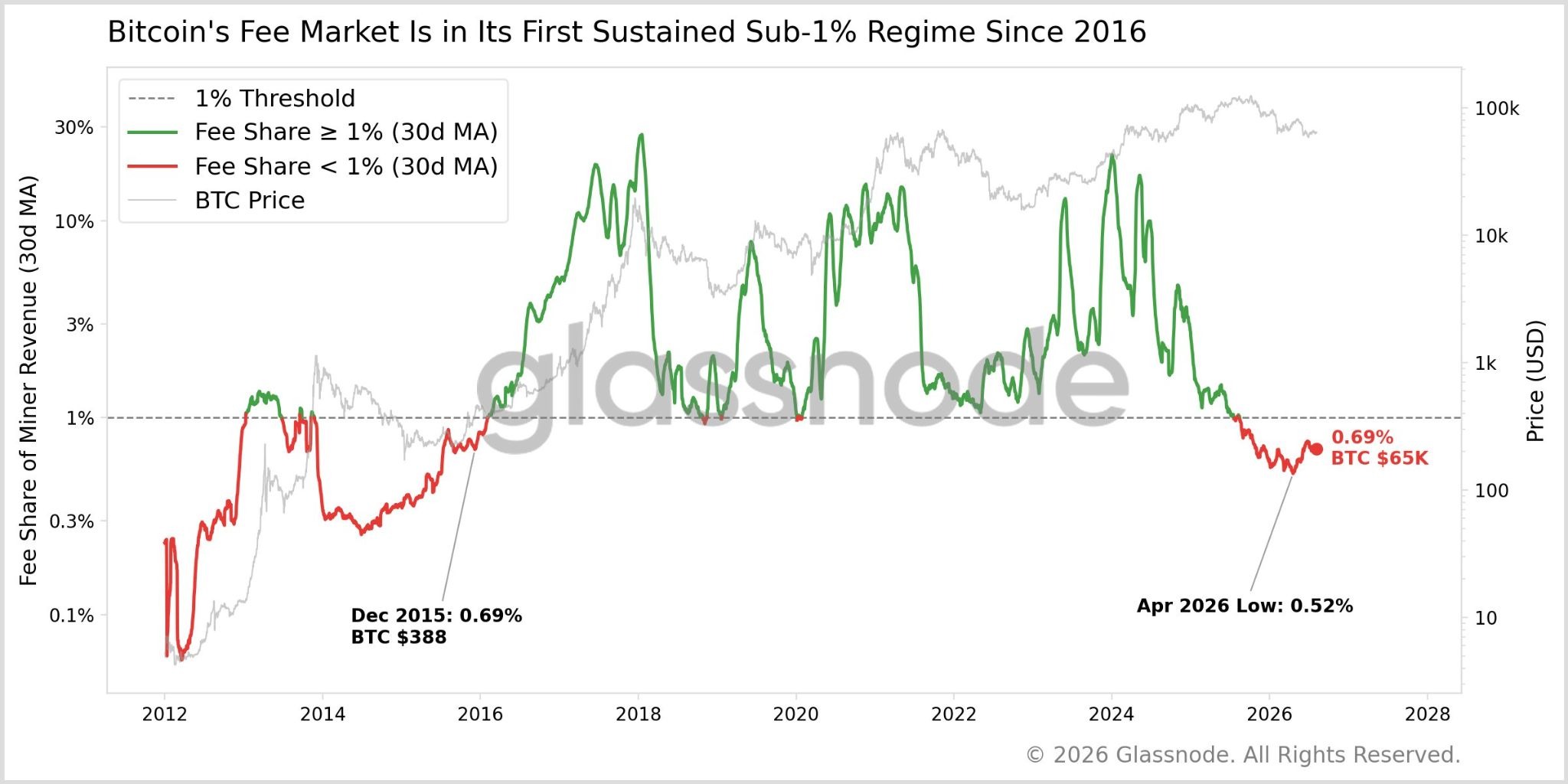
However, transaction activity on the base layer failed to provide the necessary cushion. According to data from on-chain analytics platform Glassnode, transaction fees as a proportion of total miner revenue hovered near historic lows, dropping to an alarming 0.52% in April before stabilizing around 0.69%.

Rafael Schultze-Kraft, co-founder of Glassnode, emphasized the historical gravity of the situation in a public statement on social media platform X:
"Bitcoin was below $400 the last time fee share was this low."
With transaction fees accounting for less than 1% of revenue for nearly a consecutive year, miners lost a critical shock absorber. When network congestion subsides and users increasingly migrate to Layer-2 scaling solutions like the Lightning Network, base-layer miners are left exclusively reliant on the shrinking block subsidy.
The Cost-to-Price Divergence
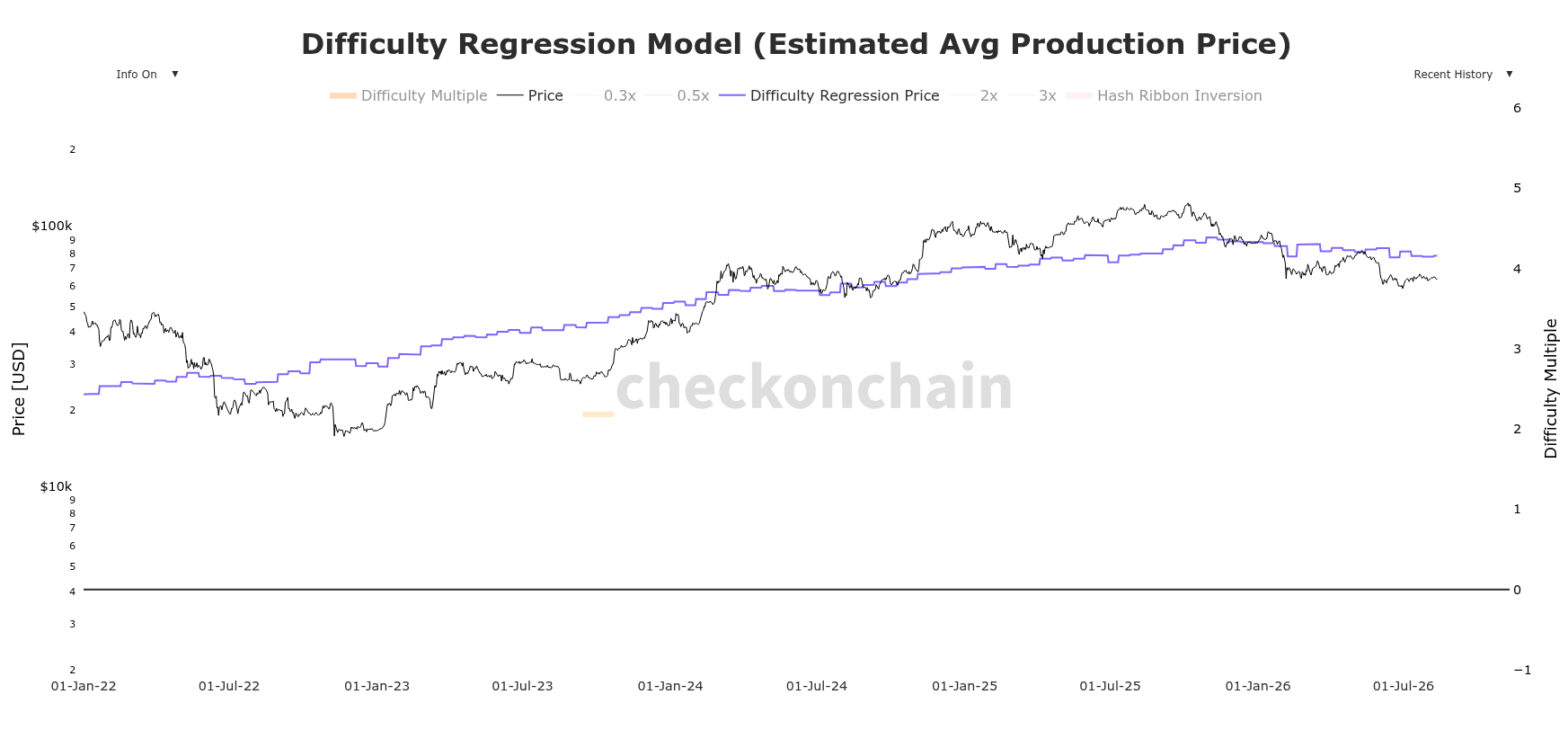
By mid-2026, the economics of mining crossed a dangerous threshold. Metrics provided by on-chain research resource Checkonchain calculated the estimated average cost of producing a single Bitcoin at $78,254—sitting approximately 23% above the prevailing spot market price.
Faced with a reality where every newly minted coin cost significantly more to extract than its market value, smaller, undercapitalized mining operations began shutting off their rigs en masse. This capitulation triggered a dramatic downward adjustment in the network’s hash rate, which tumbled by a full third from its 1.3 ZH/s peak.
Supporting Context & Metrics: Hard Numbers Behind the Shift
The numerical data illustrating the current crisis paints a stark picture of an industry under intense duress. The interplay between declining hash rates, soaring production costs, and shifting corporate strategies can be categorized across three primary metrics:
1. Network Hash Rate Contraction
- Peak (October 2025): 1.3 Zettahashes per second (ZH/s)
- Current Levels: 861 Exahashes per second (EH/s)
- Total Net Drop: ~33%
- Significance: This contraction marks one of the sharpest sustained drops in network security capacity in Bitcoin’s history, indicating that millions of mining rigs have been permanently or temporarily decommissioned.
2. Production Cost vs. Spot Price Disparity
- Estimated Average Production Cost: $78,254 per BTC
- Market Realities: Operating expenses include not only hardware amortization but also aggressive energy procurement in competitive power markets across North America, Scandinavia, and parts of Asia.
- Margin Impact: With spot prices trading well below the cost of production, inefficient operators face immediate insolvency unless subsidized by external capital or diversified revenue streams.
3. Transaction Fee Share of Revenue
- Historical Norms: During periods of network congestion (such as the Ordinals and BRC-20 token crazes), transaction fees have historically spiked to account for 20% to 40% of daily miner revenue.
- Current State: Hovering between 0.52% and 0.69%.
- Implication: The Bitcoin base layer is currently functioning almost entirely on subsidy issuance, leaving miners entirely vulnerable to macroeconomic price swings.
Official Statements and Industry Analysis
The mass exodus of computational power from Bitcoin to artificial intelligence has sparked intense debate among independent market analysts, hedge fund managers, and mining executives.
Independent Market Commentary
Writing in a comprehensive weekend market analysis, independent analyst William Clemente highlighted the compounding nature of the crisis. While acknowledging that automated difficulty adjustments historically incentivize miners to push through downturns, Clemente pointed out that the current cycle is fundamentally different due to the immediate availability of a highly lucrative alternative: AI computing.
"There is no other way to slice it, hash rate has been in a decline," Clemente wrote. "This has taken place as miner margins got squeezed post-2022 from more competition and higher energy prices, but more importantly the pivot of many into AI/HPC, which so far have shown to be prudent business decisions for the public names that have done it."
Clemente further noted that Bitcoin’s relative underperformance compared to AI-focused equities and soaring compute demand has accelerated this strategic realignment.
Corporate Pivots: CleanSpark and Keel Infrastructure
The theoretical pivot to AI has rapidly translated into concrete corporate restructuring. As previously reported by Cointelegraph, prominent Bitcoin miner CleanSpark was forced to shift its operational focus toward managing AI data centers after missing Wall Street profit targets.
Similarly, Keel Infrastructure took drastic measures, completely shutting down its US-based Bitcoin mining operations following a staggering 50% plunge in quarterly revenue. For these firms, repurposing massive electrical substations, land parcels, and cooling infrastructure for artificial intelligence workloads has transitioned from an experimental side-business into an existential necessity.
Capriole Investments Issues a Warning
Charles Edwards, founder of quantitative hedge fund and AI platform Capriole Investments, offered a sobering assessment of the trend, viewing the systematic abandonment of the Bitcoin blockchain as a dangerous blind spot for the crypto community.
Taking to X, Edwards did not mince words:
"This is the least talked about, concerning Bitcoin development in 2026."
Edwards emphasized that the acceleration of this trend—which gained significant momentum following the April fee-share lows—poses long-term questions regarding network decentralization and security budgets as future block halvings continue to reduce coin issuance.
Future Outlook: What Lies Ahead for Bitcoin Mining?
As the dust settles on the first half of 2026, stakeholders across the cryptocurrency ecosystem are forced to confront uncomfortable questions regarding the long-term economic model of Proof-of-Work networks.
The Centralization Risk
The migration of tier-one mining infrastructure toward artificial intelligence introduces a distinct centralization vector. Publicly traded mining companies answer to shareholders who demand fiduciary responsibility; if AI data leasing yields profit margins three to five times higher than validating Bitcoin transactions, corporate boards have a legal obligation to pursue artificial intelligence. Consequently, industrial-scale energy assets are increasingly locked into long-term enterprise AI contracts, potentially pricing out independent, pure-play Bitcoin miners.
The Fee Market Imperative
For Bitcoin to maintain long-term security without relying on enterprise miners who treat the blockchain as a secondary revenue source, the base-layer fee market must mature. Proponents argue that sustained adoption of Layer-2 scaling solutions, decentralized finance (DeFi) protocols on Bitcoin, and native asset issuance will eventually drive organic block space competition, lifting transaction fees well above the current sub-1% threshold.
Until that structural fee market materializes, however, the mining sector remains caught in a delicate balancing act. As long as the cost of producing Bitcoin exceeds spot market prices—and as long as AI data centers offer a frictionless escape hatch—the hash rate will remain vulnerable.
The great migration of compute power to artificial intelligence serves as a stark reminder that physical energy infrastructure is agnostic. Whether Bitcoin can successfully incentivize its security providers to stay loyal to the ledger, or whether it must adapt to a world where miners moonlight as AI utility providers, will define the next decade of cryptocurrency evolution.