


Executive Overview
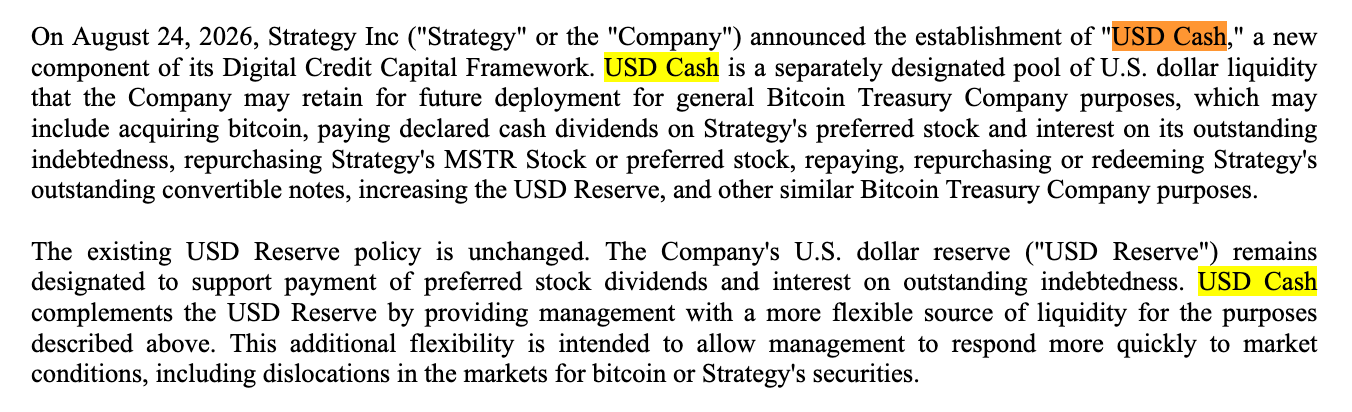
Announced via regulatory filings, this newly minted capital allocation introduces an unprecedented layer of agility into the company’s corporate balance sheet. By carving out this dedicated liquidity reserve, Strategy has granted its leadership team the operational freedom to seamlessly pivot and allocate capital across a diverse and complex matrix of assets.
These include continuous Bitcoin (BTC) accumulation, corporate share buybacks, debt obligation management, and the optimization of its preferred stock stack.
This move signals a maturing corporate playbook. As Strategy’s capital structure increasingly mirrors that of an aggressive hedge fund rather than an operating business, the establishment of a multi-billion-dollar cash reservoir provides a crucial buffer and an offensive war chest. In an era where macroeconomic volatility dictates digital asset cycles, having hyper-flexible liquidity allows Strategy to capitalize on market dislocations, defend its equity value, and service its sophisticated financial instruments without disrupting its core Bitcoin accumulation thesis.
Detailed Chronology: Anatomy of the $1.59B Reserve
The journey toward establishing this $1.59 billion cash pool is the culmination of years of iterative financial structuring. To understand the significance of this milestone, one must trace how Strategy transformed its balance sheet from conventional corporate holdings into a dynamic treasury engine.
The Evolution of Strategy’s Balance Sheet
For decades, publicly traded corporations held excess capital in low-yield short-term instruments like U.S. Treasury bills or commercial paper, deploying cash primarily for research, development, or mergers and acquisitions. Strategy disrupted this conventional framework years ago by treating Bitcoin as its primary treasury reserve asset.

However, as the scale of Strategy’s holdings grew into tens of billions of dollars, relying solely on debt issuances and equity offerings to fund operations and crypto purchases created friction. The company needed an internal shock absorber—a pool of unencumbered fiat liquidity that could act as a valve between traditional financial markets and digital asset markets.
The Regulatory Filing and Capital Allocation Framework
According to filings submitted to the U.S. Securities and Exchange Commission (SEC), the newly established $1.59 billion USD Cash pool is meticulously designed to support four distinct pillars of Strategy’s financial strategy:
- Opportunistic Bitcoin Acquisitions: Providing dry powder to sweep up Bitcoin during sharp market corrections without needing to immediately time a new debt or equity offering.
- Share Buybacks: Giving management the discretion to repurchase common stock if shares disconnect unfavorably from the underlying net asset value (NAV) of the company’s Bitcoin holdings.
- Debt Management: Ensuring that upcoming coupon payments, maturities, or liability restructurings can be handled smoothly, thereby mitigating default risks and preserving a pristine credit profile.
- Preferred Stock Operations: Stabilizing and servicing the company’s evolving preferred equity stack, which has become a vital instrument for attracting institutional investors seeking structured yield.
By codifying this cash pool, Strategy has effectively institutionalized a dynamic capital-allocation loop. Capital can flow effortlessly from cash into Bitcoin when prices dip, or pivot toward buybacks and debt servicing when macroeconomic conditions dictate balance sheet defense.
Supporting Context & Metrics: The Hedge Fundification of Corporate Treasury
To fully grasp the magnitude of a $1.59 billion cash pool, it is essential to analyze the quantitative reality of Strategy’s financial architecture. The company has long ceased to operate as a simple software firm; its market valuation, trading volume, and balance sheet dynamics are inextricably linked to the broader cryptocurrency economy.
The Numbers Behind the Move
While $1.59 billion is a staggering sum for almost any typical mid-to-large-cap enterprise, within Strategy’s context, it represents a precision-calibrated liquidity buffer.
- Liquidity vs. Holdings Ratio: While Strategy’s Bitcoin stash commands a multi-billion-dollar valuation, holding purely illiquid or volatile crypto assets leaves a company vulnerable to sudden credit crunches or liquidity squeezes. The $1.59 billion cash pool ensures that operational necessities are met a hundred times over without forced liquidations of BTC.
- Capital Velocity: In modern corporate finance, the velocity of capital—how quickly funds can be redeployed to capture arbitrage or value opportunities—is paramount. This cash pool acts as an internal clearinghouse, slashing the latency between identifying a strategic opportunity (such as a discounted convertible note or an oversold equity dip) and executing the trade.
The "Hedge Fund" Analogy
Market analysts frequently describe Strategy’s modern structure using the lexicon of alternative asset management. Traditional corporations generate revenue through the sale of goods or services, using excess profits to reward shareholders via dividends or buybacks. Strategy, conversely, leverages the public equity and debt markets to continuously scale an underlying asset base (Bitcoin), engineering a flywheel effect.

[Public Capital Markets: Debt/Equity]
           │
           ▼
[Flexible $1.59B USD Cash Pool]
     ├──► Bitcoin Accumulation
     ├──► Share Buybacks
     ├──► Debt Servicing
     └──► Preferred Stack Optimization
This financial engineering introduces immense complexity. Managing convertible debt, preferred shares, common equity dilution, and massive digital asset holdings requires institutional-grade risk management. The creation of the USD Cash pool is a direct response to this complexity, serving as the hydraulic fluid that keeps the various, competing gears of Strategy’s capital stack moving smoothly.
Official Statements and Industry Reactions
The announcement has sent ripples through both traditional Wall Street equity circles and the digital asset community, eliciting a spectrum of commentary from market makers, financial analysts, and corporate governance experts.
Market and Analyst Interpretations
Wall Street analysts have generally praised the move for introducing greater transparency and risk mitigation into Strategy’s otherwise aggressive balance sheet strategy.
“By formally segmenting a $1.59 billion cash pool, Strategy is demonstrating maturity,” noted one prominent institutional derivatives strategist. “Critics have often pointed out the recursive nature of their equity and debt issuances. Having a substantial, unencumbered fiat reserve directly addresses liquidity concerns, proving that management is thinking several steps ahead regarding macroeconomic headwinds.”
In the crypto ecosystem, proponents view the cash pool as an ultimate expression of optionality. Rather than being forced into binary outcomes—either holding all cash or all Bitcoin—Strategy can now surf market volatility with surgical precision.
Governance and Flexibility
Corporate governance experts note that establishing clear parameters for cash utilization reduces uncertainty for institutional shareholders. When a company holds billions in digital assets, vagueness surrounding operational cash can depress equity valuations due to perceived solvency or liquidity risks. By transparently detailing how the $1.59 billion can move across buybacks, debt, preferreds, and Bitcoin, Strategy provides clarity that institutional investors demand before committing large-scale capital.
Future Outlook: What’s Next for Strategy’s Capital Stack?
As Strategy moves forward with this newly optimized balance sheet, several key trends and milestones will dictate the success of the $1.59 billion cash pool and the broader corporate strategy.
Navigating Macroeconomic Cycles
The macroeconomic landscape remains fraught with shifting interest rate expectations, inflationary pressures, and regulatory developments surrounding digital assets. In a high-interest-rate environment, holding large amounts of cash historically meant sacrificing yield. However, with modern treasury management tools—such as short-term institutional money market instruments and high-yield digital asset liquidity solutions—Strategy can likely park this $1.59 billion in assets that generate respectable baseline yields while remaining instantly deployable.
The Ongoing Expansion of the Capital Stack
Looking ahead, it is anticipated that Strategy will continue refining its financial instruments. The interplay between common stock buybacks and Bitcoin accumulation will remain a delicate balancing act. If Bitcoin enters a prolonged bull market cycle, the cash pool can be heavily leaned upon to service debt or fund opportunistic buybacks if the stock price decouples from asset value. Conversely, in a bear market, the pool acts as an impenetrable fortress, ensuring debt obligations are met without ever threatening the core Bitcoin treasury.
Conclusion
Strategy’s creation of a $1.59 billion USD Cash pool is far more than a routine corporate accounting update; it is a masterclass in modern financial engineering. By building unprecedented flexibility into its capital stack, Strategy has reinforced its position as a pioneer in corporate treasury management. Whether viewed through the lens of a sophisticated hedge fund or a visionary Bitcoin holding company, Strategy has equipped itself with the financial agility necessary to navigate whatever market dynamics lie ahead.