

Executive Overview
While the Senate’s initial draft of the housing bill included a provision temporarily blocking the Federal Reserve System and regional Federal Reserve banks from issuing a CBDC until December 31, 2030, House Republicans argue that this timeline is fundamentally flawed. Rather than halting the digital currency, critics contend that a sunset clause functions as an implicit runway—effectively acting as a government-sanctioned pre-launch development period.
Led by influential House members such as Representatives Mike Flood and Warren Davidson, the newly amended House legislation strips away the 2030 expiration date, seeking to enshrine a permanent, definitive ban on a retail or wholesale Fed-issued digital dollar. Lawmakers have fiercely characterized the original Senate framework as a legislative "Trojan Horse," warning that tying a controversial monetary transformation to bipartisan housing reform deprives the American public of a transparent, standalone debate over financial privacy.
If the amended bill passes the House this week, it will return to the Senate for further negotiation. To become law, the legislation must successfully navigate both chambers before heading to President Donald Trump’s desk for his signature. This legislative showdown unfolds against a backdrop of escalating global deployment of sovereign digital currencies, intensifying a deeply polarized debate in Washington over state surveillance, individual privacy, and the future of the U.S. dollar.
Detailed Chronology of the Legislative Battle
To understand how a federal housing reform bill became the primary battlefield for the future of digital fiat currency, it is necessary to examine the rapid sequence of events driving this legislative showdown through Congress.
March 2025: The Senate Introduces the Housing Act
The legislative trajectory began in March when the U.S. Senate Committee on Banking, Housing and Urban Affairs released the text of the 21st Century ROAD to Housing Act. Primarily engineered to overhaul federal housing programs, modernize lending standards, and address inventory shortages across the country, the sweeping text also included a quiet, yet consequential, rider.
Buried within the regulatory sections was a provision explicitly forbidding the Federal Reserve System or any regional Federal Reserve bank from issuing a CBDC, or any other instrument functioning as a direct digital liability to the central bank, until December 31, 2030. While initially viewed by some moderate lawmakers as a protective compromise, cryptocurrency advocates and privacy hawks immediately raised alarms, arguing that a temporary moratorium tacitly assumes a CBDC will launch once the clock runs out.
The House Response: Rep. Mike Flood and the "Backdoor" Reversal
Recognizing the implications of the Senate’s sunset clause, House lawmakers initiated a strategic counter-offensive. Congressman Mike Flood emerged as a leading voice, explaining in public columns and legislative memos that the House’s amended version of the bill aggressively rewrites the Senate’s text.
According to Rep. Flood, the House amendment permanently blocks the Federal Reserve from developing, piloting, or issuing a digital dollar, effectively slamming the door on what he termed a "backdoor green light for a CBDC." The House leadership quickly aligned to fast-track this modified package to the floor, setting up a definitive vote scheduled for the current congressional week.

The Path Forward: House Vote, Senate Reconciliation, and Presidential Sign-off
Should the House successfully pass its amended version of the 21st Century ROAD to Housing Act this week, the bill will boomerang back to the United States Senate. Because the House version fundamentally alters the Senate’s original CBDC provision, lawmakers in the upper chamber will face a choice: accept the permanent ban, reject the House amendment and force a conference committee, or allow the bill to stall.
Ultimately, any compromise text must clear both chambers of Congress before it can be transmitted to President Donald Trump to be signed into law. Given the contentious nature of digital currency policy and financial surveillance, the CBDC rider threatens to become a major stumbling block in what was originally designed as a broadly popular bipartisan housing bill.
Supporting Context & Metrics: The Global CBDC Landscape and Domestic Risks
The legislative panic surrounding a potential U.S. digital dollar does not exist in a vacuum. It is heavily influenced by rapid international developments, evolving monetary standards, and profound ideological anxieties regarding the erosion of financial privacy.
The Global Adoption Curve
While the United States debates whether to even explore a digital sovereign currency, the rest of the world is moving forward at varying speeds. According to tracking data compiled by the Atlantic Council—a prominent Washington-based think tank—only a small handful of nations have officially deployed a fully operational CBDC:
- Nigeria: Launched the eNaira.
- Jamaica: Deployed the Jam-Dex.
- The Bahamas: Pioneered the Sand Dollar.
Meanwhile, a sprawling coalition of 41 other countries—including major economies within the G20—are actively running pilot programs or deep-dive research phases. China’s digital yuan (e-CNY) remains the most advanced and high-profile project among major global powers, frequently cited by U.S. lawmakers as a cautionary tale of state-sponsored financial surveillance.
Benefits vs. Drawbacks: The Core Debate
Human rights organizations, economic think tanks, and civil liberties advocates have long debated the dual-edged nature of central bank digital currencies.
Potential Benefits:
- Financial Inclusion: Proponents argue that a CBDC could extend banking services to unbanked or underbanked populations, reducing reliance on expensive private wire services and predatory check-cashing operations.
- Settlement Efficiency: Government-backed digital tokens promise near-instantaneous cross-border settlements, lower transaction fees for merchants, and a streamlined monetary transmission mechanism for fiscal stimulus.
Critical Drawbacks:
- Privacy Invasions: Unlike physical cash—which offers anonymity in peer-to-peer transactions—a CBDC provides central banks and government agencies with a real-time, programmable ledger of every transaction made by a citizen. Critics argue this eliminates financial privacy.
- Risk of Government Overreach and Corruption: With programmable money, authorities could theoretically freeze accounts, restrict purchases of specific goods (such as firearms, fuel, or political donations), or impose negative interest rates directly on citizens during economic downturns, paving the way for unprecedented authoritarian control.
Official Statements and Political Rhetoric
The debate over the housing bill’s CBDC rider has exposed deep ideological fractures within Congress, prompting sharp condemnations from anti-CBDC champions who view the maneuver as a threat to American liberties.
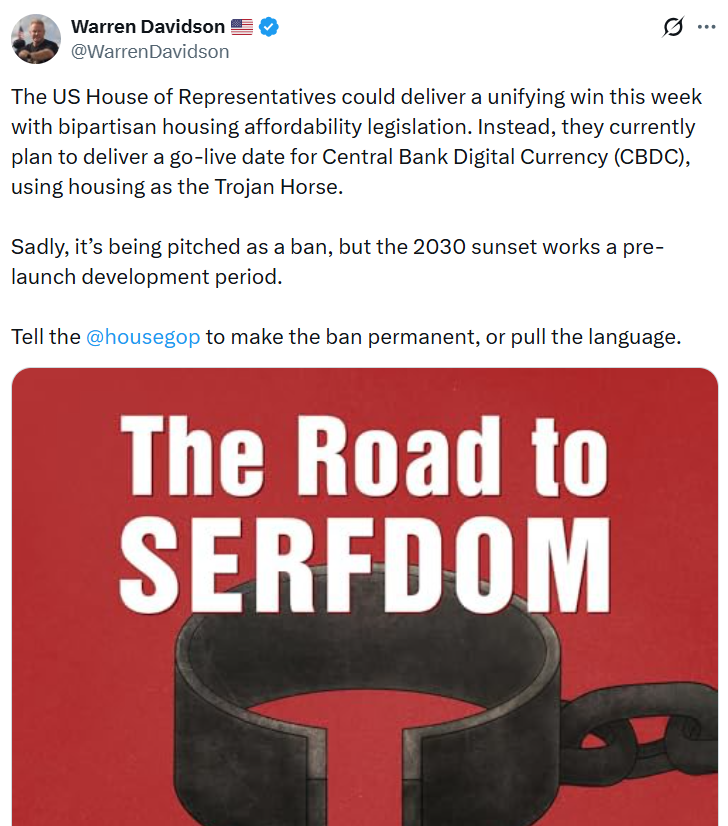
Representative Warren Davidson Warns of the "Trojan Horse"
Rep. Warren Davidson did not mince words when criticizing the strategic inclusion of the CBDC timeline within a housing bill. Highlighting his concerns on social media and in legislative briefings, Davidson argued that Congress should be focused on delivering genuine, clean wins for housing affordability rather than facilitating monetary experiments.
"The U.S. House of Representatives could deliver a unifying win this week with bipartisan housing affordability legislation. Instead, they currently plan to deliver a go-live date for Central Bank Digital Currency, using housing as the Trojan Horse," Davidson stated, emphasizing that the 2030 sunset date merely provides a runway for institutional preparation rather than a true prohibition.
Whip Tom Emmer and the Campaign Against the "Surveillance State"
While the housing bill fight plays out in real-time, other key figures in the House Republican leadership are advancing parallel legislative tracks to outlaw a Federal Reserve digital currency once and for all.
House Majority Whip Tom Emmer has fiercely championed his own standalone legislation, the Anti-CBDC Surveillance State Act (H.R. 1919), which successfully passed the House on July 17. Despite that victory, the bill has faced resistance and inertia in the Senate.
Emmer has consistently framed the issue around personal freedom, contrasting the American constitutional framework with authoritarian regimes abroad:
"The Chinese Communist Party uses a central bank digital currency (CBDC) to surveil and control its people. If the U.S. adopted its own CBDC, privacy and economic freedom as we know it would cease to exist," Emmer declared following the House vote on his bill. "My Anti-CBDC Surveillance State Act BANS our government from ever creating this Orwellian tool. The House passed it. Now, the Senate must act."
Echoing these sentiments, Senator Mike Lee previously introduced the No CBDC Act in the upper chamber as a standalone measure to restrict both the Federal Reserve and the U.S. Treasury from issuing a digital dollar. However, like Emmer’s bill, Lee’s legislation has struggled to break through the legislative gridlock in Congress, prompting lawmakers to adopt the strategy of attaching permanent bans to must-pass omnibus or sector-specific reform packages, such as the housing bill.
Future Outlook: What Lies Ahead for the U.S. Dollar?
As the House of Representatives prepares for its pivotal vote on the amended 21st Century ROAD to Housing Act, the broader implications for the U.S. financial system are profound.
- The Senate Standoff: Should the House successfully pass the housing bill with the permanent CBDC ban intact, the legislative spotlight will pivot back to the Senate. The upper chamber will have to determine whether the inclusion of a permanent ban is a dealbreaker for the entire housing package. Given that several centrist and Democratic senators have expressed openness to exploring digital currency frameworks under strict regulatory guardrails, a fierce legislative standoff is almost guaranteed during reconciliation.
- The Executive Stance: With President Donald Trump’s administration maintaining a generally skeptical view of government-controlled digital tokens—favoring decentralized cryptocurrencies and market-driven assets—any bill reaching the Oval Office containing a permanent CBDC ban is widely expected to be signed into law.
- The Long-Term Monetary Horizon: Even if a permanent ban successfully passes into law, the global race toward sovereign digital currencies will continue to evolve. Commercial banks are increasingly exploring "deposit tokens" and private-sector blockchain settlement rails to modernize legacy systems without relying on a central bank infrastructure.
For now, the immediate battle lines are drawn on Capitol Hill. As lawmakers cast their votes this week, the decision will determine whether the United States permanently locks the door against a central bank digital currency—or leaves the window cracked open for the future of digital fiat control.