


Executive Overview
Simultaneously, traditional institutional strategies are shifting. Corporate giants and publicly traded miners are recalibrating their balance sheets and operational roadmaps. Strategy—the undisputed pioneer of corporate Bitcoin accumulation—has signaled a resumption of its aggressive buying strategy despite navigating internal pressure and rare liquidity sales. Meanwhile, major Bitcoin mining firms are aggressively pivoting away from pure-play cryptocurrency production, leveraging their robust power infrastructure to secure multi-billion-dollar artificial intelligence partnerships. Compounding these dynamics, high-profile corporate treasuries, such as Trump Media, are radically restructuring their digital asset strategies following substantial quarterly losses tied to crypto asset volatility.
This comprehensive report examines the convergence of these developments, analyzing the shifting paradigms across self-custody versus exchange-traded funds (ETFs), corporate balance sheet management, and the lucrative convergence of Bitcoin mining and AI infrastructure.
Detailed Chronology of Recent Market Events
The Coldcard Exploit and Self-Custody Reassessment
The security landscape of cryptocurrency storage suffered a severe blow following a sophisticated vulnerability exploited within the Coldcard hardware wallet ecosystem. Attackers leveraged a faulty key-generation implementation, bypassing security assumptions that users have trusted for years. The exploit resulted in the immediate draining of approximately $116 million worth of Bitcoin from affected holders.
While hardware wallets have long been championed as the gold standard for sovereign, trustless asset management, this incident exposed the fragility inherent in user-managed cryptographic security. The psychological fallout was swift. Security researchers, developers, and everyday HODLers immediately engaged in heated debates across community forums, dissecting whether the absolute sovereignty of self-custody justifies the operational and existential risks of human error, supply chain tampering, or firmware vulnerabilities.
The Institutional Flow Response
Paradoxically, the wake of the Coldcard exploit coincided with a massive surge in demand for regulated investment vehicles. U.S. spot Bitcoin exchange-traded funds (ETFs) recorded their strongest weekly net inflows since April, capturing roughly $1 billion in fresh capital. Bloomberg intelligence analyst Eric Balchunas highlighted the milestone, categorizing it as the third-best accumulation week since the broader ETF market launch—a phase he conceptualizes as Bitcoin’s "silent IPO."
While correlation does not definitively equal causation, analysts point out the timing is difficult to ignore. Investors frightened by hardware wallet vulnerabilities and complex key management protocols may be using regulated ETFs as a friction-free, institutional-grade alternative to holding underlying assets directly.

Strategy’s Treasury Adjustments and Pivot Back to Buying
In the corporate sphere, Strategy—formerly MicroStrategy—made headlines after acknowledging a rare sequence of Bitcoin sales intended to shore up operational capital. Despite selling roughly 7,000 BTC earlier in the year, CEO Phong Le confirmed in a televised interview with FOX Business that the firm intends to aggressively resume its net-accumulation trajectory later in the year.
Strategy currently commands an institutional monopoly on corporate Bitcoin reserves, holding in excess of 840,000 BTC. However, the decision to execute minor sales to fund preferred dividends, corporate buybacks, and dollar reserves tested the absolute boundaries of its foundational "never sell" doctrine, inviting scrutiny from market analysts and institutional shareholders alike.
Riot Platforms and the Anthropic Compute Deal
In the infrastructure sector, Riot Platforms executed a transformative strategic pivot. The prominent Bitcoin miner reportedly struck a massive $9 billion compute deal with artificial intelligence pioneer Anthropic. Under the terms of the agreement, Riot will supply 191 megawatts of operational capacity from its Rockdale, Texas campus over a 20-year term.
This monumental transaction underscores a broader macro trend: as generative AI data centers face severe power constraints globally, the energy-rich infrastructure built by Bitcoin miners has suddenly transformed into one of the most valuable commodities in the technology sector.
Trump Media’s Treasury Overhaul
Rounding out a volatile week for corporate crypto strategies, Trump Media & Technology Group announced a sweeping overhaul of its digital asset treasury management. The announcement followed a turbulent second quarter that saw the company log a $238 million net loss, driven heavily by unrealized losses across its crypto holdings and associated securities. Despite navigating these paper losses—and active portfolio adjustments that briefly brought its holdings down before subsequent accumulation pushed totals to approximately 14,139 BTC—the firm has signaled a measured pivot toward reinforcing its core media platforms like Truth Social while mitigating counterparty risk in its digital asset strategies.
Supporting Context & Metrics
To contextualize these headline events, market analysts and research firms have published comprehensive data outlining the underlying financial mechanics at play:
- Strategy’s Holdings vs. Sales: Strategy has purchased roughly 175,000 BTC throughout the year while liquidating approximately 7,000 BTC. This reflects a buying-to-selling ratio of 25-to-1. The company’s total treasury valuation remains anchored by its massive stack exceeding 840,000 BTC.
- ETF Momentum: U.S. spot Bitcoin ETFs pulled in nearly $1 billion during the evaluated weekly period, marking a significant psychological rebound after a period of consolidation. Analysts note that early investor distribution ("the silent IPO effect") has successfully met institutional demand without triggering severe downside price volatility.
- Mining-to-AI Valuations: Riot Platforms’ shares experienced high volatility, dipping 5.4% before rallying 21% overnight following the Anthropic leak, pushing its year-to-date gains to roughly 50% with a market capitalization hovering near $7.33 billion.
- Corporate Balance Sheet Exposure: Trump Media reported $190.4 million in unrealized losses across digital assets, pledged assets, and equity securities during Q2, directly motivating its structural treasury review and risk-mitigation strategies.
Official Statements and Industry Commentary
Phong Le on Strategy’s Commitment to Accumulation
Addressing market concerns over Strategy’s recent string of asset sales, CEO Phong Le defended the company’s dual obligations to capital allocation and its long-term treasury thesis:
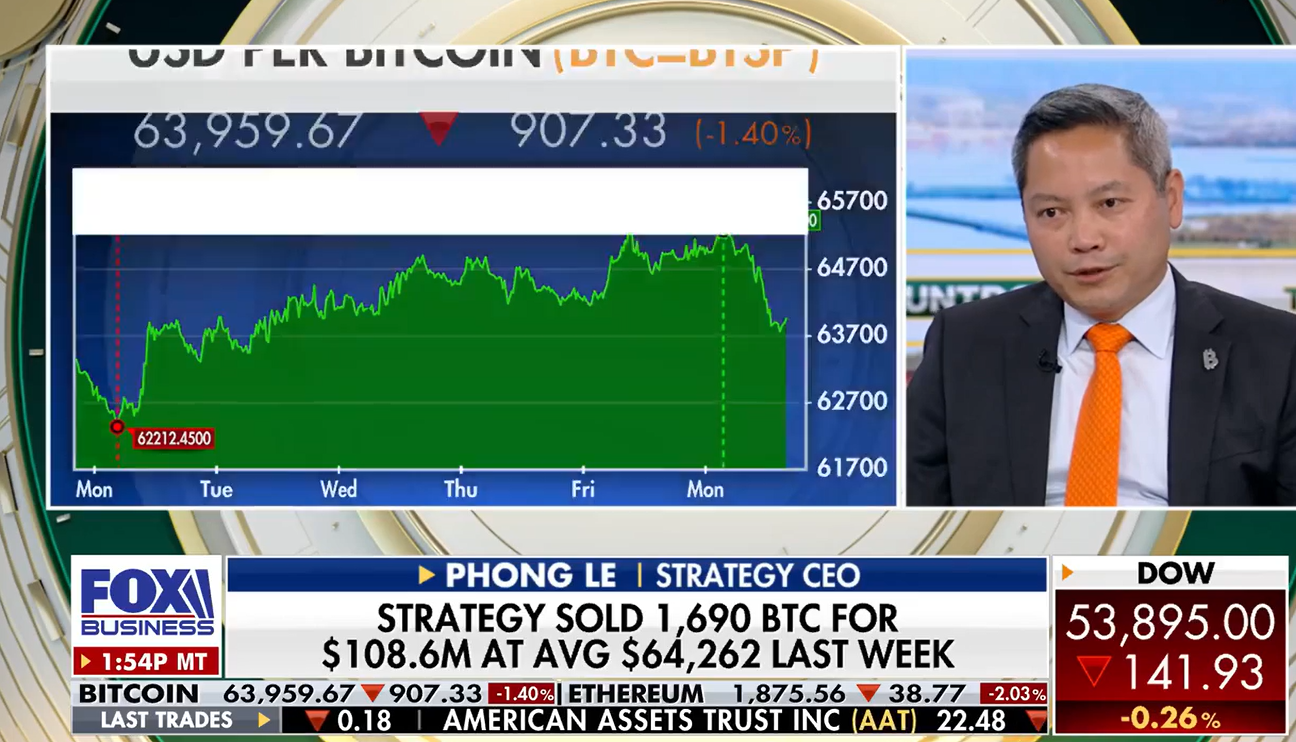
"We have bought roughly 175,000 Bitcoin and sold about 7,000 Bitcoin this year—representing a scale of accumulation vastly outweighing our divestments. Our fundamental philosophy remains unchanged: Bitcoin is our primary treasury reserve asset. The minor liquidity events executed recently were designed to strategically support preferred dividends, corporate buybacks, and our baseline dollar reserves to ensure long-term corporate health."
Eric Balchunas on the Self-Custody-to-ETF Migration
Evaluating the strange confluence between the Coldcard hack and record-breaking ETF inflows, Bloomberg’s Eric Balchunas offered a nuanced perspective on institutional psychology:
"While it is methodologically challenging to draw a direct causal line between a hardware wallet exploit and weekly ETF flows, long-term human psychology suggests a migration path. When self-custody fails at scale—resulting in tens of millions in sudden losses—risk-averse investors and wealth managers naturally gravitate toward regulated, insured wrappers like spot ETFs. We are witnessing the maturation of how capital accesses this asset class."
Bernstein Analysts on the Energy-AI Convergence
Commenting on the wave of Bitcoin miners pivoting toward artificial intelligence data center leasing—exemplified by Riot Platforms’ deal with Anthropic—researchers at Bernstein emphasized the immense macroeconomic utility of miner-controlled power assets:
"The intersection of Bitcoin mining and AI infrastructure is no longer a speculative sidebar; it is a primary economic engine for the energy sector. Miners sit on gigawatts of energized, grid-connected land in regions experiencing severe power crunches. Deals of this magnitude validate the infrastructure-first thesis, providing miners with hyper-lucrative, multi-decade cash flows independent of Bitcoin’s native block reward cycles."
Future Outlook: Trends to Watch
As the digital asset industry absorbs the structural shocks of recent weeks, several vital trends will dictate market direction over the medium to long term:
- The Evolution of Custody Models: The Coldcard vulnerability will likely accelerate the development of next-generation institutional and retail custody solutions. Expect a greater emphasis on multi-party computation (MPC), institutional-grade collaborative custody, and enhanced security audits for hardware manufacturers seeking to win back consumer trust.
- Corporate Treasury Maturity: Strategy’s ability to successfully navigate capital-raising cycles while trading relative to its Net Asset Value (NAV) will set a precedent for other publicly traded firms holding crypto. If Novaque Research’s warnings regarding dilutive financing materialize, companies may be forced to innovate entirely new yield-generating or debt-structuring mechanisms.
- The Industrial Redefinition of Bitcoin Miners: The migration of miners toward artificial intelligence and high-performance computing (HPC) is set to accelerate. As energy constraints tighten across North America and Europe, miners with substantial power purchase agreements (PPAs) will increasingly function as tier-one digital infrastructure landlords rather than single-purpose hash-rate operators.
- Regulatory and Institutional Guardrails: As traditional media conglomerates, public enterprises, and regulated asset managers deeply integrate digital assets into their balance sheets, the regulatory scrutiny surrounding counterparty risk, custody insurance, and financial transparency will undoubtedly intensify.
Ultimately, the events of this past week underscore an industry coming of age. Whether through the pragmatic surrender of self-custody in favor of ETFs, the strategic diversification of corporate balance sheets, or the industrial repurposing of mining infrastructure for AI, the cryptocurrency ecosystem continues to forge resilient pathways toward global financial integration.