


Executive Overview
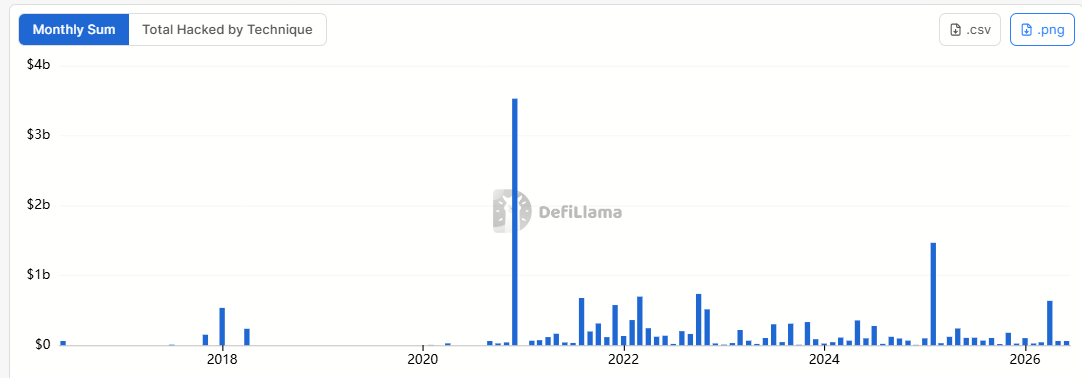
Paradoxically, while the frequency of security breaches skyrocketed, the aggregate financial damage told a different story. The $755.3 million stolen during Q2 2026, though a catastrophic sum by traditional finance standards, remains notably lower than historical apexes—most notably the fourth quarter of 2020, which still holds the grim record for the costliest quarter in crypto history with $3.56 billion drained.
This decoupling of attack frequency from record-shattering capital losses points to structural changes within the digital asset economy. Industry experts suggest that a smaller pool of aggregate value locked (TVL) in DeFi protocols, combined with a surge in operational security failures, tactical targeting of cross-chain bridges, and the controversial role of frontier artificial intelligence models, has reshaped the threat landscape. As cybercriminals refine their methods, the web3 ecosystem finds itself entrenched in an asymmetric war where rapid feature deployment continues to outpace foundational risk management.
Detailed Chronology and Notable Incidents of Q2 2026
The record-breaking volume of Q2 2026 exploits was driven by a wave of high-profile attacks that tested the structural integrity of major restaking platforms, cross-chain communication layers, and layer-2 networks.
The Heavyweights: KelpDAO and Drift Protocol
The quarter’s financial toll was heavily front-loaded by two massive exploits that collectively accounted for over half of the period’s total losses:
- KelpDAO ($293 Million): In April, the restaking platform suffered a catastrophic breach via the LayerZero OFT (Omnichain Fungible Token) bridge. The exploit alone accounted for more than 38% of all funds stolen during the entire quarter, demonstrating the systemic dangers inherent in cross-chain messaging primitives.
- Drift Protocol ($280 Million): Shortly after the KelpDAO incident, Drift Protocol—a prominent decentralized trading platform—fell victim to an exploit that drained $280 million. The incident immediately triggered intense industry-wide scrutiny regarding incident response times, protocol accountability, and multi-sig fail-safes.
Mid-Sized Breaches and Vector Diversification
Beyond the mega-hacks, a persistent drumbeat of multi-million dollar exploits kept security teams on high alert throughout May and June:
- THORChain ($10.7 Million – May 15): The decentralized liquidity network experienced a security failure involving a multi-party computation (MPC) vulnerability, resulting in a private key leak and a subsequent $10.7 million drain.
- Humanity Protocol ($36 Million – June 8): Security audits and blockchain forensics firm Quantstamp swiftly linked a $36 million exploit on Humanity Protocol to suspected state-sponsored cyber actors originating from North Korea, highlighting the ongoing national security implications of decentralized finance thefts.
- Aztec Connect’s Deprecated Infrastructure: In a stark reminder that old code never truly dies, deprecated smart contracts associated with privacy protocol Aztec Connect were targeted in two separate exploits. These attacks netted hackers $2.1 million and $1.3 million, respectively.
- Raydium ($1.3 Million): Decentralized exchange Raydium fell victim to a localized exploit in early June, resulting in a $1.3 million loss.
- Taiko Bridge Exploit ($1.7 Million): Rounding out the quarter’s bridge-focused assaults, Ethereum layer-2 network Taiko urged its community to withdraw funds after hackers compromised its chain state verification mechanism, escaping with $1.7 million.
Supporting Context & Metrics: Analyzing the Q2 Anomaly
To fully comprehend the dynamics of Q2 2026, analysts must look beyond raw dollar amounts and examine the underlying telemetry of the decentralized economy.

The TVL Shrinkage Effect
According to Dmytro Tarasiuk, product director at risk intelligence platform CORE3 and crypto security rating platform CER.live, the disparity between record-high incident counts and moderate financial losses can be largely attributed to macro-market liquidity shifts.
Tarasiuk pointed out that the Total Value Locked (TVL) across the entire DeFi sector experienced a dramatic contraction, falling from a robust $164 billion prior to a devastating market-wide liquidation event on October 10, down to approximately $73 billion by the end of Q2 2026. With less capital pooled inside smart contracts, malicious actors found themselves working with a significantly diminished bounty per successful exploit, driving up the number of attacks required to achieve lucrative payloads.
Cross-Chain Bridges as the Primary Attack Vector
Technical breakdowns of the data compiled by DefiLlama reveal that cross-chain bridges cemented their status as the single most vulnerable infrastructure component in modern web3 architecture.
- Bridges: Accounted for $351 million in total stolen value during Q2.
- Compromised Admin Accounts & Fake Token Price Manipulation: Represented 37% of overall quarterly losses.
- Private Key Compromises: Accounted for 5.66% of total losses, underscoring persistent human-element vulnerabilities.
+-------------------------------------------------------------+
|               Q2 2026 HACKED VALUE BY TECHNIQUE             |
+-------------------------------------------------------------+
| Cross-Chain Bridges      ████████████████████  ($351M)      |
| Admin / Price Manipulation███████████████████   (~37%)      |
| Private Key Compromises  ███                   (5.66%)      |
+-------------------------------------------------------------+
Official Statements and Industry Insights
The persistent vulnerability of web3 architecture has triggered intense soul-searching among security leaders, developers, and auditors. The consensus emerging from the industry is that technical complexity is rapidly outstripping organizational risk management.
The Myth of Multisig Security
Dmytro Tarasiuk pulled no punches when discussing the structural flaws endemic to protocol development teams. In an interview with Cointelegraph, he identified the core systemic weakness: protocols are consistently re-engineered and shipped at velocities that far exceed their underlying security frameworks.
"The industry’s most pressing vulnerability remains that protocols are re-engineered faster than their underlying risk management complexity, which often means that projects ‘declare a [three-of-six] multisig [and] store [three] keys on one laptop,’ leading to more operational vulnerabilities," Tarasiuk explained.
This superficial approach to decentralization—relying on cryptographic multi-signatures while failing to enforce geographic, institutional, or hardware-level key isolation—continues to expose high-value protocols to catastrophic single-point-of-failure compromises.
The "Vulnerability Apocalypse" and Artificial Intelligence
Compounding these operational failures is an emerging, highly disruptive technological paradigm shift: the proliferation of frontier artificial intelligence models.
Earlier in the year, Mitchell Amador, CEO of premier bug bounty and security platform Immunefi, warned of an impending "vulnerability apocalypse." In discussions with industry media, Amador argued that the widespread availability of advanced AI models has fundamentally altered the cybersecurity battlefield, tipping the scales decisively in favor of malicious actors.
Where human auditors and attackers once operated under relatively similar resource constraints, autonomous AI agents and large language models are now empowering malicious entities to scan codebases at unprecedented speeds, discover zero-day vulnerabilities in legacy smart contracts, and automate complex social engineering campaigns. This technological democratization of cyberattacks helps explain why Q2 2026 saw an unprecedented 83 separate exploits: breaking into protocols has never been faster, cheaper, or more automated.
Future Outlook: Securing the Decentralized Frontier
As the cryptocurrency industry moves past the halfway mark of 2026, the lessons of Q2 serve as a sobering wake-up call. The convergence of automated threat creation via artificial intelligence, institutional reliance on fragile cross-chain bridges, and sloppy operational key management has created a multi-front security crisis.
To survive and mature, the decentralized finance sector must fundamentally pivot away from rapid, growth-at-all-costs deployment models toward rigorous, defense-in-depth engineering. Key milestones for the immediate future include:
- Bridge Minimalism: Minimizing trust assumptions in cross-chain communication layers by replacing centralized relayer and validator sets with trust-minimized, zero-knowledge (ZK) light client proofs.
- Institutional-Grade Key Management: Eradicating amateur operational security habits—such as co-locating multi-sig keys—in favor of hardware isolation, decentralized governance frameworks, and institutional custody solutions.
- AI-Powered Defensive Tooling: Harnessing the same frontier AI capabilities utilized by attackers to continuously fuzz, audit, and mathematically verify smart contract codebases before deployment rather than relying solely on reactive bug bounties.
Until the web3 ecosystem bridges the widening chasm between feature velocity and risk management, quarters like Q2 2026 will serve not as statistical anomalies, but as the dangerous baseline of a perpetually under-secured financial frontier.