
Executive Overview
Kalshi, a trailblazing regulated financial exchange, is aggressively pushing past the boundaries of traditional prediction markets. Having recently launched what it claims is the United States’ first regulated perpetual futures (perps) exchange, the company is charting a course toward an expansive future: a unified, all-encompassing "super-app" for global finance. By combining the viral top-of-the-funnel acquisition engine of prediction markets with the deep liquidity, leverage, and compliance of regulated derivatives, Kalshi is building an ecosystem designed to trade nearly any asset, event, or financial risk worldwide.
In a recent comprehensive interview on the Bankless podcast, David Hoffman sat down with John Wang—a key strategist working across Kalshi’s crypto and perpetual products lines—to unpack the company’s ambitious roadmap. The ultimate objective is as audacious as it is clear: Kalshi wants to become an exchange larger and more versatile than the Chicago Mercantile Exchange (CME).
This report delves into Kalshi’s overarching strategy, examining how prediction markets serve as a strategic wedge, the mechanics and competitive positioning of its regulated perps, and the company’s grand vision to turn bespoke institutional risks and real-world assets (RWAs) into publicly traded markets.
Detailed Chronology: From Event Contracts to Perpetual Futures
To understand where Kalshi is heading, one must examine the evolutionary arc that brought the platform to its current inflection point. Founded with the mission of bringing event contracts into the mainstream financial regulatory framework, Kalshi initially focused on building a compliant venue where users could trade binary outcomes related to regulatory decisions, economic data releases, and political races.
The Prediction Market Wedge
Initially viewed by traditional finance as a novel diversion, Kalshi leadership recognized early on that event contracts possessed a unique structural advantage: they act as a supreme top-of-the-funnel user acquisition mechanism. While traditional brokerages struggle to onboard everyday users with complex derivatives or options chains, prediction markets make speculation accessible, intuitive, and culturally engaging.
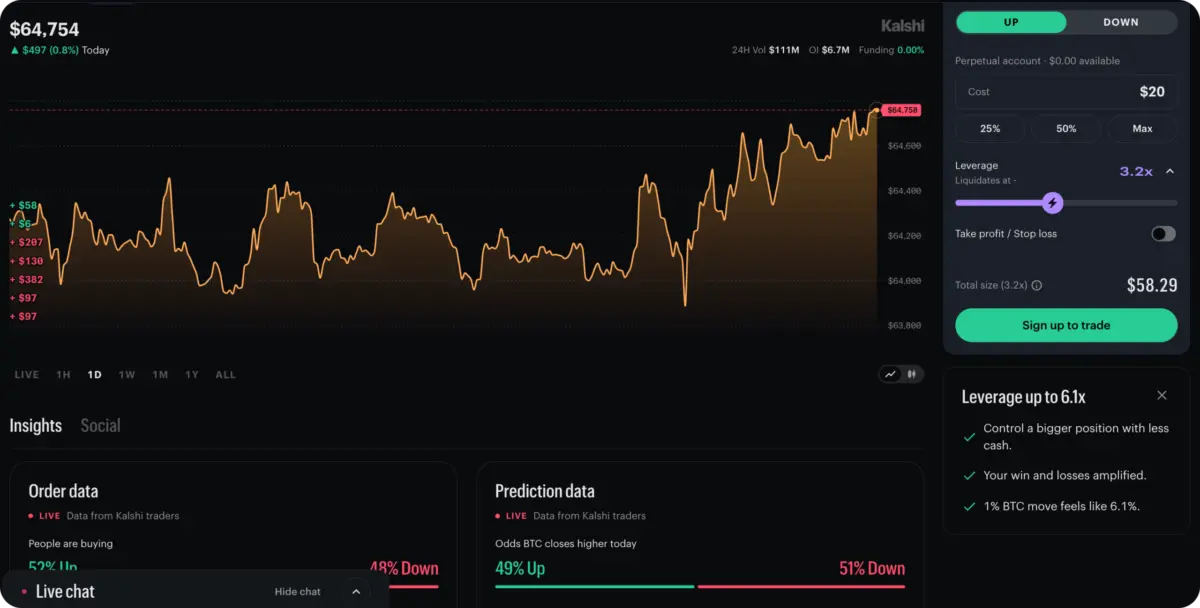
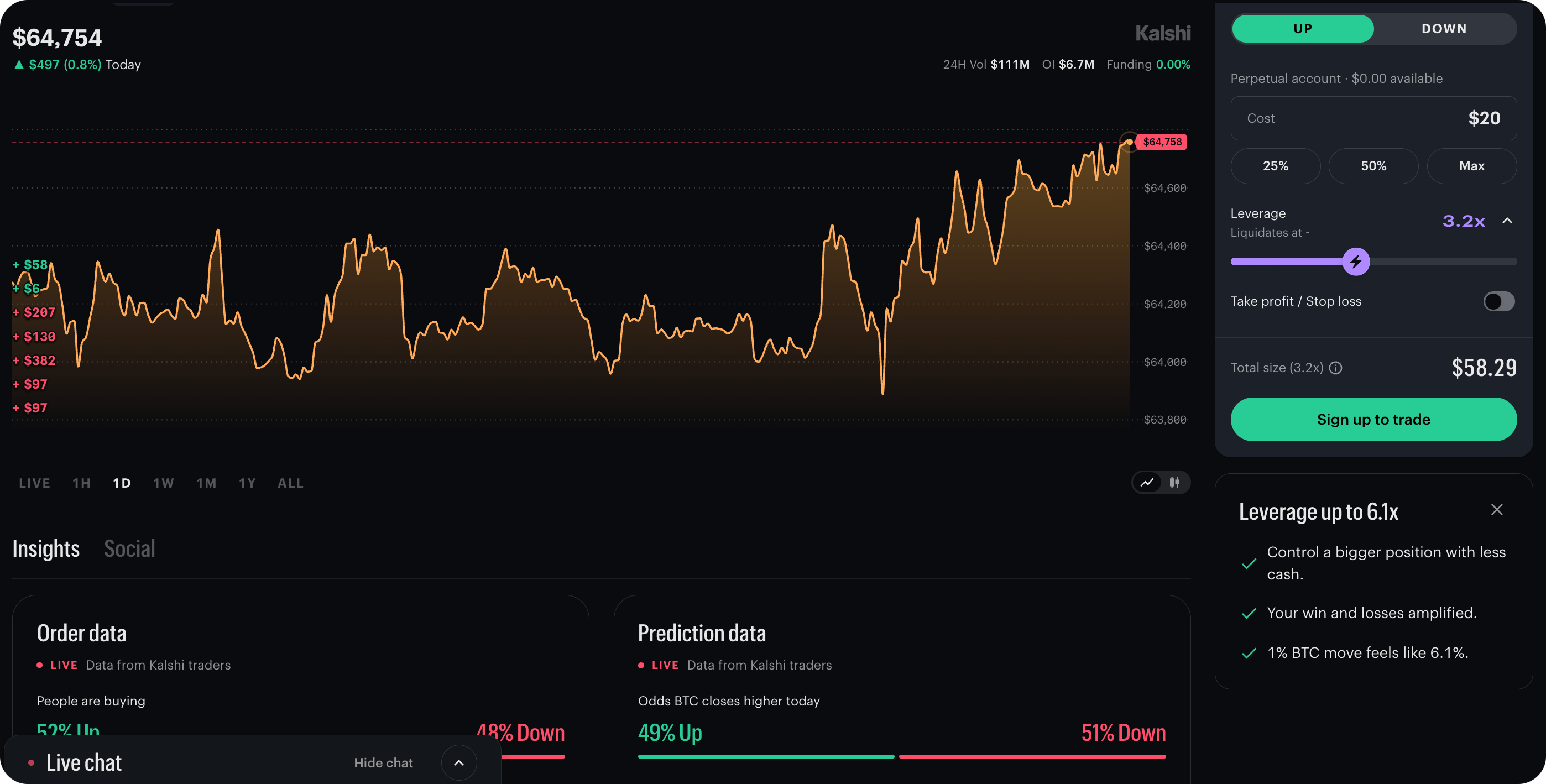
However, Kalshi’s strategy was never to stop at politics or pop culture. Instead, the platform used prediction markets to aggregate crowd-sourced data and real-time sentiment, creating a proprietary information layer. This sentiment data is now directly integrated into the platform’s newer financial products. For instance, on Kalshi’s Bitcoin perpetual futures trading page, users are greeted not just with standard order books and funding rates, but with real-time prediction data indicating whether the broader trading community expects Bitcoin to close the day higher or lower. This creates a seamless behavioral pipeline: a retail user might arrive to trade an election outcome or a crypto price threshold, discover the platform’s robust infrastructure, and naturally transition into trading leveraged perpetual futures to express more sophisticated directional views.
Launching Regulated Perps and Expanding into Commodities
Following the successful deployment of its event contracts, Kalshi crossed a major regulatory milestone by rolling out the U.S.’s first fully regulated perpetual futures exchange. While crypto-native perps platforms like Hyperliquid and Lighter have dominated onchain trading volumes, they operate largely in offshore or regulatory grey zones. Kalshi’s entry into this space introduces a compliant, onshore alternative backed by regulatory oversight from the Commodity Futures Trading Commission (CFTC).
Building upon this momentum, Kalshi’s product roadmap has rapidly evolved. Following its initial rollout of crypto derivatives, the exchange is actively preparing to launch gold and silver perpetual contracts, marking its formal expansion into traditional commodities. This calculated sequence—moving from simple event contracts to crypto perps, and subsequently into precious metals and commodities—illustrates a deliberate strategy to systematically capture adjacent verticals of the global derivatives market.
Supporting Context & Metrics: The Mechanics of Modern Competition
Competing in the perpetual futures landscape is no small feat. Decentralized and crypto-native exchanges have spent years optimizing for speed, execution, and user experience. To challenge established giants, Kalshi has had to ensure its foundational market infrastructure can stand toe-to-toe with the best in the industry.
Overcoming Core Technical Hurdles
According to John Wang, Kalshi has methodically engineered its trading engine to match the performance benchmarks that professional traders demand. When evaluating trading venues, institutional and high-frequency participants care deeply about four critical metrics:
- Fee Structures: Keeping transaction costs minimal to preserve margins for active market participants.
- Liquidity Depth: Ensuring that order books are thick enough to absorb substantial order sizes—such as six-figure blocks—without triggering catastrophic slippage.
- User Interface and Tooling: Providing professional-grade charting, API access, and order-routing tools.
- Execution Speed: Minimizing latency to prevent front-running and slippage during volatile market windows.
Wang asserts that Kalshi is already highly competitive across these core vectors. However, raw technical performance alone is insufficient to unseat deeply entrenched crypto-native venues. The true differentiator for Kalshi lies in its regulatory compliance framework.

The Regulatory Advantage
In the world of derivatives, liquidity follows trust and legal certainty. Offshore exchanges face persistent existential risks regarding regulatory crackdowns, banking access, and jurisdictional compliance. This creates a severe bottleneck for institutional capital and liquidity providers (LPs) who are legally restricted from interacting with non-compliant venues.
As a CFTC-regulated entity, Kalshi operates with a distinct structural advantage:
- Institutional Onboarding: Traditional financial institutions, family offices, and large corporate treasuries can trade on Kalshi without violating internal compliance mandates.
- Brokerage Integrations: The platform can seamlessly integrate with large legacy brokers and traditional financial plumbing.
- Compliant RWA Liquidity: For real-world assets (RWAs) and commodities—where the underlying physical markets, major traders, and primary liquidity pools are heavily concentrated in the United States—onshore regulatory access is a mandatory prerequisite for true market dominance.
By combining the intuitive user acquisition of prediction markets with the regulatory clearance required by institutional capital, Kalshi has forged a hybrid competitive moat that neither pure-play prediction apps nor offshore perps exchanges can easily replicate.
Official Statements: Insights from John Wang
During his extensive discussion with David Hoffman on Bankless, John Wang shed light on the deeper philosophy driving Kalshi’s corporate strategy. Rather than viewing prediction markets as a standalone business, Kalshi treats them as a foundational data layer and marketing funnel.
"Prediction markets are by no means the endgame. They effectively serve as a top-of-the-funnel play: bringing users onto the platform, aggregating information those users can trade against, and giving the exchange a signal layer it can carry into conventional products as a point of differentiation."
Wang emphasized that Kalshi’s ultimate aspirations extend far beyond competing with modern crypto exchanges; the company is positioning itself to challenge legacy financial institutions that have held monopolies on risk transfer for over a century. By positioning prediction data directly alongside traditional financial metrics, Kalshi is redefining how retail and professional traders interpret market sentiment.
Furthermore, addressing the company’s long-term ambitions, Wang confirmed that Kalshi’s ultimate vision is to surpass legacy giants like the Chicago Mercantile Exchange (CME). This requires scaling the platform to accommodate not just standard financial instruments, but an infinite variety of quantifiable human risks.
Future Outlook: Building an Exchange for Every Risk
Looking ahead, Kalshi’s trajectory points toward a future where the traditional boundaries separating prediction markets, derivatives exchanges, and over-the-counter (OTC) desk negotiations dissolve entirely.
The Evolution of Bespoke Institutional Hedges
The most revolutionary aspect of Kalshi’s long-term roadmap is its potential to democratize and publicize risk management. Currently, corporations, agricultural producers, supply chain conglomerates, and institutional investors seeking to hedge specialized risks must rely on private, opaque negotiations through OTC desks. These custom hedges are slow to execute, expensive, and lack price transparency.
Kalshi’s vision is to transform this antiquated process. Under this model, an institution facing a specific, highly nuanced exposure—ranging from localized weather patterns and supply chain disruptions to regulatory shifts and macroeconomic indices—could approach Kalshi to request a custom market. Kalshi can rapidly spin up a standardized event contract or derivative product, opening it up to a global pool of retail traders, institutional participants, and automated market makers.
What was once locked behind the closed doors of an investment bank’s OTC desk becomes a transparent, publicly priced market instrument.
The "Super-App" for Global Finance
Across the broader cryptocurrency and fintech ecosystems, the dominant trading platforms have all converged on a singular evolutionary endpoint: the "everything exchange" or financial super-app. Whether through spot trading, lending, derivatives, prediction markets, or real-world asset tokenization, modern platforms recognize that users prefer unified liquidity pools and single-interface experiences.

Kalshi has locked onto this exact target. By utilizing prediction markets as the engine to drive user growth, channeling that engagement into regulated perpetual futures and commodities, and ultimately expanding into bespoke institutional risk contracts, the company is constructing a comprehensive financial utility for the digital age.
As Kalshi rolls out its gold and silver perps and prepares for subsequent asset expansions, the financial industry is watching closely. If the company successfully executes its strategy, it will not merely have built a better prediction market or a compliant crypto exchange—it will have fundamentally rewritten the infrastructure of global risk exchange, creating a marketplace where virtually any asset, event, or financial uncertainty can be priced, traded, and hedged worldwide.