


Executive Overview
Proposed by a coalition that includes Ethereum Foundation researcher Justin Drake and Ethereum Community Conference (ETHCC) co-founder Jerome de Tychey, EIP-8363 aims to gradually throttle staking rewards as a larger percentage of the total Ether (ETH) supply is locked to secure the network. Under the proposed model, protocol-level issuance would taper down to absolute zero once 50% of the ETH supply is actively staked.
The rationale behind the proposal appears straightforward on paper: Ethereum has arguably crossed the threshold where additional staked capital yields diminishing security returns, while simultaneously diluting the holdings of loyal participants who choose to remain liquid. In short, the authors argue that the network is currently overpaying for a level of security it no longer requires.
However, the backlash has been swift, fierce, and widespread. From institutional asset managers and liquidity providers to DeFi protocol founders, critics argue that EIP-8363 fundamentally misreads Ethereum’s security requirements, threatens to destabilize multibillion-dollar lending markets, undermines institutional confidence in monetary predictability, and could inadvertently accelerate centralization rather than curb it. As the crypto ecosystem navigates the fallout of this proposal, the fundamental question remains: Is Ethereum genuinely over-staked, or is EIP-8363 a heavy-handed solution in search of a problem?
Detailed Chronology
The Genesis of the Proposal
The ideological roots of EIP-8363 trace back to prolonged discussions within core research circles regarding the asymptotic nature of proof-of-stake (PoS) security. For months, researchers have privately and publicly debated the long-term sustainability of paying continuous, high-yield issuance to a rapidly growing validator set.
However, the debate crossed from abstract research forums into active governance territory when EIP-8363 was officially submitted just days ahead of the August 6 submission deadline for inclusion consideration in the upcoming network upgrade. The sudden drop of a proposal carrying such massive macroeconomic implications immediately triggered alarm bells across the ecosystem.
The Fast-Track Friction
The tight timeline became a primary point of contention for critics. Industry leaders argued that introducing a policy overhaul with profound downstream consequences for decentralized finance on such short notice violated norms of open, deliberate governance.
Jerome de Tychey, however, pushed back against the narrative of a rushed rollout. In subsequent commentary, de Tychey clarified that the underlying mechanics of tapering issuance have been openly debated across public forums since 2023, and that the submitted draft underwent multiple internal iterations before seeing the light of day.
Furthermore, proponents emphasize that submission for consideration is merely the starting gun for deep technical scrutiny—not an automatic greenlight for deployment. Client teams and researchers typically spend months vetting code and modeling economic impacts before any changes are finalized for mainnet integration. Nevertheless, the friction surrounding the rollout exposed deep-seated anxieties regarding how major macroeconomic shifts are proposed and processed within decentralized ecosystems.
Supporting Context & Metrics: Is Ethereum Over-Staked?
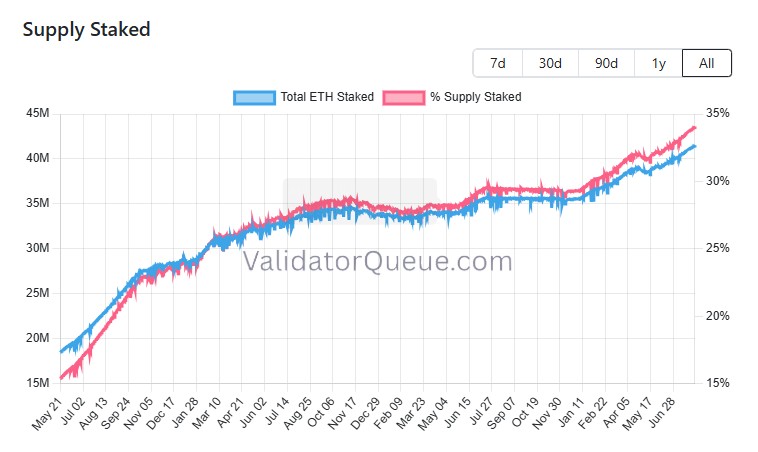
To understand the necessity—or folly—of EIP-8363, one must examine the current state of Ethereum’s staking metrics. According to data from the Ethereum Validator Queue, roughly 41.5 million ETH is currently locked in staking contracts, offering an annualized yield hovering around 2.67%. This staked volume accounts for approximately 34.07% of the entire circulating supply.

[Current Staking Snapshot]
--------------------------------------------------
Total Staked ETH:      ~41.5 million ETH
Supply Percentage:     34.07%
Average Yield (APY):   2.67%
Year-to-Date Growth:   +15% (as of 2026)
--------------------------------------------------
Proponents of the "Tapered Issuance Burn" point out that staking participation has surged dramatically, growing by roughly 15% since the beginning of the year. In their view, continuing to incentivize this influx with current issuance rates burns through network capital without providing a proportional increase in decentralization or economic security.
Market Forces vs. Protocol Intervention
Yet, prominent market participants argue that programmatic intervention is unnecessary because natural economic ceilings are already coming into effect.
Dr. Steve Berryman, Head of Client Partnerships for Ethereum at Bitwise, contends that market forces will naturally stabilize the staking ratio before it reaches dangerous levels of hyper-concentration.
"We will come to a natural ceiling probably by the end of this year," Berryman notes, pointing out that as yields compress toward the 2% range, the incentive to lock up additional capital diminishes sharply. "People need a certain amount of liquidity."
Berryman attributes the recent surge primarily to institutional inflows from major corporate allocators and asset managers such as Bitmine and BlackRock. Once these institutional pipelines complete their initial strategic asset allocations, participation is expected to reach a natural plateau without requiring a rewrite of Ethereum’s issuance code.
Echoing this sentiment, crypto commentator and vocal critic Leo Lanza challenges the core premise that standard issuance acts as a harmful “stealth tax” on non-stakers. Lanza highlights that Ethereum’s annual inflation rate remains comfortably below 1%. For context, even gold—widely regarded as the premier hard-money asset in human history—expands its physical supply by roughly 1% to 2% annually through new mining operations.
"The free market already solves this," Lanza argues. "Let the market adjust."
Official Statements & Stakeholder Perspectives
The debate has neatly divided the Ethereum community into two distinct ideological camps: those focused on long-term monetary purity and issuance efficiency, and those prioritizing ecosystem stability, institutional predictability, and DeFi integration.
The Proponent Perspective: Stopping Intermediary Subsidies
Proponents of EIP-8363, such as Justin Drake and Jerome de Tychey, argue that the status quo is fundamentally broken. They contend that higher staking rewards have failed to achieve their primary secondary objective: fostering a decentralized, independent validator set.
Instead, de Tychey points out that despite rising issuance and surging total value locked (TVL) in staking, the validator ecosystem has increasingly concentrated around a handful of large centralized exchanges, institutional custodians, and liquid staking token (LST) providers. Roughly 90% of all staked ETH is managed via delegated intermediaries.
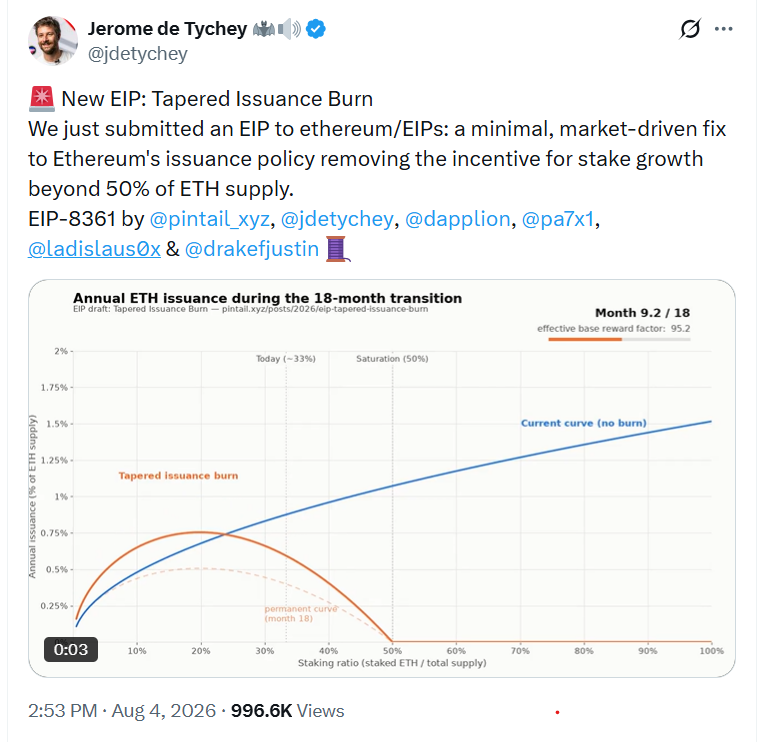
"We’ve spent years running the experiment: issuance went up with the amount staked, and the validator set became at best estimated roughly 90% delegated and concentrated," de Tychey explains. "Spending more didn’t buy decentralization, but it funded the intermediaries."
The Critic Perspective: A Threat to DeFi and Institutional Confidence
Conversely, opponents argue that tinkering with issuance creates far worse risks than the ones it attempts to resolve.
Mike Silagadze, founder of Ether.fi, voiced deep disappointment with the proposal across social channels:
"This is so disappointing on every level. […] This is bad for decentralization, this is bad for Ethereum adoption, and this is bad for the credibility of the network."
From an institutional standpoint, Dr. Steve Berryman warns that asset managers view economic stability as paramount.
"Institutional adoption requires certainty," Berryman tells analysts. "Playing with the issuance at the margin would cause uncertainty, and institutions hate uncertainty."
This sentiment is amplified within the decentralized finance sector. Staking derivatives (LSTs and liquid restaking tokens) have evolved into the foundational collateral layer powering Ethereum’s expansive DeFi ecosystem. Protocols like Aave rely heavily on these assets for borrowing, lending, and yield-generation strategies.
Stani Kulechov, founder of Aave, cautioned that reducing staking yields risks inducing capital flight from the ecosystem:
"My concern is… those who are fine with ETH beta and yield might also sell ETH for other yielding assets. […] Ethereum should not be punished for its growth."
De Tychey, however, rejects the premise that lower yields would break DeFi lending markets. He argues that borrowing rates naturally correlate with staking yields; if base staking returns compress, borrowing costs will similarly adjust.
"The trade gets smaller; it doesn’t die," de Tychey counters, questioning whether an entire financial ecosystem should perpetually rely on leveraged staking wrappers. "A DeFi built on raw ETH is sturdier than one built on wrappers."
The Impact on Solo Validators
A particularly nuanced critique of EIP-8363 centers on its potential impact on independent, solo validators. Greg Koumoutsos, technical research lead at the Lido Labs Foundation, argues that while monitoring staking ratios is healthy, EIP-8363 fundamentally misunderstands what protocol issuance purchases.
"Ethereum is not only paying for slashable ETH; it is paying for decentralization, operator diversity, censorship resistance, and network resilience," Koumoutsos notes.
Koumoutsos warns that lowering rewards would disproportionately harm independent solo operators who lack the massive economies of scale enjoyed by institutional validator pools and centralized exchanges. While ideological solo stakers may continue running nodes at a loss, marginal operators will likely unplug their hardware, accelerating centralization.
Furthermore, custodial platforms often maintain staking operations for reasons entirely detached from baseline yield—such as regulatory positioning, product integration, and customer retention. Consequently, large entities are less likely to withdraw participation, leaving solo stakers to bear the brunt of reward compression.
Future Outlook
As the dust settles on the initial shockwaves of EIP-8363, the debate has matured into a broader philosophical inquiry about Ethereum’s identity.
Is Ethereum primarily a monetary asset whose issuance schedule must be ruthlessly optimized to protect non-stakers from dilution? Or is it a global settlement layer and economic engine whose baseline yields power an intricate web of decentralized financial applications and institutional services?
The fierce pushback against EIP-8363 demonstrates that changing Ethereum’s monetary policy is no longer just a technical exercise; it is a high-stakes political battle involving billions of dollars in aligned capital. Critics warn that altering the issuance curve damages Ethereum’s reputation for predictable, unchangeable monetary governance—a trait that institutional allocators prize above all else.
Proponents, meanwhile, maintain that ignoring the long-term mathematical consequences of unconstrained staking issuance is an even greater gamble.
Ultimately, EIP-8363 may or may not survive the rigorous multi-month vetting process required for network upgrade inclusion. Regardless of its ultimate fate, the proposal has permanently opened a Pandora’s box of questions regarding how Ethereum values security, manages decentralization, and balances the competing demands of Wall Street institutions, DeFi protocols, and solo node operators.