
Executive Overview
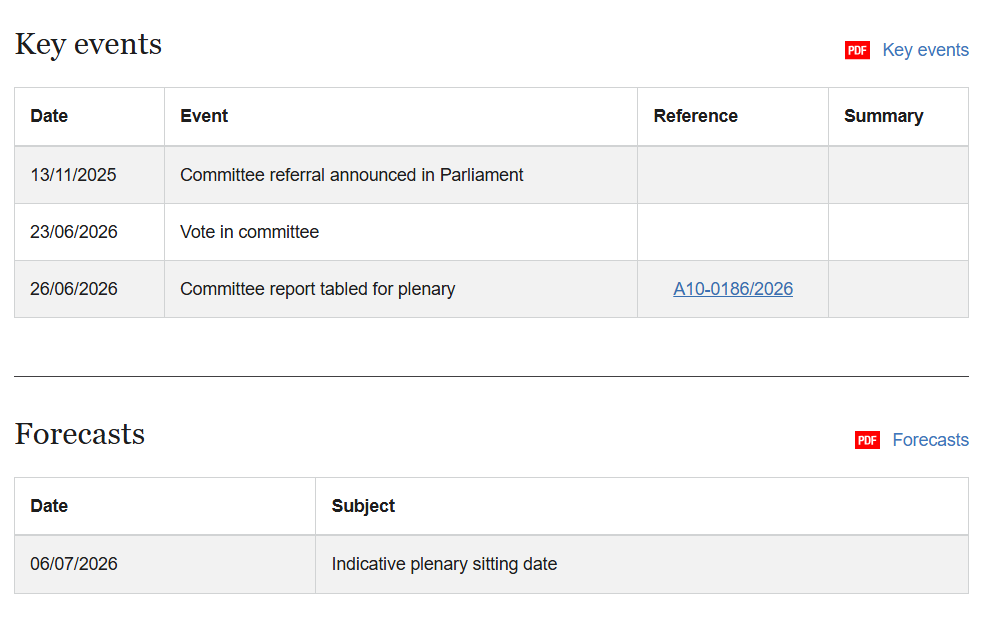
The recommendation forms the core of an own-initiative resolution drafted by Belgian Member of the European Parliament (MEP) Johan Van Overtveldt. Approved by the committee, the report was formally advanced for a plenary vote scheduled for July 6. While the resolution will not immediately amend the landmark Markets in Crypto-Assets Regulation (MiCA) or impose direct legal obligations on industry participants if passed, it will establish the European Parliament’s official stance on digital asset policy, sending a powerful signal to regulators, market participants, and institutional investors across the 27-member bloc.
Beyond targeting the more complex and decentralized sectors of the crypto economy, the committee’s comprehensive report calls for sweeping measures to promote financial tokenization, actively encourage the adoption of euro-denominated stablecoins, and ensure a harmonized application of existing laws. As the EU’s monumental MiCA transitional period reaches its hard deadline on July 1, European lawmakers are increasingly looking past the current regulatory horizon to future-proof the continent’s digital financial architecture against systemic shocks, fragmented national rules, and shifting global monetary paradigms.
Detailed Chronology: From Draft to Plenary
The journey toward this pivotal parliamentary report has been marked by careful deliberation, cross-border negotiations, and an evolving political appreciation for blockchain-based financial technologies.
[February 2025]
  └── Van Overtveldt introduces initial draft focusing on MiCA enforcement.
         │
[March – May 2025]
  └── Months of ECON committee negotiations, amendments, and public consultations.
         │
[Early June 2025]
  └── ECON committee officially approves the enriched report.
         │
[July 1, 2025]
  └── MiCA transitional period concludes; CASPs must hold full authorization.
         │
[Expected July 6, 2025]
  └── Full European Parliament plenary vote on the official resolution.
The Genesis of the Report
The legislative narrative began in earnest in February, when MEP Johan Van Overtveldt presented the initial draft of the ECON report. At its inception, the document was largely designed to assess the baseline implementation of MiCA, focusing heavily on stablecoin classifications, multi-issuer legal certainties, and preserving a level playing field across European jurisdictions.
However, following months of intense scrutiny, stakeholder feedback, and amendments by ECON committee members, the scope of the report expanded dramatically. Recognizing that the fast-moving digital asset ecosystem extends far beyond the centralized exchanges and basic token issuers initially captured by MiCA, lawmakers broadened the mandate. The final committee-approved text explicitly pushes the European Commission to analyze whether the regulatory net must be cast wider to capture the innovative, yet historically opaque, sectors of DeFi, algorithmic and non-algorithmic staking, digital asset lending platforms, and the multi-billion-dollar NFT market.
The Immediate Legislative Horizon
With the committee’s approval secured, the report is slated to face the full European Parliament in a plenary vote on July 6. If adopted, it will crystallize into the Parliament’s official policy blueprint. Although own-initiative resolutions do not carry immediate legislative teeth—meaning they cannot directly alter existing laws or draft new directives without subsequent proposals from the European Commission—they wield considerable political leverage. The Commission is legally and practically compelled to respond to Parliament’s resolutions, meaning these recommendations will likely shape the next generation of EU financial legislation.
Supporting Context & Metrics: The Shadow of Past Crises and Current Deadlines
To fully understand the urgency and tone of the ECON report, one must examine the backdrop of recent banking volatility and the critical regulatory timelines currently facing European crypto-asset service providers (CASPs).
The 2023 Banking Crisis and the Stablecoin Anxiety
The push for stricter and more comprehensive digital asset oversight does not happen in a vacuum. In 2023, during the height of the regional banking crisis that claimed Silicon Valley Bank (SVB), Signature Bank, and Silvergate Bank, Johan Van Overtveldt was among the most vocal critics of digital assets within European legislative circles. At the time, the turbulence spilled directly into the crypto market when Circle, the issuer of the USD Coin (USDC) stablecoin, revealed it held approximately $3.3 billion of its cash reserves at the collapsed SVB. This exposure caused USDC to temporarily lose its vital 1:1 parity with the US dollar, triggering widespread panic across liquidity pools.
In the heat of that crisis, Van Overtveldt publicly likened certain aspects of unregulated cryptocurrencies to high-risk substances, demanding immediate regulatory clamps. Fast forward to the present day, however, and the tone among European policymakers has undergone a nuanced transformation. Rather than seeking to eradicate digital assets, lawmakers are now actively seeking to harness stablecoins—provided they are denominated in euros and strictly regulated.
The July 1 MiCA Deadline and Fragmentation Risks
The release of the ECON report coincides with a monumental operational milestone for the European crypto industry. July 1 marks the absolute end of MiCA’s transitional grace period. From this date forward, crypto-asset service providers operating within the EU must hold formal regulatory authorization under MiCA to lawfully service European clients.
This looming deadline has created a dual-pressure environment. On one hand, major global exchanges and local platforms are rushing to secure licenses. On the other hand, regulatory friction has driven some firms to seek licenses abroad or face operational restrictions—as evidenced by recent high-profile policy clashes, such as Poland’s ongoing legislative vetoes regarding local MiCA implementation bills.
To counter the threat of regulatory arbitrage and market fragmentation, the ECON report strictly warns individual EU member states against introducing national-level requirements that go beyond MiCA. The committee stresses that a unified, single-market approach is essential to maintain European competitiveness and ensure that crypto firms do not simply migrate to friendlier, less-regulated jurisdictions within or adjacent to the bloc.
Official Statements and Policy Shifts
The evolution of European regulatory sentiment was further underscored by a concurrent ideological shift regarding digital currencies and public-private financial coexistence.
Warming Up to Euro-Denominated Stablecoins
In a striking departure from historical central banking orthodoxies—which frequently viewed private stablecoins as existential threats to monetary sovereignty—the European policy apparatus is warming up to regulated digital tokens. This shift mirrors global sentiments; notably, days before the ECON report’s release, former Bank for International Settlements (BIS) General Manager and long-standing crypto skeptic Agustín Carstens publicly softened his stance on the peaceful coexistence of stablecoins and fiat currencies.
The ECON report explicitly welcomes euro-denominated stablecoins operating under the strict parameters of MiCA. Lawmakers argued that fostering these assets could substantially modernize the bloc’s payment infrastructure, facilitate faster and cheaper cross-border settlements, and enhance the international prestige and usage of the euro. Furthermore, the report notes that private euro stablecoins can seamlessly complement tokenized commercial bank deposits and wholesale central bank digital currencies (wCBDCs).
Coexistence over Competition: The Digital Euro
This collaborative philosophy was reinforced when the ECON committee overwhelmingly backed landmark legislation advancing the digital euro Central Bank Digital Currency (CBDC). During these deliberations, European lawmakers emphasized that public-sector digital money (the digital euro) and private-sector digital money (regulated stablecoins and tokenized deposits) must be designed to coexist harmoniously rather than engage in destructive competition.
By integrating private euro stablecoins into the official regulatory vision while simultaneously championing a retail digital euro, the EU is attempting to construct a bulletproof, comprehensive digital money ecosystem that protects consumer interests while safeguarding macroeconomic stability.
Future Outlook: What Next for DeFi, NFTs, and the European Crypto Landscape?
As the European Parliament prepares for its July 6 plenary vote, stakeholders across the digital asset ecosystem are closely monitoring the trajectory of European policy.
Expanding the Regulatory Perimeter
The European Commission is already actively reviewing the scope of MiCA. In May, the Commission launched an extensive public consultation specifically designed to gather industry feedback on whether the regulatory framework should be aggressively expanded. The consultation touches directly upon the exact verticals highlighted in Van Overtveldt’s report:
- Decentralized Finance (DeFi): Assessing how to govern protocols that lack a centralized legal entity or issuer.
- Staking & Lending: Establishing consumer protection guidelines and operational standards for yield-generating crypto activities.
- Non-Fungible Tokens (NFTs): Determining whether high-value or fractionalized NFTs constitute financial instruments rather than simple digital collectibles.
- Interest-Bearing Stablecoins: Reopening heated debates over whether stablecoins should be permitted to pass yield directly to holders.
The Road Ahead
Should the European Parliament formally adopt the ECON resolution on July 6, it will establish an unshakeable legislative intent. While not an instant law, it acts as a legislative roadmap for the European Commission’s upcoming regulatory updates.
For crypto enterprises, fintech innovators, and institutional investors, the message from Brussels is unmistakable: the era of the wild west in European digital finance is coming to a definitive close. While the EU remains open to fostering technological innovation—particularly in tokenization and euro stablecoins—it is committed to bringing every corner of the blockchain economy, from institutional staking to decentralized liquidity pools, firmly under the rule of law.