rifanmuazin is a reporter for DeBitcoin covering Crypto Investing & Venture Capital. She/He is based in Indonesia.
8 August 2026 • 9 min read
For decades, financial theory recognized only two fundamental categories of assets: cash flow assets, such as equities and bonds, which derive their value from projected financial returns; and supply-and-demand assets, primarily commodities and foreign exchange, whose valuations fluctuate dynamically based on immediate market scarcity and utility. Today, however, the digital asset landscape is midwifing an entirely unprecedented financial paradigm: the Attention Asset.
Executive Overview
Driven by the explosive growth of user-generated assets (UGAs)—including non-fungible tokens (NFTs), creator coins, and memecoins—modern markets have begun pricing cultural mindshare directly. While memecoins successfully capture the zeitgeist, they fall woefully short as sophisticated financial instruments. They start at a valuation of zero, making them poorly suited for gaining exposure to established cultural entities or public figures, and they lack the robust infrastructure required for efficient short-selling, risk hedging, and institutional participation.
To bridge this chasm, market architects are proposing a transformative financial primitive: Attention Oracles and Attention Perpetual Futures (Perps). By aggregating binary prediction markets, search analytics, and sentiment data into weighted aggregate indices, these novel instruments aim to quantify cultural attention, imbue it with economic backing, and establish an authentic, tradeable asset class. This deep-dive investigation explores the mechanics of Attention Oracles, the pressing need for institutional-grade Attention Perps, and the broader implications for both crypto-native protocols and traditional equities.
Detailed Chronology: From Memetic Speculation to Structural Financialization
The evolution of the attention economy has traversed distinct generational phases over the past decade, moving from unorganized social media noise to speculative tokenization, and finally toward systematic financial engineering.
Phase 1: The Social Media and Web2 Sentiment Era (Pre-2020)
In the early days of social media analytics, platforms like Twitter (now X) and Google Trends dominated the measurement of public interest. Investors, brands, and public relations firms treated metrics like follower counts, hashtag volume, and post impressions as qualitative proxies for popularity. However, these metrics lacked financial finality. There was no direct mechanism to convert a trending hashtag into a leveraged long or short position without relying on indirect equities, such as buying advertising agency stock or social media platform shares. Furthermore, as Goodhart’s Law dictates—when a measure becomes a target, it ceases to be a good measure—these Web2 metrics proved exceptionally vulnerable to botting, engagement farming, and artificial inflation.
Phase 2: The UGA and Memecoin Explosion (2020–2024)
The advent of permissionless token creation, automated market makers (AMMs), and bonding curves fundamentally democratized asset issuance. Platforms like Pump.fun allowed anyone to spin up a memecoin in seconds with virtually zero capital overhead. These User-Generated Assets (UGAs) achieved massive product-market fit in pure speculation. They proved adept at tracking the attention lifecycle of internet memes and hyper-viral trends starting from a valuation of zero.
Yet, UGAs exposed severe structural limitations. If an investor wanted to gain financial exposure to an established global icon—such as LeBron James, Taylor Swift, or Donald Trump—deploying a memecoin proved futile. Hundreds of competing "LeBron" tokens immediately saturated the market, none of which possessed economic legitimacy, and none of which could realistically start at zero given the subject’s baseline global fame. Moreover, executing a short position on a memecoin remains notoriously difficult, expensive, and prone to catastrophic liquidation loops.
Phase 3: The Genesis of Prediction Markets and Aggregated Oracles (2024–Present)
Recognizing the limitations of pure memetic tokens, market designers turned their attention toward decentralized prediction markets like Kalshi and Polymarket. By turning real-world events into binary contracts ("Will X happen by date Y?"), these platforms generated genuine economic pricing for future outcomes.
Pioneering firms and decentralized finance (DeFi) builders began experimenting with indexing these prediction markets. Early prototypes, such as Noise utilizing Kaito’s social data aggregator, allowed traders to long or short the mindshare of prominent crypto protocols like Monad and MegaETH. However, dependence on social media inputs quickly ran into the roadblocks of manipulation and spam. This paved the way for the conceptualization of Attention Oracles—sophisticated pricing engines that derive their underlying values exclusively from liquid, adversarial prediction markets, ensuring that any attempt to manipulate the index carries an explicit financial penalty.
Supporting Context & Metrics: The Mechanics of Attention Oracles
To comprehend how Attention Oracles function in practice, one must examine their mathematical construction and structural defenses against market manipulation.
The Mathematics of an Attention Index
An Attention Oracle operates by harvesting a basket of binary prediction markets linked to a specific cultural fixture, applying a weighted multi-variable formula, and outputting a unified index value that perpetual swap contracts can track.
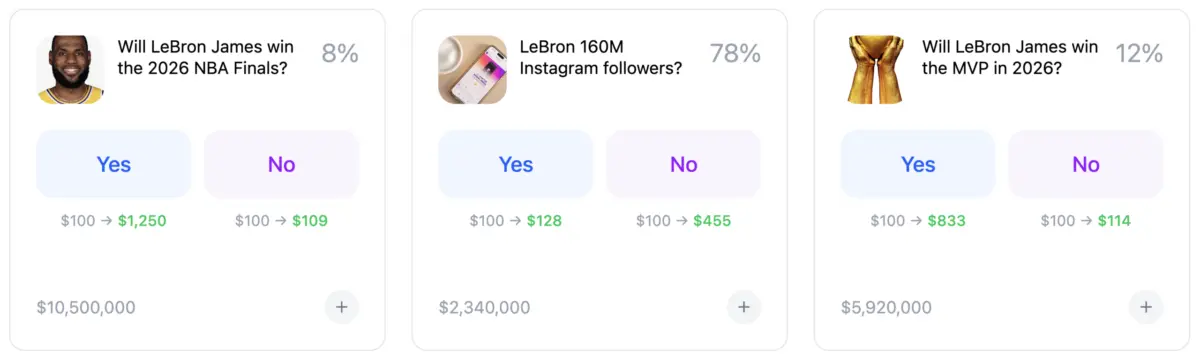
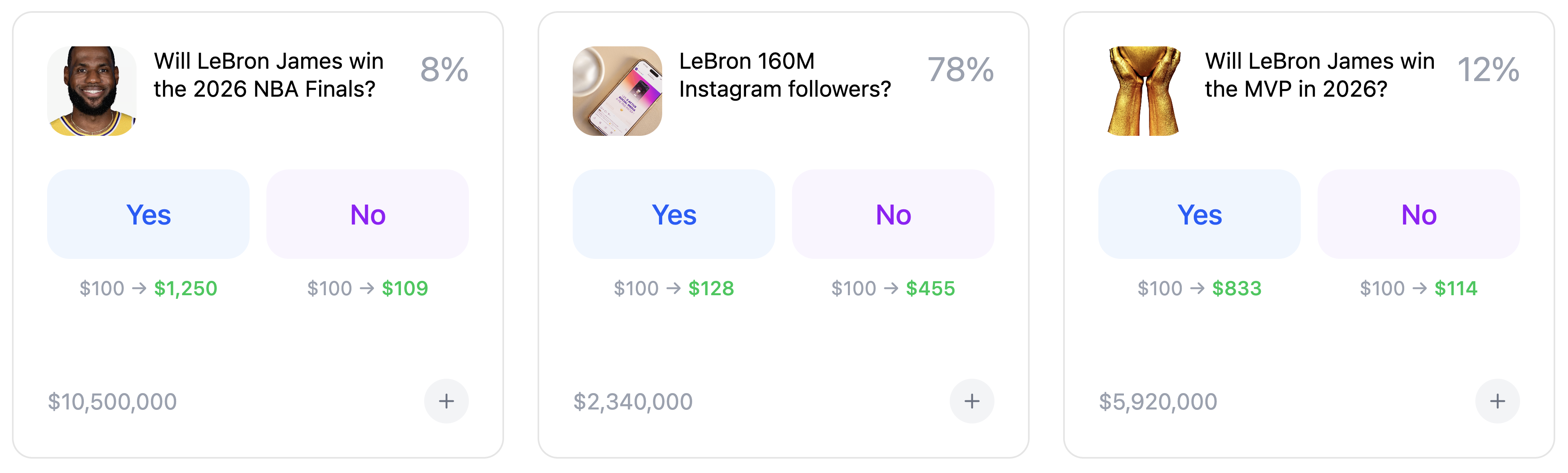
Consider a hypothetical Attention Oracle designed to track the cultural mindshare of LeBron James. Instead of monitoring noisy social media mentions, the oracle aggregates three distinct, highly liquid prediction markets:
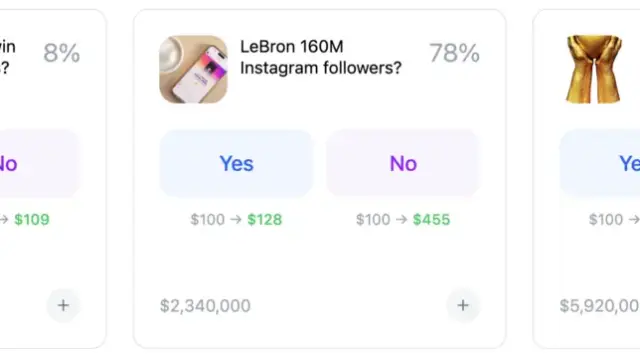
Market A: "Will LeBron James reach over 160 million Instagram followers by month-end?"
Market B: "Will LeBron James win an NBA championship in the upcoming season?"
Market C: "Will LeBron James secure an MVP award nomination?"
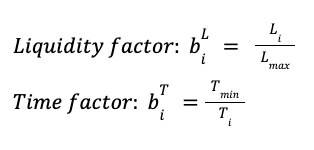
Each underlying market is evaluated through a quantitative lens incorporating four core variables:
Price ($P$): The current implied probability of the binary contract (ranging from 0 to 1).
Liquidity ($L$): The depth of the order book and available capital supporting the contract.
Time to Resolution ($T$): The duration remaining until the contract settles.
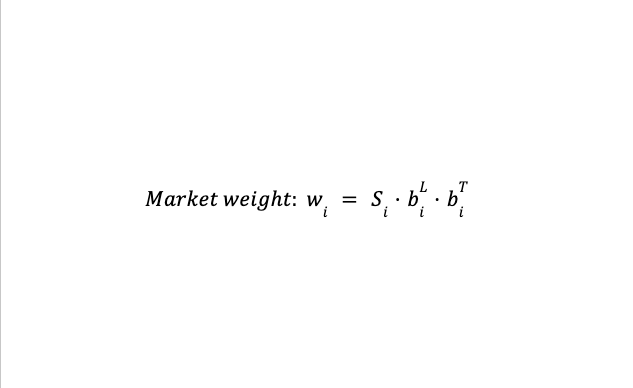
Significance Score ($S$): A qualitative weighting factor (graded on a scale from 1 to 10) assigned by protocol governance or curators to determine how deeply the market correlates with overall cultural attention.
The formula normalizes these inputs to produce an aggregate weight for each component market. When market makers execute trades on an Attention Perp, they rely on this composite index as the definitive oracle price. If a market maker takes a net short exposure on LeBron’s attention index, they can delta-hedge their position by purchasing opposing "Yes" contracts across the underlying prediction markets, creating an interlocking web of financial stabilization.
Built-In Manipulation Costs and Anti-Fragility
The crown jewel of a prediction-market-based oracle design is its embedded manipulation cost.
In traditional social-media-driven sentiment indices, bad actors can deploy bot farms to artificially inflate keyword mentions at minimal operational expense. Conversely, attempting to manipulate an Attention Oracle requires an adversary to buy up massive blocks of contracts in the underlying prediction markets.
Because these underlying markets are adversarial and heavily liquid, an attacker trying to artificially force the index upward must purchase shares at prices the broader market explicitly deems overvalued. If the attacker’s thesis is wrong, they suffer immediate, painful capital losses. This economic deterrence converts manipulation into an expensive, self-correcting endeavor.
Official Statements & Industry Perspectives
As the financialization of attention gathers momentum, thought leaders across the decentralized finance and macroeconomic sectors are taking notice.
Market architects specializing in decentralized derivatives note that the demand for attention-based exposure is an inevitable byproduct of the modern attention economy. An anonymous contributor from the research collective Adjacent emphasizes the scalability of market-based indices:
"By leveraging live, liquid markets on platforms like Kalshi to track systemic trends—ranging from macroeconomic policy shifts to high-stakes political races—we have proven that composite indices can accurately reflect real-world dynamics. Applying this exact structural methodology to cultural fixtures is the natural next frontier for financial engineering."
Crypto-economic researchers point out that while platforms like Kaito successfully aggregate developer and community mindshare for crypto-native protocols, mainstream adoption requires a shift toward financialized truth engines. Goodhart’s Law remains a persistent ghost in the machine, prompting developers to look beyond simple social volume counters.
Furthermore, decentralized exchange innovators highlight the flexibility of modern infrastructure. Protocols utilizing builder-deployed perpetual architectures—such as Hyperliquid’s HIP-3 framework—provide the exact customization required to launch Attention Perps. These frameworks allow deployers to craft hybrid oracles combining prediction market depth, verified search trends, and filtered news feeds, tailoring the risk parameters specifically to the asset class being tracked.
Future Outlook: Attention as a Macro Asset Class
Looking ahead, the implications of Attention Oracles and Attention Perps extend far beyond the boundaries of cryptocurrency and niche internet culture. We are staring down the birth of a macro asset class that could fundamentally redefine how corporations, investors, and economists measure value.
1. The Memetic Component of Traditional Equities
Ironically, the most profound application of the Attention Economy may ultimately manifest within traditional equities. Standard valuation models rely heavily on Discounted Cash Flow (DCF) analysis to determine a stock’s intrinsic value. However, the rise of retail trading platforms (e.g., Robinhood) and social investing communities (e.g., WallStreetBets) has proven that a stock’s valuation is increasingly driven by its memetic value.
As more equities trade heavily based on cultural narrative rather than pure earnings multiples, institutional analysts will be forced to adopt rigorous methodologies to model memetic value. Attention Oracles could soon become standard enterprise tools, allowing hedge funds to hedge equity exposure against shifts in consumer attention and public sentiment.
2. Attention as a Leading Economic Indicator
In macroeconomic terms, attention is the ultimate leading indicator for consumer preferences, capital allocation, and spending behavior. Businesses direct billions of dollars in research and development, hiring, and marketing toward the precise vectors where public attention converges.
By converting attention into a liquid, tradeable asset class via perpetual futures, markets create a decentralized price-discovery mechanism for human interest. Just as crude oil futures dictate energy production schedules, Attention Perps could soon provide forward-looking signals for brand valuation, entertainment box-office performance, and political outcomes.
3. Challenges and the Path Forward
Despite its immense promise, the Attention Asset ecosystem faces notable hurdles. Obtaining liquid, long-lived prediction markets for a diverse array of global topics remains a logistical bottleneck. Furthermore, cultural attention is notoriously non-linear; an individual’s mindshare can skyrocket due to negative controversy even as prediction markets for their specific career milestones trend downward.
To overcome these friction points, the next generation of oracle design will likely lean into multi-source hybrids: fusing the deep liquidity of prediction markets with privacy-preserving Google Trends API telemetry and large language model (LLM) text-parsing layers designed to filter out spam across global news outlets.
Conclusion
The transition from passive social media scrolling to active, leveraged financial exposure marks a monumental leap in market design. Attention Oracles and Attention Perps transform intangible cultural capital into quantifiable, protected, and tradeable financial instruments. As prediction markets deepen and oracle architecture matures, attention is poised to shed its reputation as fleeting internet noise and cement its place as one of the most valuable, heavily traded asset classes of the 21st century.