
Executive Overview
The emergency rescue operation safely brought over $500,000 worth of digital assets into Yuga Labs’ temporary custody. According to company executives, these prized pieces of digital real estate are currently locked away in a secure multi-signature wallet. They are slated to be safely returned to their rightful owners once a comprehensive recovery and verification solution is finalized.
This security breach underscores the persistent fragilities inherent in decentralized finance (DeFi) and fractionalization protocols, particularly those undergoing structured wind-downs or facing unexpected abandonment. Flooring Protocol—which had already initiated a phased sunset of its consumer-facing operations—fell victim to vulnerability exploitation during a period of diminished oversight and organizational turbulence.
While the broader NFT market has cooled significantly from its astronomical bull-run peaks, blue-chip ecosystems like CryptoPunks and Bored Apes continue to command immense valuations. This incident not only highlights the resilience and rapid response capabilities of industry-leading entities like Yuga Labs, but also exposes the hazardous vulnerabilities left behind when Web3 projects shutter their doors without securing all user assets.
Detailed Chronology of the Exploit and Rescue
The Vulnerability and the Breach
The crisis unfolded on a Monday when anomalous on-chain transactions flagged potential vulnerabilities within Flooring Protocol’s legacy architecture. The protocol, designed to fractionalize NFTs into tradeable ERC-20 tokens, was left exposed due to ongoing internal restructuring, liquidity drains, and an unmanaged NFT division.
Malicious actors quickly identified these structural gaps, targeting pools containing substantial liquidity and unmanaged user assets. Among the primary targets were personal holdings left on the platform by former executives attempting to facilitate user exits, alongside residual assets from fractionalized vaults.
The Intervention
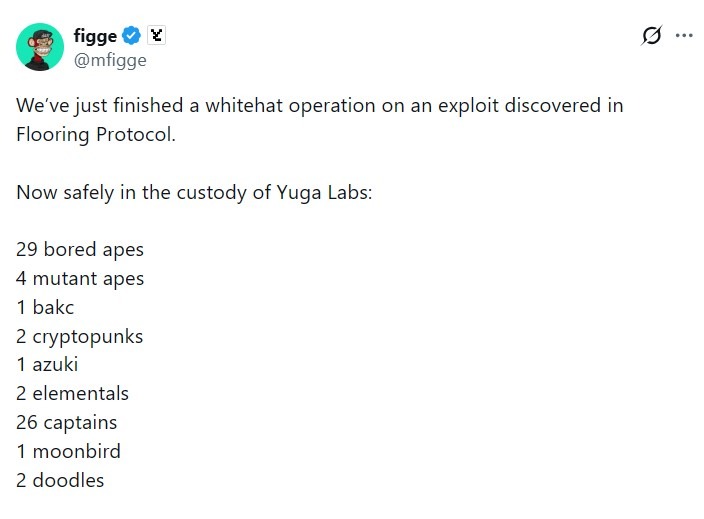
Realizing the imminent danger posed to foundational Web3 assets, developers closely affiliated with Yuga Labs mobilized on-chain defenses. Operating with tactical speed, the rescue team deployed preemptive measures to sweep the vulnerable vaults, successfully pulling 68 high-value tokens out of harm’s way before malicious exploiters could drain them entirely.
Yuga Labs CEO Michael Figge took to social media platform X (formerly Twitter) on Monday to confirm the successful intervention. Figge assured the community that the rescued NFTs were safely residing within the company’s custody. He emphasized that Yuga Labs is actively formulating a secure distribution framework to return the tokens to their rightful owners.
Amplifying these details, Yuga’s pseudonymous Vice President of Blockchain, 0xQuit, provided granular insights into the scale of the operation. According to 0xQuit, the emergency rescue operation safeguarded an estimated portfolio exceeding $500,000 in underlying NFT value.

Supporting Context & Metrics: The State of Blue-Chip Assets
Despite the severe capital rotation away from digital collectibles over the past several years, elite collections continue to anchor multi-million-dollar valuations. The assets rescued from Flooring Protocol represent some of the most liquid and culturally significant digital artifacts in the blockchain ecosystem.
Valuation and Market Standing
According to real-time data aggregators like CoinGecko and NFT Price Floor, individual assets within these rescued collections carry substantial weight:
- CryptoPunks: Retained a resilient floor price of approximately 32.7 ETH, translating to roughly $54,612 per individual punk at the time of the incident.
- Bored Ape Yacht Club (BAYC): Maintained a floor price hovering around 9.16 ETH.
When viewed at a macro level, the sheer scale of these collections remains staggering. NFT Price Floor data indicates that CryptoPunks commands a total market capitalization of roughly 339,400 ETH (approximately $560 million), making it the undisputed heavyweight of the NFT economy. Meanwhile, Bored Ape Yacht Club stands as the second-largest collection, boasting a market capitalization of approximately 90,590 ETH (roughly $150 million).
Broader NFT Market Dynamics
The wider digital asset marketplace has experienced persistent turbulence. Following a brief springtime surge in late April and early May—which saw overall NFT market capitalization climb briefly to approximately $2 billion—the sector retreated. By the time of the Flooring Protocol exploit, total market capitalization had contracted back down to roughly $1.4 billion.
This macro-cooling trend has compounded the difficulties faced by consumer-facing Web3 applications, liquidity platforms, and marketplaces. Earlier industry friction, such as OpenSea’s strategic postponement of its anticipated SEA token launch due to "challenging market conditions," underscores a broader industry-wide defensive posture. Platforms are increasingly prioritizing risk mitigation, compliance, and capital preservation over aggressive expansion.
Official Statements and Post-Mortem Analysis
The collapse of Flooring Protocol’s security posture did not happen in a vacuum. A deeper post-mortem reveals a cascade of strategic errors, liquidity crunches, and administrative abandonments that left the door wide open for exploitation.
Flooring Protocol’s Wind-Down Trajectory
Flooring Protocol had begun signaling its operational retreat long before Monday’s exploit. In September 2025, the platform officially announced that its Web3 consumer services were entering "sunset mode." Management strongly urged all FPv2 token holders to redeem their fractional positions, reclaim their underlying NFTs, and completely exit the platform by an established deadline of October 15, 2025.
However, transitioning a decentralized protocol down to zero is notoriously difficult. As user engagement dwindled and liquidity dried up, structural abandonment set in.
Insights From Former Leadership
Weighing in on the incident, Flooring Protocol’s former CEO, known pseudonymously as FreeLunchCapital, shed light on the organizational chaos that preceded the exploit. FreeLunchCapital revealed that the protocol had been crippled by severe liquidity issues coupled with sweeping internal organizational changes. These structural shifts inadvertently left critical components of the NFT division entirely unmanaged and vulnerable.
In a display of personal accountability, FreeLunchCapital noted that they had continued providing personal liquidity out-of-pocket and maintained several of their own high-value NFT assets within the protocol’s vaults. The explicit goal was to give remaining users a functional exit ramp. Tragically, those very assets became the prime targets exploited by bad actors during the security breach.
Despite the catastrophe, FreeLunchCapital confirmed that active back-channel negotiations are currently underway. The former CEO is in direct talks with the parent group behind the protocol’s management team in an effort to legally and technically regain control of the remaining infrastructure, aiming to assist in the remediation process.
Future Outlook: Lessons for the NFT and DeFi Ecosystems
The Flooring Protocol rescue mission serves as both a cautionary tale and a masterclass in white-hat solidarity within the Web3 community. As the digital asset landscape continues to mature, several key takeaways emerge from this incident:
1. The Perils of Protocol Sunsetting
When decentralized protocols shut down, they rarely vanish cleanly. Abandoned smart contracts, uncollected user balances, and orphaned liquidity pools create lucrative honey-pots for malicious hackers. Future projects winding down operations must implement stricter automated redemption safeguards, time-locks, or forced-migration mechanisms to prevent stranded assets from becoming sitting ducks.
2. The Rise of Decentralized Inter-Protocol Rescues
The proactive intervention by Yuga Labs-affiliated developers highlights a growing industry trend: cross-project solidarity. Rather than remaining siloed within their own corporate ecosystems, major Web3 powerhouses are increasingly utilizing their technical expertise and on-chain clout to rescue broader industry assets from imminent theft. This collaborative defense mechanism is vital for maintaining consumer trust in blockchain technology.
3. Regulatory and Legal Accountability
As discussions continue between former executives and parent management groups, legal scrutiny surrounding abandoned crypto infrastructure is bound to intensify. Users and investors who suffered losses due to unmanaged protocols are likely to demand greater accountability from founders and venture backers who walk away from deployed smart contracts before full decommissioning is achieved.
Conclusion
While the 68 rescued NFTs are currently resting safely in Yuga Labs’ multi-sig vault awaiting repatriation, the incident leaves an indelible mark on the history of NFT infrastructure. It demonstrates that while code may be law on the blockchain, human oversight, liquidity preservation, and responsible protocol sunsets are the ultimate lines of defense against catastrophic loss.