


Executive Overview
At the same time, micro-level market structures revealed divergent trends. The Ethereum Foundation continued its systematic, policy-driven token liquidations despite rising ETH prices, drawing scrutiny from retail observers unfamiliar with the protocol’s internal treasury protocols. Concurrently, political memecoins faced acute downward pressure even amidst high-profile networking events, while institutional products for alternative layers like XRP experienced a notable resurgence in capital inflows.
This comprehensive review examines the key market movements, structural adjustments, and macroeconomic catalysts shaping the digital asset economy.
Detailed Chronology: Week in Review
Mid-Week Volatility and Macro Pressures
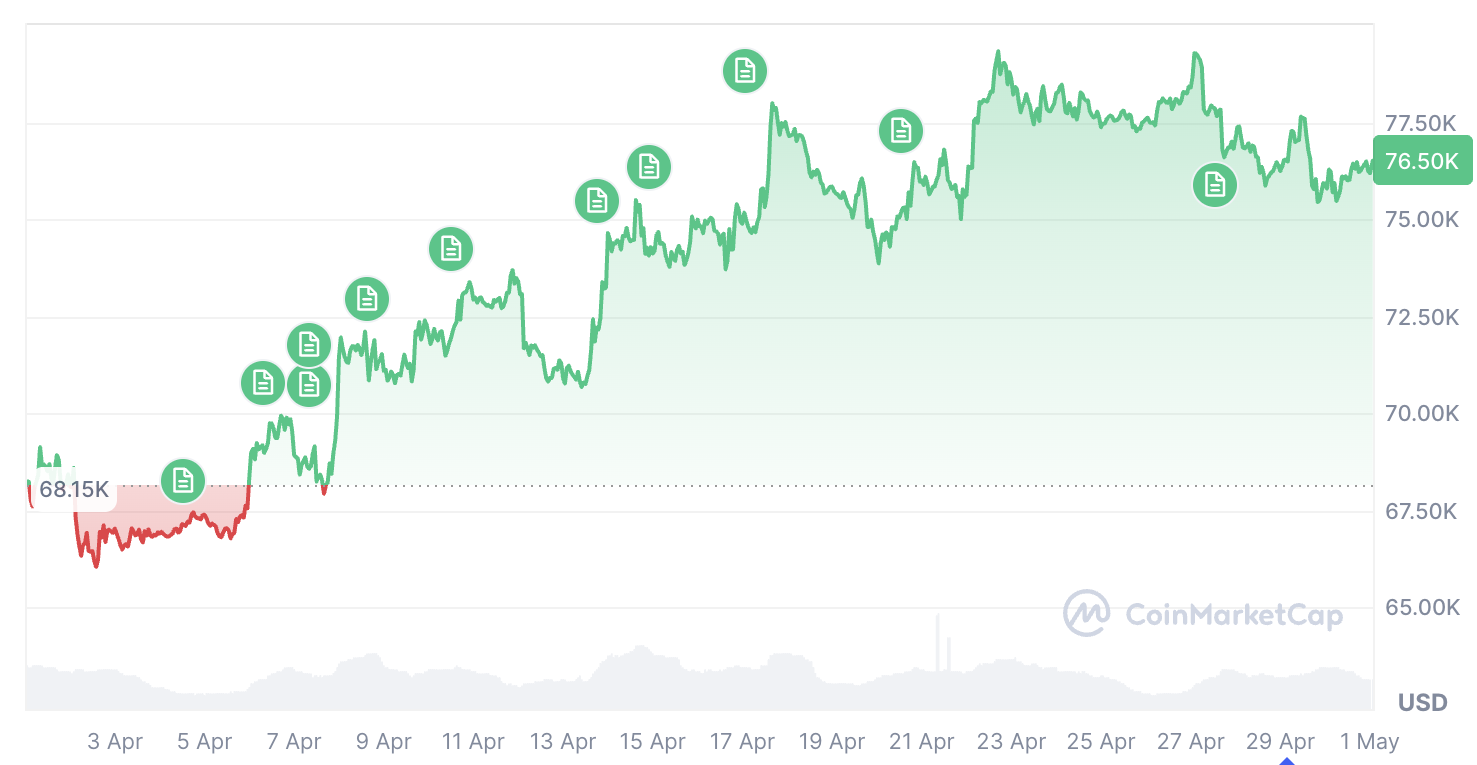
The week’s trading activity was heavily dictated by external macroeconomic factors colliding with technical resistance levels. On Wednesday, Bitcoin faced strong rejection at the $78,000 threshold, pulling back sharply to retest the $76,000 support level. This corrective movement closely mirrored weakness observed in traditional equity markets, specifically the S&P 500 Index, which struggled to maintain momentum near the 7,200 level.

The correlation between risk-on traditional equities and digital assets was exacerbated by geopolitical developments. As the conflict in Iran marked its 60th day, international crude oil prices climbed toward $118 per barrel. Analysts noted that the resulting inflationary pressures threatened consumer spending and corporate earnings through escalated logistics costs. Furthermore, growing skepticism surrounding the immediate profitability of enterprise investments in artificial intelligence (AI) further dampened broader risk appetite across global markets.
The Federal Reserve’s Rate Decision
Adding to the macroeconomic friction, the Federal Open Market Committee (FOMC) released minutes confirming the central bank’s decision to maintain the target range for the federal funds rate at $3frac12$ to $3frac34$ percent.
While the rate pause aligned with prevailing market expectations, Federal Reserve Chairman Jerome Powell’s accompanying press conference underscored an environment of heightened uncertainty. The FOMC minutes explicitly cited escalating developments in the Middle East as a primary risk factor, prompting the central bank to preserve maximum optionality as it evaluates threats to both sides of its dual mandate of maximum employment and price stability.
Despite initial mid-week volatility—which saw Bitcoin perpetual futures funding rates turn briefly negative—analysts pointed to underlying market resilience. Commenting on the price action, Hyblock CEO Shubh Varma characterized the drop as a routine "sell the news" reaction to the FOMC meeting, noting that Bitcoin managed to recover to pre-announcement levels within hours, signaling robust underlying conviction among spot holders.
Supporting Context & Metrics
Ethereum Foundation Treasury Dynamics
One of the most heavily discussed narratives within the decentralized finance ecosystem concerned the ongoing treasury operations of the Ethereum Foundation. Despite Ether surging more than 10% through the month of April to reach local highs of $2,430, the nonprofit organization continued a series of calculated asset liquidations.
Data from blockchain intelligence platform Arkham Intelligence highlights the scale and mechanics of these transactions:
- Early April Sale: The Foundation liquidated 5,000 ETH in exchange for approximately $11 million in DAI.
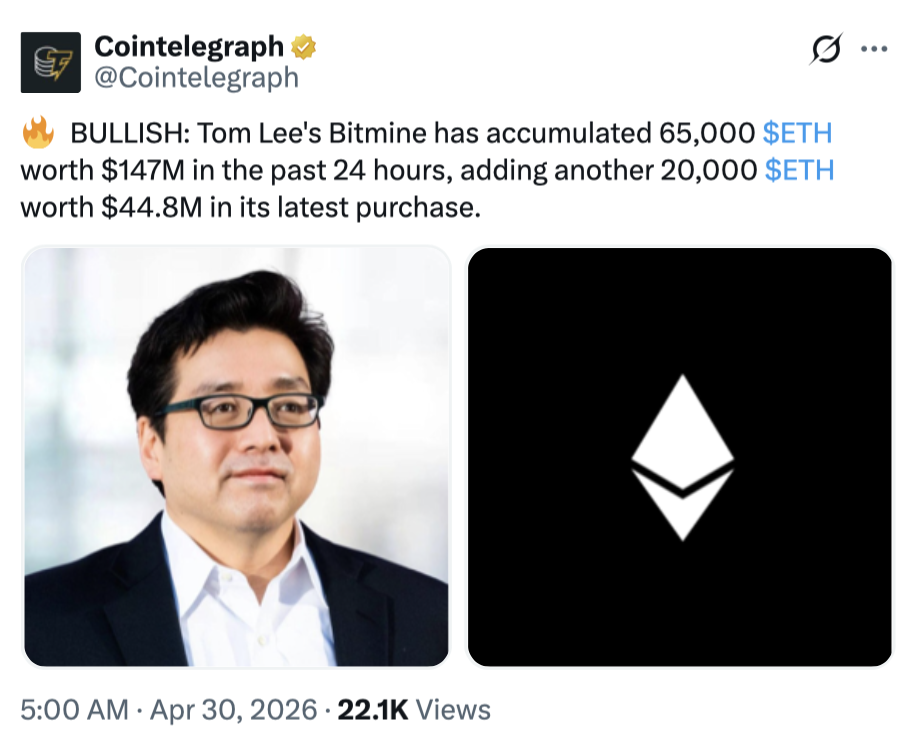
- OTC Transaction: A subsequent over-the-counter (OTC) sale saw 10,000 ETH transferred to Tom Lee’s Bitmine at an average execution price of $2,387, generating roughly $23.9 million.
- Year-to-Date Volume: Throughout 2026, the Foundation has systematically sold approximately 20,000 ETH, raising cumulative proceeds exceeding $45 million.
Despite these sales, the entity maintains a robust financial posture. Its current holdings include approximately 92,500 ETH in liquid treasury reserves (valued near $215 million) alongside an additional 53,000 ETH locked in staking contracts.
Bitcoin Derivatives and Futures Positioning
Beneath Bitcoin’s spot price fluctuations, derivatives markets displayed shifting sentiment among institutional and retail participants. Following the mid-week rejection at $77,800, Bitcoin perpetual futures funding rates briefly dipped into negative territory on Wednesday, breaking away from the neutral-to-bullish baseline observed earlier in the week.
In a structurally healthy, expansionary crypto market, funding rates typically hover between 6% and 12% annualized, reflecting a cost of capital where long positions consistently pay short positions to maintain exposure. A sudden transition to negative funding rates indicates an uptick in demand for leveraged bearish positions, suggesting that short-term traders were positioning defensively against macro-driven downside risks. However, whale long-to-short ratios on major centralized exchanges concurrently signaled that large-scale holders were maintaining structural optimism despite the macro overhang.
XRP Spot ETFs Post Strong Monthly Rebound
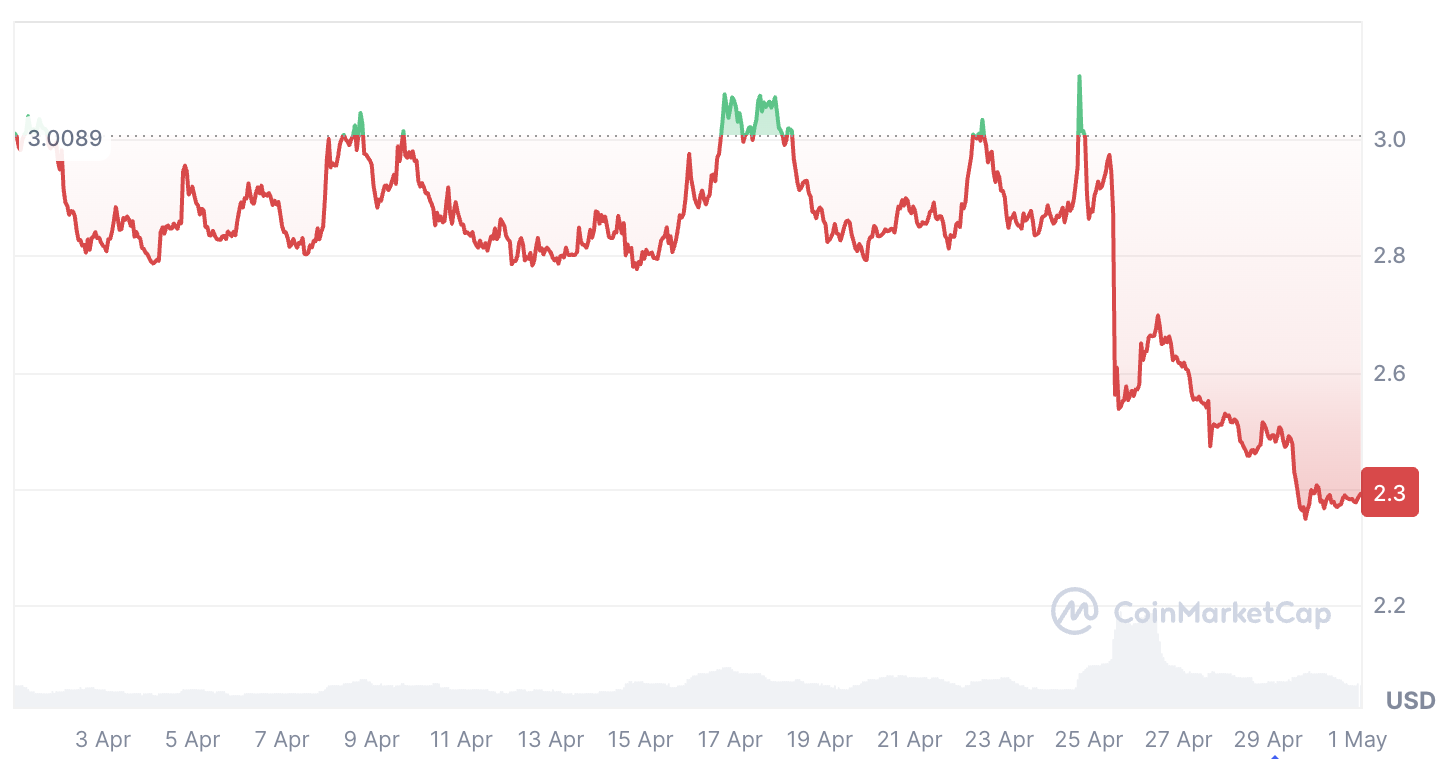
While Bitcoin and Ethereum wrestled with macroeconomic resistance, the XRP ecosystem experienced a powerful resurgence in institutional product demand. According to data compiled by SoSoValue, XRP spot exchange-traded funds (ETFs) registered net inflows in 11 out of 13 trading sessions, accumulating $82.42 million over that timeframe.
For the entirety of April, XRP investment vehicles pulled in a net total of $83.9 million, completely erasing the capital outflows of $31.16 million recorded in March. Market analysts noted that this performance constitutes the strongest monthly inflow for the asset class since December 2025. Commenting on the structural shift, market analyst Xfinancebull emphasized that the sustained capital accumulation demonstrates that institutional demand for regulated exposure remains firmly active and expanding, providing vital structural support as bulls target the $2 psychological milestone.
Official Statements and Institutional Policy
The Mechanics of the Ethereum Foundation Treasury Policy
To counter retail speculation and panic surrounding the timing of institutional sales, market participants frequently reference the formal structural framework governing the Ethereum Foundation. The ongoing liquidations are not reactive measures triggered by short-term price action, but rather the execution of a disciplined Treasury Policy officially adopted in June 2025.
Under the parameters of this mandate, the Foundation explicitly maintains fiat and stablecoin reserves designed to cover approximately 2.5 years of projected operational expenses. Periodic, programmed ETH sales are executed to replenish these fiat buffers, ensuring uninterrupted funding for core protocol development, cryptographic research, developer grants, and global ecosystem support. By automating and publicizing these fiscal parameters, the Foundation seeks to decouple its operational funding needs from market volatility.
Future Outlook
Key Catalysts and Market Trajectory
As the digital asset market looks toward the remainder of the quarter, price discovery will likely hinge on the resolution of external macroeconomic pressures rather than internal network developments alone.
- Geopolitical Stabilization: The trajectory of crude oil prices and the duration of supply chain disruptions tied to Middle Eastern conflicts will remain primary determinants of global inflation figures. Any easing of these tensions could alleviate pressure on the Federal Reserve, potentially paving the way for a more accommodative monetary policy stance in the second half of the year.
- Institutional Product Adoption: The continued resilience of spot ETF inflows—particularly demonstrated by XRP products and sustained interest in Bitcoin and Ethereum institutional vehicles—signals that structural capital channels remain operational. If institutional allocations continue to absorb circulating supply, downside volatility may find firm floors.
- Network Upgrades and Execution: For foundational assets like Ethereum, the ability of developers to deploy scheduled protocol enhancements without operational friction will reinforce fundamental valuations, insulating long-term network growth from short-term treasury liquidations.
Ultimately, while macroeconomic uncertainty continues to test trader conviction, the maturation of institutional infrastructure and the resilience of derivative and spot markets suggest that the broader digital asset economy remains positioned for continued integration into global financial portfolios.