
Executive Overview
This major structural overhaul means that centralized NFT marketplace services, trading order books, and native exchange-level interactions are being phased out in favor of decentralized alternatives. Binance asserts that this transition will ultimately provide digital asset holders with "easier access to Web3 and decentralized features." However, the move is also indicative of a broader, systemic withdrawal by centralized financial platforms from the NFT sector—a market that has faced severe liquidity crunches and depressed valuations following its historic 2021–2022 peak.
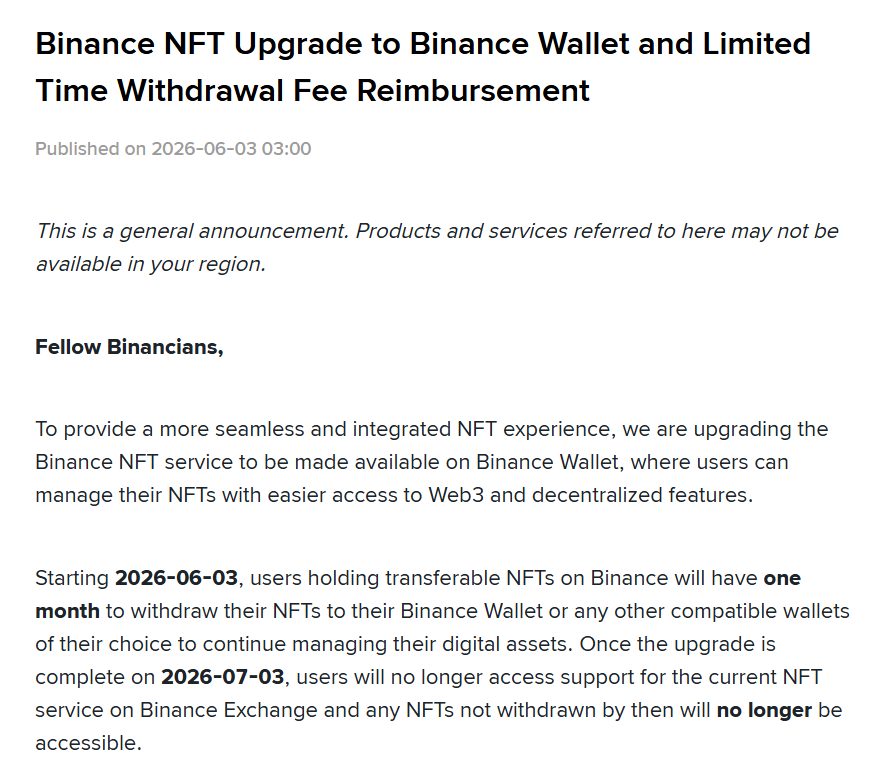
Users currently storing digital collectibles on the Binance Exchange face a strict operational deadline. All transferable NFTs must be withdrawn to external self-custody solutions—such as the Binance Wallet or other compatible Web3 applications—by July 3. Assets left on the exchange after this cutoff date will become permanently inaccessible. For non-transferable, utility-based assets built natively into the platform’s architecture that cannot be exported by design, Binance has introduced a novel alternative: Binance Academy will issue official PDF certificates of course completion to honor the provenance of these credentials.
To ease friction during this migration period, Binance has rolled out a targeted reimbursement scheme covering withdrawal gas fees for up to 100,000 eligible users. Yet, beneath the operational details of migration lies a starker industry reality. Binance’s exit from the exchange-level NFT business mirrors similar retreats across the digital asset landscape. Competitor platforms, including Kraken and OpenSea, have similarly pruned or shuttered their native NFT offerings as transaction volumes have dried up.
This comprehensive report examines the structural mechanics of Binance’s NFT wind-down, analyzes the macroeconomic and market forces driving the contraction of the broader NFT sector, reviews critical valuation metrics of leading blue-chip collections, and explores what this pivotal transition means for the future of digital art, tokenization, and Web3 infrastructure.
Detailed Chronology of the Wind-Down and Migration Mechanics
The phasing out of Binance’s NFT marketplace did not occur in a vacuum; it represents the culmination of a multi-year recalibration of the exchange’s product suite. Since peaking during the euphoric bull run of 2021, centralized exchanges have found maintaining dedicated, high-maintenance NFT infrastructure increasingly difficult against a backdrop of dwindling user engagement and regulatory scrutiny.
Key Operational Dates and Deadlines
- Wednesday Announcement: Binance publicly outlines its roadmap to sunset exchange-level NFT capabilities, directing users toward self-custodial solutions.
- Immediate Transition Window: Active trading, listing, and marketplace functionalities are restricted or slated for permanent removal as the platform begins its infrastructure migration.
- July 3 Hard Deadline: The absolute final cutoff for users to withdraw all transferable NFTs from their Binance Exchange accounts. Assets remaining on the platform past this milestone will face permanent inaccessibility.
- July 3 Spot Crediting: The date by which Binance will disburse 1 USDC fee reimbursements to the spot accounts of up to 100,000 eligible users who successfully execute NFT withdrawals.
Handling Transferable vs. Non-Transferable Assets
The logistical challenge of sunsetting a major exchange’s NFT division involves untangling thousands of distinct smart contracts, token standards, and proprietary assets. Binance has bifurcated its user asset management strategy into two distinct categories:
- Transferable NFTs: This category encompasses standard ERC-721, ERC-1155, and BNB Smart Chain-native digital collectibles. Holders of these assets must proactively connect a Web3 wallet—preferably the Binance Wallet—and initiate a manual withdrawal. To incentivize compliance and offset user friction, Binance has instituted a one-month fee reimbursement program. Up to 100,000 selected users will receive a 1 USDC credit directly into their spot accounts to cover the blockchain gas fees associated with moving their collectibles. The program is split into two pools: one addressing general NFT withdrawals and a specialized pool dedicated to CR7 (Cristiano Ronaldo) branded NFT collections.
- Non-Transferable NFTs: Certain platform-specific achievements, soulbound tokens, or educational completion badges are hard-coded into the exchange’s internal database and cannot technically be transferred across blockchain networks. Recognizing the sentimental or educational value of these items, Binance has arranged for its educational arm, Binance Academy, to issue verifiable PDF certificates of course completion to affected users, preserving a record of their milestones even as the on-chain metadata structures are retired.
Industry Context: The Retreat of Centralized NFT Marketplaces
Binance’s decision to offload NFT management to a decentralized wallet is not an isolated corporate strategy; it is part of a sweeping industry trend. For several years, major centralized exchanges attempted to diversify their revenue streams by launching native NFT marketplaces, hoping to capture the explosive retail interest that characterized the 2021–2022 digital art boom. However, as macroeconomic conditions tightened and retail speculation migrated back to spot trading, memecoins, and decentralized finance (DeFi) protocols, maintaining these resource-intensive marketplaces became economically unviable.
A Pattern of Industry Capitulation
The contraction of centralized NFT infrastructure has accelerated over the past year and a half:
- OpenSea and BNB Smart Chain: In August 2023, pioneering NFT marketplace OpenSea announced it was officially disabling support for BNB Smart Chain-native NFTs, citing low trading volumes and a strategic realignment toward Ethereum-centric layers and alternative high-performance networks.
- Kraken NFT Marketplace Closure: Continuing the contraction into early 2025, prominent United States-based cryptocurrency exchange Kraken officially shuttered its dedicated NFT marketplace. Kraken advised its users to withdraw their assets, similarly citing shifting strategic priorities and a pivot toward tokenized real-world assets (RWAs) and core exchange operations.
- Binance’s Pivot to Web3 and Real-World Assets: By moving NFT management exclusively to the Binance Wallet, Binance is effectively washing its hands of the legal, custodial, and operational overhead associated with running a centralized marketplace. Instead, the company is redirecting engineering and capital resources toward higher-growth sectors, such as decentralized application (dApp) aggregation, multi-chain bridging, and institutional-grade tokenized assets.
This structural migration underscores a fundamental truth of the current market cycle: centralized exchanges are increasingly abandoning consumer-facing digital collectible speculation in favor of infrastructure plays that empower user self-custody while shielding the corporate entity from direct marketplace liability.
Supporting Context and Metrics: The Deep Bear Market in Digital Collectibles
To fully understand why platforms like Binance, Kraken, and OpenSea are stepping back from NFTs, one must examine the devastating valuation crash that has plagued the digital collectibles sector since its historic peaks in mid-2022. The narrative of "digital art as an inflation hedge" has given way to a stark liquidity drought, with trading volumes across major marketplaces reduced to a fraction of their former glory.
The Collapse of Blue-Chip Valuations
Market data compiled by aggregators such as NFTPriceFloor reveals the depth of the downturn across the industry’s most prestigious collections:
- CryptoPunks: As the undisputed grandfather of modern profile picture (PFP) NFTs and the largest collection by market capitalization, CryptoPunks once commanded astronomical prices. Currently, the floor price of a CryptoPunk hovers around 30.9 Ether (ETH). This represents a staggering 61% decline from its all-time high of 80.9 ETH recorded in July 2022.
- Bored Ape Yacht Club (BAYC): Once the ultimate status symbol of the crypto-wealthy elite, Yuga Labs’ flagship collection has suffered an even more catastrophic drawdown. The floor price for a Bored Ape has plummeted to approximately 7.9 ETH—a punishing 93% collapse from its historic high of 128 ETH achieved in May 2022.
+---------------------------+-------------------+-------------------+-------------------+
| NFT Collection            | All-Time High     | Current Floor     | Percentage Drop   |
+---------------------------+-------------------+-------------------+-------------------+
| Bored Ape Yacht Club      | 128 ETH (May '22) | 7.9 ETH           | -93%              |
| CryptoPunks               | 80.9 ETH (Jul '22)| 30.9 ETH          | -61%              |
+---------------------------+-------------------+-------------------+-------------------+
These dramatic reductions in floor prices reflect not only a loss of speculative fervor but also a structural flight of capital from high-risk digital art assets toward yield-generating DeFi instruments, layer-2 infrastructure tokens, and macroeconomic safe havens like stablecoins and Bitcoin. Without a reliable influx of fresh retail liquidity, maintaining centralized trading books for thousands of illiquid NFT collections became an unjustifiable overhead expense for exchanges operating in highly competitive regulatory environments.
Official Statements and Strategic Vision
In its official communication, Binance framed the discontinuation of exchange-level NFT support not as a retreat from the digital asset space, but as a maturation of its product architecture.
"Binance is shutting down support for non-fungible tokens on Binance Exchange and moving NFT management to its self-custodial cryptocurrency wallet, Binance Wallet. This transition will offer NFT holders easier access to Web3 and decentralized features," the company stated in its Wednesday release.
By transitioning from a centralized custodial model to a self-custodial Web3 framework, Binance aligns itself with the core ethos of cryptocurrency: user sovereignty and decentralization. In a custodial exchange environment, the platform holds the private keys on behalf of the user, exposing the company to regulatory liabilities regarding copyright infringement, wash trading, and asset custody disputes. By pushing NFTs into the Binance Wallet, users retain total control over their private keys, while Binance distances itself from the transactional mechanics of a secondary NFT marketplace.
Furthermore, industry analysts note that this move allows Binance to streamline its compliance reporting. Navigating anti-money laundering (AML) and know-your-customer (KYC) mandates for millions of heterogenous, highly illiquid digital art pieces presents a disproportionate administrative burden compared to standardized ERC-20 tokens and major cryptocurrencies.
Future Outlook: The Evolution of Web3, Tokenization, and Digital Ownership
As the dust settles on Binance’s marketplace closure and the broader contraction of the NFT sector, industry participants are forced to ask: What comes next for digital collectibles, and where is the frontier of blockchain-based ownership heading?
1. The Rise of Real-World Asset (RWA) Tokenization
While speculative digital art and profile picture projects have experienced a protracted winter, institutional interest in blockchain-based tokenization has never been higher. Major financial institutions, asset managers, and fintech giants are rapidly migrating capital into tokenized real-world assets—including U.S. Treasury bills, real estate equity, private credit funds, and commodity inventories. For exchanges like Binance and Kraken, pivoting engineering resources away from consumer NFT art and toward compliant, yield-bearing RWA infrastructure represents a pragmatic reallocation of capital toward sectors with sustainable, long-term institutional demand.
2. The Shift to Pure Self-Custody and Decentralized Protocols
The migration of Binance’s user base to the Binance Wallet accelerates a broader structural shift away from centralized walled gardens toward open Web3 infrastructure. True digital ownership was never meant to be mediated by centralized exchange order books; it was designed to live immutably on-chain, accessible via decentralized applications (dApps), marketplaces like Blur and Magic Eden, and user-controlled browser extensions. By forcing users to migrate their assets into self-custodial wallets, Binance is inadvertently educating its vast retail user base on the fundamentals of Web3 security, key management, and decentralized finance interaction.
3. Reimagining NFT Utility Beyond Speculation
The collapse of blue-chip floor prices may ultimately serve as a healthy cleansing mechanism for the NFT industry. Stripped of the hyper-speculative frenzy that characterized 2021, builders, creators, and developers are refocusing on the fundamental utility of non-fungible tokens. Future iterations of NFT technology are increasingly likely to manifest as:
- Verifiable Digital Identity and Credentials: Decentralized credentials, academic diplomas (such as those provided via Binance Academy’s PDF certificate initiative), and professional licenses.
- Gaming and Metaverse Interoperability: In-game assets, virtual land deeds, and cross-platform character skins owned outright by players rather than game publishers.
- Intellectual Property Rights and Fractional Ownership: Programmable royalties, musical streaming rights, and legal fractionalization of physical fine art.
Conclusion
Binance’s decision to deprecate exchange-level NFT support and migrate all digital collectible management to the Binance Wallet marks the end of an era for centralized crypto exchanges acting as retail art galleries. With a strict withdrawal deadline of July 3, users must act decisively to secure their transferable assets or risk permanent loss, while non-transferable milestones find a practical archival home through Binance Academy certificates.
As platforms like Binance, Kraken, and OpenSea recalibrate their operations in response to prolonged bear market conditions and shifting regulatory realities, the digital asset ecosystem is maturing. The speculative excess of the 2021–2022 NFT boom has given way to a sober, infrastructure-focused paradigm. By shedding the operational weight of centralized NFT marketplaces, industry leaders are clearing the path for a more resilient future anchored by true self-custody, decentralized Web3 applications, and institutional-grade real-world asset tokenization.