rifanmuazin is a reporter for DeBitcoin covering Decentralized Finance (DeFi). She/He is based in Indonesia.
8 August 2026 • 9 min read
The decentralized finance (DeFi) landscape is undergoing a structural bloodletting that is defying historical market conventions. When the veteran DeFi dashboard Zapper announced its decision to sunset operations this month after nearly seven years of service, it marked a solemn milestone. Zapper did not fall to the catastrophic contagion of the Terra-Luna collapse, nor was it hollowed out by the FTX implosion or the regulatory crossfire of Chokepoint 2.0. Instead, its closure—alongside a growing casualty list that includes Bitcoin DeFi platform Botanix, Solana portfolio tracker Step Finance, analytics provider Parsec, and DEX aggregator Odos Protocol—signals something far more systemic.
Executive Overview
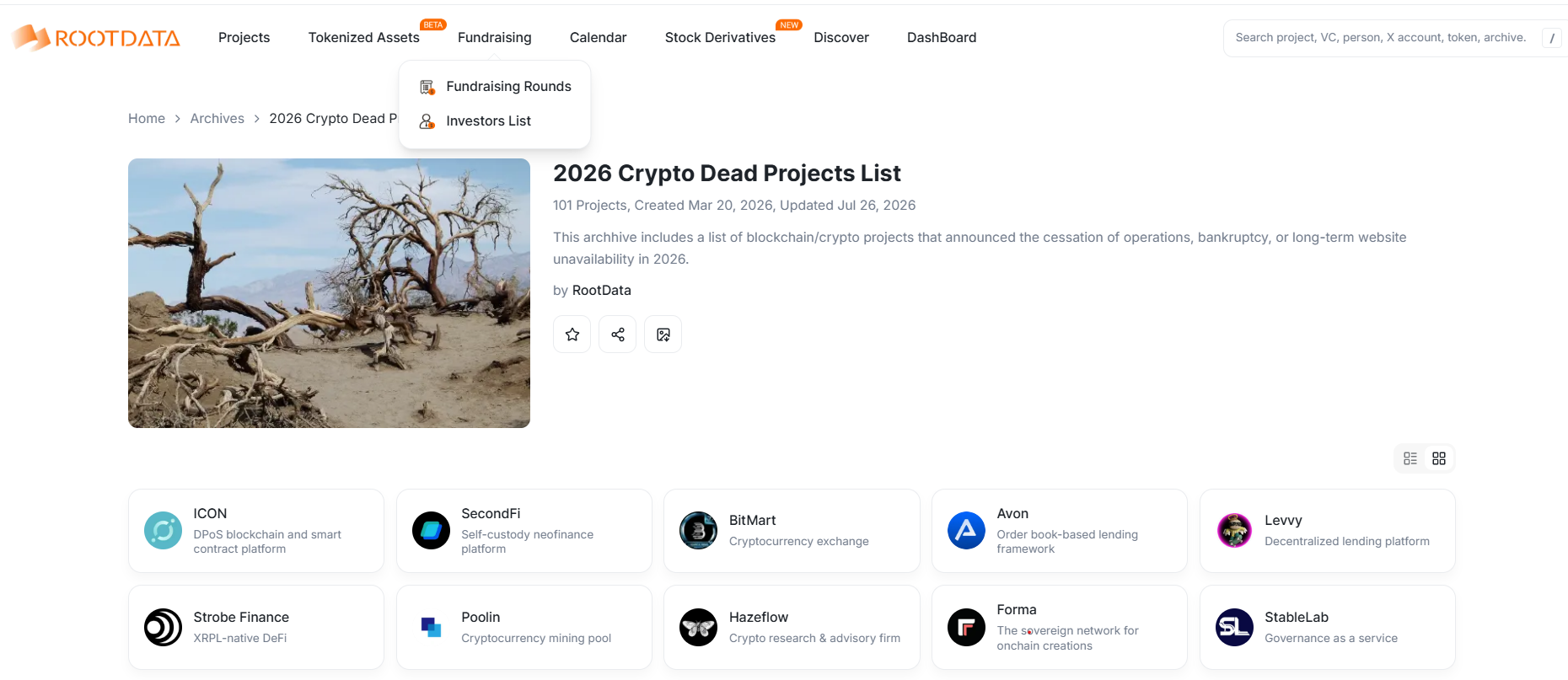
According to data compiled by RootData, the broader cryptocurrency ecosystem has witnessed the quiet demise of 101 "dead" projects by mid-summer 2026. Strikingly, decentralized finance accounts for more than half of these corporate casualties.
This wave of liquidations has forced an uncomfortable question across boardrooms and developer discords alike: Is this simply a lagging casualty of prolonged bear market blues, or does it represent an aggressive, irreversible maturation of the digital asset economy? Industry veterans, quantitative researchers, and protocol founders agree on one fundamental truth—the rules of engagement have fundamentally changed. Capital has not abandoned the onchain economy; rather, it has grown discerning, abandoning legacy infrastructure in favor of hyper-efficient adjacent applications, institutionalized yield products, and deeply embedded distribution channels.
Detailed Chronology: A Wave of Historic Wind-Downs
The cadence of project closures throughout 2026 reveals a stark departure from previous crypto winters. In past downturns, protocols typically faded into obscurity due to sudden exploits, macroeconomic shocks, or sudden liquidity drains. The current wave, however, is characterized by deliberate, orderly wind-downs executed by teams that successfully navigated the turbulent waters of 2022 and 2023.
The 2026 Casualty List
Zapper: After nearly seven years as a foundational portfolio management and analytics dashboard backed by industry heavyweights like Mark Cuban, Zapper announced its closure, citing a shifting operational landscape that rendered its legacy business model unsustainable.
Botanix: Promoted as a high-profile Bitcoin scaling and DeFi platform, Botanix officially pulled the plug after admitting that its core architecture failed to capture expected market demand. Founders pointed to a harsh reality: onchain activity was consolidating with ruthless efficiency around centralized giants and hyper-liquid derivatives platforms like Hyperliquid.
Step Finance & Parsec: Solana’s premier portfolio tracker and DeFi’s go-to analytics suite, respectively, both bowed to persistent market volatility and shrinking margins, proving that even indispensable data layers are vulnerable when user fees compress.
Odos Protocol: The prominent decentralized exchange (DEX) aggregator wound down its operations after four years of service, underlining the brutal margin compression facing routing and aggregation protocols in an increasingly fragmented multi-chain environment.
These closures illustrate that survival through multiple market cycles is no longer an inoculation against obsolescence. When founders pull the plug on platforms that survived the darkest days of past bear markets, it highlights a profound structural evolution in how users interact with decentralized applications.
Supporting Context & Metrics: Where Did the Liquidity Go?
To understand the current culling, one must dismantle the persistent narrative that capital is fleeing the ecosystem. Surface-level metrics can easily deceive, prompting many to assume that total user engagement is drying up. However, granular onchain data tells a drastically different story.
The Myth of Increasing DeFi Concentration
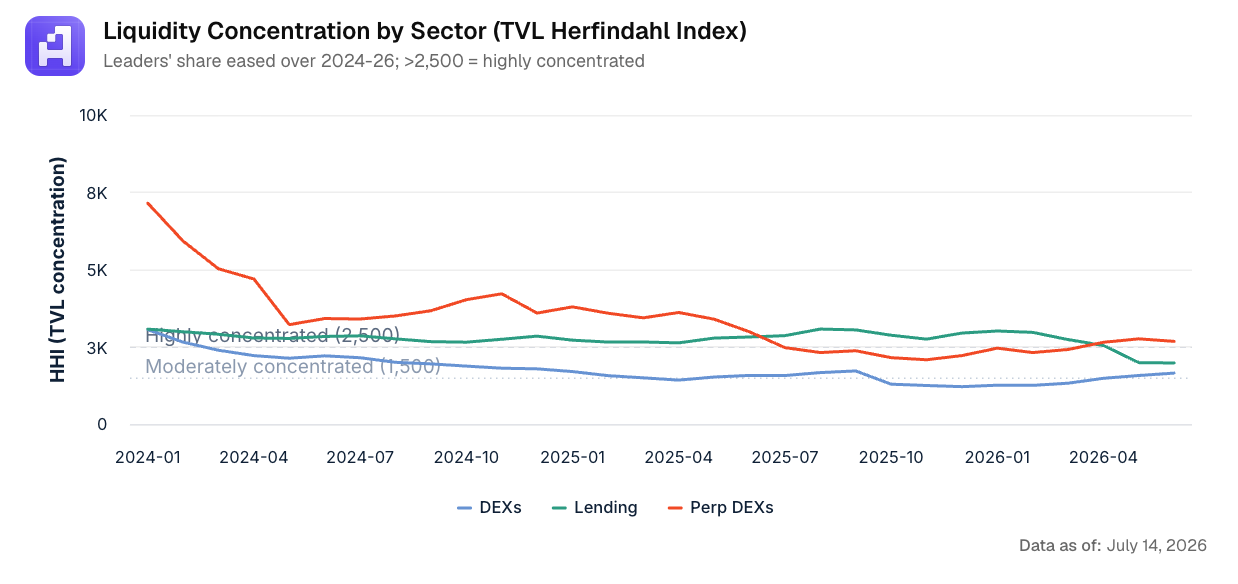
Conventional wisdom has long held that DeFi is experiencing a relentless march toward monopolization—a process where capital concentrates exclusively in "Lindy-effect" heavyweights like Uniswap, Aave, and Jupiter. Alex Weseley, a researcher at Artemis Research, challenges this narrative directly, pointing to empirical data showing that liquidity concentration across tracked DeFi protocols has actually drifted lower since 2024.
"The prevailing narrative has been that concentration is increasing in DeFi, caused by a series of exploits and capital rotation into the most ‘Lindy’ protocols," Weseley explains. "But the data disagrees."
While dominant sector leaders still hold the lion’s share of Total Value Locked (TVL), Weseley notes that every single one of those market leaders commands a smaller percentage of its respective sector today than it did two years ago. More protocols are competing for a slice of the pie, but the pie itself is slicing into smaller and smaller fractions.
Revenue vs. TVL: The True Health Indicator
For years, Total Value Locked (TVL) served as the undisputed North Star for assessing DeFi health. Industry analysts now argue that TVL is an increasingly misleading metric, often inflated by mercenary capital and recursive token incentives.
+-------------------------------------------------------------------------+
|                  THE SHIFT IN ONCHAIN METRICS (2025-2026)               |
+-------------------------------------------------------------------------+
|  Metric Focus        |  Past Eras (2020-2023)  |  Current Era (2026)    |
+----------------------+-------------------------+------------------------+
|  Primary Benchmark   |  Total Value Locked     |  Fees & Real Revenue   |
|  Capital Behavior    |  Chased Yield/Incentives|  Demands Sustainable   |
|                      |                         |  Track Records         |
|  Competitive Field   |  Few Pioneers           |  Thousands of Rivals   |
+-------------------------------------------------------------------------+
Weseley emphasizes that fees and revenue generation are far superior indicators because they measure economic viability directly. Artemis data reveals a striking trend: the number of DeFi applications generating at least $1 million in monthly fees climbed to a peak of roughly 33 to 34 protocols in late 2025, before dropping back to 25 or 26 during the first half of 2026. More dramatically, the elite tier of protocols generating more than $10 million in monthly fees has roughly halved over the same timeframe.
Capital Rotation, Not Capital Flight
If traditional DeFi application revenue is contracting while overall onchain fee generation remains robust, where is the money going?
The answer lies in capital rotation. Liquidity has not left the blockchain; it has simply migrated to adjacent, high-velocity sectors. Platforms like perpetual exchange Hyperliquid, prediction market Polymarket, and memecoin launchpad pump.fun have absorbed billions in user attention and economic activity. Classic DeFi viability has shrunk not because blockchain adoption is stalling, but because user appetites have shifted toward speculative velocity and novel financial primitives.
Official Statements and Industry Insights
To gain a clearer picture of this macroeconomic pivot, leading venture capitalists, infrastructure builders, and risk managers have shared their perspectives on the 2026 market structure.
Nicholas Cannon, Chief Business Officer at Gauntlet
Despite the sobering number of project closures, risk management firm Gauntlet maintains an optimistic outlook on the foundational health of the digital asset economy.
"Demand is the strongest it has ever been," notes Nicholas Cannon. "Stablecoin supply keeps growing, and traditional finance is moving toward DeFi rather than away from it."
According to Cannon, the defining psychological shift since the last market slump is that capital has matured. In previous cycles, liquidity blindly followed short-term token incentives and speculative yield-farming gimmicks. Today, capital is discerning.
"What changed is that capital got discerning. In previous cycles, liquidity followed incentives wherever they pointed. Today it follows sustainable yield, track record, and curation. Incentives still have a role in bootstrapping, but they no longer carry a protocol on their own."
Markus Levin, Co-founder of XYO
Echoing this sentiment, Markus Levin, co-founder of blockchain infrastructure firm XYO, highlights the hyper-competitive nature of the current landscape compared to the pioneering days of early DeFi.
"The DeFi space is much more competitive than it was during the last bear cycle," Levin explains. "Early DeFi projects benefited from first-mover advantage and a relatively small field of competitors. Now, there are thousands of protocols competing for the same users and liquidity."
Levin warns that institutional capital in 2026 is uncompromisingly selective, overwhelmingly favoring platforms with bulletproof track records over experimental protocols attempting to buy users with inflationary token emissions.
"The projects that survive this cycle are likely to be the ones that already have meaningful user distribution or can reach users beyond the traditional DeFi audience."
The Rules of Attraction Have Permanently Changed
The death of legacy applications is paving the way for a radical restructuring of how financial products are built and deployed onchain. The era of launching an uninspired fork of Uniswap or Compound, throwing a native governance token at users, and hoping for organic retention is definitively over.
Infrastructure Consolidation and Higher-Layer Innovation
As basic financial primitives become commoditized, fewer engineering teams are attempting to build foundational base-layer money markets from scratch. Instead, developers are leveraging established infrastructure like Morpho, Aave, and Uniswap as modular building blocks for specialized applications.
This architectural shift is clearly reflected in venture capital deployment. In June, DeFi lender Morpho secured a massive $175 million capital raise to scale its open credit network for institutional participants. Simultaneously, agentic DeFi startup Alpaca closed a $135 million funding round in July to build advanced infrastructure tailored for autonomous, AI-driven financial agents.
The Power of Native Distribution
Merlin Egalite, co-founder of Morpho Labs, argues that the next generation of breakout protocols will abandon the obsolete strategy of competing directly with foundational infrastructure. Success, he asserts, is entirely dependent on distribution.
"The protocols growing fastest will be the ones embedded into the platforms where users already are," Egalite stresses. "Fintechs, wallets, and exchanges building on top of you rather than competing with you."
Furthermore, Egalite points out that institutional integration is shifting toward seamless embedding rather than standalone adoption. The future belongs to traditional financial institutions, neobanks, and consumer fintech platforms that want to absorb DeFi’s unmatched back-end liquidity without the friction of rebuilding the underlying plumbing themselves.
Future Outlook: Navigating the Post-2026 Landscape
As the digital asset industry presses forward past the halfway mark of 2026, the ongoing culling of decentralized finance projects should be viewed not as a symptom of systemic decay, but as a painful yet necessary rite of passage.
The web3 ecosystem is shedding its excess baggage—unsustainable business models, copy-paste protocols relying entirely on token emissions, and user interfaces that fail to provide genuine utility. In their place, a hardened, institutional-grade architecture is taking root. Tokenized real-world assets (RWAs), expansive stablecoin liquidity pools, and emerging frontiers like agentic, AI-managed finance are rapidly defining the new parameters of digital wealth generation.
For the projects that manage to weather this current realignment, the reward is an economy characterized by genuine demand, sustainable revenue generation, and deep integration with traditional global finance. However, for builders banking on the old playbooks of easy venture capital and mercenary liquidity, the message from the 2026 market is unambiguous: adapt to the rigorous demands of real-world utility, or prepare to join the growing archive of dead protocols.