

Executive Overview
According to an official announcement released on Wednesday, the decision is designed to offer NFT holders "easier access to Web3 and decentralized features." However, the move is symptomatic of a broader macroeconomic and sector-wide recalibration among centralized exchanges, which are increasingly divesting from high-maintenance digital art and collectible marketplaces to refocus on core trading, liquidity products, and emerging frontiers like real-world asset (RWA) tokenization.
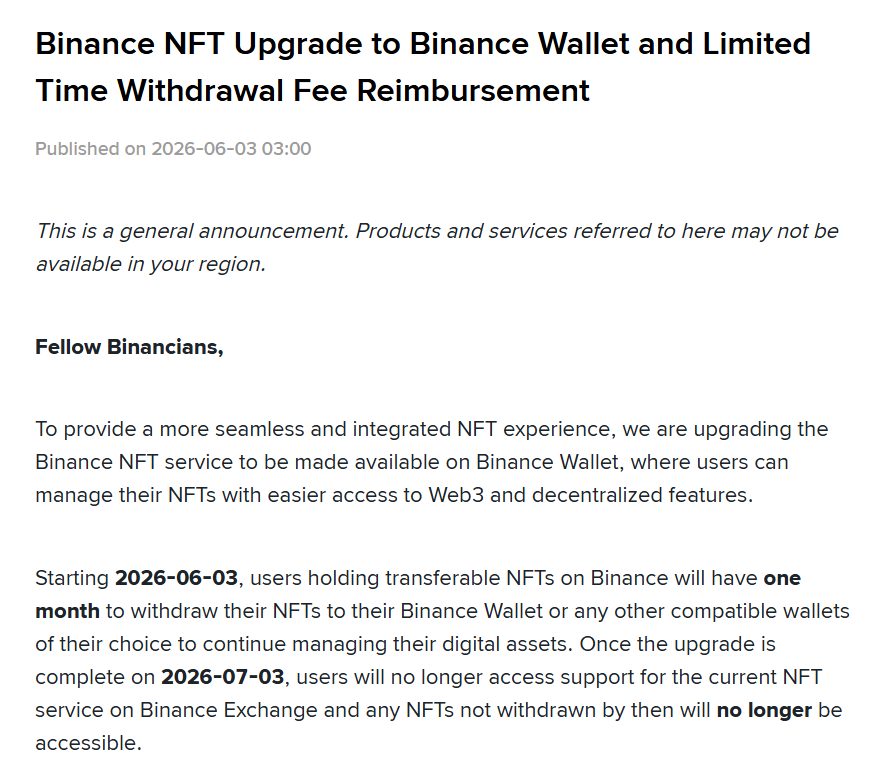
The transition carries strict operational deadlines for users. NFT holders have been given a firm ultimatum: they must withdraw their transferable NFTs from the platform by July 3, or risk losing access permanently. Meanwhile, non-transferable digital assets—such as platform-native credentials built directly into network architecture—will be handled via alternative archival methods, with Binance Academy stepping in to issue downloadable PDF certificates of course completion.
To ease the friction of migration, Binance has rolled out a targeted fee-reimbursement campaign, offering up to 100,000 users financial incentives to cover withdrawal costs. Yet, even as Binance smooths the exit ramp for digital collectibles, the timing of the shutdown reflects a sobering reality: the once-booming NFT market remains a shadow of its 2021 and 2022 heyday, plagued by depressed floor prices, waning retail enthusiasm, and a strategic retreat by major industry players.
Detailed Chronology: The Phase-Out and Migration Mechanics
The deprecation of Binance’s exchange-integrated NFT marketplace marks the end of an era for one of the industry’s most widely utilized centralized gateways for digital art. The phased withdrawal plan has been meticulously structured to give users adequate time to secure their assets, though the strict July 3 cutoff leaves little room for procrastination.
Key Deadlines and User Actions
- Transferable NFTs: Users maintaining collections on the Binance Exchange must execute withdrawals to self-custodial wallets (specifically the Binance Wallet or other compatible Web3 wallets) no later than July 3. Assets remaining on the exchange past this timestamp will become permanently inaccessible.
- Non-Transferable Assets: Certain ecosystem-specific tokens and utility items designed to be non-transferable by code will not be movable. For educational credentials and completion tokens, Binance Academy has arranged a contingency: users can secure verified proof of their milestones via downloadable PDF course-completion certificates.
- Fee Reimbursement Promotions: To mitigate user friction during the migration phase, Binance has instituted a one-month withdrawal fee reimbursement program. The initiative is split into two distinct categories:
- General NFT Withdrawals: Reimbursements covering standard network gas and transfer fees for non-CR7 collections.
- CR7 Collections: Specialized withdrawal reimbursements tailored for holders of Cristiano Ronaldo-branded promotional NFTs.
Under the mechanics of the reimbursement scheme, Binance will select up to 100,000 eligible participants. Each chosen user will receive 1 USDC credited directly to their Binance spot accounts by July 3, effectively neutralizing the immediate financial penalty of moving assets off the centralized order books and into self-custodial environments.
Supporting Context & Metrics: The Anatomy of a Cooling Market
Binance’s retreat from the NFT sector does not happen in a vacuum. It is the latest high-profile capitulation in a prolonged sector-wide contraction that has crippled digital collectible valuations and forced centralized platforms to reallocate engineering and compliance resources toward more lucrative segments of the crypto economy.
A Domino Effect Across Centralized Platforms
The erosion of exchange-hosted NFT infrastructure has been unfolding progressively over the past two years:
- August 2023: Leading multi-chain marketplace OpenSea officially disabled support for BNB Smart Chain-native NFTs, signaling early friction between high-volume platforms and specific ecosystem standards.
- February 2025: Rival crypto exchange Kraken officially shuttered its dedicated NFT marketplace, directing users to liquidate or withdraw their holdings as the firm streamlined its product offerings.
- Present Day: Binance’s complete phasing out of exchange-level NFT management solidifies a bleak consensus among centralized players—maintaining dedicated, high-overhead NFT infrastructure is no longer commercially viable.
Plummeting Valuations: The Blue-Chip Collapse
The structural retreat by exchanges is directly correlated with the catastrophic erosion of floor prices across the industry’s premier collections. According to aggregate data from NFTPriceFloor, the blue-chip sector has failed to mount a meaningful recovery toward the all-time highs established during the speculative frenzy of mid-2022.
- CryptoPunks: As the undisputed gold standard of digital collectibility and historical market capitalization, CryptoPunks currently trade at a floor price of approximately 30.9 ETH. This represents a staggering 61% depreciation from its historic peak of 80.9 ETH recorded in July 2022.
- Bored Ape Yacht Club (BAYC): Once the premier status symbol of the Web3 boom, Yuga Labs’ flagship collection has suffered an even steeper decline. BAYC floor prices hover near 7.9 ETH—a crushing 93% collapse from its all-time high of 128 ETH achieved in May 2022.
This severe contraction in liquidity and speculative capital has starved secondary marketplaces of trading fee revenue, transforming what was once a hyper-lucrative vertical into a capital drain for centralized exchanges bound by stringent regulatory and operational overheads.
Official Statements and Strategic Vision
In its official Wednesday communication, Binance framed the deprecation of exchange-based NFTs not as a retreat from digital ownership, but as a structural evolution toward true decentralization.
"This transition will offer NFT holders easier access to Web3 and decentralized features," the exchange noted, emphasizing the alignment of its product roadmap with the ethos of self-custody.
By steering users toward the Binance Wallet—a self-custodial interface—the exchange is effectively insulating itself from the regulatory liabilities associated with hosting secondary marketplaces for speculative digital assets, while still retaining users within its proprietary ecosystem software.
Industry analysts point out that this maneuver reflects a broader maturation phase for centralized exchanges. Rather than acting as universal department stores for every experimental token standard, Tier-1 platforms are aggressively doubling down on high-yield, high-utility sectors. These include derivatives trading, institutional custody, layer-2 scalability solutions, and the rapidly growing frontier of tokenized real-world assets (RWAs)—such as U.S. Treasury bills, private equity, and real estate—which command institutional-grade interest and sustainable yield profiles.
Future Outlook: The Evolution of Digital Ownership
As the dust settles on the centralized exchange NFT era, the broader landscape of digital assets is undergoing a profound mutation. The closure of Binance’s exchange marketplace and Kraken’s earlier shutdown do not spell the death of NFTs; rather, they mark the end of the speculative "wild west" era driven by profile picture (PFP) mania and celebrity endorsements.
The Shift Toward Utility and Infrastructure
The future of NFTs is increasingly tethered to functional utility rather than speculative art appreciation. Developers and enterprises are deploying non-fungible tokens as foundational layers for:
- Decentralized Identity (DID): Verifiable credentials, academic records, and professional certifications.
- Gaming and Virtual Real Estate: In-game assets fully owned and traded by players across composable virtual worlds.
- Real-World Asset Tokenization: Representing legal ownership of physical commodities, intellectual property, and financial instruments on public ledgers.
Furthermore, the migration of retail users from centralized marketplaces to self-custodial wallets—spurred in part by Binance’s forced deprecation timeline—may ultimately strengthen the decentralized foundations of the Web3 ecosystem. By compelling users to take direct custody of their private keys and interact with decentralized applications (dApps) directly, platforms are inadvertently fostering a more resilient, self-reliant user base.
What Lies Ahead for Binance Users
For the millions of traders utilizing Binance, the immediate mandate is clear: audit portfolios, verify asset locations, and execute necessary withdrawals ahead of the July 3 deadline. Those who successfully transition their assets to the Binance Wallet will retain full sovereignty over their digital artifacts, positioning themselves to interact with emerging decentralized marketplaces and specialized peer-peer protocols.
Ultimately, Binance’s departure from exchange-hosted NFTs serves as a definitive bellwether for the crypto industry. The era of casual, centralized digital art speculation has given way to an era of pragmatic utility, strict operational efficiency, and a renewed emphasis on the core tenets of self-custody and decentralized finance.