
Executive Overview
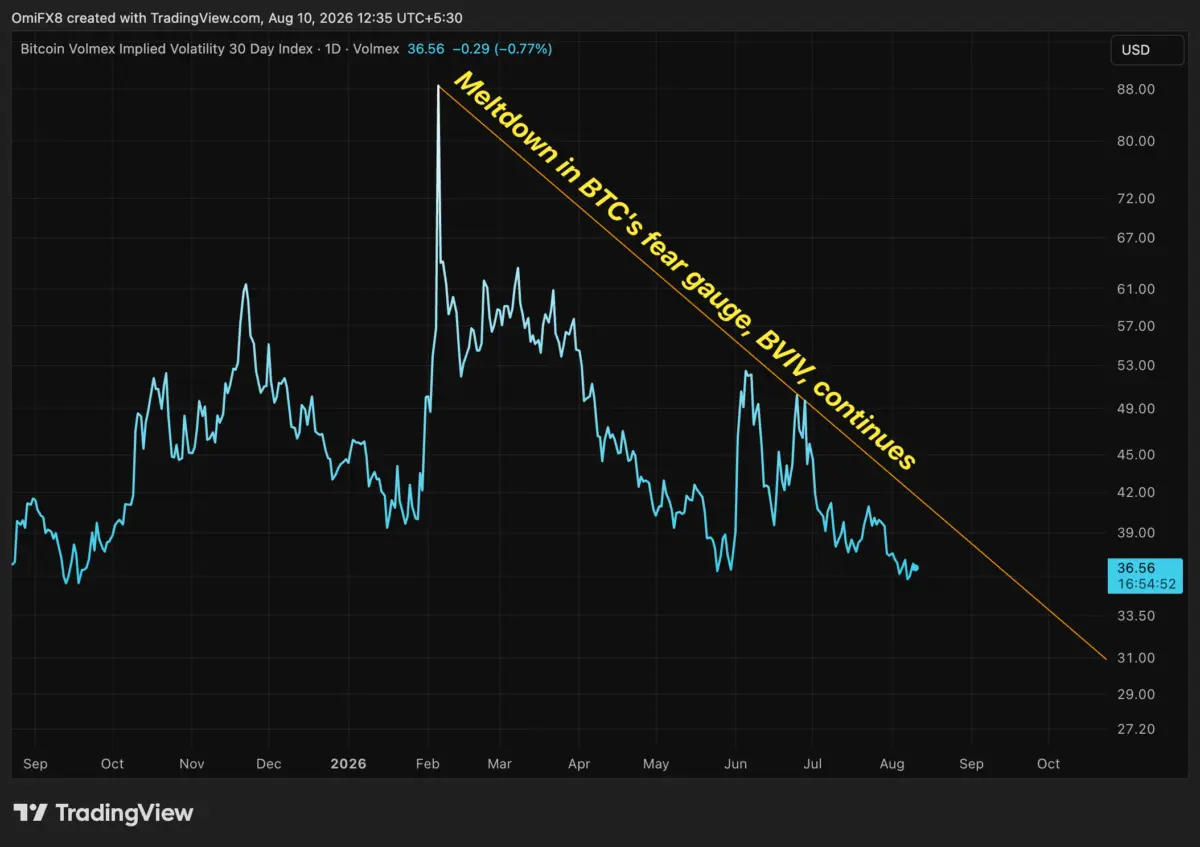
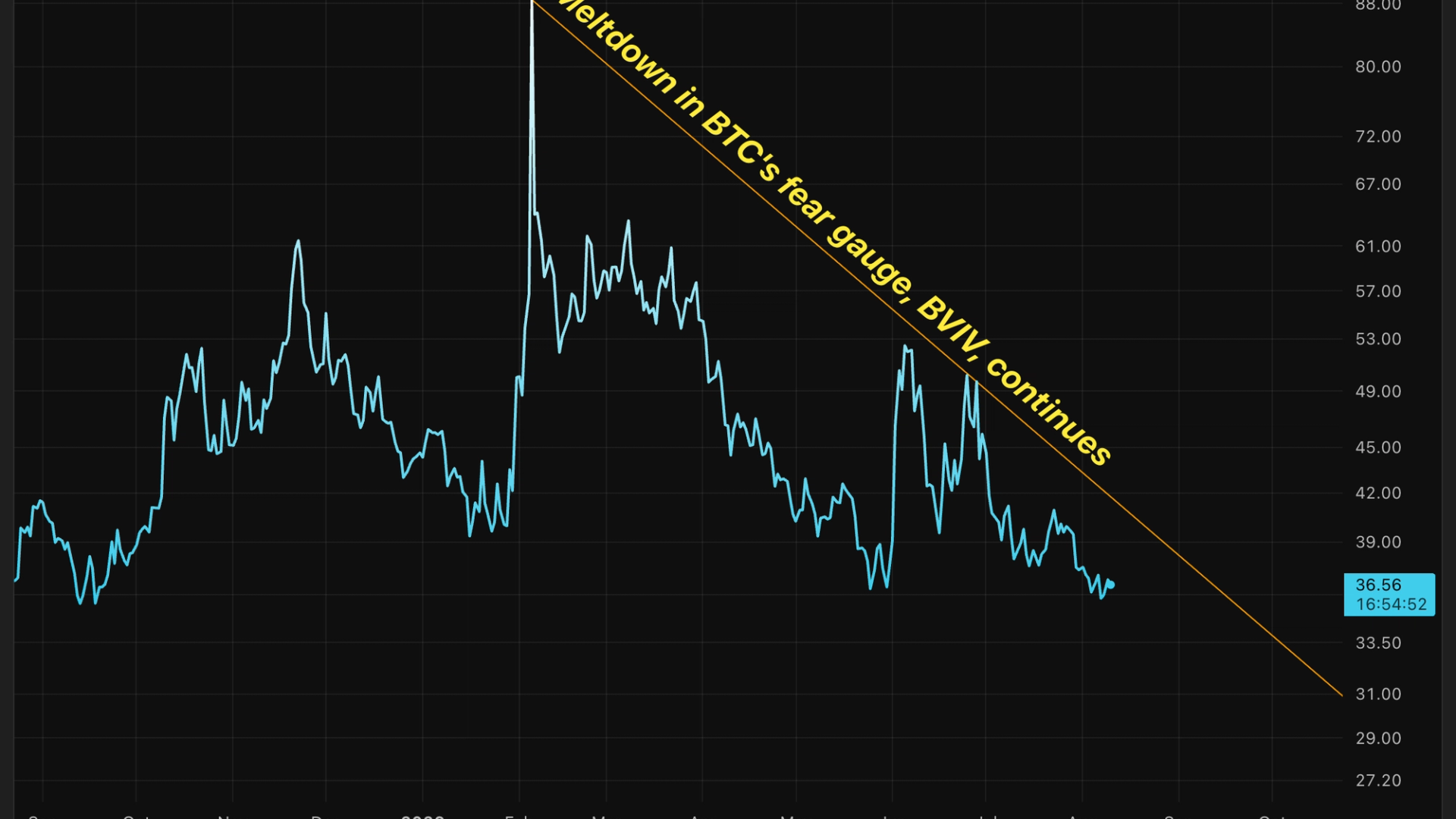
To traditional financial market observers, the BVIV functions as the crypto-native equivalent of the Cboe Volatility Index (VIX), universally recognized as Wall Street’s premier "fear gauge." The precipitous drop in this metric—down drastically from a frantic peak above 90% in early February when Bitcoin suffered a violent correction from $90,000 down to nearly $60,000—suggests that speculative fervor has completely evaporated.
However, a deeper dive into the architecture of the crypto options market reveals a more nuanced, complex reality. While headline volatility metrics flash green for tranquility, institutional behavior tells a different story. A structural supply-demand imbalance, driven heavily by systematic yield-generating programs, has artificially suppressed absolute volatility. Meanwhile, "put skew" remains stubbornly elevated. Professional market participants are still paying a steep premium for downside protection, indicating that beneath the placid surface, institutional investors harbor lingering anxieties about a potential deepening of the bear market.
Furthermore, market experts warn that this prolonged low-volatility environment may be breeding a false sense of security. As cheap leverage becomes accessible once again, over-leveraged traders risk repeating historical cycles of complacency, leaving the ecosystem highly vulnerable to sudden liquidity shocks and cascading liquidations.
Detailed Chronology: From February Panic to Summer Range-Bound Stagnation
To fully grasp the magnitude of the current volatility collapse, one must examine the dramatic trajectory of Bitcoin’s market structure over the first half of the year.
The Early-Year Turbulence (February 2025)
The year began with extreme structural turbulence. In February, Bitcoin suffered a violent sell-off that rattled confidence across both retail and institutional cohorts, crashing from lofty heights near $90,000 down toward the $60,000 threshold. This rapid drawdown triggered a massive wave of defensive positioning. Traders and leveraged funds scrambled frantically to acquire options contracts to hedge their portfolios, pushing Volmex’s BVIV index well past the 90% mark. During this period, implied volatility—reflecting the market’s expectation of future price swings—surged in tandem with realized volatility as panic-driven liquidations cascaded through centralized and decentralized exchanges alike.
The Summer Consolidation (July–August 2025)
By early July, the frantic sell-offs had burned themselves out, giving way to an extended phase of consolidation. Bitcoin’s spot price successfully carved out a narrow, resilient trading channel between $62,000 and $66,000. This stubborn price stability drained the life out of directional optionality. With the asset locked in a tight corridor, speculative traders lost interest in placing aggressive directional bets on short-term breakouts or breakdowns.
As spot trading volumes cooled off—exacerbated by the typical midyear vacation lull and a general lack of macro catalysts—the entire options market shifted gears. Realized volatility plummeted to historic lows, pulling implied volatility down in a symbiotic feedback loop. By late August, the BVIV index breached its multi-month lows, touching 35.59% and marking the quietest market conditions observed since September of the previous year.
Supporting Context & Metrics: Unpacking the Supply-Demand Imbalance
The drastic contraction of the BVIV index is not merely a psychological reflection of trader apathy; it is the mathematical outcome of structural shifts within the crypto derivatives plumbing.
The Mechanics of the Supply-Demand Imbalance
According to Griffin Sears, Head of Derivatives at cryptocurrency prime brokerage FalconX, the current market climate is defined by a profound "broad supply-demand imbalance."
In a healthy, dynamic options market, demand for directional optionality—purchasing call options to capture upside rallies or put options to profit from market crashes—balances out the willingness of market participants to sell those options. However, during the recent summer range-bound consolidation, retail and directional appetite for buying options evaporated entirely.
Concurrently, the supply side of the equation swelled significantly. This "high supply" dynamic does not imply a lack of counterparties; rather, it reflects a surge in investors actively writing (selling) options to market-neutral market makers who provide continuous liquidity.
The Rise of Systematic Overwriting Programs
A primary driver behind this localized supply glut is the widespread adoption of systematic overwriting strategies. Institutional entities, Bitcoin miners facing compressed operating margins, and corporate treasury managers are increasingly turning to yield-enhancement strategies. By systematically writing call options against their spot BTC holdings, these entities generate supplementary yield.
However, this widespread institutional behavior carries a distinct structural byproduct: it floods the options market with call supply, effectively capping upside price potential and driving implied volatility metrics like the BVIV downward. When combined with the seasonal midyear liquidity drain, these institutional hedging and yield-harvesting programs created a powerful downward vortex on volatility expectations.
Official Statements & Market Perspectives
Industry leaders and market analysts have offered critical insights into the structural implications of this multi-month volatility meltdown, warning that headline metrics do not tell the whole story.
Griffin Sears on Skew and Term Structure
Griffin Sears emphasizes that while outright volatility appears docile, a closer inspection of options pricing reveals a persistent structural bias.
"While outright volatility is low, ‘put skew’ remains elevated," Sears notes.
This means that despite lower overall option pricing, investors are continuing to pay an uncomfortably high premium for puts—contracts that insure portfolios against sudden downside price movements. Put skew demonstrates that market participants are pricing in an asymmetry: while they do not foresee an immediate, massive breakout in either direction, they remain hyper-vigilant regarding the risk of a sharp downward correction.
Consequently, sophisticated institutional traders have abandoned blunt, unnuanced "long volatility" trades. Instead, Sears points out that professional desks are pivoting toward relative-value strategies:
"Volatility-focused participants have increasingly looked beyond outright long volatility positions. Instead, [they are] finding relative value in Bitcoin’s steep term structure and elevated put skew."
Professional trading desks are shifting their focus away from directional speculation, opting instead to extract alpha from the pricing differentials across varying option expiration dates and capitalizing on the heavy premium commanded by downside insurance.
Himashu Sahay on the Illusion of Safety and Leverage Risks
Offering a cautionary perspective from the lending sector, Himashu Sahay, Co-Founder and Chief Technology Officer of bitcoin-backed lending platform Arch, warns that declining volatility expectations are playing a dangerous psychological trick on market participants.
In an email commentary, Sahay highlighted the structural perils of complacency:
"Low implied volatility creates a false sense of security for BTC borrowers. When leverage is cheap, positioning gets aggressive without much thought to downside protection."
Sahay argues that the fundamental risks facing the cryptocurrency market have not evaporated; rather, they have simply become underpriced and underhedged. When borrowing costs drop alongside compressed volatility, over-leveraged traders routinely ramp up exposure without implementing adequate risk management protocols. This sets the stage for systemic vulnerability, where even a modest, unexpected price shock can trigger cascading, forced liquidations across lending protocols and centralized exchanges.
To mitigate these threats, Sahay advocates for structural reform in how credit and leverage are administered across the digital asset economy:
"The fix isn’t to wait for a volatility spike to force discipline, but to structure credit/leverage with defined, transparent risk parameters upfront, so a temporary liquidity squeeze doesn’t turn into a forced liquidation."
Future Outlook: Navigating the Calm Before the Storm?
As the cryptocurrency market navigates the twilight of the summer trading period, the critical question facing portfolio managers, miners, and leveraged traders is how long this volatility desert will persist.
Historically, prolonged periods of low volatility in Bitcoin’s lifecycle do not represent a permanent new equilibrium. Instead, they function as compression coils—energy storage phases that inevitably precede violent, decisive directional breakouts. The convergence of heavy institutional overwriting suppressing headline volatility indices like the BVIV, paired with a stubbornly elevated put skew, indicates that the smart money is quietly positioning for a regime change.
Key Factors to Watch Moving Forward:
- Macroeconomic Catalysts and Liquidity Returns: As global financial markets transition out of the summer holiday lull and institutional desks return to full capacity in the fourth quarter, traditional macroeconomic catalysts—including central bank monetary policy shifts, inflation prints, and regulatory developments—are expected to inject fresh volume into spot markets.
- Breakout of the Range: Bitcoin’s stubborn consolidation between $62,000 and $66,000 cannot hold indefinitely. A definitive breakout above resistance or a breakdown below support will force systematic option writers to violently adjust their hedges, potentially triggering a rapid repricing of implied volatility.
- Leverage Hygiene: Lending platforms and risk officers will need to monitor leverage accumulation closely. If borrowers continue to exploit artificially cheap volatility to build unhedged leveraged positions, the market risks replicating past cycles where sudden liquidity squeezes caught the ecosystem completely flat-footed.
In summary, while Bitcoin’s volatility meltdown has lulled casual market participants into a state of relaxed comfort, professional derivatives traders are acutely aware of the underlying asymmetry. The premium attached to downside protection serves as a constant reminder that in the volatile world of digital assets, extreme calm is rarely the destination—it is merely the prelude to the next major market storm.