

Executive Overview
Yet, beneath the wave of celebratory market sentiment lies a profound, structural dilemma that has haunted Ethereum’s scaling roadmap for years: Do successful layer-2 networks actually drive sustainable, organic demand for the base-layer asset (ETH), or do these modern offshoots capture all the economic value for themselves, leaving the mainnet starving for revenue?
While high-profile figures from across the crypto and traditional finance (TradFi) sectors have hailed the move as an undeniable validation of Ethereum’s institutional dominance, on-chain analytics reveal a stark disconnect. Despite generating record-breaking transaction volumes and vibrant decentralized exchange (DEX) activity, the platform remits only a fraction of a percent of its overall revenue back to the Ethereum Layer-1 (L1) mainnet.
This deep dive examines the anatomy of Robinhood Chain’s meteoric rise, dissects the conflicting economic theses dividing the crypto community, and evaluates whether this monumental TradFi integration signals a golden era for ETH, or highlights a ticking economic time bomb for its tokenomics.
Detailed Chronology: The Making of a Milestone Launch
The path to Robinhood Chain’s debut was paved by months of quiet architecture and strategic positioning, culminating in a July that reshaped the narrative surrounding Ethereum rollups.
The First Fortnight: Metrics That Broke the Mold
- July 1: Robinhood officially launches its Ethereum L2 network, built using Arbitrum rollup technology to guarantee high performance, compliance features, and privacy while inheriting Ethereum’s native security layer.
- July 1–15: In just 14 days, user capital floods the platform. On-chain records show more than $141 million in Ether bridged onto the chain.
- Mid-July: DeFiLlama metrics reveal that over half a million unique wallets actively hold ETH on the Robinhood network, propelled largely by a frantic retail memecoin trading wave that momentarily pushed Robinhood Chain’s 24-hour DEX volume past both the Ethereum L1 mainnet and Coinbase’s competing Base L2.
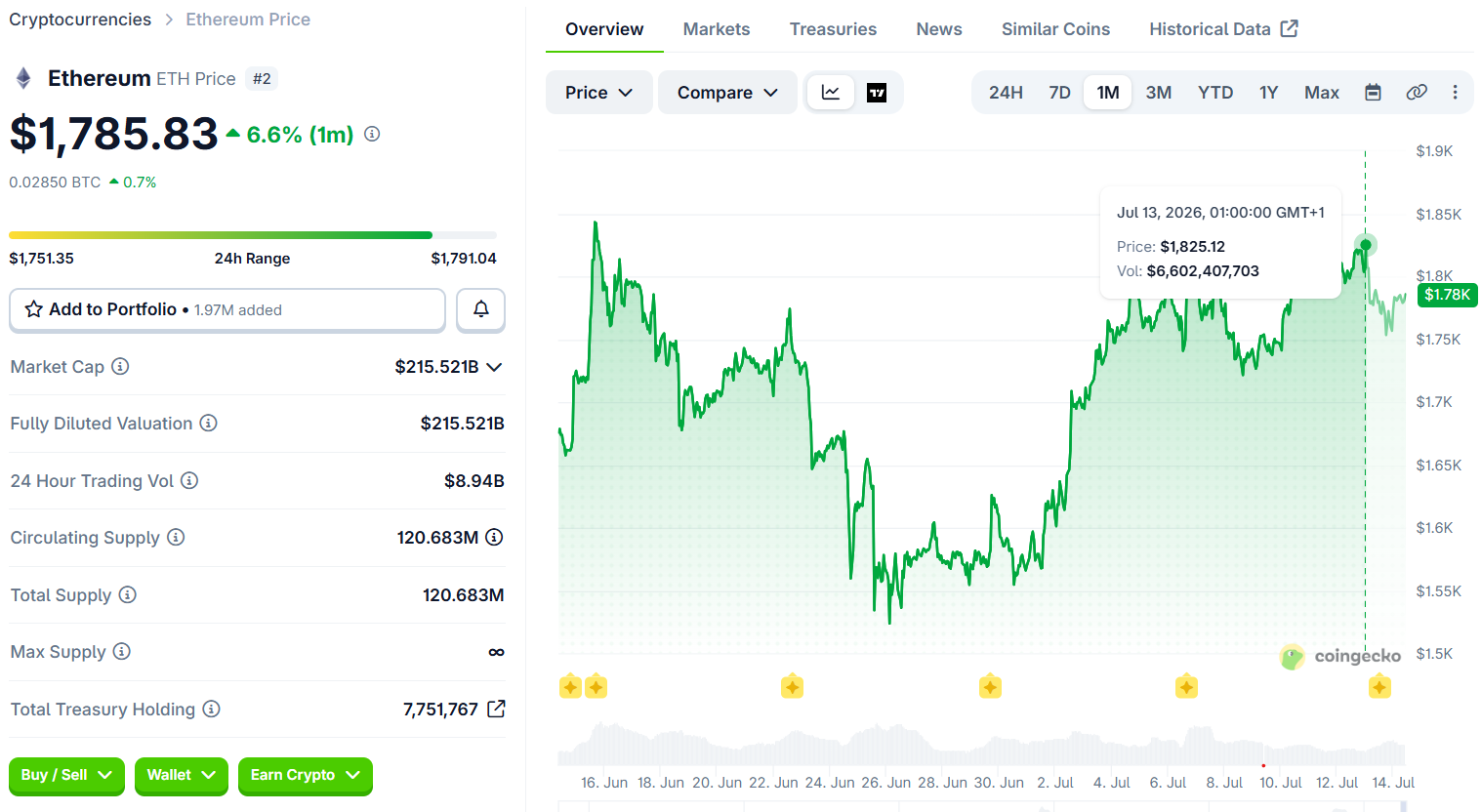
- July 1–13: Bolstered by a barrage of bullish market commentary and institutional endorsements, Ether’s spot price stages a notable recovery, rallying roughly 15% from a localized low of $1,582 on July 1 to $1,825 by July 13, according to CoinGecko data.
Unlike prior L2 rollups conceived by crypto-native development shops, Robinhood Chain’s arrival marks the first time a publicly listed retail brokerage with tens of millions of traditional accounts has deployed its own dedicated blockchain infrastructure. Token Terminal analytics confirm that within days of going live, the chain accounted for a staggering 6.9% of all tokenized stockholders globally, cementing its status as an immediate heavyweight in the real-world asset (RWA) tokenization arena.
Supporting Context & Metrics: The Mechanics of the Boom
To understand why Robinhood Chain has sparked such intense debate, one must look at the underlying mechanics of Layer-2 rollups and the specific economic footprint they leave behind.
The Technical Architecture
Ethereum L2 networks operate by executing transactions off-chain via dedicated execution environments—in this case, utilizing Arbitrum’s advanced rollup framework—before batching and settling those transactions back onto the Ethereum main chain. For Robinhood, this architecture offers the best of both worlds: the lightning-fast speeds and low fees required for modern retail trading, paired with the robust, uncompromised settlement security of the world’s leading smart contract platform.
Tokenized Assets and TradFi Precedents
Robinhood’s ultimate vision for the chain extends far beyond speculative memecoins. The infrastructure has been meticulously tailored to support the seamless trading of tokenized stocks and other complex real-world assets (RWAs). By integrating compliant framework elements natively into the rollup, Robinhood has provided a blueprint that legacy financial institutions have long sought.

This success is already inspiring copycat strategies across the sector. Most notably, banking giant Deutsche Bank has advanced development on its own ZK-powered Ethereum L2, dubbed DAMA 2, which is specifically engineered to streamline institutional finance and asset management on-chain.
+-----------------------------------------------------------------+
|                        ROBINHOOD CHAIN                          |
|  - High-Speed Off-Chain Execution (Arbitrum Tech)               |
|  - Tokenized Stocks & RWAs                                      |
|  - Over $141M Bridged ETH (First 2 Weeks)                       |
+-----------------------------------------------------------------+
                                 |
                                 | (Periodic Batch Settlement)
                                 v
+-----------------------------------------------------------------+
|                         ETHEREUM L1                             |
|  - Ultimate Security & Consensus                                |
|  - Minimal Direct Fee Revenue Remittance (~0.15% to 0.6%)       |
+-----------------------------------------------------------------+
The Financial Disconnect: Revenue vs. Activity
Despite the torrential inflow of volume, the economic feedback loop to the Ethereum mainnet remains remarkably weak.
Data compiled by Ark Invest’s Lorenzo Valente highlights a jarring disparity: during its initial weeks of operation, Robinhood Chain generated roughly $816,000 in gross revenue. While Arbitrum claimed a 10% cut of this sum, a minuscule fraction—pegged by Valente at 0.15% (and later refined by analytics platform GrowThePie to approximately 0.6%)—actually found its way back to Ethereum L1.
In real-world terms, even though Robinhood Chain routinely out-paced competing L2s in daily gas fee generation, the Ethereum mainnet captured a mere $4,400 of that bounty. This economic reality has laid bare a profound philosophical split among Ethereum researchers, developers, and long-term investors.
Official Statements & Industry Perspectives
The dichotomy between operational success and token value capture has prompted starkly contrasting commentary from prominent industry leaders.
The Bullish Institutional Thesis
Optimism regarding institutional adoption has reached a fever pitch. Eric Trump, representing World Liberty Financial, took to social media on July 11 to declare:
"ETH is pumping hard! Great to see!"
Tom Lee, chairman of BitMine Immersion Technologies, echoed this sentiment, arguing that the rollout powerfully reinforces the thesis that "ETH is money." Lee pointed to Ether’s indispensable role as the network’s native gas token and its function as the ultimate settlement asset for L2 finality.
Max Shannon, senior research analyst at Bitwise, views the Robinhood deployment as a watershed moment that outstrips previous L2 experiments.
"It represents the growth of the Ethereum ecosystem, particularly among major institutions," Shannon told Cointelegraph. "It also arrives at a time when Ethereum has more broadly repositioned itself toward institutions through Eth Labs and Ethereum Institutional."
Alex Gluchowski, founder and CEO of Matter Labs (the development team behind zkSync), hailed the launch as a major milestone for the entire blockchain industry.
"It shows Ethereum L2s have gone from something crypto-native teams experiment with to infrastructure a regulated, publicly listed company will run its business on," Gluchowski noted. He emphasized that rather than spinning up a proprietary chain from scratch—the path chosen by firms like Stripe with their Tempo project—Robinhood strategically leveraged an Ethereum rollup to inherit institutional security and tap directly into existing liquidity pools.
The Bearish Value-Accrual Reality Check
Conversely, market analysts hyper-focused on tokenomics have voiced sharp warnings. Lorenzo Valente’s widely shared assessment neatly encapsulated the dual nature of the debate:
"If your thesis is ‘ETH is money,’ Robinhood building here is ultra bullish. More activity, more ETH collateral, more lindyness. If your thesis is ‘ETH is a revenue-generating asset,’ this is the ultra-bear case."
Mike Dudas of 6th Man Ventures initially called Robinhood Chain "the single most bullish thing I’ve seen in eth-land in years." However, upon reviewing the stark revenue-sharing metrics calculated by Valente, Dudas added a sobering caveat:
"Eth cooked unless ‘eth is money’ takes off or the price of l1 settlement increases."
Future Outlook: Can Ethereum Adapt to the L2 Era?
As the dust settles on Robinhood Chain’s record-breaking debut, the broader Ethereum community faces a reckoning. The network’s core scaling strategy—intentionally designed to lower fees for L2 rollups to maximize user adoption and network effects—has worked precisely as intended. Yet, this success has exposed a structural flaw: record-breaking L2 transaction activity no longer translates into massive fee revenue or accelerated ETH token burning on the L1 mainnet.
+-----------------------------------------------------------------+
|                     THE VALUE-ACCRUAL DILEMMA                   |
+-----------------------------------------------------------------+
|  THESIS A: "ETH is Money"                                       |
|  - Proponents: Tom Lee, Alex Gluchowski                         |
|  - Outlook: Bullish. L2 users rely on ETH as base settlement    |
|    money, driving long-term monetary premium.                   |
+-----------------------------------------------------------------+
|  THESIS B: "ETH is a Yield-Generating Asset"                    |
|  - Proponents: Lorenzo Valente, Mike Dudas                      |
|  - Outlook: Cautious/Bearish. Low L1 fee capture fails to       |
|    enrich tokenholders, demanding a tokenomics overhaul.        |
+-----------------------------------------------------------------+
Navigating the Road Ahead
- Shifting Paradigms in Valuation: As Alex Gluchowski points out, the future appreciation of ETH may decouple entirely from direct fee revenue capture. Instead, value may accrue as Ether solidifies its status as the universally accepted, un-forgeable base monetary asset underpinning a sprawling web of institutional L2 ecosystems—even if end-users ultimately pay their daily gas fees in stablecoins or never interact with ETH directly.
- Tokenomic Re-Engineering: Conversely, analysts like Max Shannon argue that technological milestones like the Fusaka upgrades are insufficient on their own. For the network to thrive equitably, a wholesale evolution in developer mindsets and Ethereum’s internal token economics may be required to ensure that surging L2 throughput directly benefits the underlying asset holders.
- The TradFi Floodgates: Whether Robinhood Chain proves to be an isolated outlier or the opening salvo of a massive institutional migration remains the ultimate wildcard. With traditional financial giants exploring custom rollups—such as Deutsche Bank’s DAMA 2 initiative—Ethereum’s infrastructural monopoly is secure. However, translating that technical dominance into undeniable financial utility for everyday ETH holders remains the defining challenge of the network’s next decade.
Ultimately, Robinhood Chain has proven beyond a doubt that legacy financial institutions can successfully deploy cutting-edge crypto infrastructure at scale. Whether that victory enriches the broader Ethereum economy or simply creates walled gardens of off-chain wealth is a question that will define the future of digital asset valuation.