

As traditional financial and ticketing rails increasingly migrate to the blockchain, the 2026 World Cup functioned as a live-fire stress test for digital economies. Nearly 400,000 unique blockchain wallets interacted with prediction markets during the tournament, driving a cumulative $5.7 billion in wagers over the five-week event. From high-stakes questions regarding tournament winners to novelty outcomes—such as whether retiring Portuguese icon Cristiano Ronaldo would shed tears at the conclusion of his campaign—the data paints a vivid picture of a borderless, digitally native spectator base.
Simultaneously, the official “FIFA Collect” platform utilized Avalanche blockchain infrastructure to issue digital collectibles with real-world utility, redefining how fans accessed matches via stablecoin-powered economies. Yet, beneath the veneer of enthusiastic mass participation lies a complex web of regulatory, compliance, and illicit financial challenges. While the vast majority of on-chain activity was organic and legitimate, blockchain forensics uncovered notable intersections with sanctioned entities, highlighting the urgent necessity for advanced real-time compliance frameworks as the world transitions to decentralized rails.
Detailed Chronology: From Qualifiers to the Final
The financial footprint of the 2026 World Cup began taking shape long before the tournament’s opening whistle on June 11, 2026. Rather than materializing overnight, the on-chain prediction market economy evolved alongside the final months of the international qualification campaigns.

The Run-Up (January – May 2026)
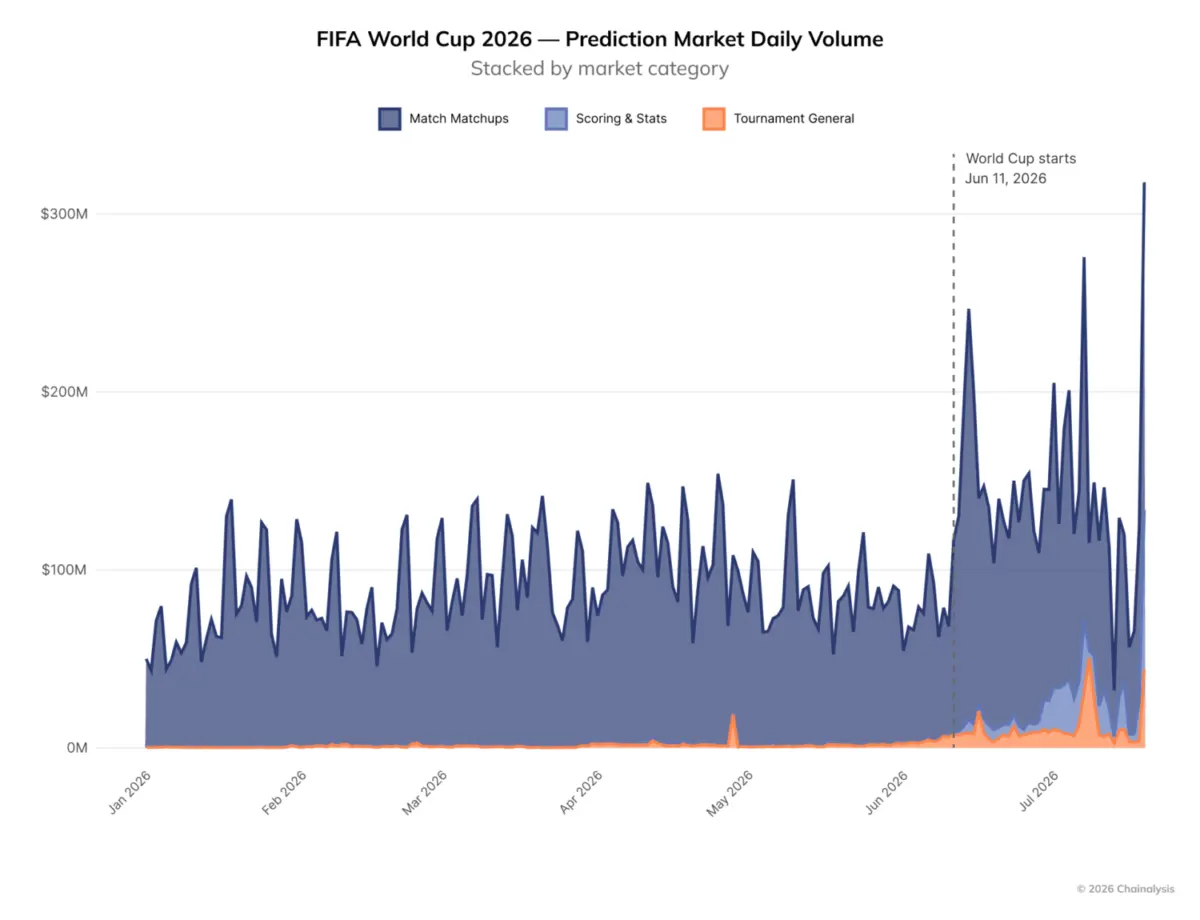
Beginning in January 2026, prediction market participants were already generating nearly $50 million in daily on-chain volumes. This early activity was concentrated primarily on qualification matches concluding in March, group-stage placement projections, and preliminary tournament outcomes. Throughout the spring, $50 million served as a reliable baseline daily floor for prediction market activity, occasionally surging past the $100 million threshold during high-stakes qualification playoffs.
This extended runway demonstrated that modern sports bettors are increasingly abandoning centralized, legacy sportsbooks in favor of transparent, smart-contract-driven prediction markets that allow for continuous, dynamic speculation over extended periods.
The Tournament Surge (June 11 – July 2026)
As soon as the tournament officially kicked off on June 11, on-chain volumes experienced an immediate parabolic upward trajectory. Daily volumes instantly scaled to the $250 million range, maintaining this elevated momentum across the entirety of the group stages and knockout rounds. Activity only experienced minor tapering during the latter stages of the tournament, driven exclusively by the dwindling number of active teams and wider spacing between matches.
The Grand Finale
The tournament’s crescendo more than compensated for any late-stage volume contraction. On the day of the final match—which saw Spain decisively best Argentina—bettors fueled over $300 million in single-day volume. Across the duration of the tournament, FIFA World Cup markets accounted for approximately 63% of the global prediction market volume, cementing the event’s dominance in the decentralized forecasting sector.

In addition to core match outcomes, novelty and statistical props captured significant market share. The viral market querying whether Cristiano Ronaldo would cry at the end of his campaign amassed an astonishing $49 million in volume, illustrating the appetite for granular, emotionally driven wagers within decentralized ecosystems. Overall, 55% of all tournament bettors finished the event in profit, with experienced prediction market prognosticators accounting for 79% of those successful outcomes.
Supporting Context & Metrics: Geographic Distribution and Tokenized Ticketing
To comprehend the true scale of the 2026 World Cup’s digital footprint, analysts must examine both geographic flow distribution and the mechanics of the tokenized ticket economy.
Global Participation and Geographic Flows
Utilizing advanced geolocation methodologies, Chainalysis data revealed that participation in World Cup prediction markets was a truly global phenomenon, spanning every continent except Antarctica. The United States and China led the global volume charts by a wide margin, supported heavily by strong contributions from Canada, Thailand, and the United Kingdom.
While geolocation mapping carries inherent uncertainties due to the widespread utilization of Virtual Private Networks (VPNs) and privacy-enhancing mixers, the data confirms that decentralized betting infrastructure effectively bypassed geographic restrictions, drawing liquidity from heavily regulated Western markets and Asian financial hubs alike.

The FIFA Collect Ecosystem
Beyond prediction markets, FIFA’s official digital collectibles platform, FIFA Collect, operated on the Avalanche blockchain to merge digital memorabilia with physical event access. Rather than relying solely on traditional, highly competitive lottery systems for match tickets, fans utilized FIFA Collect to acquire the "right to buy" tickets or purchase verified access passes on secondary markets.
Powered by stablecoins, the platform’s primary smart contract processed $24 million in minting payments and secondary market trades between May 2025 and the tournament’s conclusion. FIFA successfully captured at least $6 million in secondary transaction fees (representing a 5% cut), which were systematically routed through intermediary stopover wallets before being cashed out via mainstream centralized exchanges.
Analysis of user wallet histories indicated that over 100,000 fans successfully leveraged the platform to secure match tickets. Furthermore, funds flowing into FIFA Collect predominantly originated from countries whose national teams had qualified for the tournament, contributing $17.6 million compared to $6.6 million from non-qualifying nations. Interestingly, the platform proved moderately successful in onboarding existing crypto-native users rather than absolute novices, with the vast majority of capital driven by wallets boasting pre-existing on-chain transaction histories.
Official Statements, Forensic Insights, and Compliance Realities
While the staggering volume figures celebrate the adoption curve of Web3 technologies, blockchain analytics also provide a sobering look at the intersection of public sports entertainment and illicit finance.

Tracing Illicit Exposure in Prediction Markets
Despite the overwhelming majority of bettors being legitimate sports enthusiasts, on-chain forensics identified approximately 3,700 wallets (representing less than 1% of total participants) with direct histories of interacting with illicit actors prior to placing their wagers.
By transaction volume, the single largest source of tainted capital traced back to Huobi (HTX). Following its late-May sanctions by UK and EU authorities for allegedly facilitating Russian trade blockade evasions and illicit crypto flows, the exchange’s international user base inevitably overlapped with World Cup bettors. At least $5.4 million in volume directly flowed from Huobi-associated addresses into wallets actively betting on World Cup prediction markets.
The Contrast: Rigorous KYC on FIFA Collect
In sharp contrast to open prediction markets, FIFA Collect exhibited a negligible direct exposure to illicit crypto flows. Out of the $24 million processed through its smart contracts, virtually none of the volume traced back to known bad actors, scammers, or sanctioned entities.
This pristine compliance record was largely the result of stringent Know-Your-Customer (KYC) protocols enforced by the platform. To acquire tokenized ticket access, users were required to undergo comprehensive identity verification, declare the explicit source of their funds, and clear manual profile reviews. This heavy-handed vetting process successfully deterred bad actors, proving that institutional-grade compliance can effectively insulate mainstream Web3 consumer applications from illicit exploitation.

Future Outlook: The On-Chain Horizon
The convergence of the 2026 FIFA World Cup and blockchain technology serves as a definitive preview of the future of global events. The stark contrast between open prediction markets and permissioned NFT ticketing platforms highlights the dual nature of crypto’s expansion into mainstream culture.
On one hand, open, permissionless prediction markets unlocked multi-billion-dollar global participation and captured the imagination of hundreds of thousands of users, yet they remained susceptible to peripheral liquidity from sanctioned platforms. On the other hand, permissioned platforms like FIFA Collect demonstrated that robust, real-time compliance and rigorous KYC protocols can safeguard brand integrity and prevent illicit abuse, albeit within a more controlled environment.
As global financial and ticketing infrastructure continues its inevitable migration on-chain, the lessons learned from the 2026 World Cup will resonate across industries. Regulators, event organizers, and technology platforms face a shared imperative: develop sophisticated, real-time blockchain intelligence tools capable of tracing, attributing, and assessing financial flows without stifling the open innovation that makes decentralized ecosystems thrive. The digital rails have been laid, and the global economy is running on them; the challenge moving forward is ensuring those rails remain secure for the billions of fans watching from the sidelines.