


Executive Overview
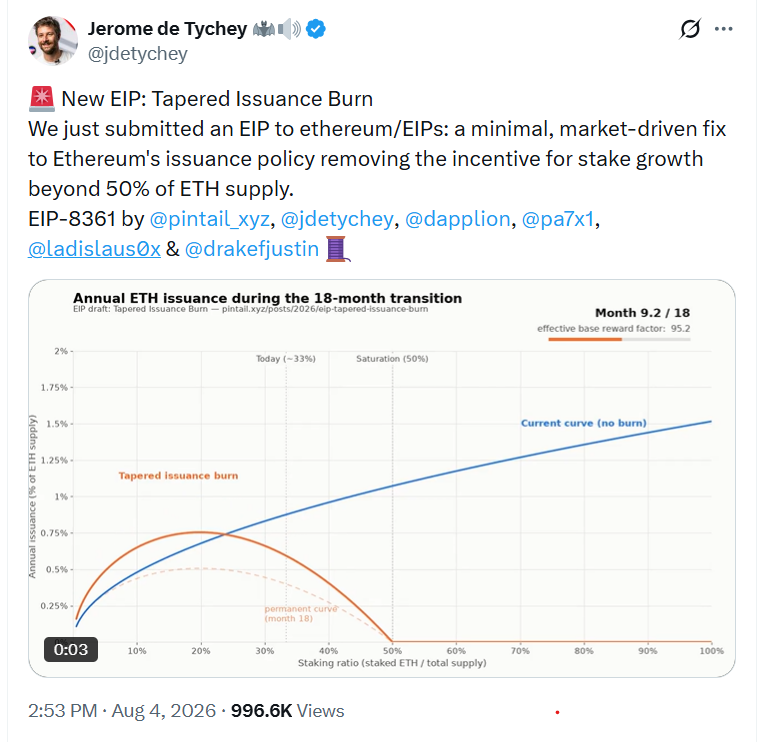
Authored by prominent figures within the ecosystem—including the Ethereum Foundation’s Justin Drake and Ethereum Community Conference (ETHCC) co-founder Jerome de Tychey—EIP-8363 proposes a fundamental shift in how validator rewards are distributed. Specifically, the proposal calls for a gradual reduction in staking yields as more Ether (ETH) is locked up to secure the network, eventually driving new protocol issuance to absolute zero once 50% of the total ETH supply is staked.
The core thesis of the proposal is as provocative as it is straightforward: Ethereum has reached a critical mass where additional staked capital yields diminishing security returns while unnecessarily diluting non-staking holders. In short, proponents argue that the network is currently paying a heavy financial premium for a level of security it no longer requires.
However, the backlash from across the crypto landscape has been swift, fierce, and widespread. Spanning decentralized finance (DeFi) architects, institutional staking providers, and independent developers, critics contend that EIP-8363 threatens to destabilize Ethereum’s lending markets, weaken its decentralization safeguards, and severely undermine institutional confidence through unpredictable monetary policy adjustments. As the ecosystem grapples with the fallout of this controversial draft, the crypto community is forced to confront a deeply foundational question: Is Ethereum genuinely over-spending on security, or is EIP-8363 a heavy-handed solution in search of a problem?
Detailed Chronology & Origins of the Debate
The Spark Before the Deadline
The controversy erupted in early August when EIP-8363 was formally submitted just two days ahead of the crucial August 6 deadline for proposals to be considered for inclusion in the upcoming Ethereum network upgrade. The tight rollout immediately drew fire from industry leaders who argued that a change carrying such seismic, far-reaching implications for the entire decentralized finance ecosystem deserved a far longer, more deliberate runway for community deliberation.
Critics like Ether.fi founder Mike Silagadze publicly voiced their dismay, arguing that publishing a foundational monetary overhaul on such a compressed timeline damaged governance trust.
Conversely, co-author Jerome de Tychey defended the timeline, pointing out that the underlying economic principles of the proposal have been actively debated in public forums since 2023. De Tychey emphasized that submitting a draft for inclusion merely opens the door to rigorous peer review rather than sealing its fate.
"Proposed for inclusion is where scrutiny begins and absolutely not where it ends," de Tychey noted. "Nothing ships without months of review by client teams and researchers."
Tracing the Rationale: Diminishing Returns on Security
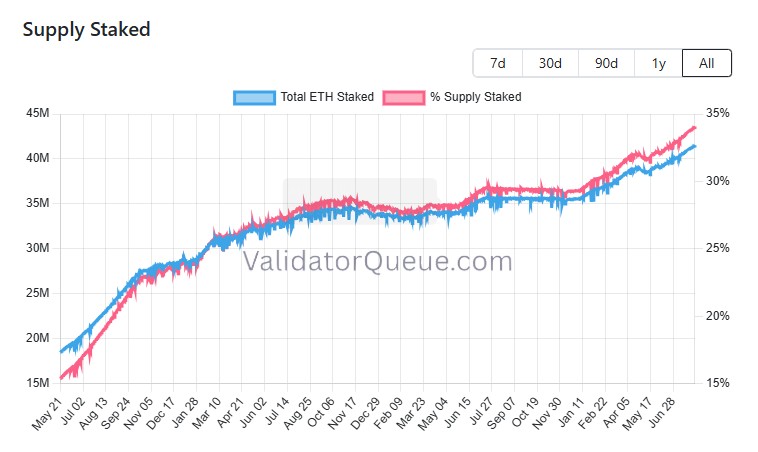
To understand the motivation behind EIP-8363, one must examine Ethereum’s current operational state. According to data from the Ethereum Validator Queue, approximately 41.5 million ETH—representing roughly 34.07% of the entire circulating supply—is currently staked, earning a baseline yield of around 2.67%.

While conventional consensus dictates that a higher volume of locked collateral increases the economic cost of attacking the network, EIP-8363’s architects argue that this linear relationship breaks down past a certain threshold. Once a network secures tens of billions of dollars in economic finality, additional billions provide negligible marginal security benefits while compounding the "stealth tax" imposed on users and holders who choose to keep their assets liquid.
By tapering issuance as adoption scales toward a 50% saturation ceiling, the authors hope to protect Ethereum from bloated token supply expansion and prevent runaway validator concentration.
Supporting Context & Metrics: Is Ethereum Over-Staked?
Staking Growth and Market Realities
The debate unfolds against a backdrop of rapid evolution in Ethereum’s staking landscape. Staking participation grew by roughly 15% year-over-year, largely propelled by institutional capital inflows from major traditional finance entrants and specialized staking infrastructure providers like Bitmine and BlackRock.
Yet, opponents of EIP-8363 argue that market dynamics are already naturally regulating this growth without requiring algorithmic intervention from the protocol layer. Dr. Steve Berryman, Head of Client Partnerships for Ethereum at Bitwise, suggests that a natural ceiling is fast approaching.
"We will come to a natural ceiling probably by the end of this year," Berryman projects, noting that as yields compress toward the 2% threshold, the incentive to lock up additional capital diminishes sharply. "People need a certain amount of liquidity."
Independent Ethereum commentator Leo Lanza echoed similar sentiments, challenging the fundamental premise that validator issuance functions as a harmful tax on non-stakers. Lanza pointed out that Ethereum’s annual inflation rate remains comfortably below 1%—comparable to or even lower than gold, widely considered the premier store of value, which expands its supply by 1% to 2% annually.
"The free market already solves this," Lanza argued, advocating for organic market adjustments over protocol-enforced monetary tweaks.
Official Statements & Stakeholder Perspectives
The fault lines surrounding EIP-8363 cut deep across distinct sectors of the Ethereum economy, creating stark divisions between research purists, infrastructure providers, and institutional allocators.
The Institutional Stance: The Cost of Uncertainty
For institutional investors, predictability is paramount. Dr. Steve Berryman argues that altering issuance parameters at the margin introduces a dangerous element of policy volatility that institutions actively avoid.
"Institutional adoption requires certainty," Berryman explained. "Playing with the issuance at the margin would cause uncertainty, and institutions hate uncertainty. It’s not broken; why try and fix it?"
Mike Silagadze of Ether.fi reinforced this warning, cautioning that sudden monetary shifts could permanently impair confidence in the network’s governance.
"Any nation-state or large institution looking at this will justifiably have a dramatic loss of confidence in the governance and stability of Ethereum," Silagadze stated.
The DeFi Ecosystem Under Threat
Beyond institutional asset management, a major concern is the potential ripple effect EIP-8363 could have on Ethereum’s sprawling decentralized finance ecosystem, where liquid staking tokens (LSTs) and liquid restaking tokens (LRTs) serve as foundational collateral assets.
Aave founder Stani Kulechov pointed out that reducing staking rewards could incentivize capital flight toward alternative yield-generating assets outside the ecosystem.
"My concern is… those who are fine with ETH beta and yield might also sell ETH for other yielding assets," Kulechov warned. "Ethereum should not be punished for its growth."
Silagadze warned bluntly: "This will obviously kill a huge chunk of DeFi which is built around the staking ecosystem."
In response, de Tychey rejected the notion that lower staking yields would inevitably cripple lending markets, arguing that borrowing rates naturally adjust downward alongside yields. Furthermore, he questioned whether DeFi should rely so heavily on derivative wrappers in the first place.
"A DeFi built on raw ETH is sturdier than one built on wrappers," de Tychey asserted.
Decentralization and the Solo Staker Dilemma
A particularly contentious point of debate involves the impact of EIP-8363 on validator decentralization. Critics argue that lower protocol rewards would disproportionately harm independent solo stakers who lack the economies of scale enjoyed by massive centralized exchanges and institutional staking pools.
Greg Koumoutsos, Technical Research Lead at the Lido Labs Foundation, highlighted the heavy operational burdens faced by independent operators:
"A solo validator has real costs: some ideological solo stakers may remain, but many marginal solo validators will not, and fewer new ones will enter, if any."
Koumoutsos also emphasized that Ethereum’s issuance is paying for much more than raw cryptographic security:
"Ethereum is not only paying for slashable ETH; it is paying for decentralization, operator diversity, censorship resistance, and network resilience."
Conversely, de Tychey argued that the current high-issuance model has actually failed to achieve true decentralization, pointing out that nearly 90% of staked ETH has become heavily delegated and concentrated among a handful of centralized intermediaries.
"We’ve spent years running the experiment: issuance went up with the amount staked, and the validator set became concentrated in a handful of exchanges and staking providers," de Tychey noted. "Spending more didn’t buy decentralization, but it funded the intermediaries."
Future Outlook: Where Does Ethereum Go From Here?
The fierce controversy surrounding EIP-8363 underscores the profound maturity—and growing pains—of governance within decentralized networks. As Ethereum cements its role as the global settlement layer for institutional finance and decentralized applications alike, balancing economic efficiency with monetary predictability becomes an increasingly delicate tightrope walk.
Whether EIP-8363 survives the crucible of core research review or is ultimately relegated to the history books as an overly aggressive experiment, it has permanently shifted the conversation regarding Ethereum’s long-term economic architecture. The debate has made one thing abundantly clear: in a network powered by consensus, every economic adjustment creates profound trade-offs, and finding consensus on the price of security remains one of crypto’s toughest challenges.