

Executive Overview
For years, institutional capital seeking exposure to alternative layer-1 and privacy-adjacent digital assets faced substantial regulatory hurdles, custody friction, and complex tax compliance landscapes. The arrival of $ZCSH effectively bridges this gap, allowing traditional investors, wealth managers, and retirement accounts to gain seamless exposure to ZEC through standard brokerage accounts without the operational complexities of managing private keys or navigating centralized crypto exchanges.
However, the launch has also ignited a vigorous debate within the broader cryptocurrency community. While $ZCSH introduces unprecedented institutional accessibility and liquidity pipelines to the Zcash ecosystem, a critical technical caveat remains: the underlying assets held within the Grayscale trust operate entirely outside Zcash’s signature shielded, zero-knowledge privacy pools. Instead, the holdings reside in transparent, publicly auditable addresses to comply with stringent regulatory and custodial standards.
This comprehensive report examines the structural mechanics of the $ZCSH launch, analyzes the macroeconomic and regulatory context surrounding Zcash, reviews official statements from key stakeholders, and evaluates the long-term implications of bringing a historically privacy-centric asset into the regulated perimeter of traditional finance.
Detailed Chronology: From Concept to NYSE Arca Listing
The path to listing the world’s first spot Zcash ETF on a major national securities exchange was paved by years of evolving regulatory postures toward digital assets, alongside Grayscale’s persistent efforts to expand its suite of single-asset crypto trusts into fully reporting exchange-traded products.
The Evolution of Single-Asset Trusts
Grayscale Investments has long operated as a pioneer in institutional crypto asset management, initially introducing Over-the-Counter (OTC) private placement trusts that catered to accredited investors. Over the preceding years, the firm successfully navigated the transition of flagship products like the Grayscale Bitcoin Trust (GBTC) and Grayscale Ethereum Trust (ETHE) into spot ETFs following landmark legal victories and shifting SEC interpretations.
Buoyed by these regulatory precedents, asset managers increasingly turned their attention toward mid-cap and alternative layer-1 protocols. Zcash—long recognized for its pioneering cryptography, fixed supply cap, and historical significance in the development of zero-knowledge (ZK) proofs—emerged as a prime candidate for institutional packaging.
Regulatory Filing and SEC Review
The groundwork for $ZCSH involved extensive dialogue between Grayscale and regulatory authorities to ensure compliance with the Securities Exchange Act of 1934 and NYSE Arca listing standards. Unlike Bitcoin, whose decentralized and transparent ledger architecture became familiar to regulators, Zcash presented unique compliance challenges due to its optional privacy features.
To satisfy regulatory oversight, anti-money laundering (AML), and know-your-customer (KYC) mandates, the structural framework of the $ZCSH trust was designed to isolate exposure strictly to transparent ZEC. This design choice mitigated regulatory pushback regarding illicit finance risks, clearing the path for formal approval and trading commencement.
Opening Bell and Immediate Market Reaction
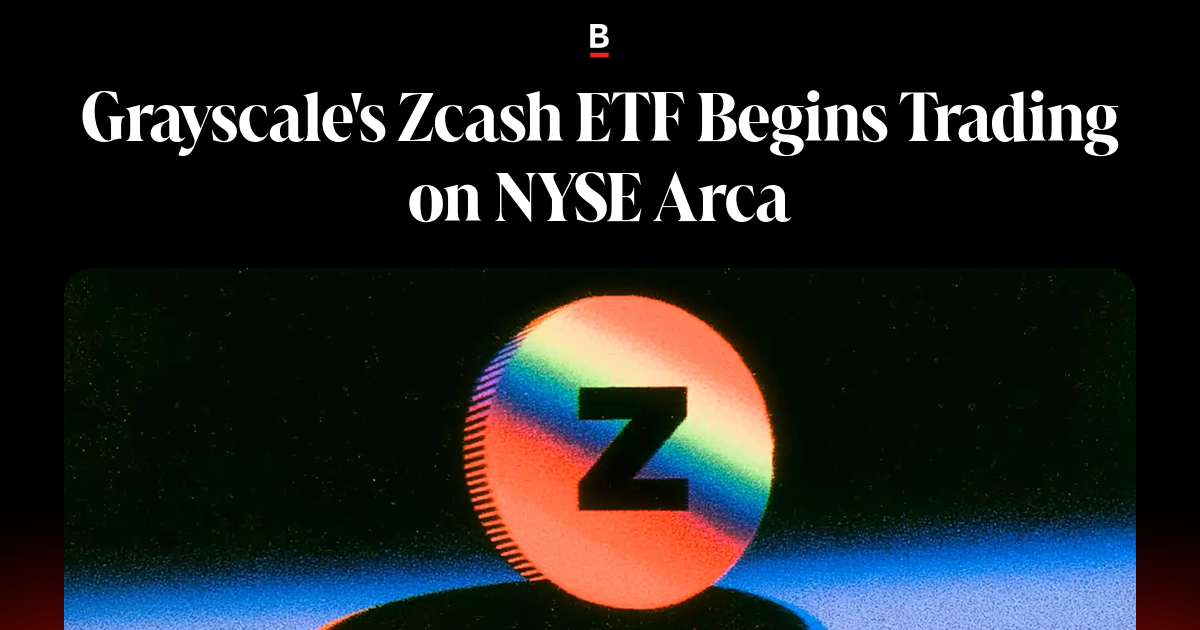
On launch day, NYSE Arca officially welcomed $ZCSH to its trading board. Grayscale’s executive team, alongside market makers and authorized participants, marked the occasion with official announcements highlighting the milestone. Trading volume surged out of the gate as institutional desks, algorithmic traders, and retail brokerages integrated the ticker into their routing systems.
The introduction of $ZCSH immediately decoupled traditional market hours from 24/7 crypto spot markets for a segment of ZEC liquidity, creating new arbitrage pathways between spot exchanges and the exchange-traded vehicle. Initial market depth indicated robust institutional interest, signaling that demand for alternative altcoin exposure outside of Bitcoin and Ethereum remains resilient even amid fluctuating macroeconomic conditions.
Supporting Context & Metrics: Understanding Zcash and $ZCSH
To fully grasp the significance of Grayscale’s latest financial product, one must examine the underlying mechanics of the Zcash network, its tokenomics, and the specific structural compromises embedded within the $ZCSH fund architecture.
[Traditional Investors / Brokerages]
          │
          ▼ (Buy/Sell $ZCSH Shares)
   [NYSE Arca: $ZCSH]
          │
          ▼ (Institutional Custodian)
[Transparent ZEC Holdings (No Shielded Pools)]
          │
          ▼ (Base Layer)
     [Zcash Network]
Tokenomics and the 21-Million Supply Cap
In its official promotional rollout, Grayscale drew direct parallels between Zcash and Bitcoin—the undisputed patriarch of digital scarcity. Like Bitcoin, Zcash features a hard-coded maximum supply limit of 21 million ZEC.
- Issuance Schedule: Zcash follows a halving schedule mirroring Bitcoin’s, reducing block rewards at predetermined intervals to curb inflation and enhance long-term scarcity dynamics.
- Consensus Mechanism: Originally launched as a fork of the Bitcoin codebase utilizing a Proof-of-Work (PoW) consensus algorithm, Zcash has maintained a robust, battle-tested security model that appeals to traditional investors seeking hard-money narratives.
- Utility vs. Store of Value: While Bitcoin functions primarily as digital gold, Zcash was engineered to combine this fixed-supply monetary policy with advanced cryptographic privacy capabilities.
The "Transparent vs. Shielded" Dilemma
The most critical nuance of the $ZCSH product lies in its handling of Zcash’s native privacy technology. The Zcash protocol allows users to transact via two types of addresses:
- Transparent Addresses ($t$-addrs): Similar to Bitcoin transactions, balances and transaction histories are publicly visible on an immutable ledger.
- Shielded Addresses ($z$-addrs): Utilizing advanced zero-knowledge succinct non-interactive arguments of knowledge (zk-SNARKs), these transactions cryptographically conceal the sender, recipient, and transaction amount while still validating network consensus.
Grayscale’s $ZCSH exclusively holds transparent ZEC.
This design decision was necessitated by regulatory compliance frameworks. Institutional custodians, prime brokers, and regulatory watchdogs require complete transparency regarding the provenance of underlying assets to comply with Office of Foreign Assets Control (OFAC) sanctions, AML regulations, and tax reporting requirements.
Consequently, investors purchasing $ZCSH gain economic exposure to the price of ZEC, but they do not participate in, nor do their holdings benefit from, the network’s native zero-knowledge privacy pool ecosystem. This trade-off has sparked intense debate among cypherpunks and privacy advocates, who argue that stripping away the privacy component removes the core value proposition of Zcash. Conversely, institutional pragmatists maintain that regulated exposure via transparent holdings is a necessary stepping stone toward broader adoption.
Official Statements and Industry Perspectives
The launch of $ZCSH has prompted a wide array of commentary from crypto founders, institutional executives, traditional financial analysts, and privacy advocates.
Grayscale’s Official Stance
In its launch communications, Grayscale emphasized the democratization of access and the growing appetite for diversified crypto exposure among mainstream investors.

"The Zcash ETF—Built by Grayscale (Ticker: $ZCSH) begins trading today," the firm stated via official channels. "The world’s first Zcash ETF offering exposure to $ZEC, now accessible from standard brokerage or investment accounts. Zcash shares key features with Bitcoin: a 21 million supply cap and robust cryptographic foundations."
Grayscale executives highlighted that bringing assets like ZEC into traditional financial wrappers allows wealth advisors to construct more diversified digital asset portfolios for clients who are otherwise restricted from interacting with decentralized exchanges or managing self-custodial wallets.
The Crypto Community: Celebration vs. Criticism
Reaction within the broader Web3 ecosystem was deeply polarized, reflecting the ongoing tension between regulatory compliance and core ideological tenets of cryptocurrency:
- The Bullish Institutional View: Market analysts and liquidity providers lauded the launch as a major win for Zcash’s market visibility. By securing an ETF ticker on a major U.S. exchange, Zcash successfully re-entered the conversation among top-tier digital assets, potentially paving the way for enhanced institutional liquidity, brand legitimacy, and capital inflows.
- The Privacy Advocate Critique: Prominent members of the privacy and cryptographic communities expressed concern over the "watered-down" nature of the product. Critics noted that by locking institutional capital exclusively into transparent $t$-addresses, the product fails to drive demand for actual shielded transactions, which are essential for maintaining the anonymity set required to make the privacy network effective. Some commentators warned that a heavy concentration of ZEC in transparent, regulated institutional trusts could create a two-tiered market where transparent coins trade at a premium or suffer differential regulatory treatment compared to untraceable shielded coins.
Future Outlook: What $ZCSH Means for the Road Ahead
As trading settles into a regular rhythm on NYSE Arca, the long-term impact of the $ZCSH ETF will depend on several macroeconomic, regulatory, and technological variables.
1. Inflows and Institutional Demand
The primary metric of success for any ETF is sustained net inflows. If wealth management platforms, registered investment advisors (RIAs), and pension funds allocate meaningful capital to $ZCSH, it could catalyze a supply squeeze on transparent ZEC exchanges, driving upward price momentum. Conversely, sluggish inflows could relegate the product to a niche offering with minimal impact on broader market trends.
2. Regulatory Precedent for Privacy-Adjacent Assets
The approval and listing of $ZCSH establish an interesting regulatory benchmark. By decoupling the underlying asset from its privacy-enhancing features to satisfy compliance mandates, the SEC and NYSE Arca have signaled a willingness to permit institutional access to privacy-origin coins provided they are sanitized through transparent custodial wrappers. This framework could serve as a blueprint for future institutional products involving other advanced cryptographic protocols.
3. Impact on Zcash Core Development
The Zcash development ecosystem—including Electric Coin Company (ECC) and the Zcash Foundation—stands at a critical crossroads. While increased price discovery and capital inflows driven by $ZCSH can fund ongoing research and development, the community must actively work to ensure that the core mission of financial privacy is not sidelined by institutional compromise. Efforts to improve the user experience of shielded transactions, enhance cross-chain interoperability, and expand zero-knowledge utility will remain vital to proving that Zcash is more than just a "Bitcoin clone with privacy features."
Summary
Grayscale’s launch of the Zcash ETF ($ZCSH) on NYSE Arca represents a monumental milestone in the maturation of digital asset markets. By bridging the gap between traditional brokerage infrastructure and alternative layer-1 protocols, $ZCSH opens new frontiers for institutional participation. Yet, as the industry navigates the delicate balance between regulatory compliance and the fundamental ethos of financial privacy, the true legacy of $ZCSH will be forged in how the market reconciles transparent institutional capital with the decentralized, private future of money.