

Executive Overview
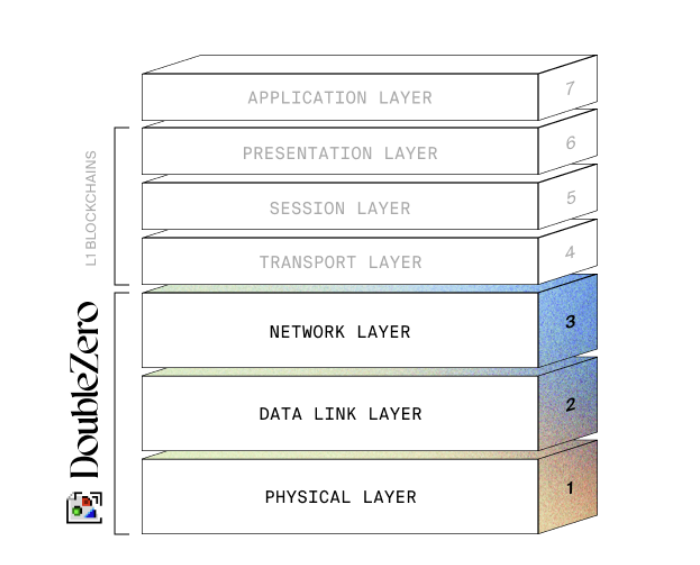
Following a $28 million investment round co-led by Multicoin Capital earlier this year, DoubleZero officially launched its mainnet-beta, with the Solana network serving as its inaugural ecosystem-scale customer. Backed by industry heavyweights such as Jump Trading—which acts as DoubleZero’s primary bandwidth supplier—alongside Galaxy, Rockaway X, and a coalition of global infrastructure providers, DZ sits squarely below Layer 1 (L1) protocols in the OSI model.
Crucially, the protocol’s path to widespread commercialization was significantly de-risked following a favorable no-action letter issued by the U.S. Securities and Exchange Commission’s (SEC) Division of Corporation Finance on September 29, 2025. This regulatory clarity clears the runway for the protocol’s native utility and governance token, the 2Z token, empowering a decentralized model where hardware providers are programmatically rewarded for maintaining critical digital transit corridors.
Detailed Chronology: From Concept to Mainnet-Beta and Regulatory Clarity
The trajectory of DoubleZero reflects a convergence of elite high-frequency trading (HFT) engineering and cutting-edge decentralized systems design.
The Genesis of High-Performance Infrastructure
The genesis of dedicated networking traces back to the 2008–2010 era, when elite quantitative trading firms realized that the public internet was inherently too slow and unpredictable for modern arbitrage and latency-sensitive execution. Firms like Jump Trading, Citadel, HRT, Two Sigma, and DRW began investing billions of dollars into customized physical network infrastructure. This included commissioning undersea fiber-optic cables and building custom microwave towers capable of beaming radio waves across challenging topographies like Lake Michigan. Similarly, hyperscalers like Google, Meta, Microsoft, and Amazon constructed private global backbones to connect their sprawling data centers.
However, these elite assets remained strictly siloed within corporate walls. Access to dedicated fiber was historically restricted to the most capitalized entities in traditional finance and Big Tech. DoubleZero was conceived to change that paradigm by creating an open, permissionless marketplace that unlocks unutilized or underutilized private infrastructure for public utility.
Securing Regulatory Relief
As DoubleZero prepared for its commercial rollout, navigating the complex U.S. regulatory landscape remained a paramount objective. On September 29, 2025, the project cleared a monumental hurdle when the SEC’s Division of Corporation Finance issued a no-action letter (NAL) to the DoubleZero Foundation.
Spearheaded by Austin Federa and DoubleZero Foundation General Counsel Mari Tomunen, who worked closely with regulatory bodies, the NAL granted specific relief regarding programmatic transfers of the 2Z token. The regulatory guidance confirmed that the Division of Corporation Finance would not recommend enforcement actions for programmatic token transfers integral to the protocol’s function. This ensured that transactions involving 2Z—used for network fees and operational incentives—do not require registration as securities under U.S. federal law. By eliminating severe legal ambiguity, the NAL provided DoubleZero with a clear, compliant pathway for its mainnet-beta deployment.

Mainnet-Beta Launch and Ecosystem Integration
Following months of development and testing, DoubleZero officially launched its mainnet-beta. Solana emerged as the foundational first adopter, integrating DZ directly into its core validator stack. Major Solana clients—including Agave, Firedancer, and Jito—have embedded DoubleZero natively into their architectures, with Jito’s block engine adopting the protocol to optimize transaction processing pipelines.
Simultaneously, a diverse coalition of node operators, infrastructure providers, and institutional backers—including Galaxy, Distributed Global Technologies, Rockaway X, Cherry Servers, Latitude, South 3rd Ventures, and Teraswitch—committed physical fiber links to the fledgling network, establishing an immediate, robust global footprint.
Supporting Context & Metrics: Unlocking the OSI Stack’s Missing Layer
To understand the structural significance of DoubleZero, one must examine how blockchains interact with traditional networking paradigms.
+-------------------------------------------------------+
|                Layer 7: Application                   |
+-------------------------------------------------------+
|                Layer 3: Network                       |
+-------------------------------------------------------+
|                Layer 1: Physical                      |
|              [ DoubleZero (DZ) ]                      |
+-------------------------------------------------------+
The OSI Model and the Physical Bottleneck
In the Open Systems Interconnection (OSI) model, blockchain protocols typically operate at the upper software and state-management layers. Over the past ten years, core L1 developer teams have heavily optimized every software component within their purview:
- Consensus Protocols: Shifting from energy-intensive Proof-of-Work to lightning-fast Proof-of-Stake variations.
- Execution Engines: Implementing parallelized transaction execution (e.g., Solana’s Sealevel, Firedancer).
- Storage Layers: Refining state pruning, state rent, and historical data archiving.
Yet, despite billions of dollars in R&D, these systems have historically relied on the standard, public internet to transmit blocks and transactions across nodes scattered globally. The public internet routes packets dynamically over congested, multi-hop public pathways that prioritize cost-efficiency and fault-tolerance over raw speed. For distributed ledgers, where every millisecond counts toward determinism and consensus finality, this creates an invisible performance ceiling.
How DoubleZero Works
DoubleZero sits directly below traditional L1s in the OSI stack, functioning as an incentivized, permissionless routing layer optimized specifically for high-throughput consensus data.
- Infrastructure Providers: Entities owning dedicated fiber lines, undersea cables, dark fiber, or microwave towers contribute their surplus bandwidth capacity to the DoubleZero network.
- The 2Z Token Economy: Network participants utilize the native 2Z token to pay for guaranteed transmission speeds and low-latency packet delivery. A portion of these fees is programmatically routed to infrastructure providers as direct compensation for their hardware maintenance and uptime. Furthermore, resource providers receive newly minted 2Z tokens for tracking network interactions, calculating provider fees, and administering protocol-level accounting.
- Solana Integration Metrics: With DoubleZero active on Solana mainnet-beta, validators experience reduced block propagation latencies. Consensus is reached faster, global data flows with minimal jitter, and end-users and market makers enjoy significantly higher transaction inclusion rates—mitigating issues related to network congestion and front-running vulnerabilities driven by uneven latency profiles.
Official Statements and Leadership Insights
The leadership team behind DoubleZero combines decades of institutional high-frequency trading infrastructure experience with top-tier blockchain advocacy.
Kyle Samani, co-founder of Multicoin Capital—which co-led DoubleZero’s $28 million financing round—has been an outspoken advocate for the project’s thesis. Reflecting on the team’s pedigree, industry observers have noted the exceptional caliber of talent assembling around the foundation.
Austin Federa, a well-known figure in the Solana ecosystem who joined forces with DoubleZero, partnered closely with General Counsel Mari Tomunen to secure the milestone SEC no-action letter. Federa collaborates alongside technical leadership including Andrew McConnell (CTO of Malbec Labs) and Mateo Ward, both of whom bring decades of institutional engineering experience designing ultra-low-latency dedicated fiber networks for Jump Trading.
In commentary regarding the network’s architectural ambitions, project insiders emphasize that DoubleZero was built by engineers who understand both the grueling physical realities of submarine cables and microwave links, and the unique, unforgiving performance demands of high-throughput blockchains.
Future Outlook: Beyond Solana to the Wider Internet
While Solana represents the tip of the spear for DoubleZero’s mainnet-beta, the protocol’s long-term roadmap extends far beyond a single ecosystem.
Multi-Chain Adoption and Layer 2 Scaling
The architects of DoubleZero anticipate that every major Layer 1 protocol will ultimately be forced to integrate DZ-enhanced networking within the coming years. In a competitive landscape where finality times and throughput define market dominance, relying on unoptimized public internet routes will put competing chains at an insurmountable disadvantage.
Furthermore, DoubleZero holds immense utility for centralized-sequencer Layer 2 (L2) rollups. By leveraging DZ’s optimized physical backbones, L2s can efficiently fan out state updates and transaction data to various localized Remote Procedure Call (RPC) servers distributed globally, dramatically improving performance for latency-sensitive applications like decentralized derivatives exchanges and high-frequency automated market makers (AMMs).
Ubiquitous Real-Time Applications
Looking toward the horizon, the ultimate vision for DoubleZero transcends blockchain infrastructure altogether. Any internet-connected application that demands strict, deterministic low-latency performance can leverage the network. As global bandwidth requirements surge, DoubleZero is positioned to become the underlying transit fabric for next-generation consumer technology:
- Real-Time Global Augmented Reality (AR): Delivering zero-latency spatial computing data streams to untethered headsets.
- Competitive Cloud Gaming: Eliminating input lag in multi-player competitive gaming environments.
- Ultra-High-Definition Video Communications: Providing jitter-free, instantaneous global video routing.
By democratizing access to dedicated fiber and aligning incentives via a cryptoeconomic marketplace, DoubleZero has bridged the gap between elite institutional networking and open-source decentralized systems—ushering in a new era where physical infrastructure is finally synchronized with the speed of digital consensus.