


Executive Overview
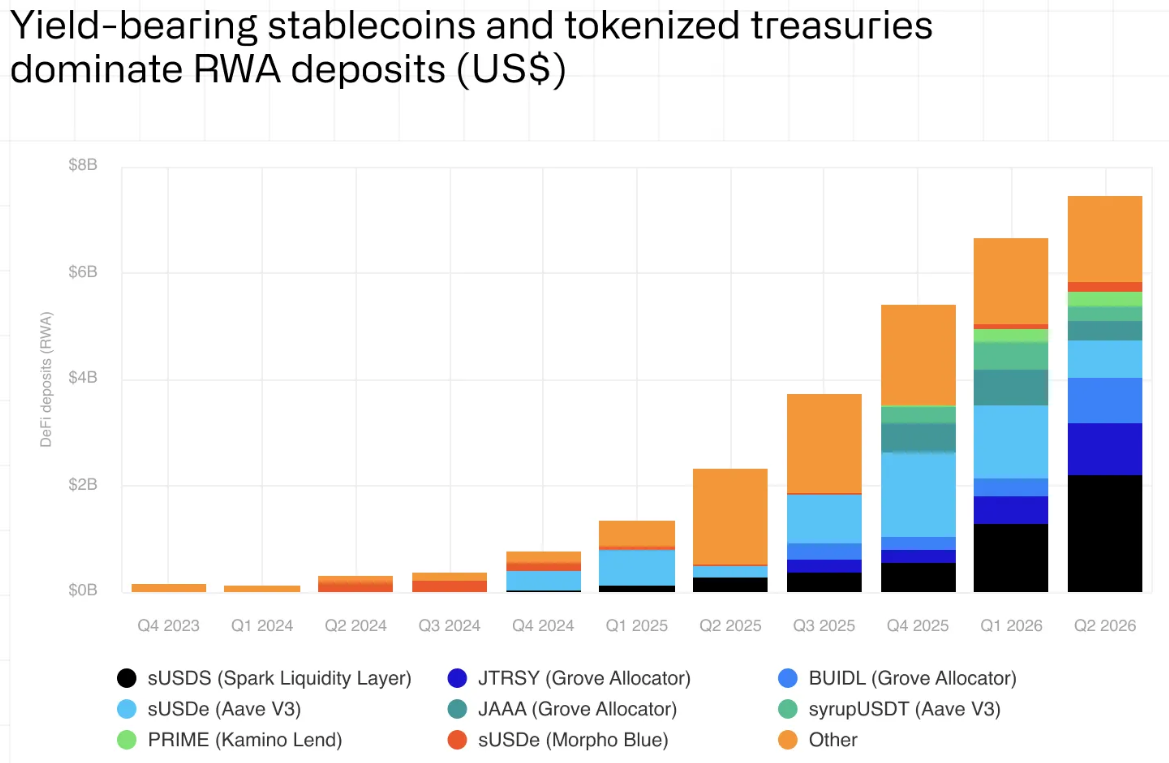
According to a comprehensive joint report published on Thursday by digital asset manager CoinShares and blockchain analytics platform Token Terminal, RWA deposits across decentralized finance protocols experienced exponential growth in the second quarter of 2026. While the broader DeFi sector faced a contraction—with total value locked (TVL) and deposits falling by approximately 15% year-over-year—RWA deposits skyrocketed, more than tripling to reach an impressive $7.4 billion.
This striking divergence highlights a maturing market where demand for tokenized assets is anchored by undeniable financial utility rather than the fickle winds of crypto market cycles. As institutional adoption deepens and retail investors seek robust, yield-bearing alternatives to volatile digital tokens, RWAs have cemented their status as the bridge between legacy financial systems and the borderless efficiency of Web3.
This article explores the driving forces behind the Q2 2026 RWA surge, dissects the specific asset classes leading the charge—from tokenized Treasuries to gold-backed stablecoins—and analyzes the expansion of RWAs into sophisticated derivatives and leveraged markets.
Detailed Chronology: The Evolution of RWA Integration Through Q2 2026
To understand the magnitude of the Q2 2026 milestone, it is essential to trace how tokenized real-world assets evolved from conceptual frameworks into the bedrock of modern on-chain finance.
Phase 1: The Tokenization Promise and Initial Issuance (2022–2023)
In the immediate aftermath of previous market cycles, traditional financial institutions began experimenting with distributed ledger technology (DLT) primarily for operational efficiency. Banks and asset managers issued tokenized commercial paper, private credit, and short-term government debt on private or permissioned blockchains. During this period, RWAs were largely isolated from public DeFi ecosystems due to regulatory caution, compliance hurdles, and technical friction. Investors could purchase tokenized products, but the utility of these assets remained trapped at the issuer level.
Phase 2: Bridging the Gap to Public Blockchains (2024–2025)
As regulatory clarity slowly improved—particularly concerning stablecoins and digital securities—issuers began moving their products onto public networks like Ethereum, Layer 2 scaling solutions, and high-throughput app-chains. This transition allowed tokenized funds to interact with smart contracts. Yield-bearing stablecoins and tokenized U.S. Treasuries emerged as the vanguard, enabling crypto-native investors to capture macro-level yields without needing to exit the blockchain ecosystem.
Phase 3: The Decoupling and Utility Boom (Q2 2026)
The second quarter of 2026 marked a watershed moment. For the first time, the RWA sector demonstrated complete independence from broader crypto market fluctuations. Even as general DeFi deposits contracted by 15%, RWA deposits surged past the $7.4 billion threshold. This period was characterized by the widespread adoption of RWAs as core primitives in decentralized lending markets, decentralized exchange (DEX) liquidity pools, and perpetual futures platforms. RWAs stopped being passive investments and transformed into active, yield-generating collateral that powered the engine of decentralized commerce.
Supporting Context & Metrics: Unpacking the Q2 Data
The CoinShares and Token Terminal joint report provides a granular look at the metrics defining the RWA boom. The numbers not only quantify the growth of the sector but also illustrate how and where capital is being deployed across the on-chain economy.

1. The Deposit Surge and Yield Landscape
Total RWA deposits crossing $7.4 billion in Q2 2026 represent a more than threefold increase compared to the same period in the previous year. This growth occurred against a backdrop of macro-economic uncertainty and a general cooling-off period for native crypto tokens.
Within this ecosystem, products are currently delivering yields ranging from approximately 3.2% to 5.5%:
- Lower-Risk End (3.2% – 4.0%): Occupied primarily by short-term tokenized U.S. Treasury bills and institutional cash-equivalent funds. These assets provide a predictable, risk-adjusted baseline return that mirrors traditional macroeconomic interest rates.
- Higher-Yield Strategies (4.5% – 5.5% and above): Comprising structured yield-bearing stablecoins, algorithmic dollar products, and tokenized private credit strategies that carry varying degrees of smart contract, counterparty, or market risk.
2. Yield-Bearing Stablecoins and Treasuries Dominate
The composition of RWA deposits clearly indicates investor preference for liquidity combined with yield generation.
- Sky Protocol’s sUSDS: During Q2, sUSDS emerged as a dominant force within the stablecoin category. By holding sUSDS, users gained exposure to a yield-generating iteration of the USDS stablecoin, seamlessly blending the utility of a medium of exchange with the income-generating properties of a fixed-income instrument.
- Institutional Treasury Funds: BlackRock’s USD Institutional Digital Liquidity Fund (BUIDL) and similar tokenized government debt products firmly established themselves as premier on-chain collateral assets. DeFi protocols increasingly accepted BUIDL and equivalent tokens as margin, allowing users to borrow stablecoins or trade against liquid pairs while continuing to earn underlying Treasury yields.
3. Spot Trading Volumes and DEX Dynamics
While lending markets absorbed billions in RWA deposits, secondary spot markets experienced an equally dramatic transformation. RWA spot trading volumes on decentralized exchanges (DEXs) surged roughly 240% to 250% year-over-year, even as overall DEX trading volumes experienced a severe 70% downturn.
This massive divergence points to the maturation of secondary RWA markets. Rather than relying solely on primary issuance and redemption channels—which often involve strict know-your-customer (KYC) checks and prolonged settlement times—investors are actively trading tokenized claims on decentralized order books and automated market makers (AMMs).
- Tokenized Gold: Gold-backed stablecoins such as Tether Gold (XAUt) and Paxos Gold (PAXG) recorded substantial volume spikes. As macroeconomic tensions and shifting monetary policies drove traditional gold prices to new highs, on-chain investors leveraged XAUt and PAXG to trade gold price volatility 24/7 without touching legacy brokerage accounts.
- Yield-Bearing Dollars: Products like Ethena’s sUSDe also contributed significantly to spot activity, providing high-velocity trading assets that captured both crypto-native yields and spot market liquidity.
4. Expansion Into Leveraged and Derivatives Markets
Perhaps the most forward-looking trend identified in the Q2 report is the rapid expansion of RWAs into derivatives and leveraged markets. On-chain traders are no longer restricted to spot ownership; they are increasingly accessing synthetic and derivative exposure to traditional financial assets.
Platforms specializing in RWA perpetual futures—most notably tradeXYZ, built on the high-performance Hyperliquid network—have witnessed extraordinary adoption. Trading volumes on tradeXYZ have multiplied roughly 20-fold since its inception. Activity in these leveraged markets has concentrated heavily on:
- Global commodities (such as precious metals and energy futures).
- Major equity indices, including the S&P 500 and the Nasdaq-100.
- High-beta technology equities.
Crucially, open interest in these RWA derivatives has maintained an upward trajectory, signaling that institutional and sophisticated retail traders view on-chain perpetual markets as a viable, highly efficient alternative to traditional derivatives exchanges.
Official Statements and Industry Perspective
The resilience and decoupling of the RWA sector have drawn commentary from top-tier executives across the digital asset industry. The driving sentiment among market leaders is that utility-driven adoption has permanently separated sustainable financial innovation from cyclical speculation.
Weighing in on the Q2 findings, CoinShares CEO Jean-Marie Mognetti emphasized that the data refutes skeptics who view blockchain technology merely as a vehicle for speculative mania.
"When an asset class grows through a downturn in its host ecosystem, demand is being driven by financial utility, not by market cycles," Mognetti stated.
His remarks encapsulate the core thesis of the CoinShares and Token Terminal report: when digital assets solve real-world friction—offering instant settlement, global accessibility, composability within smart contracts, and transparent yield generation—users adopt them regardless of whether Bitcoin or Ethereum are in bull or bear markets.
Industry analysts further note that the ability of RWAs to function as pristine collateral in decentralized lending protocols has created a sticky liquidity loop. Once an institutional investor or high-net-worth individual experiences the capital efficiency of depositing a yield-bearing Treasury token into a DeFi money market to borrow liquidity without selling their underlying position, returning to legacy financial rails becomes unappealing.
Future Outlook: Where Do Tokenized Assets Go From Here?
As the industry moves beyond the milestones of Q2 2026, the trajectory of real-world asset tokenization points toward deeper institutional integration, regulatory evolution, and cross-chain interoperability. Several key trends are expected to shape the future of the RWA landscape:
1. Broadening Beyond Treasuries and Gold
While U.S. Treasuries and gold-backed tokens have captured the lion’s share of liquidity, the next wave of RWA adoption will likely unlock more complex, illiquid asset classes. Real estate equity, intellectual property rights, carbon credits, and sophisticated private equity funds are increasingly being prepped for on-chain issuance. As zero-knowledge proofs (ZKPs) and advanced cryptographic privacy layers mature, issuers will be able to balance institutional privacy requirements with the public verifiability of decentralized networks.
2. Regulatory Harmonization
The exponential growth of RWAs has not gone unnoticed by global financial watchdogs. Moving forward, the regulatory framework governing tokenized securities, cross-border stablecoin transactions, and decentralized lending will play a pivotal role in determining the speed of institutional capital influx. Jurisdictions that establish clear, innovation-friendly compliance pathways for tokenized assets are poised to capture the lion’s share of the RWA economy.
3. The Convergence of TradFi and DeFi Infrastructure
The strict boundary separating traditional financial infrastructure from decentralized networks is blurring. Major global custodians, asset managers, and payment networks are actively building infrastructure that bridges legacy core banking systems directly with public blockchains. As these technological pipelines solidify, the friction associated with moving capital between Wall Street and Web3 will approach zero.
Conclusion
The Q2 2026 data compiled by CoinShares and Token Terminal serves as a clear proof-of-concept for the future of finance. By surpassing $7.4 billion in RWA deposits during a broader market correction, real-world asset tokenization has proven its mettle. It is no longer a peripheral experiment in the crypto ecosystem; it is a fundamental pillar of a modern, efficient, and resilient global financial system.