
Executive Overview
According to Multicoin’s thesis, Jito has successfully embedded itself at the epicenter of a multi-sided network comprising stakers, validators, decentralized frontends, and everyday users. By dominating the transaction supply chain, block production, and maximum extractable value (MEV) processing, Jito acts as the critical software layer that keeps Solana running at peak performance.
The scope of Jito’s integration across the Solana network is difficult to overstate. Operating as a unified triad of transaction processing, liquid staking, and restaking infrastructure, Jito handles more than half of all transaction fees on Solana. As the public blockchain ecosystem matures—with Solana consistently outpacing competitors in real economic value (REV) and decentralized exchange (DEX) trading volumes—Multicoin asserts that Jito is structurally positioned to capture an unprecedented share of this economic activity. Backed by these fundamental tailwinds, Multicoin has issued a striking bull-case price target of $11.63 for the JTO token, representing a 4.43x multiple over its early-March 2025 baseline pricing.
Detailed Chronology: A Three-Year Accumulation and Strategic Evolution
The journey of Jito and Multicoin Capital’s involvement is a testament to the rapid maturation of high-performance layer-1 blockchains. To understand how Jito became indispensable, one must trace its evolution from a nascent MEV infrastructure project into a sprawling modular suite.
Phase 1: The Foundations of MEV on Solana (2022–2023)
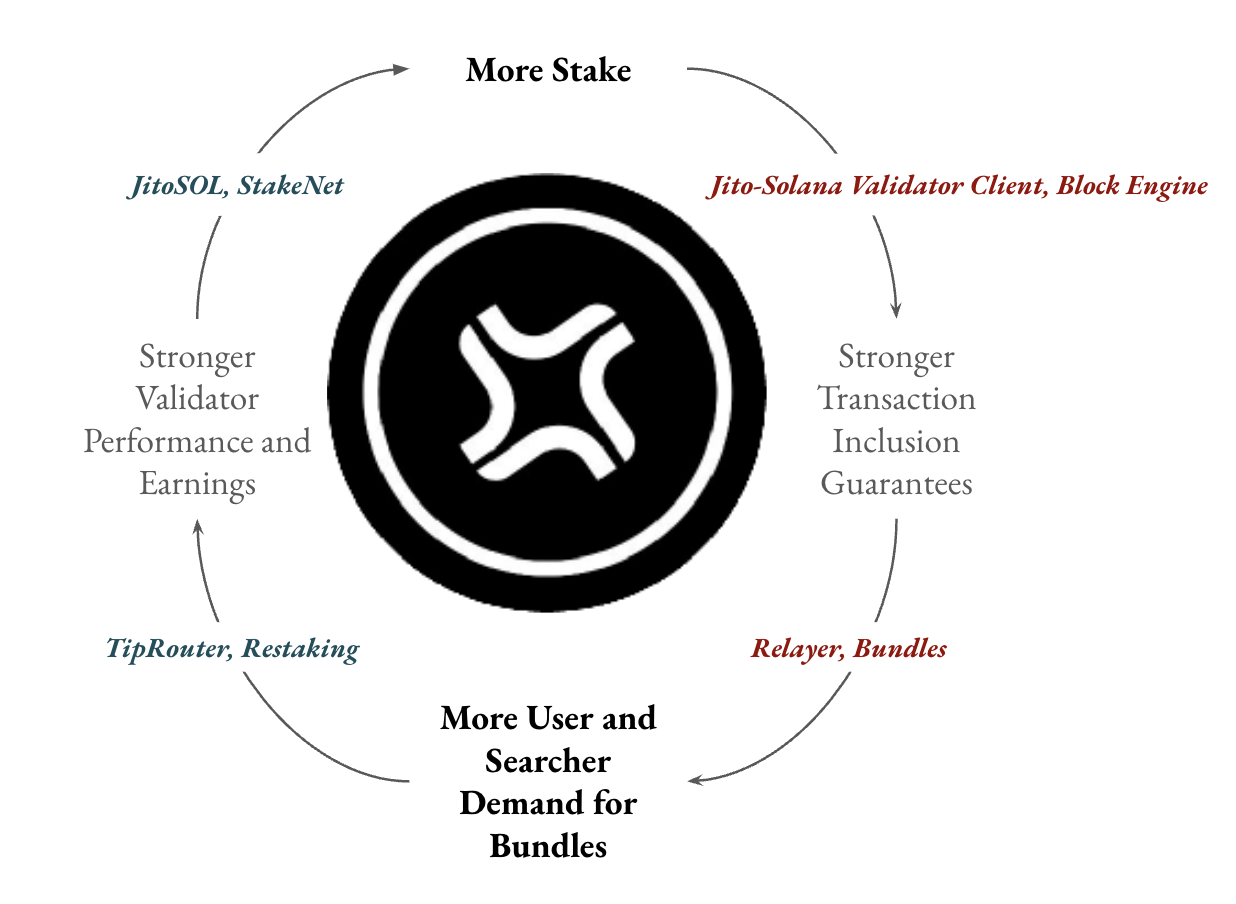
In the early days of Solana’s scaling journey, network congestion and unpredictable transaction sequencing plagued user experience. During this period, MEV (Maximum Extractable Value) emerged as both a challenge and an opportunity. Multicoin Capital recognized early on that MEV dynamics would dictate how value flows across asset ledgers. Through systems like the Jito-Solana Validator Client, Relayers, and Block Engines, Jito introduced an orderly framework for transaction bundling and MEV redistribution. By allowing searchers to bundle transactions and bid for block space transparently, Jito transformed chaotic mempool dynamics into a streamlined, predictable pipeline.
Phase 2: Scaling Up the Stack and Introducing Liquid Staking (2023–2024)
As transaction volumes exploded throughout 2024, value capture shifted decisively "up the stack" toward sequencing and infrastructure layers. Jito capitalized on this structural shift by expanding its product suite horizontally and vertically. The introduction of JitoSOL—the network’s liquid staking token—provided users with a way to earn staking yields while maintaining liquidity across Solana’s burgeoning DeFi ecosystem. Concurrently, the network scaled its validator adoption. By late 2024 and early 2025, over 94% of the total stake on Solana was running the Jito-Solana client, cementing its status as de facto standard infrastructure.

Phase 3: The Restaking Era and the $11.63 Bull Thesis (2025 and Beyond)
Entering 2025, Jito evolved beyond basic MEV and staking into advanced restaking architectures, deploying Node Consensus Networks (NCNs), TipRouter, and Jito Vaults. These innovations created recursive economic loops, incentivizing token utility and securing auxiliary networks. Recognizing these compounding network effects, Multicoin Capital finalized its exhaustive 45-page valuation model in March 2025. Setting a 7-day TWAP baseline of $2.61, the firm published its aggressive bull-case target of $11.63, underpinned by the explosive growth of Solana’s Internet Capital Markets.
Supporting Context & Metrics: Unpacking the Jito Architecture
To evaluate Multicoin’s thesis, one must examine the specific components that make Jito an economic powerhouse. Jito’s integrated software architecture can be broken down into three core pillars:
1. Transaction Processing and Block Production Architecture
At the root of Jito’s utility is its validator-facing infrastructure. The Jito-Solana Validator Client, working in tandem with the Jito Relayer, Shredstream, Block Engine, and Jito Bundles, solves Solana’s most complex bottleneck: ordering transactions around hotly contested states.
In a permissionless, high-performance ledger aiming for "Nasdaq speeds," handling extreme data ingress and egress with minimal latency is non-negotiable. Jito segments transactions by time preference. This capability stabilized Solana during periods of extreme market volatility, successfully preventing catastrophic network congestion and ensuring that priority transactions (such as liquidations or arbitrage orders) land reliably.
2. Staking Architecture (JitoSOL and Stakenet)
Jito’s liquid staking token, JitoSOL, has become a cornerstone of Solana DeFi. It is paired with Stakenet, an autonomous, decentralized stake delegation algorithm. Stakenet optimizes validator selection to maximize yields for stakers while decentralizing the network’s overall stake distribution. Because running the Jito-Solana client allows validators to capture more profitable MEV opportunities, validators are organically incentivized to adopt the software, creating an impenetrable moat of network security and liquidity.
3. Restaking Architecture (Node Consensus Networks, TipRouter, and Vaults)
Looking toward the future of cryptoeconomic security, Jito has rolled out restaking capabilities via Node Consensus Networks (NCNs). Utilizing TipRouter and Jito Vaults, the protocol allows users to restake their JitoSOL and JTO tokens to secure third-party services, data feeds, and decentralized networks. This unlocks incremental yield streams for stakers while reinforcing the structural lock-in of the Jito ecosystem.
The Metrics Driving the Valuation
The quantitative foundation of Multicoin’s report rests on Solana’s undisputed dominance in on-chain metrics:
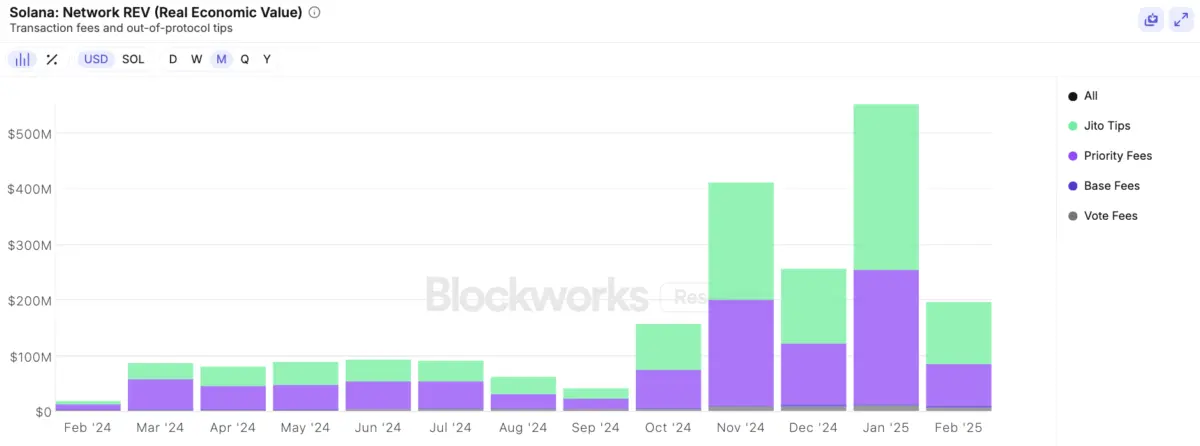
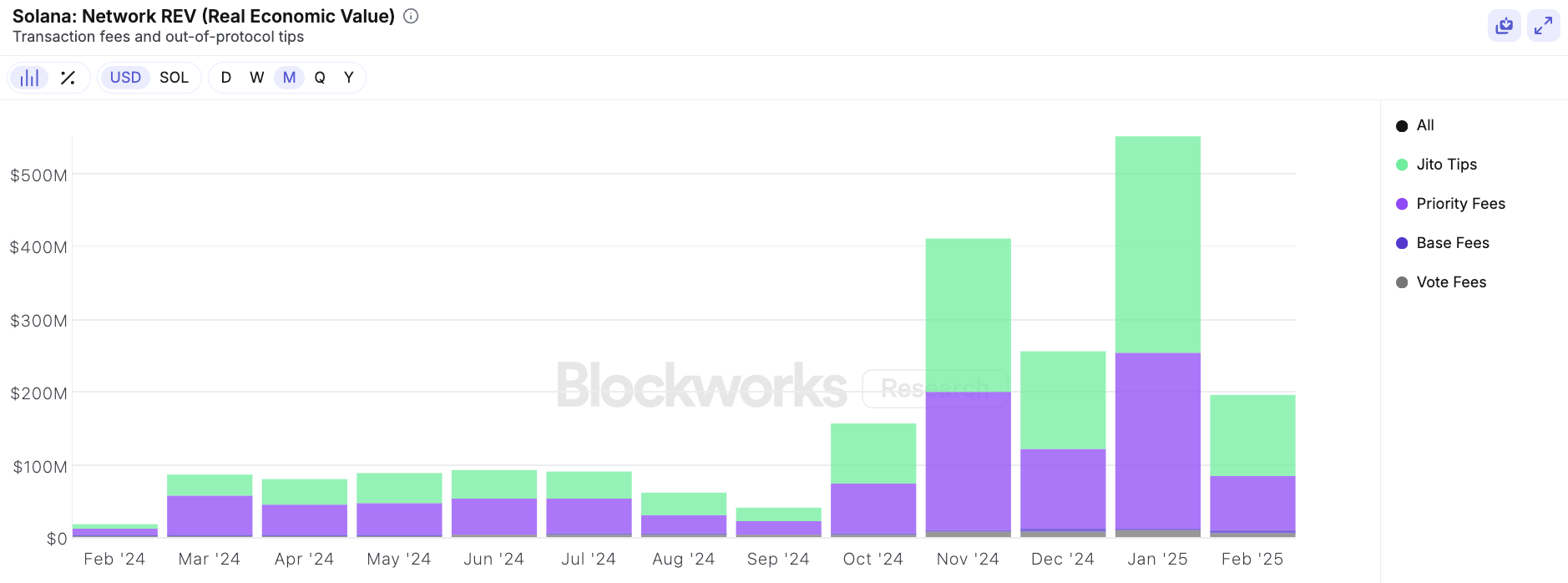
- Transaction Revenue (Real Economic Value): Starting in Q4 2024 and extending into 2025, Solana consistently surpassed all other major public blockchains in REV (excluding tips), as tracked by Blockworks Research and Dune Analytics.
- DEX Trading Volume: Per DefiLlama data, Solana commands the lion’s share of decentralized exchange volumes.
- Fee Dominance: More than half of all transaction fees on Solana are processed through the Jito system.
- Validator Penetration: Over 94% of Solana’s total stake runs the Jito-Solana client, ensuring unmatched reliability and low median fees during high-stress market events.
This robust throughput directly empowers Solana’s application layer, enabling high-performance derivatives exchanges (like Drift), decentralized physical infrastructure networks (DePINs such as io.net, Render, Hivemapper, GEODNET, and Helium), and spot asset issuance platforms (like Jupiter, Clearpools, and Backpack) to operate smoothly at scale.
Official Statements and Industry Insights
The release of Multicoin Capital’s comprehensive report has sent ripples through the broader digital asset community. Industry leaders have increasingly pointed to Jito as the definitive case study for how infrastructure protocols can capture value on high-performance execution layers.
In related ecosystem developments highlighting the explosive growth of Solana-adjacent infrastructure, Multicoin partner Shayon Sengupta noted the broader institutional push into high-utility token networks. Commenting on the firm’s strategic focus on assets that power physical and digital capital markets, Sengupta emphasized that the intersection of real-world utility and decentralized ledger mechanics represents the most asymmetric investment opportunity in crypto today.
While Multicoin’s asset report focuses heavily on Jito’s internal mechanics, the overarching message from fund leadership is clear: value capture is moving up the stack. Protocols that control the sequencing, validation, and MEV distribution layers will inevitably extract more economic value than the underlying applications or the base layer itself.
Jito’s core developers and contributors have consistently echoed this sentiment, emphasizing that decentralizing the transaction supply chain is the only way to scale public blockchains to billions of global users without sacrificing censorship resistance or performance.
Future Outlook: The Road to $11.63 and Beyond
As the crypto market structure matures throughout 2025, the convergence of high-speed trading, liquid staking, and modular restaking places Jito at the absolute center of gravity for Solana.
Multiple avenues of value accrual support Multicoin’s bull-case valuation of $11.63:
- Bundle Tips: As network activity increases, searchers will continue to pay premium tips for guaranteed block inclusion, directly benefiting Jito validators and token holders.
- Staking Yields: The organic compounding of JitoSOL adoption drives sustained demand for network security.
- Restaking Yields: NCNs and Jito Vaults unlock entirely new dimensions of economic throughput, turning passive token holdings into productive, yield-generating collateral.
However, analysts and investors are urged to review the granular assumptions embedded within Multicoin’s financial models. While the bull case outlines a lucrative 4.43x upside from the March 2025 baseline of $2.61, crypto markets remain inherently volatile, and outcomes depend heavily on sustained macroeconomic tailwinds, regulatory clarity, and Solana’s continued dominance over competing layer-1 networks.
Ultimately, Jito has transcended its origins as a niche MEV tool to become the indispensable operating system of Solana. For investors seeking asymmetric exposure to Internet Capital Markets, the thesis is unambiguous: Solana is the most productive blockchain in existence, and Jito is its beating heart.