


Executive Overview
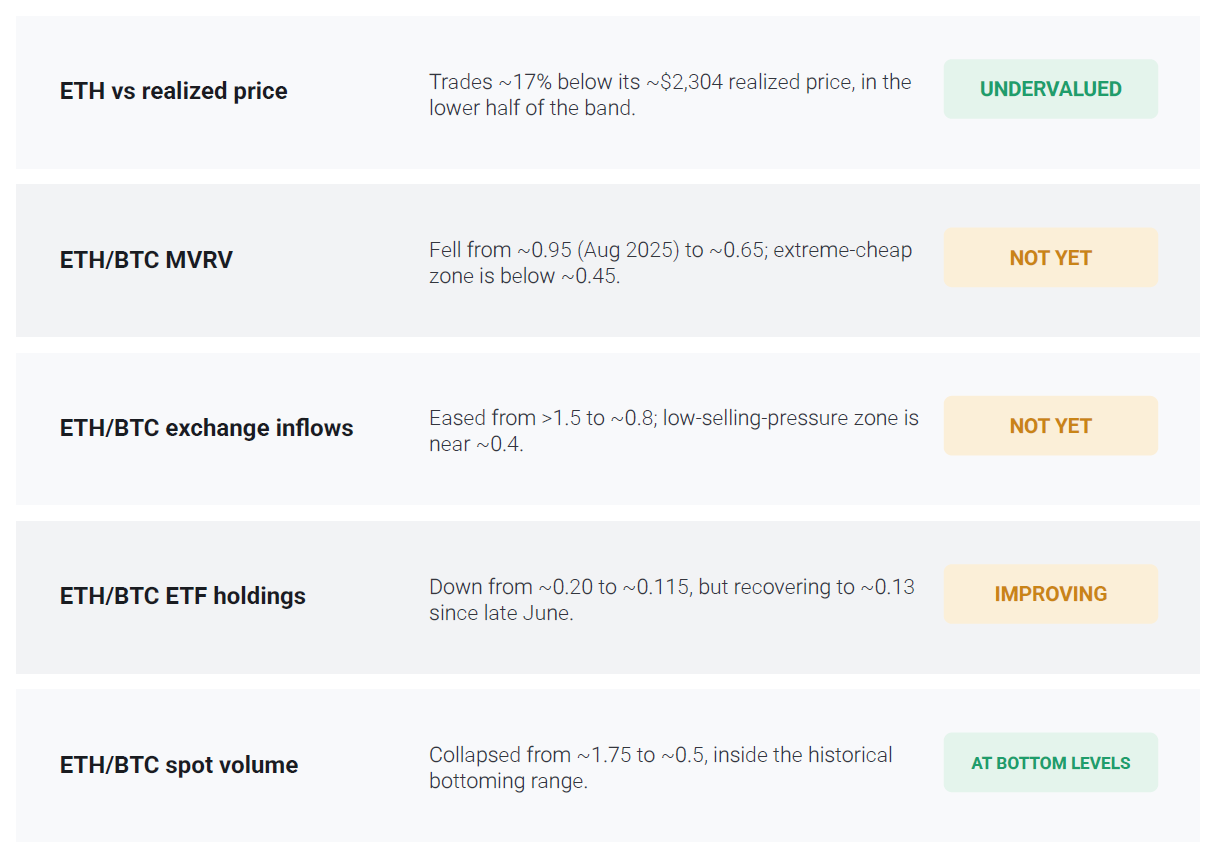
Despite these attractive valuation fundamentals, however, the overarching narrative is nuanced. CryptoQuant’s multi-variable framework reveals that while valuation models are flashing early green lights, the broader market has yet to carve out a definitive and absolute cycle low. Out of a comprehensive suite of five core bottoming indicators tracked by the analytics firm, only two have officially crossed into historical reversal territory. The remaining three metrics, while steadily improving and pointing in a constructive direction, have not yet reached the extreme bearish capitulation levels that traditionally characterize the ultimate bottom of a crypto winter or cyclical correction.
This complex market dynamic unfolds against a backdrop of shifting macroeconomic tailwinds, regulatory optimism inside the United States—specifically centered around the advancing US CLARITY Act—and an intensifying supply squeeze. With exchange outflows hitting multi-year highs, an unprecedented 34% of the total circulating Ethereum supply locked safely within staking contracts, and institutional heavyweights aggressively accumulating, the stage is set for a fascinating structural tug-of-war. This report offers a granular exploration of Ether’s current valuation, the underlying onchain metrics, institutional behavior, and the forward-looking market outlook.
Detailed Chronology of Recent Market Movements
To fully understand Ether’s current positioning, it is necessary to trace the sequence of events, price actions, and onchain milestones that have defined the market landscape over recent weeks.
Early July: The Catalyst of Supply Compression
As the calendar turned to July, the Ethereum ecosystem began displaying anomalous yet profoundly constructive onchain behaviors. During the week commencing June 29, withdrawal activity on Binance—the world’s largest cryptocurrency exchange by trading volume—experienced a dramatic surge. Data compiled by blockchain sleuths indicated that ETH withdrawals on the platform climbed to their highest absolute level in more than three years.
In traditional financial markets, massive exchange outflows are universally interpreted as a flight to safety. Within the digital asset space, this behavior signifies that investors are systematically moving their tokens away from centralized trading venues and into self-custody cold storage or decentralized staking pools. While such movements do not automatically guarantee immediate accumulation or aggressive buying, they effectively neutralize immediate spot selling pressure, shrinking the liquid supply available on order books.
Mid-July: Regulatory Optimism and Price Rebounds
By mid-July, macro and legislative factors began to inject fresh bullish sentiment into the broader digital asset economy. Sparked by growing optimism surrounding the imminent progression of the US CLARITY Act through legislative channels, cryptocurrency markets experienced a coordinated relief rally. Bitcoin surged past the psychological $67,000 resistance level, while Ether managed to break out of its protracted consolidation range, briefly climbing above the $1,950 threshold.
Concurrently, market observers began tracking potential capital rotation narratives. With traditional equity markets experiencing bouts of fatigue in richly valued artificial intelligence (AI) stocks, analysts increasingly pointed to the possibility of institutional capital rotating out of the tech sector and into the alternative asset classes of crypto. Should this macro risk-on appetite broaden, Ether—trading at a severe discount relative to its historical metrics—stands to capture a disproportionate share of incoming liquidity.
Late July: Staking Milestones and Corporate Accumulation
As July progressed toward its final weeks, structural supply tightening reached new milestones. Staking Rewards data confirmed that a record-shattering 34% of the entire circulating Ethereum supply was now actively locked up in staking contracts. This massive immobilization of capital means that more than a third of all existing ETH is entirely removed from active daily circulation, earning yields while simultaneously insulating the asset from sudden, panic-driven liquidations.

Adding fuel to this supply crunch, institutional and corporate entities intensified their buying campaigns. Notably, Tom Lee’s Bitmine Immersion Technologies—widely recognized as the single largest corporate holder of Ether—continued its relentless accumulation strategy. Despite sitting on substantial unrealized losses from previous acquisitions, the firm aggressively boosted its treasury holdings by an astounding 325,000 ETH over a compressed one-month window. Bitmine’s long-term corporate mandate remains fixed on capturing a staggering 5% of the total circulating supply of the world’s second-largest cryptocurrency, underscoring profound institutional conviction regardless of short-term price fluctuations.
Supporting Context & Onchain Metrics
The quantitative backbone of the current Ethereum analysis relies heavily on onchain data, valuation ratios, and comparative studies against Bitcoin. CryptoQuant’s weekly reports provide an invaluable window into the health, sentiment, and structural integrity of the Ethereum network.
The Realized Price and Undervaluation
The most striking metric highlighted by CryptoQuant is Ether’s position relative to its realized price. Currently hovering around $2,300, the realized price calculates the onchain cost basis of every single ETH token based on the exact timestamp it last moved on the blockchain. With ETH trading roughly 17% below this figure, historical precedent suggests the asset is entering deep value territory. In past cycles, trading below the realized price has consistently marked the accumulation zones favored by long-term “smart money” investors before subsequent macro expansions.
+-------------------------------------------------------------------------+
|                  ETH VALUATION & ONCHAIN HEALTH MATRIX                  |
+------------------------------+------------------------------------------+
| Metric                       | Current Status / Observation             |
+------------------------------+------------------------------------------+
| Realized Price               | ~$2,300 (ETH trading ~17% below)         |
| MVRV Ratio (ETH/BTC)         | Declined from ~0.95 (Aug 2025) to ~0.65  |
| Staking Participation        | Record 34% of circulating supply locked  |
| Exchange Outflows            | 3-year high recorded on Binance          |
| Bottoming Indicators Confirmed| 2 out of 5 historical reversal levels   |
+------------------------------+------------------------------------------+
The ETH/BTC MVRV Compression
The relationship between Ether and Bitcoin has also undergone a dramatic structural shift. The Market Value to Realized Value (MVRV) ratio for ETH relative to BTC has retreated sharply. Specifically, the ETH/BTC MVRV ratio plummeted from a local peak of nearly 0.95 in August of the previous year down to approximately 0.65.
This contraction visually demonstrates that Ethereum has become substantially cheaper when priced against Bitcoin. Historically, when the ETH/BTC MVRV ratio compresses into this specific range, it signals that the pendulum of market outperformance has swung too far in favor of Bitcoin, creating an asymmetric, high-probability entry point for traders looking to rotate capital back into Ethereum ahead of a trend reversal. Furthermore, exchange-traded fund (ETF) holdings, which suffered months of persistent outflows and sluggish demand, have finally begun to stabilize and show early signs of net recovery. Concurrently, spot trading volumes for the ETH/BTC trading pair have compressed into historical ranges that have previously marked definitive market bottoms.
The Five-Indicator Conundrum
Despite these overwhelmingly positive underlying metrics, CryptoQuant’s analysts urge caution, emphasizing that the market structure is not yet fully mature. Out of the firm’s five designated bottoming indicators—which collectively measure metrics such as derivatives leverage, miner/validator capitulation, network activity, valuation ratios, and exchange reserves—only two have officially triggered historical reversal levels.
The remaining three indicators are displaying positive trajectories but have yet to register the extreme statistical readings that typically accompany true market capitulation. This divergence implies that while Ethereum is undeniably cheap and fundamentally robust, the final stages of the bottom-forming process may require additional time, consolidation, or a final flush of lingering leveraged positions before a sustained bull run can officially launch.
Official Statements and Industry Insights
Market participants, analysts, and blockchain research institutions have weighed in heavily on the current bifurcation between favorable onchain valuations and lagging macroeconomic confirmation.
CryptoQuant Analytics Team
In their widely circulated weekly briefing, CryptoQuant’s research analysts emphasized the dual nature of the current market cycle:
"Ether is undoubtedly presenting an attractive proposition from a valuation standpoint, trading at a notable discount to its aggregate onchain acquisition cost. However, structural cycle bottoms are rarely instantaneous events. While foundational metrics like the MVRV ratio, falling exchange inflows, and rebounding ETF holdings point to a maturing market base, the reality that only two of our five key bottoming indicators have been confirmed suggests patience is required as the final phase of the cycle bottom takes shape."
Onchain Analysts on Supply Dynamics
Commenting on the massive movement of tokens off centralized exchanges and into staking protocols, independent market structure analysts noted:
"When you combine a 3-year high in exchange withdrawals with a staggering 34% of total supply locked up in staking contracts, you are looking at an engineered supply squeeze. The amount of liquid ETH available to absorb sudden market demand is historically low. If macroeconomic headwinds clear and institutional capital begins flowing in earnest through vehicles like corporate treasuries and spot ETFs, the velocity of an upside price breakout could catch many market participants off guard."
Future Outlook & Market Implications
As the cryptocurrency market navigates the second half of the year, the trajectory for Ether hinges upon the convergence of onchain supply dynamics, macroeconomic shifts, and regulatory clarity.
Short-Term Headwinds vs. Long-Term Accumulation
In the immediate short term, traders must remain cognizant of the warning embedded within CryptoQuant’s data: the market may not have reached its definitive absolute low. The fact that three out of five bottoming indicators have yet to touch historical extremes leaves the door open for potential volatility, sudden re-tests of lower support levels, or prolonged sideways consolidation. Macroeconomic uncertainties, regulatory bottlenecks, and shifting risk appetites across global financial markets will continue to dictate day-to-day price action.
The Bullish Structural Horizon
Conversely, the long-term structural outlook for Ethereum remains exceptionally robust. The persistent accumulation by corporate giants like Bitmine Immersion Technologies, combined with an unprecedented 34% staking saturation rate, points to a fundamental paradigm shift. Institutional investors are no longer treating Ether purely as a speculative trading instrument; instead, they are viewing it as a yield-bearing, deflationary digital settlement layer that warrants deep, long-term treasury allocation.
As regulatory frameworks in key jurisdictions like the United States edge closer to formalization—exemplified by discussions surrounding the US CLARITY Act—the institutional road map for digital asset adoption becomes increasingly clear. Should capital successfully rotate out of overextended traditional equities and into the digital asset ecosystem, Ethereum’s deeply discounted valuation relative to both its realized price and Bitcoin positions it perfectly to capture immense upside value.
Ultimately, while the final strokes of Ethereum’s cycle bottom are still being painted on the onchain canvas, the underlying fundamentals suggest that patient accumulators are being handed a historically validated entry window into the future of decentralized infrastructure.