


Executive Overview
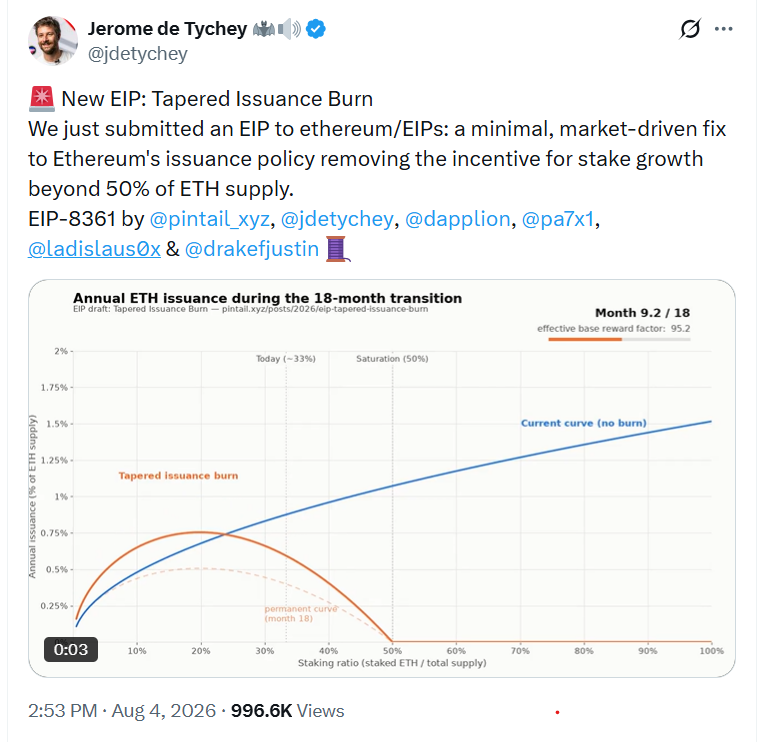
Authored by prominent figures within the ecosystem—including Ethereum Foundation researcher Justin Drake and Ethereum Community Conference (ETHCC) co-founder Jerome de Tychey—the proposal is built on a simple premise: Ethereum has reached a point of maturation where additional staking yields diminishing security returns while unnecessarily diluting non-stakers. In essence, the authors argue that the network is paying an exorbitant, unjustifiable premium for a level of security it no longer requires.
However, this ideological vision of a leaner, more economically efficient blockchain has met with fierce, coordinated resistance. From decentralized finance (DeFi) architects and institutional custodians to independent solo validators and liquid staking providers, critics contend that EIP-8363 is a solution in search of a problem. Opponents warn that tampering with foundational issuance schedules risks destabilizing institutional confidence, crushing the sprawling yield-bearing DeFi markets built on top of liquid staking tokens (LSTs), and inadvertently concentrating power in the hands of mega-validators.
As the dust settles from the initial shockwaves of the proposal’s rollout, the broader Ethereum community is left grappling with a fundamental question: Is the network genuinely over-staked and over-paying, or does EIP-8363 threaten to dismantle the very pillars that drive Ethereum’s massive adoption?
Detailed Chronology: From Concept to Community Upheaval
The controversy surrounding EIP-8363 erupted seemingly overnight, catching much of the ecosystem flat-footed and exposing deep ideological fractures within the Ethereum community.
The Spark and the Rationale
The proposal was published in mid-2026, dropping just days before a critical Aug. 6 deadline for submissions to be considered for the network’s upcoming major upgrade. Authored by Justin Drake, Jerome de Tychey, and collaborators, EIP-8363 outlines a dynamic issuance curve. As the total amount of staked ETH scales upward toward a 50% threshold of the aggregate supply, the protocol rewards given to validators would progressively shrink.
The rationale behind the timing and mechanism is rooted in post-Merge economic realities. Since transitioning to Proof-of-Stake (PoS), Ethereum has successfully secured its ledger with tens of millions of locked ETH. Proponents of the Tapered Issuance Burn argue that continuing to aggressively incentivize further capital locking is economically redundant. Furthermore, they argue that high issuance functions as a form of "stealth tax" on holders who prefer to keep their assets liquid, unfairly diluting their purchasing power to pay for a security margin that yields marginal risk reduction.
The Immediate Backlash
Despite the pedigree of its authors, the reaction from the broader ecosystem was swift, visceral, and overwhelmingly negative. Critics pointed out the severe irony of dropping a proposal with multi-billion-dollar implications for the entire decentralized economy on such an abbreviated timeline.
Social media channels and developer forums immediately lit up with sharp rebukes. DeFi leaders, who rely heavily on predictable baseline yields and liquid staking integrations, argued that the proposal fundamentally misunderstood the symbiotic relationship between staking and the broader Ethereum application layer. What started as a technical debate over validator economics rapidly morphed into a referendum on governance transparency, monetary predictability, and the socio-economic contract binding the Ethereum Foundation to its users.

Supporting Context & Metrics: Is Ethereum Really Over-Staked?
To evaluate the merits of EIP-8363, one must examine the current state of Ethereum’s validator pool and macroeconomic profile.
The Numbers Behind the Staking Boom
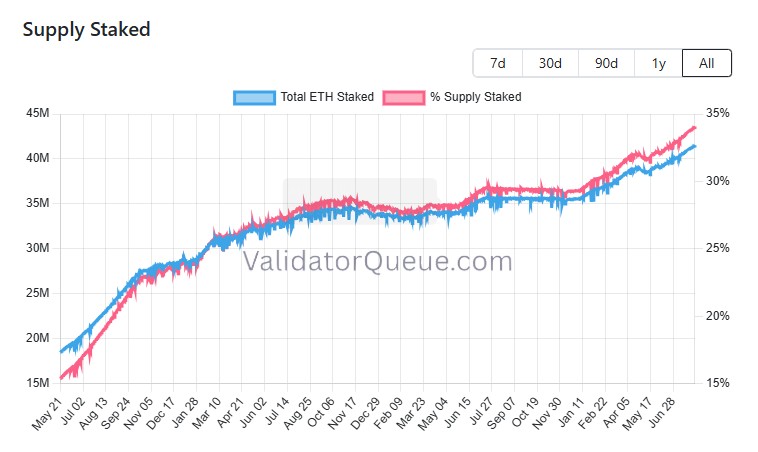
According to metrics from the Ethereum Validator Queue, the network currently boasts roughly 41.5 million ETH staked, yielding an average annual return of 2.67%. This accounts for an impressive 34.07% of the entire circulating ETH supply.
Following explosive growth earlier in the year—which saw total staked volume surge by roughly 15%—proponents of EIP-8363 argue that the network is hurtling toward an unsustainable trajectory of capital lockup.
Conversely, market analysts argue that these fears are overblown and mathematically misread natural market plateaus. Dr. Steve Berryman, Head of Client Partnerships for Ethereum at Bitwise, points out that market forces are already acting as a natural brake on staking participation.
"We will come to a natural ceiling probably by the end of this year," Berryman notes, explaining that as yields compress toward the 2% mark, the marginal incentive to lock up liquidity evaporates for a significant portion of holders. "People need a certain amount of liquidity," he adds, noting that recent inflows have been driven primarily by institutional giants—such as Bitmine and BlackRock—completing their initial portfolio allocations, a wave that is inherently finite.
The Inflation and "Stealth Tax" Debate
Supporters of the Tapered Issuance Burn often frame current issuance as a burden on non-stakers. However, independent commentators like Leo Lanza push back against this narrative, noting that Ethereum’s annual inflation rate remains comfortably below 1%.
To put this in perspective, even traditional hard assets viewed as premier global stores of value, such as physical gold, experience an annual supply expansion of roughly 1% to 2%. Lanza argues that artificial intervention via EIP-8363 is entirely unnecessary:
"The free market already solves this […] Let the market adjust."
Official Statements and Stakeholder Perspectives
The debate over EIP-8363 has created strange bedfellows, uniting institutional asset managers, independent solo stakers, and decentralized finance pioneers in common opposition to the Ethereum Foundation’s proposals.
Institutional Anxiety and Monetary Predictability
For institutions deploying capital at scale, predictability is valued far above marginal yield optimizations. Introducing a dynamic, shifting issuance curve injects a heavy dose of regulatory and operational uncertainty into boardrooms.
"Institutional adoption requires certainty, and playing with the issuance at the margin would cause uncertainty, and institutions hate uncertainty," Dr. Steve Berryman tells Magazine. He underscores that institutions stake ETH not necessarily chasing high-risk double-digit yields, but to capture a predictable return while holding a foundational asset. "It’s not broken, why try and fix it?"
Mike Silagadze, founder of Ether.fi, shares this grim assessment of the proposal’s potential fallout, warning that it damages the network’s hard-won reputation for stability:
"This is so disappointing on every level. […] This is bad for decentralization, this is bad for Ethereum adoption, and this is bad for the credibility of the network. Any nation-state or large institution looking at this will justifiably have a dramatic loss of confidence in the governance and stability of Ethereum."
The DeFi Collateral Crisis
Beyond institutional balance sheets, the heartbeat of Ethereum’s application layer—DeFi—relies heavily on liquid staking derivatives (LSTs and LRTs) to function as baseline collateral, liquidity pools, and yield-bearing instruments across lending markets like Aave, Maker, and Compound.
Stani Kulechov, founder of Aave, cautioned that penalizing or actively reducing staking rewards could trigger an adverse capital flight out of the ecosystem entirely:
"My concern is… those who are fine with ETH beta and yield might also sell ETH for other yielding assets […] Ethereum should not be punished for its growth."
Silagadze echoes this sentiment bluntly, noting, "It will obviously kill a huge chunk of DeFi which is built around the staking ecosystem."
Beyond Slashable ETH: The True Cost of Decentralization
Greg Koumoutsos, Technical Research Lead at the Lido Labs Foundation, argues that the fundamental premise of EIP-8363 suffers from a narrow definition of what validator issuance actually purchases for the network. While acknowledging that proactively discussing high staking ratios is healthy, Koumoutsos warns against economic reductionism:
"Ethereum is not only paying for slashable ETH; it is paying for decentralization, operator diversity, censorship resistance, and network resilience."
Koumoutsos highlights a critical, often-overlooked paradox: reducing rewards could actually exacerbate centralization rather than cure it.
Independent solo stakers bear real operational, hardware, and maintenance costs without the financial cushion of economies of scale. While ideological solo validators may grit their teeth and stay online, marginal solo operators will find the enterprise uneconomical, halting new independent entrants. Meanwhile, centralized exchanges, massive custodial staking operations, and large liquid staking protocols often maintain staking infrastructure for reasons entirely decoupled from pure protocol yield—such as customer retention, ecosystem positioning, and product integration. Consequently, lower issuance punishes the small decentralized actor while corporate giants easily weather the storm.
Future Outlook: Where Does Ethereum Go From Here?
The fierce firestorm ignited by EIP-8363 serves as a stark reminder of the immense difficulty inherent in governing a decentralized, multi-billion-dollar global economic engine. As blockchain networks mature, simple technical adjustments cease to be purely academic exercises; they ripple outward, directly impacting complex ecosystems of lenders, borrowers, institutional investors, and independent operators.
Whether EIP-8363 manages to claw its way through the pipeline or is permanently shelved as a well-intentioned misfire, the debate has permanently shifted the discourse around Ethereum’s monetary policy. It has forced the community to explicitly define what Ethereum is striving to be: an ultra-sound, hyper-optimized monetary asset mirroring corporate balance sheet conservatism, or a sprawling, vibrant, yield-generative platform that prioritizes expansive economic activity and developer flexibility above monetary purity.
For now, the message from the market is deafeningly clear. As stakeholders continue to push back against top-down economic tinkering, the Ethereum ecosystem has made it known that when it comes to the delicate machinery of network security and decentralized finance, stability is the ultimate currency.