


Executive Overview
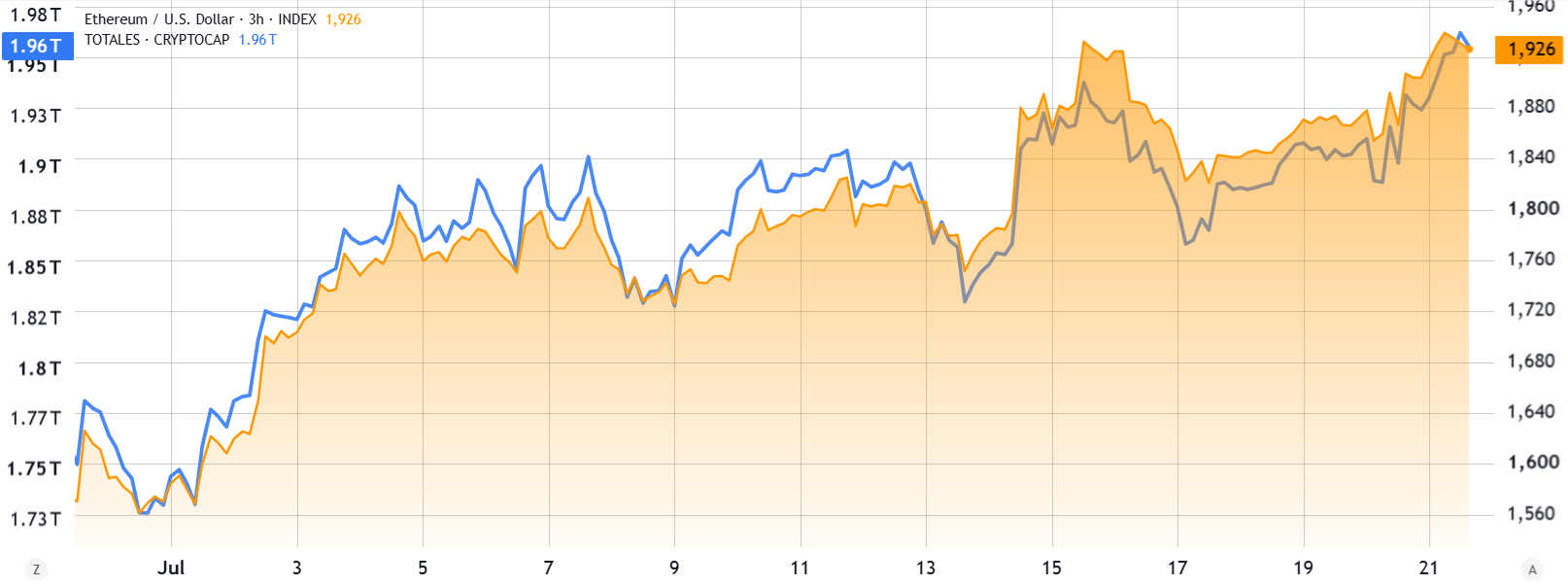
The recent bullish surge marks a remarkable 29% recovery from its multi-month low of $1,500 recorded on June 26. This upward trajectory has largely mirrored a broader risk-on sentiment across traditional and digital asset markets, a shift that simultaneously propelled Bitcoin (BTC) past the $66,500 mark. As market participants survey the landscape, a burning question dominates crypto trading desks: Can ETH maintain its momentum and successfully punch through the psychological and technical resistance level at $2,100?
While macroeconomic factors—such as stabilizing equity markets and anticipation surrounding major corporate earnings reports—have injected fresh liquidity into crypto assets, Ethereum’s internal metrics tell a more cautious story. Onchain activity remains subdued, decentralized application (DApp) revenues have hit multi-month lows, and derivatives markets continue to exhibit a degree of hesitation. However, record-breaking Ethereum staking rates and aggressive accumulation by institutional whales suggest that long-term conviction remains robust.
This comprehensive analysis examines the macro catalysts driving Ether’s recent price recovery, dissects the lagging onchain fundamentals, evaluates derivatives market sentiment, and explores the key technical hurdles standing between ETH and a sustained rally toward $2,100.
Detailed Chronology: The Road to $1,950
The June 26 Pivot Point
The foundation for Ether’s recent resurgence was laid in late June. On June 26, ETH dipped to a local low of $1,500, a level that severely tested the resolve of retail and institutional investors alike. The downward spiral was compounded by a broader cooling period in global risk assets, lingering skepticism over regulatory frameworks, and a general lack of speculative appetite for altcoins.
However, this capitulation phase ultimately cleared out over-leveraged long positions and set the stage for a classic contrarian bounce. As selling pressure began to exhaust itself, dip-buyers stepped in, initiating a gradual accumulation phase that laid the groundwork for July’s relief rally.
The July Macro Shift and Traditional Markets
Ether’s price trajectory during July has been tightly correlated with the broader macro economy. The general crypto market trend shifted into positive territory as fears surrounding stretched valuations in traditional equities—particularly the red-hot artificial intelligence (AI) stock sector—began to dissipate.

A pivotal moment in this market psychology shift occurred on Tuesday morning, when industrial giant 3M Company (MMM US) reported robust quarterly earnings. The strong report eased investor anxieties regarding corporate profitability, instilling confidence that traditional markets could absorb high interest rates and economic headwinds without entering a severe downturn.
This renewed stability in traditional equities bled directly into the digital asset class. As capital flowed freely back into risk-on assets, Bitcoin breached $66,500, dragging Ether along in its wake. On Tuesday, ETH officially pierced the $1,950 mark, punishing short-sellers who had bet on a continuation of the mid-year downtrend and liquidating roughly $62 million in bearish derivatives contracts.
The Alphabet Catalyst and Tech Earnings
As the dust settles on Tuesday’s rally, market attention has shifted squarely toward Wednesday’s after-hours earnings report from Google’s parent company, Alphabet. Wall Street analysts and crypto market makers alike are closely monitoring Alphabet’s earnings, particularly anticipating a projected 64% year-over-year growth in cloud services revenue driven by massive capital expenditures in AI infrastructure.
For cryptocurrency investors, traditional tech earnings serve as a proxy for overall liquidity conditions and institutional risk appetite. A stronger-than-expected report from Alphabet could solidify investor confidence, potentially pushing the total cryptocurrency market capitalization past the coveted $2 trillion threshold. Conversely, any earnings misses or cautious forward guidance could trigger a sudden risk-off rotation, threatening Ether’s fragile gains near the $2,000 psychological barrier.
Supporting Context & Metrics: The Dichotomy Between Price and Utility
While Ether’s price performance paints an encouraging picture for swing traders and short-term speculators, a deep dive into Ethereum’s onchain metrics and derivatives data reveals a stark disconnect. The network’s core fundamental activity has yet to catch up with its valuation gains.
Stagnant Onchain Demand and DApp Revenue Slumps
Demand for block space and blockchain processing power on the Ethereum network remains notably depressed compared to levels observed six months ago. Much of this stagnation can be attributed to waning retail and speculative interest in memecoins, governance tokens, and niche utility assets.
The cooling of speculative fervor has taken a heavy toll on some of Ethereum’s most prominent decentralized finance (DeFi) projects. Several leading tokens within the ecosystem have experienced catastrophic drawdowns, posting losses of 50% or more year-to-date. Assets such as Ethena (ENA), Mantle (MNT), and Arbitrum (ARB) have struggled to recapture their previous highs, reflecting a broader capital rotation away from mid-cap altcoins and toward established blue-chip assets like Bitcoin and Ether.
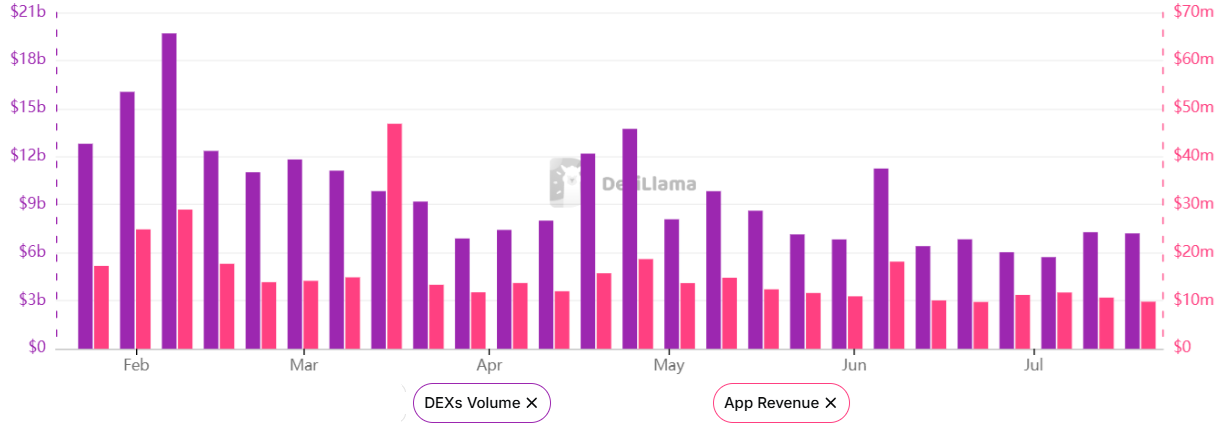
Furthermore, financial data from DefiLlama highlights a troubling trend in application-layer revenue. Weekly revenue for Ethereum decentralized applications (DApps) plummeted to $9.8 million—the lowest level recorded since September 2024. Within this shrinking revenue pool, only a handful of protocols are demonstrating consistent economic viability. Sky (formerly MakerDAO) emerged as a top performer, generating $3.2 million in weekly revenue, followed by Oracle network Chainlink, which brought in $1.2 million over the same period. Meanwhile, decentralized exchange (DEX) trading volumes across the Ethereum ecosystem contracted to $7.2 billion per week.
Subdued Derivatives Markets and Perpetual Funding Rates
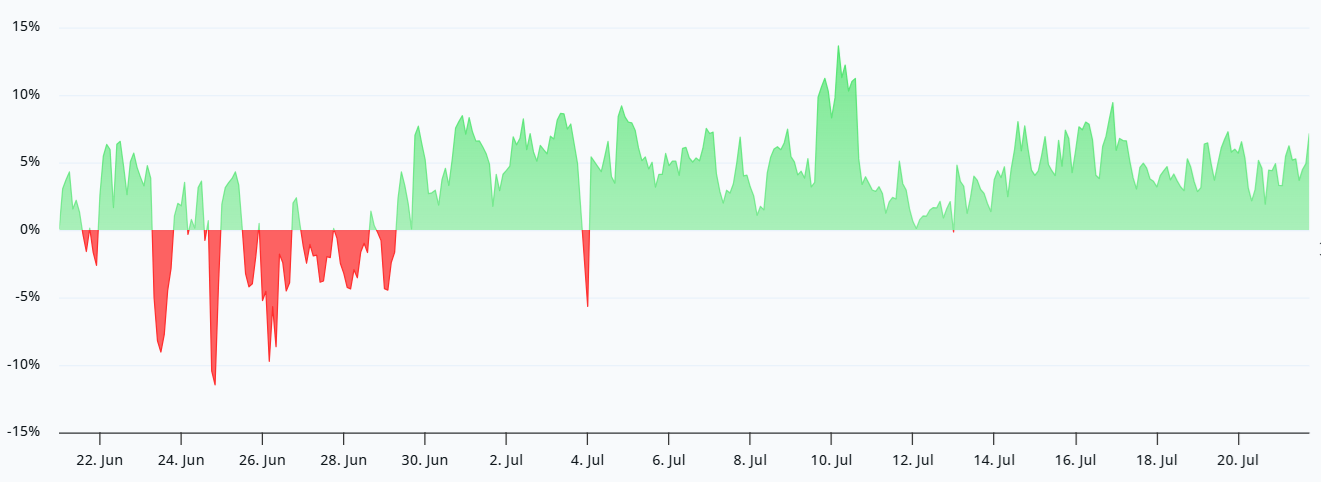
Ethereum’s sluggish onchain fundamentals are directly mirrored in the behavior of its derivatives markets. Over the past month, the annualized funding rate on ETH perpetual futures has struggled to maintain a consistent footing within the historical neutral range of 6% to 12%.
While market sentiment has undeniably improved since late June—when persistently negative funding rates signaled overwhelming bearish positioning and aggressive short selling—traders remain cautious. The absence of elevated, sustained positive funding rates indicates that leveraged bulls are hesitant to deploy aggressive long strategies, remaining wary of sudden macroeconomic shocks or a failure to break key technical resistance zones.
Record Stacking and Whale Accumulation as a Counterweight
Despite muted derivatives activity and soft onchain metrics, a powerful supply-side dynamic is quietly reshaping Ethereum’s market structure: institutional and long-term staking accumulation.
According to data from Staking Rewards, a record-breaking 34% of the entire circulating ETH supply is now locked in staking contracts, up from 33% just one month prior. This massive reduction in liquid supply has created a formidable structural buffer against sudden sell-offs.
Market analysts emphasize that as long-term holders and institutional entities continue to lock up supply, potential selling pressure is drastically curtailed. A prime example of this trend is institutional whale activity, such as Tom Lee’s Bitmine Immersion (BMNR US), which aggressively accumulated 156,719 ETH over the past month. Corporate treasuries and institutional funds of this caliber now control roughly 4.8% of the total available supply, signaling intense long-term confidence that completely contrasts with short-term retail apathy.
Official Statements and Industry Insights
Market strategists, DeFi founders, and institutional analysts have offered diverse perspectives on Ethereum’s current trajectory, balancing macro optimism against onchain reality checks.
Industry analysts tracking the intersection of traditional equities and digital assets have emphasized the catalytic role of corporate earnings in shaping crypto liquidity. In recent commentary regarding the tech sector’s influence on digital assets, market observers noted:
"The stabilization of risk-on sentiment in equities is acting as the primary oxygen tank for the crypto market. When tech giants like Alphabet and industrial bellwethers like 3M post solid results, it removes the immediate fear of a macro liquidity crunch, giving speculative capital the green light to re-enter high-beta assets like Ethereum."
At the same time, DeFi developers and infrastructure researchers have pointed out the structural evolution of the Ethereum network, particularly regarding layer-2 scaling solutions and changing user behaviors. Addressing the slump in DApp revenues and transaction volumes, senior ecosystem contributors have argued that activity has not disappeared entirely, but rather migrated:
"The narrative that Ethereum is dying because layer-1 DApp revenues are down misses the forest for the trees. Activity has largely scaled out to layer-2 rollups like Arbitrum, Optimism, and Base. While this temporarily dampens base-layer fee generation and burn rates, it secures Ethereum’s long-term dominance as the premier settlement layer for global tokenized value."
Meanwhile, derivatives traders and institutional allocators focusing on supply dynamics highlight the unprecedented staking figures as a crucial safety net. One prominent crypto fund manager remarked:
"With 34% of ETH locked in staking contracts and institutional accumulation running hot, the floating supply available on centralized exchanges is at historic lows. All it takes is a minor spark in retail demand to trigger a violent supply squeeze. If ETH clears $2,000 decisively, the technical path toward $2,100 and beyond is remarkably unobstructed by heavy sell walls."
Future Outlook: Can ETH Sustain Its Climb to $2,100?
As Ether trades near multi-week highs, the road ahead remains defined by a complex interplay of macroeconomic catalysts, institutional accumulation, and technical resistance levels.
Key Technical Levels to Watch
- Immediate Resistance ($1,950 – $2,000): This zone represents the critical psychological and technical barrier where short positions were recently liquidated. A confirmed daily and weekly candle close above $2,000 will invalidate the multi-month bearish structure and open the door for a rapid advance toward the $2,100 target.
- Primary Support ($1,750 – $1,800): Should macro headwinds return—such as disappointing tech earnings or unexpected regulatory hurdles—ETH will likely retrace to test this intermediate support band. A breakdown below $1,750 could expose the asset to a retest of the June lows near $1,500.
- All-Time High Context: It is vital to contextualize current price action: ETH remains approximately 61% below its all-time high recorded in August 2025. This steep discount explains why retail enthusiasm and derivatives euphoria remain subdued compared to previous bull cycles.
The Verdict on the $2,100 Target
Ultimately, whether Ether can successfully conquer the $2,100 resistance level depends heavily on the continued decompression of risk aversion across global financial markets. Wednesday’s earnings guidance from Alphabet and ongoing macroeconomic data releases will serve as the immediate litmus test for market liquidity.
While Ethereum’s onchain metrics and DApp revenues show undeniable signs of fatigue and structural transition, the simultaneous surge in staking participation to 34% and aggressive corporate accumulation provide a sturdy floor. If macro tailwinds persist and institutional buyers continue to absorb liquid supply, Ether may soon prove its skeptics wrong, turning its recent relief rally into the catalyst for a sustained multi-month recovery.
Disclaimer: This article is produced in accordance with strict editorial guidelines and is intended solely for informational purposes. It does not constitute financial, legal, or investment advice. Cryptocurrency markets carry inherent volatility and risk; readers are strongly encouraged to conduct independent research and consult with qualified financial professionals before making any investment decisions.