

Executive Overview
This unprecedented multilateral strike marks a fundamental evolution in how Western governments combat systemic cyber threats. Rather than focusing exclusively on individual hackers or isolated malware strains, global enforcement agencies are systematically dismantling the entire cybercrime supply chain. By simultaneously targeting bullet-proof hosting providers, clandestine virtual private network (VPN) services, malware-as-a-service (MaaS) platforms, and senior syndicate administrators, the U.S., EU, and U.K. are starving transnational threat groups of the operational scaffolding required to execute high-stakes ransomware campaigns.
At the heart of this multi-agency offensive is the formal identification and public designation of Vitaly Nikolayevich Kovalev—better known by his primary alias, "Stern"—a Russian national identified as the high-ranking administrator and "CEO-like" figure of the notorious Trickbot criminal syndicate. Through cryptocurrency tracking and leaked internal communications, investigators have linked Stern to individual wallet receipts exceeding $300 million in ransom payouts, establishing him as arguably the most prolific and financially successful ransomware operator ever unmasked.
Detailed Chronology and Enforcement Actions
The July 13 designations represent the culmination of years of meticulous intelligence gathering, international police collaboration, and on-chain forensic analysis. To fully appreciate the magnitude of this offensive, it is necessary to examine the chronological escalation of pressure applied by Western authorities against these cyber syndicates.
The Evolution of Trickbot Sanctions (2023–2026)
The groundwork for the 2026 sanctions was laid in early 2023. On February 9, 2023, the U.S. Department of the Treasury’s Office of Foreign Assets Control (OFAC)—acting in tandem with the U.K.’s Office of Financial Sanctions Implementation (OFSI)—issued initial sanctions against key members of the Trickbot cybercrime organization. Over the course of that year, additional tranches of sanctions followed, targeting 7 members in early 2023 and another 11 in September 2023, bringing the total number of officially designated Trickbot operatives to 18.
However, a critical missing piece in the regulatory puzzle was the formal European Union designation and the public linkage of the elusive alias "Stern" to a real-world identity. While OFAC and OFSI previously flagged illicit wallets associated with the moniker, the EU’s July 2026 action officially codified Vitaly Nikolayevich Kovalev as the man behind the mask. This unified designation across Washington, London, and Brussels closed critical legal loopholes, ensuring that Kovalev’s assets and financial networks can be systematically hunted and frozen across multiple global jurisdictions simultaneously.
Dismantling the Infrastructure: The Takedown of 1VPNS
Beyond direct syndicate leadership, the U.S. Treasury Department’s OFAC expanded its crosshairs to target the shadowy infrastructure providers that shelter cybercriminal groups from law enforcement detection.
Chief among these targets was First VPN Service (1VPNS), a specialized virtual private network provider whose primary client base consisted of active ransomware gangs and state-sponsored intrusion sets. OFAC officially designated 1VPNS alongside its principal administrator, Dmytro Rashevskyi, and cryptor provider Yevgeniy Vladimirovich Silayev. According to financial intelligence reports, OFAC identified illicit cryptocurrency wallet addresses linked directly to 1VPNS and Rashevskyi spanning a vast array of blockchains, including Bitcoin, Ethereum, Litecoin, Zcash, Dash, TRON, Dogecoin, and Solana.
This economic sanction was the direct byproduct of an aggressive international operational takedown executed in May 2026. During that operation, European law enforcement authorities—operating with vital technical and tactical support from the Federal Bureau of Investigation’s (FBI) Boston Field Office—successfully seized and dismantled the web infrastructure and servers underpinning 1VPNS.
The EU Target Matrix: Suppressing the Cybercriminal Ecosystem
Complementing the U.S. and U.K. treasury actions, the European Union deployed its own sweeping designations aimed at crippling the broader technical apparatus that powers modern cyber extortion. The EU targeted an array of specialized enablers, including:
- Malware-as-a-Service (MaaS) Developers: Platforms that commercialize sophisticated data-stealing software and ransomware payloads, leasing them out to lower-tier affiliate hackers in exchange for a percentage of extorted ransoms.
- Cryptor Providers: Specialized technical vendors who obfuscate malicious code, mutating malware binaries to continuously evade signature-based detection by commercial endpoint security and antivirus solutions.
- Bullet-Proof Hosting Providers: Shady autonomous system operators—most notably entities like Media Land LLC, a Russian hosting provider implicated in shielding high-profile operations such as LockBit, EvilCorp, and BlackBasta since 2016—that ignore abuse complaints, bypass international legal assistance treaties, and actively resist law enforcement takedowns.
Supporting Context, Metrics, and Technical Analysis
The mechanics of modern cybercrime syndicates mirror legitimate multinational corporations. They operate with hierarchical management structures, dedicated human resources, strict internal budgeting, procurement divisions, and performance-based compensation models. On-chain blockchain analytics provided by firms like Chainalysis have unveiled how these financial structures operate in practice.

Stern: The $300 Million Ransomware Administrator
Internal communications leaked during the infamous "Conti Leaks"—a massive dump of internal chat logs from the Conti ransomware syndicate—revealed that Vitaly Nikolayevich Kovalev functioned as a "CEO-like" executive within the broader Trickbot ecosystem. Far from being a mere line-level coder, Stern wielded sweeping discretionary authority over the syndicate’s financial treasury, infrastructure procurement, personnel hiring, affiliate management, and attack planning.
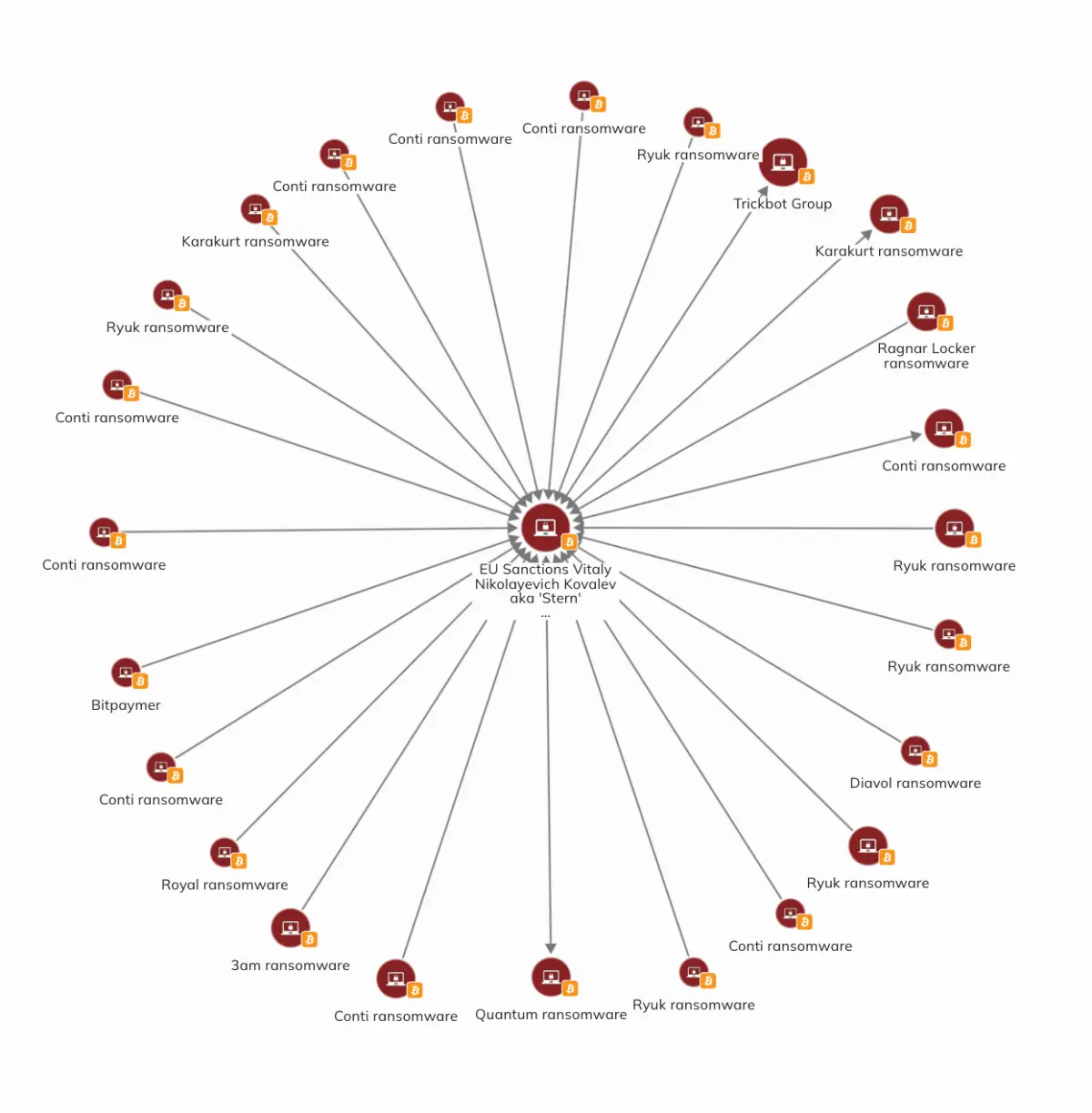
Blockchain analysis illustrates that Stern sat at the absolute center of a sprawling financial nexus. Wallets directly controlled by or attributed to Stern processed in excess of $300 million in cryptocurrency ransom payments. Crucially, on-chain forensic tracking demonstrates that this astronomical figure represents primarily his personal cut and executive draw from the operations. The collective, aggregate financial haul amassed by Trickbot, Ryuk, and Conti over their operational lifespans dwarfs this sum, underscoring the industrial-scale nature of their enterprise.
Data visualized in Chainalysis Reactor graphs demonstrates that Stern’s wallet infrastructure transacted fluidly across a staggering variety of prominent ransomware and extortion strains, including:
- Trickbot
- Ryuk
- Conti
- Diavol
- Karakurt
- Royal
- 3am
- Quantum
- Bitpaymer
The cryptocurrency transaction flows mirrored the rigid corporate hierarchy of the syndicate. Stern was responsible for doling out operational capital to subordinate team members, paying for bullet-proof hosting infrastructure, and compensating external service providers who maintained the malware strains. By designating Stern and cutting off his access to regulated fiat gateways and compliant cryptocurrency liquidity pools, international regulators have struck a severe blow to the operational liquidity of these syndicates.
The Underground Tooling Ecosystem
The scope of the 2026 sanctions also sheds light on specialized sub-sectors of the cybercrime economy, such as information stealers and cryptors:
- LummaC2: A rapidly growing Malware-as-a-Service (MaaS) platform frequently utilized by threat actors to systematically harvest sensitive victim data, browser credentials, stored corporate session cookies, cryptocurrency wallet keys, and foundational system intelligence.
- Cryptor and Obfuscation Services: Tools designed to render malicious payloads invisible to modern security software. By targeting the individuals who build and sell these cryptographic shields, regulators are dismantling the technical innovations that allow ransomware operators to bypass perimeter defenses.
Official Statements and Regulatory Paradigm Shifts
The coordinated announcement by the U.S. Treasury, the European Commission, and the U.K. Foreign, Commonwealth & Development Office emphasizes a profound philosophical and operational pivot in cyber defense strategy.
For decades, the standard law enforcement response to ransomware was reactive—focusing heavily on decryptor development, incident response containment, and the pursuit of individual low-level hackers who frequently resided in non-extradition jurisdictions like Russia. While these measures offered short-term relief to individual victims, they failed to disrupt the underlying economic incentives and infrastructural dependencies of the criminal enterprise.
The July 2026 sanctions signal the maturation of a "Whole-of-Ecosystem" doctrine. Law enforcement agencies have recognized that ransomware is not merely a collection of isolated hacking incidents, but a vertically integrated illicit economy. To break the cycle of extortion, authorities must choke off the infrastructure providers—the VPNs, the bullet-proof hosting providers, the MaaS developers, and the money launderers—without which ransomware gangs cannot scale their operations.
Furthermore, cryptocurrency compliance has taken center stage in this regulatory crusade. Leading blockchain intelligence firms have updated their compliance suites, instantly labeling and flagging the newly designated wallet addresses associated with Stern, 1VPNS, and their associated enablers. This integration ensures that cryptocurrency exchanges, decentralized finance (DeFi) protocols, and traditional financial institutions can proactively screen transactions, freeze illicit funds at the point of ingress or egress, and maintain rigorous adherence to international sanctions law.
Future Outlook: What Lies Ahead for Cyber Enforcement
As the dust settles on the July 13 announcements, cybersecurity experts, national security analysts, and compliance officers are looking toward the future. While the joint U.S.-EU-U.K. sanctions represent an extraordinary milestone, the war against transnational ransomware is far from over.
Anticipated Adversary Adaptation
Cybercriminal syndicates are nothing if not adaptable. Historically, when major infrastructure nodes—such as specific VPN providers, hosting companies, or cryptocurrency mixing services—are sanctioned or seized, threat actors rapidly pivot to new, decentralized, or harder-to-track alternatives.

- Decentralized Infrastructure: Expect criminal syndicates to experiment further with decentralized hosting models, peer-to-peer communication channels, and encrypted messaging applications to insulate their command-and-control networks from traditional law enforcement takedowns.
- Alternative Payment Rails: While Bitcoin and privacy coins (like Monero and Zcash) remain heavily utilized, threat actors are continuously exploring novel methods of laundering funds, including complex multi-chain bridging, non-fungible token (NFT) wash trading, and small-scale peer-to-peer cash networks.
The Imperative of Continuous Cross-Border Collaboration
The success of the 2026 enforcement action proves that geopolitical divides cannot be allowed to paralyze cyber defense. Cybercriminals deliberately exploit the jurisdictional friction between sovereign states, operating out of safe havens where local authorities turn a blind eye to transnational computer intrusions as long as domestic targets are left unharmed.
To counter this, allied Western democracies must maintain relentless pressure through synchronized sanctions, diplomatic isolation, and proactive law enforcement disruptions. The inclusion of the EU, U.S., and U.K. in a unified front creates an expansive regulatory perimeter that makes it increasingly difficult for cybercriminals to enjoy their ill-gotten gains within the global financial system.
Conclusion
The joint sanctions of July 13, 2026, will be studied for years as a defining moment in digital statecraft. By unmasking elite syndicate leaders like Vitaly Nikolayevich Kovalev ("Stern"), dismantling criminal infrastructure like 1VPNS, and targeting the foundational enablers of Malware-as-a-Service, the international community has sent an unmistakable message: the era of unchecked digital extortion is coming to a close. As compliance tooling evolves and global intelligence sharing deepens, the walls around the cybercrime underground are closing in, transforming what was once a low-risk, high-reward enterprise into a perilous and economically hazardous endeavor.
Frequently Asked Questions (FAQs)
Q: Who is "Stern"?
A: "Stern" is the primary online alias of Vitaly Nikolayevich Kovalev, a Russian national identified by international law enforcement as a senior executive and "CEO-like" figure within the Trickbot and Conti ransomware syndicates. He has been linked to over $300 million in personal cryptocurrency ransom receipts.
Q: Which government bodies issued the sanctions on July 13, 2026?
A: The sweeping sanctions were jointly announced by the United States Department of the Treasury (via OFAC), the European Union, and the United Kingdom (via OFSI).
Q: What specific entities were targeted by OFAC alongside ransomware operators?
A: OFAC targeted First VPN Service (1VPNS)—a virtual private network provider catering to cybercriminals—alongside its administrator, Dmytro Rashevskyi, and cryptor provider Yevgeniy Vladimirovich Silayev.
Q: What is LummaC2?
A: LummaC2 is a sophisticated Malware-as-a-Service (MaaS) platform utilized by threat actors to infiltrate victim systems, steal sensitive data, harvest browser credentials, drain cryptocurrency wallets, and extract foundational system information.
Q: What is Media Land LLC?
A: Media Land LLC is a notorious Russian bullet-proof hosting provider that has actively facilitated ransomware operations—including LockBit, EvilCorp, and BlackBasta—since 2016 by offering infrastructure services explicitly designed to resist law enforcement takedowns and abuse complaints.
Q: Why is international coordination essential in the fight against ransomware?
A: Cybercriminals intentionally operate across multiple international borders to exploit jurisdictional gaps and evade local prosecution. Coordinated, multi-nation sanctions synchronize legal frameworks, closing these gaps and freezing illicit assets across multiple global financial systems simultaneously.