


Executive Overview
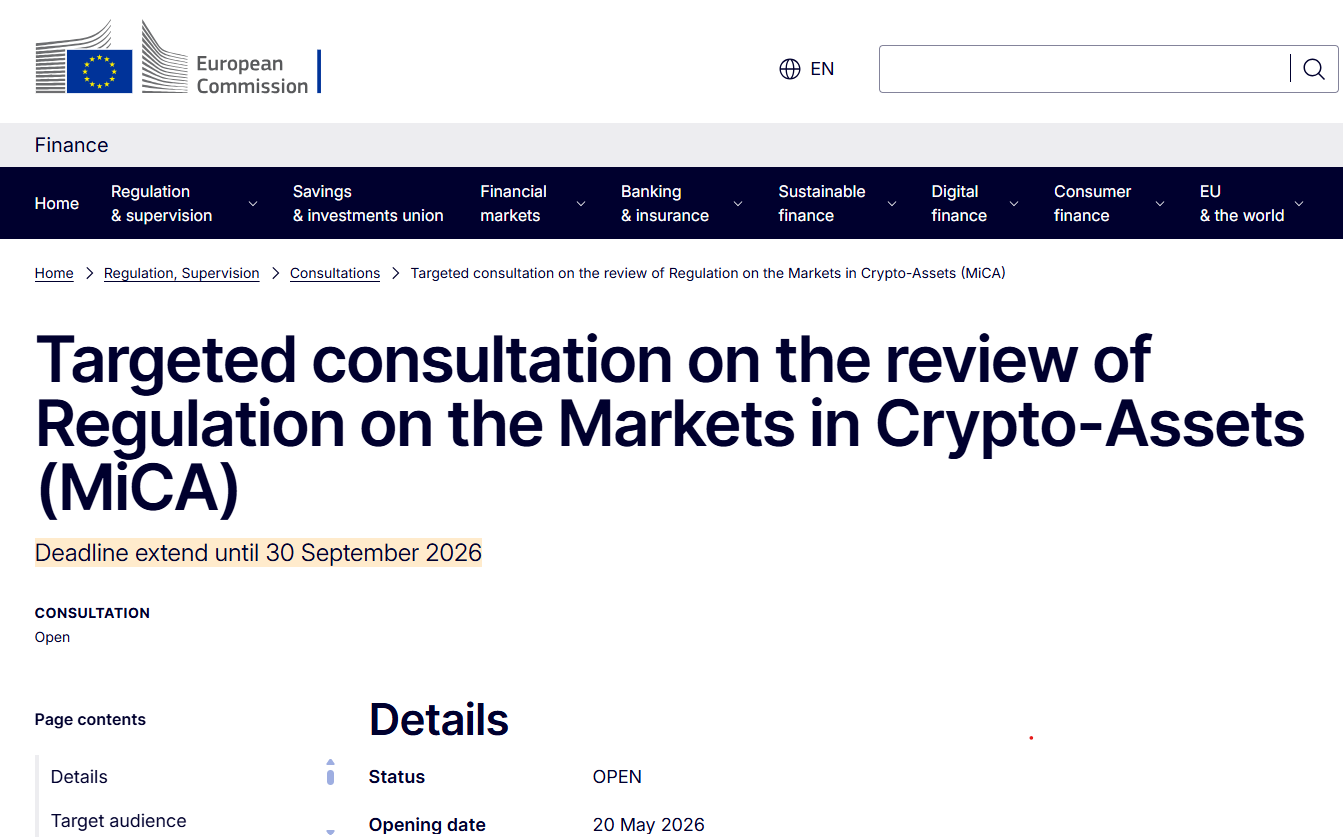
On May 20, 2026, the European Commission initiated a targeted consultation inviting stakeholders, legal experts, and industry leaders to weigh in on the expansion of MiCA’s perimeter. Central to this inquiry are the complex mechanisms of decentralized finance, specifically crypto lending and borrowing, alongside the rapidly expanding ecosystem of crypto-lending vaults.
These sophisticated onchain financial instruments are now channeling billions of dollars into decentralized credit markets. Yet, because they operate on decentralized architectures rather than through conventional corporate structures, they currently exist in a legal grey area. Their current regulatory status relies on non-binding interpretations suggesting they fall outside both MiCA and traditional EU fund rules.
As the European Commission’s consultation window runs toward its September 30 deadline, the crypto industry faces a high-stakes question: If Brussels decides to bring onchain lending within the regulatory perimeter, what will it mean for decentralized finance, and where will it leave the developers, DAOs, and protocols powering these vaults? This report investigates the structural, legal, and operational hurdles facing European regulators as they attempt to map traditional financial compliance onto the programmable, borderless world of decentralized finance.
Detailed Chronology: From MiCA’s Exclusions to the 2026 Review
To understand the magnitude of the European Commission’s current initiative, it is essential to trace the legislative timeline that brought the European Union’s digital asset market to this juncture.
The Original MiCA Framework and DeFi’s Exclusion
When MiCA was conceptualized and subsequently negotiated, lawmakers faced the monumental task of establishing a harmonized regulatory framework for crypto-asset service providers (CASPs), stablecoin issuers (referred to as Asset-Referenced Tokens and E-Money Tokens), and general crypto-asset issuance across the 27 member states.
Recognizing the nascent, rapidly evolving nature of decentralized finance, drafters deliberately left fully decentralized protocols outside the regulatory framework. MiCA’s preamble and operational articles explicitly excluded crypto-asset services provided in a "fully decentralized manner without any intermediary."
However, this carve-out immediately created a compliance gray area. True full decentralization is rare; most protocols exist on a spectrum, utilizing multi-sig wallets, governance tokens, foundations, or core development teams that exert varying degrees of influence over smart contracts. Furthermore, as the crypto economy matured, financial engineers developed products—most notably lending vaults—that mimicked the economic functions of traditional banks and investment funds without fitting neatly into any existing legal category.
The May 20, 2026, Consultation Launch
Recognizing these regulatory arbitrage opportunities and consumer protection gaps, the European Commission took its first formal step toward closing the loop. On May 20, 2026, the Commission published its targeted consultation paper for the review of the MiCA regulation.
The document explicitly calls for industry feedback on areas previously left unregulated, highlighting the systemic importance of crypto lending, borrowing, and DeFi liquidity aggregators. By opening this consultation, Brussels has signaled that the honeymoon period for unregulated onchain credit markets in Europe may be drawing to a close. Stakeholders have until September 30 to submit their empirical data, legal arguments, and structural proposals before the Commission drafts formal legislative amendments.
Structural Complexities: The Morpho Dilemma and Vault Architectures
The core challenge facing European regulators is not merely a philosophical disagreement over decentralization; it is a fundamental mismatch between traditional legal definitions and modern smart contract engineering.

The Regulatory Identity Crisis of "Vaults"
In traditional finance (TradFi), a lending fund or credit facility has a clear corporate identity, a managing entity, appointed directors, fiduciary duties, and a defined regulatory perimeter. In onchain finance, these roles are frequently disintermediated and distributed across code and multiple ecosystem participants.
Consider the case of crypto-lending vaults, which can aggregate and channel billions of dollars into onchain credit markets. Yuriy Brisov, an EU digital assets lawyer and partner at Digital & Analogue Partners, highlights the foundational legal conundrum:
"EU law has no category called a ‘vault.’ A lawyer therefore defines it the way a regulator would qualify it: by function, not by label."
Because these vaults perform the economic functions of credit intermediation—gathering capital from depositors and allocating it to borrowers—regulators might be tempted to classify them as credit institutions or alternative investment funds (AIFs). However, doing so ignores how these vaults are structurally built and managed.
Parsing Morpho’s Vault V2 Architecture
Decentralized lending protocol Morpho offers a prime example of why applying traditional labels to onchain infrastructure is an uphill battle. Morpho’s advanced Vault V2 architecture deliberately decentralizes responsibilities across multiple actors rather than concentrating power in a single corporate entity.
Under this design, responsibilities are cleanly divided among four distinct pillars:
- The Owner: Holds administrative capabilities over the vault’s core configuration.
- The Curator: Configures the underlying strategies, risk parameters, and asset pools.
- The Allocator: Executes the actual allocation of capital according to the curator’s strategy.
- The Sentinel: Possesses specific, limited powers designed to intervene and mitigate risk in emergency scenarios.
While this sophisticated setup distributes risk and operational overhead, it shatters the traditional regulatory model. Under MiCA or EU fund law, identifying the single, responsible "provider" of a lending service becomes nearly impossible. Is it the curator setting the strategy? The allocator executing the transactions? Or the decentralized protocol developers who wrote the underlying smart contracts?
Supporting Context, Metrics, and Expert Analysis
As legal and financial experts dissect the European Commission’s consultation papers, a consensus is emerging: a blunt-force regulatory approach could inflict catastrophic damage on Europe’s digital asset sector.
The Danger of Over-Inclusive Categorization
Jonathan Galea, a partner at Cahill Gordon & Reindel, recently addressed these complexities in a comprehensive client advisory focusing on lending vaults and their position under EU financial regulation. Galea warns policymakers against treating all onchain vaults as a single, homogenous category.
"Bring ‘DeFi lending’ into the perimeter as a single label, and structures that deserve opposite answers risk ending up captured together," Galea cautioned in an interview.
He notes that lending vaults perform a vital economic service by channeling fragmented liquidity into productive onchain lending markets. Conversely, other types of vaults may focus purely on algorithmic trading, derivatives exposure, or synthetic asset generation. Grouping these distinct financial instruments under a single regulatory umbrella could inadvertently criminalize beneficial financial innovations or drive them out of the European Economic Area (EEA).
Furthermore, Galea challenges the notion that "decentralization" can serve as a simple, binary legal test to determine regulatory oversight:
"Decentralization is a spectrum and a function of time: a test built on it would penalize newer, more novel protocols while entrenching mature incumbents that have had years to distribute control."
Structural Tests vs. Corporate Undertakings
Offering an alternative path forward, Yuriy Brisov argues that regulators should look past corporate labels and evaluate the structural design of the smart contracts themselves.
"The safer ground is structural: there is no undertaking, no appointed manager, the holder has a direct coded claim on the pool, and the user can exit before any parameter change takes effect," Brisov explains.
According to Brisov, if Brussels ultimately decides that decentralized lending and borrowing warrant direct oversight, lawmakers should explicitly add lending services to the enumerated list of regulated crypto-asset activities, rather than artificially expanding the definition of a Crypto-Asset Service Provider (CASP) to capture decentralized codebases.
Tailoring Rules to DeFi’s Unique Mechanics
Michael Egorov, founder of Curve Finance, echoes the call for caution, emphasizing that decentralized lending operates under fundamentally different mechanics than traditional banking. While traditional finance requires stringent human-managed safeguards—such as institutional credit checks and manual debt-recovery processes—DeFi relies on over-collateralization, programmatic liquidations, and transparent, immutable ledgers.
"If DeFi lending is ever brought into the scope of regulation, it should be treated completely differently," Egorov states. "DeFi doesn’t need some of the safeguards which traditional lending requires, and yet, at the same time, it may need others."
Egorov argues that a bespoke, dedicated regulatory framework could enhance systemic safety and open onchain lending to institutional investors who currently shy away due to legal uncertainty. However, this must be achieved through nuanced policymaking rather than attempting to force square pegs into round regulatory holes.
Future Outlook: What Lies Ahead for EU Onchain Finance?
The European Commission’s targeted consultation on the MiCA review is scheduled to close on September 30. The feedback gathered from lawyers, protocol developers, institutional curators, and academic experts will lay the groundwork for potential legislative proposals in the European Parliament and Council.
The choices facing Brussels carry profound implications for the future of European tech and finance:
- The Risk of Regulatory Flight: If the EU adopts an overly aggressive or legally ambiguous framework for DeFi lending, European capital and development talent may migrate to more hospitable jurisdictions, such as Switzerland, the United Kingdom, or the United Arab Emirates.
- Institutional Adoption vs. Open Access: Conversely, a well-crafted, modular regulatory framework could provide the legal certainty institutional asset managers require to deploy capital into Morpho vaults, Curve pools, and other advanced onchain credit protocols.
- The Enforcement Dilemma: Regulating entities that lack a physical headquarters or legal incorporation remains an unprecedented challenge for enforcement agencies. Regulators will have to determine whether targeting user interfaces, front-end node operators, or protocol governance tokens is a viable enforcement mechanism.
Conclusion
As the September 30 consultation deadline approaches, the European Union stands at a critical crossroads. The challenge for Brussels is not merely deciding whether to regulate decentralized finance, but mastering the art of nuance. Writing rules that successfully distinguish between vastly different onchain architectures—while accurately identifying who (if anyone) exercises true control—will define the success or failure of Europe’s digital asset regulatory strategy for the next decade.