rifanmuazin is a reporter for DeBitcoin covering Decentralized Finance (DeFi). She/He is based in Indonesia.
23 August 2026 • 8 min read
The regulatory landscape for digital assets in the European Union is bracing for a potential paradigm shift. When the landmark Markets in Crypto-Assets (MiCA) regulation was originally drafted and passed, decentralized finance (DeFi), crypto lending, and complex onchain credit architectures were largely left outside its primary rulebook. Lawmakers focused heavily on centralized exchanges, stablecoin issuers, and traditional crypto-asset service providers (CASPs).
Executive Overview
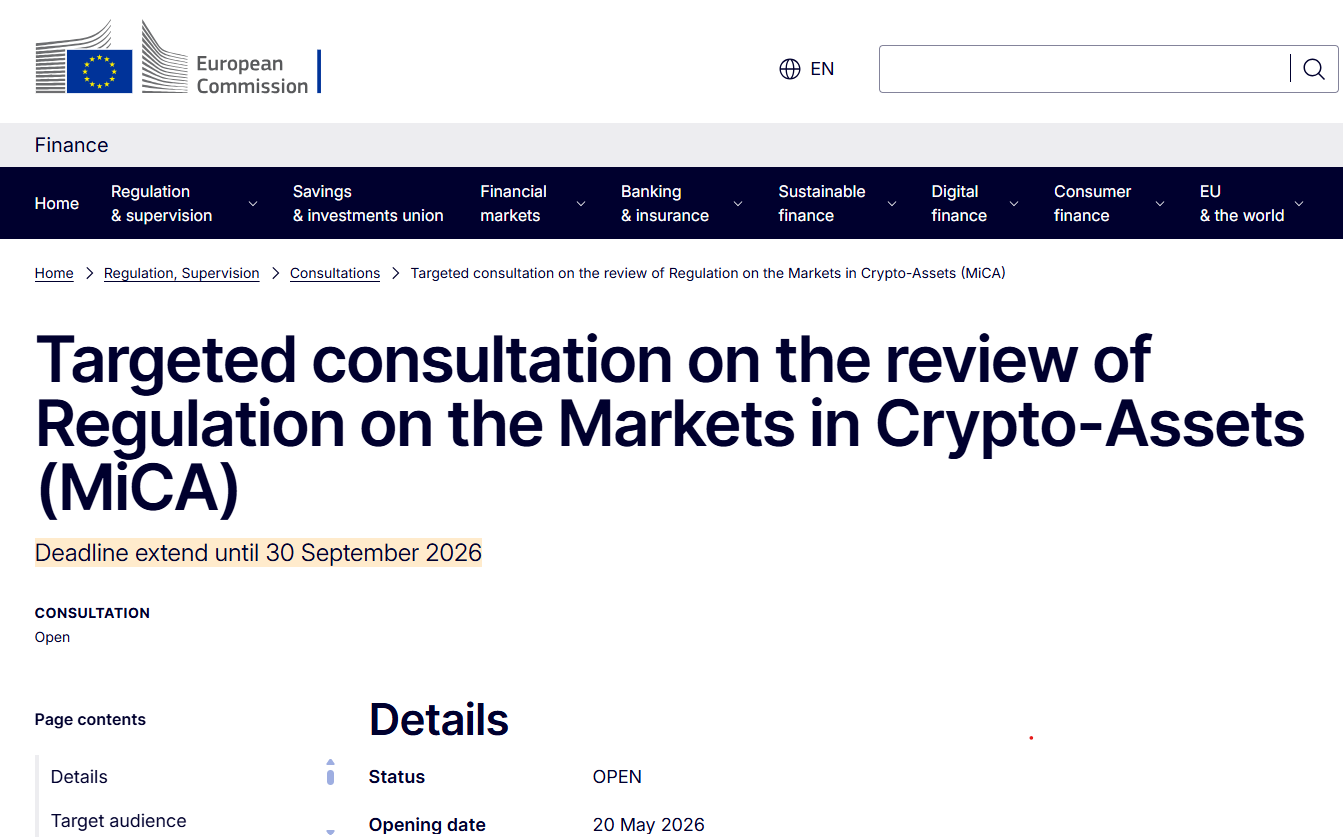
However, as the crypto ecosystem has matured, the boundaries between conventional financial plumbing and decentralized onchain credit markets have blurred. On May 20, 2026, the European Commission initiated a targeted consultation process, formally asking industry stakeholders, legal experts, and developers to weigh in on these glaring omissions. At the center of the debate are DeFi lending, borrowing protocols, and, most notably, automated lending vaults.
These sophisticated onchain financial instruments are capable of funneling billions of dollars into credit markets without resembling conventional banks or centralized lending platforms. Their current legal ambiguity forces legal practitioners to navigate a patchwork of non-binding interpretations, leaving them outside both MiCA and traditional EU fund laws.
If Brussels ultimately decides to pull crypto lending and decentralized credit vaults inside the regulatory perimeter, the consequences for the European DeFi sector could be profound. It forces a fundamental question that regulators, lawyers, and developers have struggled to answer: How do you regulate an economic activity when the traditional concept of a "provider" or a single corporate entity simply does not exist?
Detailed Chronology: The Evolution of MiCA and the DeFi Blind Spot
To understand the current regulatory dilemma, it is necessary to trace how MiCA developed and why decentralized lending was deferred to a later date.
The Foundation of MiCA
Conceived years prior to its full implementation, MiCA was designed to bring legal certainty to the wild west of the European crypto market. Its primary objectives were to protect investors, ensure financial stability, and foster innovation while preventing market abuse. Lawmakers established robust frameworks for asset-referenced tokens (ARTs), e-money tokens (EMTs), and CASPs.
Yet, during the drafting phases, the rapid and complex evolution of decentralized finance presented a moving target. Policymakers recognized that applying traditional, entity-based regulatory compliance to immutable, self-executing smart contracts was nearly impossible. Consequently, MiCA included explicit exemptions for crypto-asset services provided in a "fully decentralized manner."
The Rise of Onchain Credit and Vaults
While regulators focused on centralized operations, the DeFi ecosystem engineered sophisticated capital-allocation mechanisms. Chief among them are lending vaults—automated systems that aggregate liquidity from multiple users and deploy it into various onchain lending strategies.
Unlike traditional mutual funds or lending desks, these vaults operate through smart contracts. They distribute administrative duties, risk curation, liquidity allocation, and oversight across multiple distinct participants. By late 2025 and into 2026, these vaults had scaled dramatically, managing billions of dollars in liquidity and bridging institutional capital with decentralized yield opportunities.
The May 2026 Consultation Kickoff
Recognizing a massive regulatory blind spot, the European Commission launched its targeted consultation on May 20, 2026. The consultation specifically targets the areas left outside the original MiCA framework, highlighting decentralized finance, crypto lending, and borrowing. The submission window runs through September 30, 2026, serving as a critical battleground for how the EU approaches the next generation of financial technology.
Supporting Context & Metrics: The Anatomy of Onchain Complexity
The regulatory challenge facing Brussels is not merely political; it is fundamentally structural. Traditional financial regulation relies on a clear chain of command: a legal entity, a board of directors, compliance officers, and an identifiable counterparty. DeFi obliterates this architecture.
The Morpho Paradigm: A Case Study in Multi-Party Architecture
Decentralized lending protocol Morpho offers a textbook example of why mapping onchain architecture onto conventional regulatory models is exceptionally difficult. Morpho’s Vault V2 infrastructure deliberately fragments control and operational responsibility across distinct roles:
The Owner: Manages core administrative parameters of the vault contract.
The Curator: Configures the underlying strategy, selects approved lending markets, and manages risk parameters.
The Allocator: Executes the actual allocation of capital across the designated markets.
The Sentinel: Holds specific risk-mitigation powers designed to protect user funds in volatile market conditions.
None of these participants individually or collectively constitute a "regulated lending service" under the strict definitions of current EU law. Yet, collectively, they perform the exact economic function of a sophisticated credit fund or prime broker. This fragmentation makes identifying the legally responsible "provider" nearly impossible under existing frameworks.
The Legal Void: Functional vs. Label-Based Regulation
Because European law has no formal statutory category for a "vault," legal analysis must rely on functional interpretation. Yuriy Brisov, an EU digital assets lawyer and partner at Digital & Analogue Partners, highlights this exact dilemma:
"EU law has no category called a ‘vault.’ A lawyer therefore defines it the way a regulator would qualify it: by function, not by label."
This functional approach creates a minefield for compliance. Vaults perform traditional lending functions while dispersing execution across immutable code and decentralized actors, rendering traditional compliance mandates like KYC (Know Your Customer) and AML (Anti-Money Laundering) checks exceptionally difficult to assign.
Furthermore, Jonathan Galea, a partner at Cahill Gordon & Reindel, analyzed these dynamics in a recent client update on lending vaults under EU financial rules. Galea cautions that policymakers must avoid painting with too broad a brush, pointing out that lending vaults actively solve practical liquidity bottlenecks by channeling fragmented capital into efficient credit markets.
"Bring ‘DeFi lending’ into the perimeter as a single label, and structures that deserve opposite answers risk ending up captured together," Galea warns.
Official Statements and Industry Perspectives
As the September 30 consultation deadline approaches, industry leaders, legal minds, and protocol architects are fiercely debating how—or even if—DeFi lending should be regulated.
The Spectrum of Decentralization
A major point of contention within the European Commission’s previous guidelines is the reliance on "decentralization" as an exclusionary test. MiCA currently exempts fully decentralized services, but leaves gray areas where partial decentralization exists.
Jonathan Galea argues that anchoring regulation entirely to a protocol’s degree of decentralization is fundamentally flawed. He notes that decentralization is not a binary switch, but rather a spectrum that evolves over time:
"Decentralization is a spectrum and a function of time: a test built on it would penalize newer, more novel protocols while entrenching mature incumbents that have had years to distribute control."
Instead of penalizing nascent innovation, Yuriy Brisov suggests looking closely at the structural guarantees baked into the code itself. He emphasizes that regulatory focus should center on structural protections rather than trying to force a decentralized protocol into a centralized corporate box:
"The safer ground is structural: there is no undertaking, no appointed manager, the holder has a direct coded claim on the pool, and the user can exit before any parameter change takes effect."
Brisov advocates that if Brussels determines lending and borrowing warrant formal oversight, lawmakers should explicitly add them to the catalog of regulated crypto-asset services, rather than clumsily expanding the sweeping definition of a Crypto-Asset Service Provider (CASP).
Reimagining Risk for Onchain Finance
Traditional financial lending regulations are built around systemic risks involving leveraged banking, institutional insolvencies, and centralized counterparty failure. DeFi, however, operates on different economic and technical assumptions—often eliminating certain traditional risks while introducing entirely new smart contract vulnerabilities.
Michael Egorov, founder of Curve Finance, stresses that regulators must recognize these inherent differences. According to Egorov, attempting to impose legacy banking rules onto automated market makers and decentralized lending pools will stifle innovation without achieving safety:
"If DeFi lending is ever brought into the scope of regulation, it should be treated completely differently. DeFi doesn’t need some of the safeguards which traditional lending requires, and yet, at the same time, it may need others."
Egorov urges regulators to approach the consultation with extreme care, suggesting that a bespoke, dedicated framework could enhance ecosystem safety and invite institutional capital. However, a rigid, one-size-fits-all mandate would render many protocols technically non-compliant due to their immutable nature.
Future Outlook: What Lies Ahead for European DeFi?
The closure of the European Commission’s targeted consultation on September 30 marks the beginning of a high-stakes legislative battle. The feedback gathered from lawyers, protocol developers, institutional investors, and compliance experts will dictate whether the EU attempts a legislative update to MiCA or introduces secondary regulatory guidelines specifically targeting onchain credit.
Key Scenarios for European Crypto
The Broad Sweep (High Risk): Brussels groups all onchain yield, lending, and vault activities under a broad "DeFi lending" definition. This could trigger an exodus of protocol developers, liquidity providers, and innovators from the EU jurisdiction to more permissive global markets.
The Tailored Framework (Optimistic Scenario): Recognizing the nuances highlighted by experts like Galea, Brisov, and Egorov, the Commission crafts a specialized, activity-based regulatory sandbox or separate legislative tier. This would acknowledge the structural realities of smart contracts while offering legal certainty for institutional participants looking to deploy capital into vaults.
The Stagnant Gray Area: Regulatory paralysis or overly complex compliance mandates could trap European users in a perpetual state of legal ambiguity, isolating EU-based funds from participating in global onchain liquidity loops.
Conclusion
The challenge facing European policymakers goes far beyond deciding whether to regulate DeFi lending. It is a fundamental test of whether 20th-century legal concepts can successfully govern 21st-century cryptographic networks. As the consultation period moves toward its conclusion, the decisions made in Brussels will set a global precedent, signaling whether Europe intends to embrace the evolution of onchain finance or legislate it out of existence.