

Executive Overview
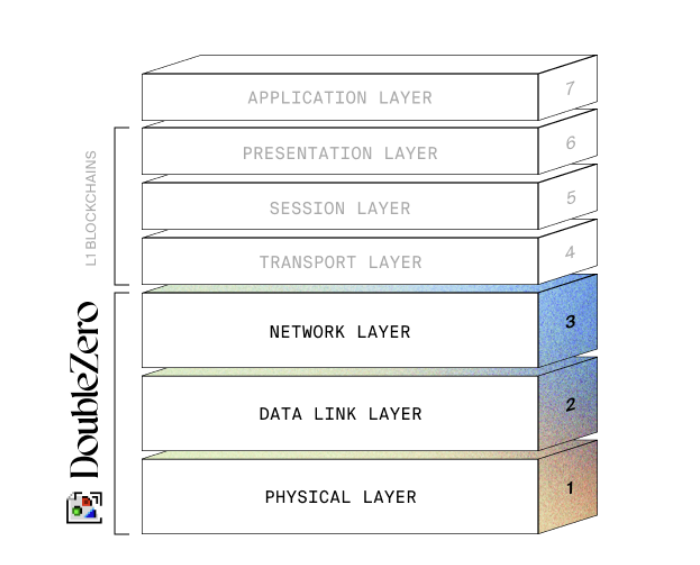
That paradigm shift arrived today with the official mainnet-beta launch of DoubleZero (DZ). Co-backed by a $28 million investment round co-led by Multicoin Capital earlier this year, DoubleZero introduces a permissionless marketplace for high-performance dedicated network links. By sitting squarely beneath traditional Layer 1 architectures in the context of the OSI (Open Systems Interconnection) model, DoubleZero aims to fundamentally accelerate the global flow of data packets.
Crucially, the protocol’s rollout coincides with a major regulatory milestone. On September 29, 2025, the U.S. Securities and Exchange Commission’s (SEC) Division of Corporation Finance issued a no-action letter (NAL) to DoubleZero, providing critical regulatory clarity for its native token, 2Z. With institutional-grade bandwidth suppliers like Jump Trading already contributing capacity, and the Solana network serving as its inaugural integration, DoubleZero is positioned to redefine latency and throughput standards not just for blockchain infrastructure, but eventually for the entire high-performance internet.
Detailed Chronology: From Concept to Mainnet-Beta and Regulatory Clarity
The trajectory of DoubleZero reflects an intersection of traditional high-frequency trading (HFT) infrastructure design and modern decentralized network architecture. The timeline leading up to today’s mainnet-beta launch highlights the deliberate, multi-year engineering and regulatory efforts required to build a physical-layer decentralized protocol:
- 2008–2010 (The Genesis of Private Infrastructure): Recognizing that the public internet was inherently too slow, congested, and unpredictable for stringent latency requirements, elite trading firms began investing heavily in dedicated, private networking infrastructure. Undersea cables and custom microwave towers spanning regional landscapes became the competitive edge for firms like Jump Trading, Citadel, and Two Sigma.
- Early 2025 (Funding & Foundation): DoubleZero secures a substantial $28 million investment round co-led by Multicoin Capital. Behind the scenes, veteran networking architects Andrew McConnell and Mateo Ward—drawing on decades of experience building high-performance dedicated fiber networks for Jump Trading—join forces with key industry figures like Austin Federa and DoubleZero Foundation General Counsel Mari Tomunen.
- September 11, 2025 (Strategic Expansion & Vision): Industry stakeholders outline the grand architecture of the protocol, detailing how decentralized infrastructure can borrow institutional-grade speed to solve validator consensus bottlenecks.
- September 29, 2025 (Regulatory Milestone): DoubleZero clears a massive hurdle for mainstream and institutional adoption. The SEC’s Division of Corporation Finance issues a formal no-action letter regarding planned programmatic transfers of the protocol’s native token, 2Z. This ruling confirms that programmatic distribution of 2Z to network and resource providers does not require registration as a securities transaction under U.S. federal law.
- Today (Mainnet-Beta Launch): DoubleZero officially transitions to mainnet-beta, going live with deep integrations across the Solana network and onboarding a coalition of prominent infrastructure providers.
Supporting Context & Metrics: Unlocking Private Fiber for the Decentralized World
To understand the profound impact of DoubleZero, one must first examine the structural divergence between how global data moves across the traditional web versus high-frequency financial markets.
The Divide Between Public and Dedicated Internet Lines
Globally, internet traffic is bifurcated into two distinct categories:
- Public Internet Lines: The default routing paths utilized by the vast majority of web applications. While ubiquitous, public lines traverse multiple hops, shared commercial routers, and congested exchange points, introducing variable latency and jitter.
- Dedicated/Private Fiber Infrastructure: High-speed, point-to-point connections designed for predictable, ultra-low-latency transmission.
Historically, access to dedicated fiber was tightly guarded by capital-intensive barriers. For over a decade, elite proprietary trading firms—including Jump, Citadel, HRT, Two Sigma, and DRW—poured billions of dollars into customized hardware, undersea cables, and microwave towers (such as systems beaming radio waves directly across geographic barriers like Lake Michigan). Similarly, hyper-scalers like Google, Meta, Microsoft, and Amazon constructed private backbones to interconnect their global data centers.
DoubleZero democratizes this elite tier of connectivity. It functions as a permissionless network layer that allows any owner of dedicated network infrastructure—whether they possess dark fiber, undersea links, or microwave towers—to monetize their unutilized or under-utilized capacity. By pooling these resources into a decentralized marketplace, DoubleZero extends institutional-grade speeds to decentralized protocols that previously had to rely on the erratic public web.

The Solana Integration and Technical Architecture
The initial deployment of DoubleZero is deeply intertwined with the Solana network. The protocol has achieved native integration across all three major Solana client implementations:
- Agave
- Firedancer
- Jito (including direct integration into the Jito block engine)
Furthermore, a robust roster of enterprise-grade infrastructure providers and validators—including Galaxy, Distributed Global Technologies, Rockaway X, Cherry Servers, Latitude, South 3rd Ventures, Teraswitch, and initial bandwidth supplier Jump Trading—have committed to contributing vital fiber links to bootstrap the network.
By routing validator communication through DoubleZero’s optimized physical network layer, validators achieve consensus at significantly accelerated rates. Data flows more predictably and swiftly across geographical nodes, ensuring that market makers and everyday users land transactions with minimized slippage and superior reliability.
The Mechanics and Regulatory Status of the 2Z Token
At the heart of DoubleZero’s economic model is the native 2Z token. The token serves dual operational functions within the decentralized marketplace:
- Transaction Fee Settlement: Users and protocols pay network transmission fees in 2Z to route communications across the DoubleZero fiber marketplace.
- Provider Compensation: A programmatic share of these fees is automatically rewarded to infrastructure providers as compensation for allocating their dedicated fiber links and running underlying hardware. Additionally, resource providers receive newly minted 2Z tokens for monitoring user interactions, calculating transmission metrics, and administering protocol functions.
The September 29, 2025, no-action letter (NAL) issued by the SEC’s Division of Corporation Finance provides essential legal clarity. By explicitly confirming that the Division will not recommend enforcement action regarding programmatic 2Z transfers, the NAL removes a primary regulatory overhang. This clears the path for seamless, automated network operations and reinforces regulatory recognition of functional, utility-driven digital asset architectures.
Official Statements & Industry Perspectives
The convergence of elite engineering talent, institutional-grade infrastructure, and forward-thinking regulatory strategy has generated immense enthusiasm across the Web3 venture and development landscape.
Kyle Samani of Multicoin Capital has long championed structural optimizations at the lowest levels of infrastructure. In recent analyses, Samani highlighted the necessity of upgrading physical data pathways, noting that traditional L1 optimizations are ultimately capped by the physical limitations of the public internet.
The leadership team behind DoubleZero brings unmatched domain expertise to the table. Andrew McConnell (CTO of Malbec Labs) and Mateo Ward bring decades of battle-tested experience designing ultra-low-latency dedicated fiber networks for Jump Trading. Their technical execution is complemented by strategic leadership from communications veteran Austin Federa and General Counsel Mari Tomunen, whose collaborative engagement with regulators was instrumental in securing the SEC no-action letter.
Industry observers note that the inclusion of institutional giants as initial suppliers signals a profound maturation in how traditional capital markets and decentralized protocols share foundational plumbing. By bridging proprietary high-frequency trading assets with open-source blockchain networks, DoubleZero bridges two previously siloed technological worlds.
Future Outlook: Beyond Solana and Blockchain Core Infrastructure
While today’s mainnet-beta launch centers heavily on supercharging Solana, the architectural ambitions of DoubleZero extend far beyond a single blockchain ecosystem.
Expansion Across Layer 1s and Layer 2s
The DoubleZero team anticipates that every major Layer 1 network will be forced to adopt physical-layer optimizations in the coming years. In a hyper-competitive multi-chain environment, networks operating on unoptimized public internet lines will struggle to compete with the deterministic speed and throughput enabled by DoubleZero-enhanced backbones.
Moreover, the network holds immense utility for centralized-sequencer Layer 2 (L2) rollups. By assisting L2s in fanning out batch data to globally distributed localized RPC servers, DoubleZero can dramatically reduce latency for latency-sensitive decentralized finance (DeFi) applications and high-frequency on-chain trading venues.
The Broader Internet Horizon
Looking further into the future, the market potential for a permissionless dedicated fiber marketplace transcends Web3 entirely. Any internet-enabled application demanding absolute minimum latency stands to benefit. As global bandwidth demands surge, DoubleZero is architected to eventually serve as the foundational transport layer for:
- Ultra-low-latency real-time video calling and conferencing
- Global, real-time Augmented Reality (AR) and Mixed Reality (MR) infrastructure
- Competitive cloud gaming and interactive simulation services
By systematically attacking the physical networking bottleneck that core blockchain developers have historically ignored, DoubleZero has not only launched a new protocol—it has rewritten the performance ceiling for the globally distributed internet.