rifanmuazin is a reporter for DeBitcoin covering Crypto Investing & Venture Capital. She/He is based in Indonesia.
6 August 2026 • 9 min read
For the better part of the past decade, entering the cryptocurrency ecosystem has been defined by a single mechanism: the fiat-to-crypto onramp. Users swapped traditional currencies for digital assets through centralized exchanges, buying into an alternative financial system based largely on asset appreciation and speculation. However, a structural shift is quietly underway. Observers of global economic trends argue that the next wave of crypto adoption will not be driven by passive buyers, but by active earners.
Executive Overview
The rationale behind this shift is simple yet profound: the vast majority of the world’s population lives off income, not asset purchases. When earning moves on-chain, a critical second-order effect emerges. Earnings become balances, balances become savings, and savings naturally evolve into active participation in Internet Capital Markets.
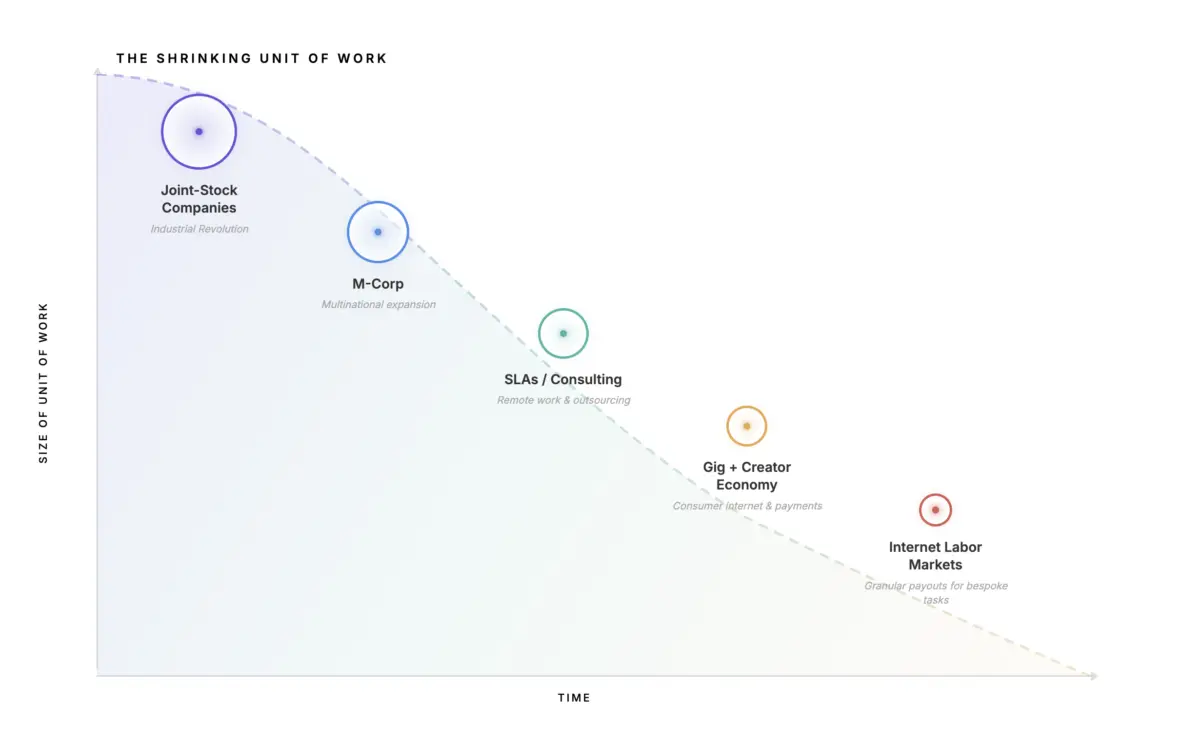
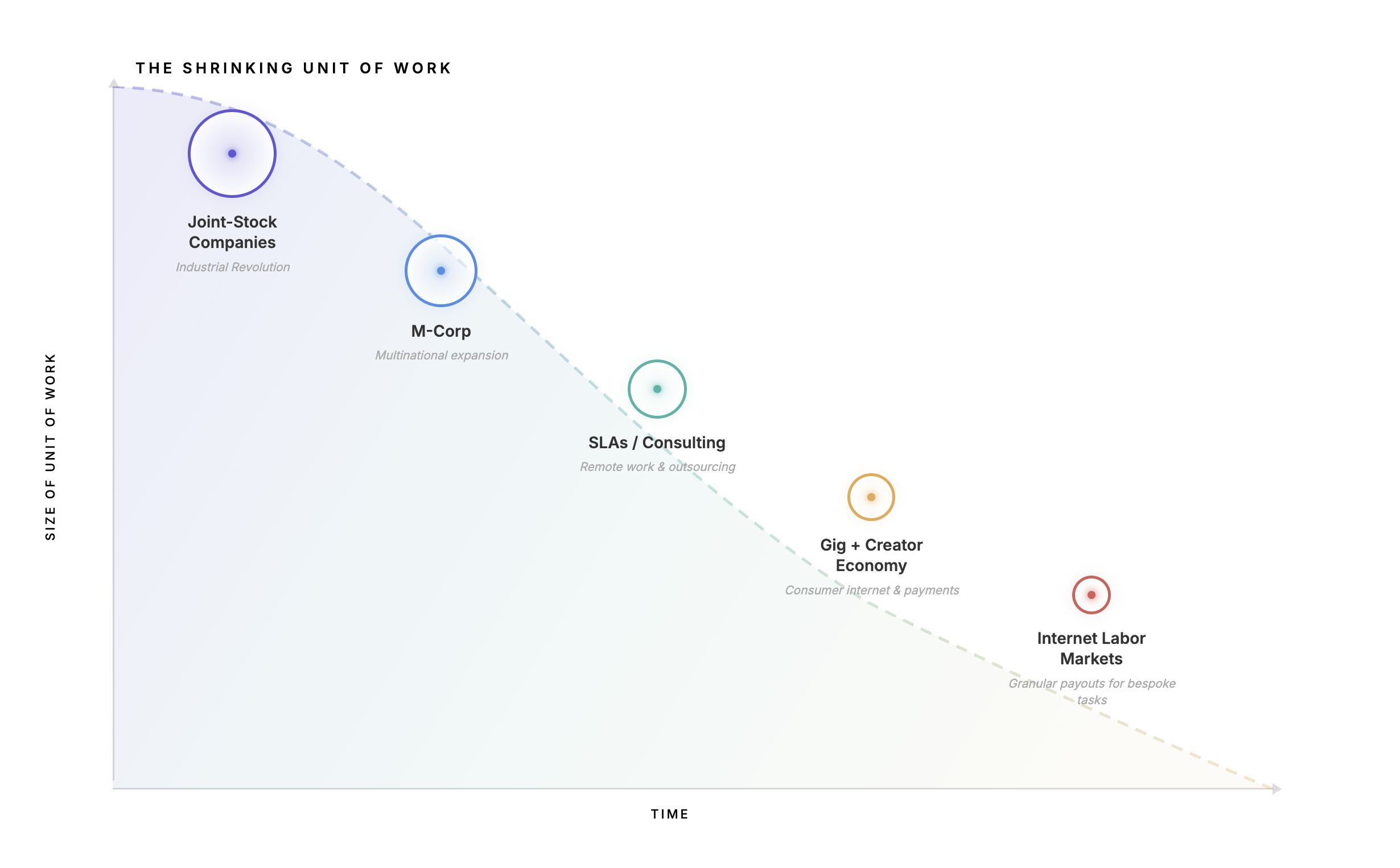
This transformation is being supercharged by the convergence of two powerful forces: cryptographic coordination primitives and artificial intelligence. As AI compresses the cost of building software and shrinks the size of core corporate teams, it creates a decentralized paradox. Companies are becoming smaller at the center while expanding dramatically at the edge. They require an array of non-software inputs—such as data labeling, physical deployment, domain expertise, and high-stakes verification—that cannot be efficiently managed through traditional employment models.
Enter Internet Labor Markets (ILMs): contributor-owned marketplaces where the unit of work is a verifiable task, settled instantly over crypto rails. By leveraging programmable incentives, decentralized physical infrastructure networks (DePIN), and rigorous verification methods, ILMs are dismantling the traditional corporate firm and replacing it with borderless, programmatic coordination.
Detailed Chronology: The Evolution of On-Chain Coordination
To understand how Internet Labor Markets emerged, one must trace the decade-long evolution of blockchain-based coordination mechanisms. The crypto industry has continuously iterated on how to align economic incentives across distributed networks of strangers.
Phase 1: The Compute Primitive and Basic Ledgers (2009–2018)
Crypto’s original superpower has always been trustless coordination. The genesis of this movement was Bitcoin: a single, highly specific compute primitive (hashing) executed globally to maintain an immutable, decentralized ledger. This proved that individuals who had never met could agree on a shared state without relying on a centralized intermediary.
Phase 2: Bootstrapping Supply Through Tokens and DePIN (2019–2023)
Following the emergence of decentralized finance, the ecosystem developed DePIN (Decentralized Physical Infrastructure Networks) and DeVIN. Networks like Filecoin, Helium, and Hivemapper demonstrated that builders could utilize crypto capital markets to invert traditional capital expenditure (capex). By issuing tokens, projects could transfer cold-start risk onto early contributors who believed in the network’s vision.
During this era, early decentralized autonomous organizations (DAOs) attempted to reinvent capital allocation decision-making (such as The LAO). However, the lackluster durability of general-purpose DAOs revealed a fundamental rule of decentralized design: the smaller the surface area of contribution, the more effective the network. Networks coordinating simple, highly specific actions—such as setting up a router or a base station—vastly outperformed those trying to mimic traditional corporate governance structures.
Phase 3: The Refinement of Work Verification and Micro-Tasks (2024–2025)
As the DePIN ecosystem matured, founders addressed its historical weaknesses, including poor inflationary reward mechanics and vulnerable anti-fraud systems. Through collective trial and error, market leaders implemented rigorous work-verification primitives (such as zkTLS), robust spam resistance via bonding and slashing mechanisms, and rewards tied directly to recurring contributions rather than passive, time-based emissions.
Simultaneously, tens of millions of people became accustomed to earning tokens for performing specific collective objectives—whether participating in social quests via platforms like Galxe and Kaito, solving bug bounties on ImmuneFi, or surfacing information via Arkham.
Phase 4: The Rise of Internet Labor Markets (Present and Beyond)
Today, we are entering the next phase of this design space. DePINs and modern organizations are moving away from broad, passive contributions toward hyper-specific, task-based work. Rather than setting up a Wi-Fi hotspot and receiving indefinite tokens, contributors execute precise actions: delivering a physical package from point A to point B, or reducing localized energy consumption during peak hours in exchange for bill-discounting utility tokens. Powered by AI and global stablecoin adoption, this marks the official birth of Internet Labor Markets.
Supporting Context & Metrics: Mapping the Design Space
Internet Labor Markets operate on a vastly different paradigm than traditional employment systems. To analyze how they function, we must map their design space across three core dimensions: task granularity versus payout frequency, verification methods versus work domains, and contributor skill levels versus financial constraints.
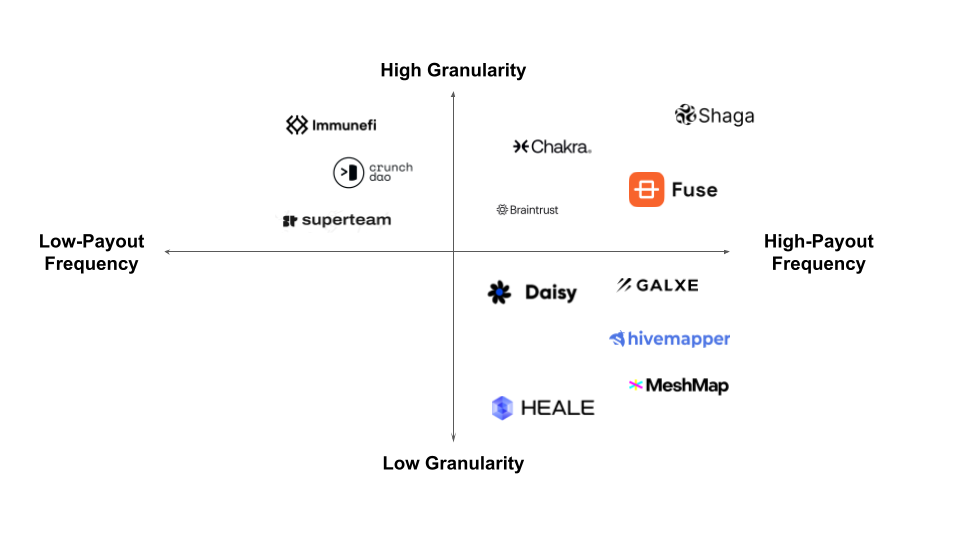
Dimension 1: Task Granularity & Payout Frequency
Large Tasks / Low Settlement Frequency: These resemble crypto-native contracting. Examples include writing a complex software integration, executing a comprehensive security review, or building a dataset collection methodology. Because verification is partially subjective, these roles require portable reputation systems and trusted arbiters.
Large Tasks / High Settlement Frequency: These function like traditional bounties with fixed ex-ante rewards and cryptographic verification. Examples include finding a zero-day software vulnerability, beating an AI model on a specific benchmark, or compiling 250 high-signal edge cases with verified citations.
Small Tasks / High Settlement Frequency: These operate like high-throughput task exchanges. Examples include micro-evaluations of medical reasoning, rapid GPS trace validation, or image classification. These tasks require near-instant settlement and deterministic verification.
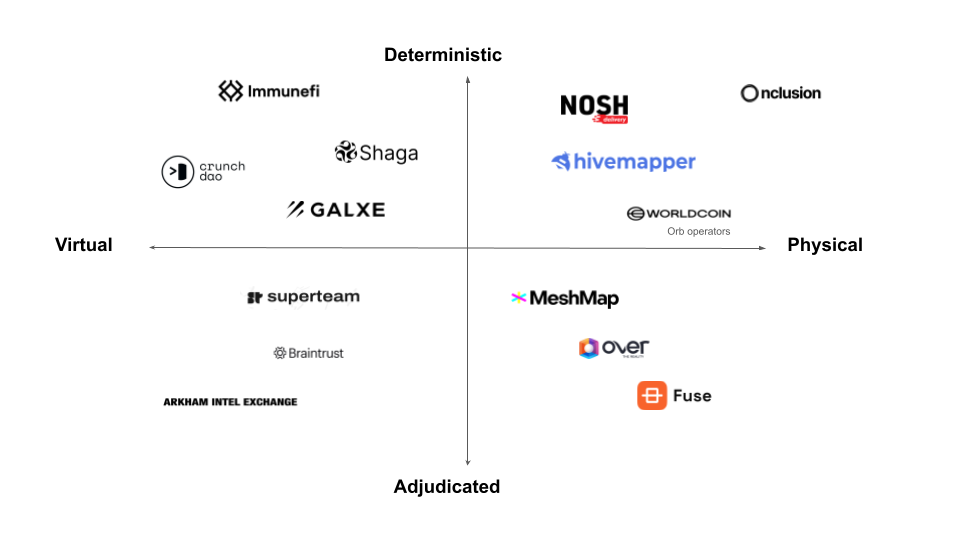
Dimension 2: Verification Method & Work Domain
The intersection of verification methods (deterministic vs. adjudicated) and work domains (virtual vs. physical) creates four distinct quadrants:
Virtual + Deterministic: Low verification overhead and easy to set up, but vulnerable to copycat competition. Defensibility relies on trust, brand, and demand-side relationships.
Physical + Deterministic: Requires heavy investment in hardware attestation and cryptographic-proof infrastructure (e.g., Hivemapper, Geodnet). High barriers to entry create durable competitive advantages.
Virtual + Adjudicated: Requires building robust reviewer networks. Once scaled, these reviewer networks form a powerful defensibility moat that cannot be easily forked.
Physical + Adjudicated: The most difficult quadrant to scale because it requires physical presence and complex review infrastructure (e.g., decentralized delivery or local energy networks). However, once established, it features virtually zero direct competition due to insurmountable entry barriers.
Matching compensation structures to contributor needs is vital for ILM success. High-skill contributors fall into two camps: believers, who underwrite long-term upside and accept token-heavy rewards, and professionals (such as physicians, lawyers, and senior engineers), who require predictable fiat or stablecoin settlement for high-stakes work.
Lower-skill contributors split into accumulators (part-time participants compounding rewards, like weekend mapping drivers) and wage earners (liquidity-constrained workers who require price stability and instant payouts). For wage earners, the onboarding narrative is clear: stablecoin-first wages with optional ownership layered on top, avoiding the pitfalls of forced paycheck speculation.
Official Statements and Industry Insights
Leading voices in capital markets and economic research are increasingly vocal about the structural transformations occurring at the intersection of labor, AI, and blockchain technology.
On the Inevitability of Income-Driven Onboarding:
Market analysts emphasize that expecting billions of people to onboard into crypto through speculative asset purchases is fundamentally flawed. According to global wage data compiled by the International Labour Organization (ILO), the vast majority of the world lives off recurring income.
"The second wave of adoption will dwarf the first in both the sheer number of participants and total volume because the vast majority of people in the world live off of income, not asset purchases or appreciation."
On the Shrinking Firm and AI Leverage:
Economic researchers and venture capital firms point out that artificial intelligence is actively reshaping organizational structures. Rather than replacing human labor wholesale, AI dramatically increases individual leverage.
"AI compresses the cost and latency of building software… The result is that companies can be started by fewer people, and can hit scale faster. These ‘thin’ organizations however still depend on non-software inputs—data, labeling, evaluation, integrations, distribution, physical deployment, domain expertise."
On the Convergence of AI and On-Chain Rails:
Industry leaders note that as automated autonomous agents proliferate, they require a reliable, programmable labor pool to handle edge cases, physical execution, and high-stakes judgment calls.
"What used to be a single occupation is now a portfolio of small, modular roles across unrelated domains… AI shrinks the firm, but tokens scale contributors. We’re already seeing one-person organizations reach nine-figure outcomes."
Future Outlook: The Convergence of ILMs and Internet Capital Markets
As we look toward the remainder of the decade, the trajectory of Internet Labor Markets points toward a radical decentralization of human enterprise. The traditional corporate ladder is giving way to a modular, task-oriented economy where talent is globally distributed and instantly coordinated.
1. The Proliferation of AI-Enabled, One-Person Enterprises
With AI tools dramatically reducing software development costs and latency, the threshold to launch a scalable business has never been lower. However, these agile, "thin" organizations will rely heavily on external networks of on-demand human contributors. The primary constraint for modern founders will no longer be headcount restrictions, but rather how quickly they can source, verify, and pay for marginal contributions using programmable infrastructure.
2. Solving the RLHF and Agent Supervision Bottlenecks
As generative artificial intelligence models are deployed into high-stakes domains like medicine, law, and critical infrastructure, the demand for specialized human feedback (RLHF) and agent supervision will skyrocket. Machines cannot act autonomously in the physical world without human oversight, exception handling, and ground-truth verification. ILMs will serve as the standing, global labor pool that autonomous agents call upon when ambiguity arises.
3. Closing the Loop: From Labor to Capital Markets
The ultimate significance of Internet Labor Markets lies in their ability to redefine crypto onboarding. By paying workers in stablecoins and native digital assets for verifiable tasks, the industry solves its most persistent bottleneck.
The marginal user of tomorrow will not be a speculator studying white papers or chasing memecoins on a decentralized exchange. Instead, the marginal participant will be an everyday worker who completes a task, receives instant settlement over crypto rails, and naturally opts into the ecosystem because it offers the most efficient, transparent compensation. Once earnings become balances, and balances become savings, the bridge to Internet Capital Markets is complete—ushering in a new era of global economic participation.