
Executive Overview
However, a structural transformation is quietly rewriting the rules of digital adoption. Industry analysts, economists, and protocol architects increasingly point to a profound paradigm shift: the future of crypto onboarding will not be driven by buyers swapping assets, but by earners receiving digital capital for labor.
Because the vast majority of the global population lives off ongoing income rather than surplus asset appreciation, an "earn-in" model has the potential to dwarf the first wave of crypto adoption in both sheer participant volume and total economic throughput. As earnings seamlessly convert into balances, balances mature into savings, and savings translate into active participation within Internet Capital Markets, a new economic engine is born.
This evolution is not happening in a vacuum. It is being supercharged by the explosive rise of artificial intelligence, which is systematically shrinking the traditional corporate firm, unbundling monolithic job descriptions into modular tasks, and driving down the cost of global coordination. At the intersection of programmable money and decentralized cryptographic infrastructure lies a revolutionary economic paradigm: Internet Labor Markets (ILMs). These are contributor-owned networks where work is executed as verifiable tasks and settled instantaneously across global, borderless crypto rails.
Detailed Chronology: The Evolution of Onchain Coordination
To understand how Internet Labor Markets emerged, one must trace the evolutionary trajectory of cryptographic coordination primitives over the past decade. This journey reveals a steady march from monolithic, system-wide ledgers to hyper-granular, task-specific execution frameworks.
Phase 1: The Monolithic Compute Primitive (2009–2018)
Crypto’s original superpower has always been trustless, decentralized coordination. The foundational iteration of this phenomenon was Bitcoin. By utilizing a single, highly specific compute primitive—cryptographic hashing—distributed globally without central oversight, the network successfully produced a unified, immutable ledger. While groundbreaking, Bitcoin’s coordination scope was narrow, focused primarily on monetary settlement rather than generalized labor or resource allocation.

Phase 2: The Rise of DePIN and Physical Work (2019–2023)
The next evolution arrived with Decentralized Physical Infrastructure Networks (DePIN) and Decentralized Video Infrastructure Networks (DeVIN). Protocols like Filecoin mapped novel types of computer storage work directly to cryptographic tokens, enabling permissionless participants to bootstrap supply by performing the underlying labor themselves.
Later, projects such as Helium and Hivemapper demonstrated that builders could leverage crypto capital markets and cryptographic primitives to invert traditional capital expenditure (capex). By using tokens to transfer cold-start operational risk onto early contributors who believed in a project’s long-term vision, these networks pioneered the essential prerequisites for scalable onchain coordination:
- Fast, cheap settlement layers capable of handling high transaction throughput.
- Verifiable outputs that prove work was genuinely completed.
- Strong trust and reputation guarantees that protect supply-side contributors from bad actors.
During this period, early decentralized autonomous organizations (DAOs) attempted to decentralize broad capital allocation decisions (such as The LAO). However, many general-purpose DAOs suffered from poor durability, proving that the broader the scope of governance, the higher the coordination drag and operational failure rate. Conversely, networks coordinating ultra-simple, hyper-specific physical actions—such as setting up Wi-Fi hotspots or base stations—achieved significantly higher efficiency.
Phase 3: The Modular Task Revolution & AI Convergence (2024–Present)
By trial and error, the ecosystem learned critical lessons regarding incentive design. Market leaders phased out poorly structured inflationary reward mechanics and naive time-based emissions, replacing them with rigorous work verification frameworks (such as zkTLS), robust spam resistance (via bonding and slashing mechanisms), and rewards strictly commensurate with contributed effort.
Concurrently, tens of millions of users became normalized to earning tokens for performing specific micro-actions via social quests (Galxe, Kaito), bug bounties (ImmuneFi), and information-gathering platforms (Arkham).
Today, this design space is entering its most advanced phase. Organizations can now define discrete units of work with surgical precision, moving far beyond passive rewards ("put up a Wi-Fi hotspot and receive tokens indefinitely") to active, execution-driven specifications ("deliver this package from point A to point B for a fixed reward" or "reduce energy consumption by 100KW during peak hours to earn electricity bill credits via networks like Fuse Energy").
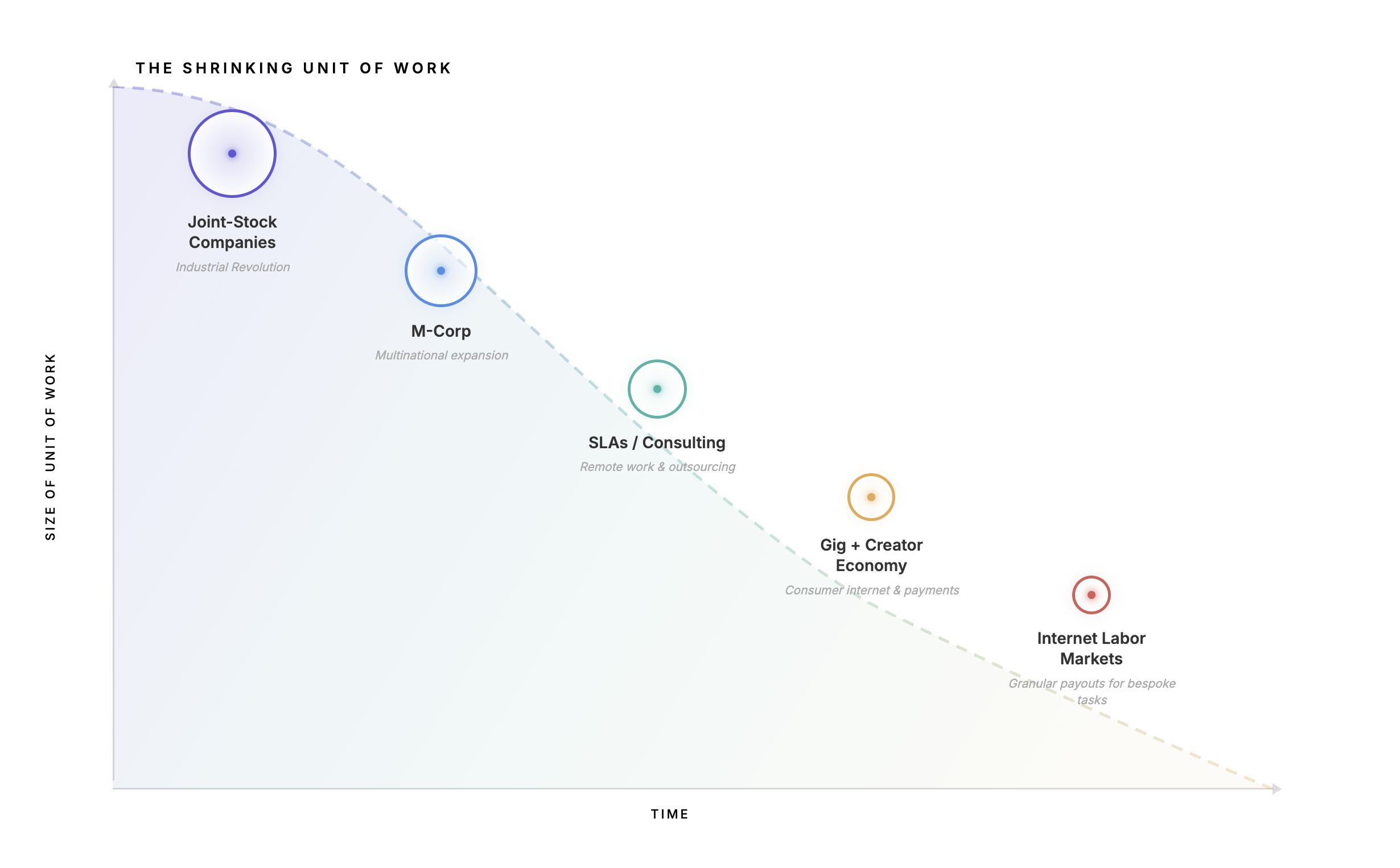
This trajectory is now reaching an inflection point, dramatically accelerated by the generative AI boom, which is collapsing the cost of software creation and birthing agile, single-person enterprises.
Supporting Context & Metrics: Deconstructing Internet Labor Markets
Internet Labor Markets (ILMs) represent the institutional maturation of this coordination trend. Defined as contributor-owned marketplaces where the core unit of work is a verifiable task settled instantly over crypto rails, ILMs distinguish themselves through two vital characteristics: Arbitrarily Bespoke Inventory and Strong Verification Guarantees.
[ Traditional Employment ]           [ Internet Labor Markets (ILMs) ]
--------------------------           ---------------------------------
• Rote, multi-day invoice flows      • Instant programmatic settlement
• Monolithic job descriptions        • Arbitrarily bespoke task inventory
• High human administrative overhead • Deterministic & bonded verification
• Localized or corporate hiring      • Globally distributed, modular labor
Arbitrarily Bespoke Inventory
Traditional labor marketplaces force diverse, emerging forms of work into rigid, pre-existing categories (e.g., standard contractor agreements or hourly job postings), resulting in poor specifications, uneven quality, and massive coordination overhead.
In contrast, an ILM defines inventory dynamically through core parameters: task specifications, eligibility constraints, verification methods, and payout functions. Because frontier work rarely fits traditional definitions for long, ILMs allow protocols to adapt their purchasing needs in real-time while retaining the same underlying contributor base, verification layer, and reputation system. Whether a medical network is sourcing structured edge-case data from certified doctors, a cybersecurity protocol is paying for a reproducible exploit patch, or a physical mapping network is auditing store hours via geofenced proof, the task definition itself carries the operational workflow.
Strong Verification Guarantees & Multi-Dimensional Mapping
Traditional employment models rely on sluggish administrative pipelines—submit work, issue invoice, manager approval, finance processing, and settlement landing days or weeks later. While tolerable for large, infrequent deliverables, this pipeline collapses under the weight of high-frequency, adversarial work.
ILMs solve this by combining two distinct verification regimes:
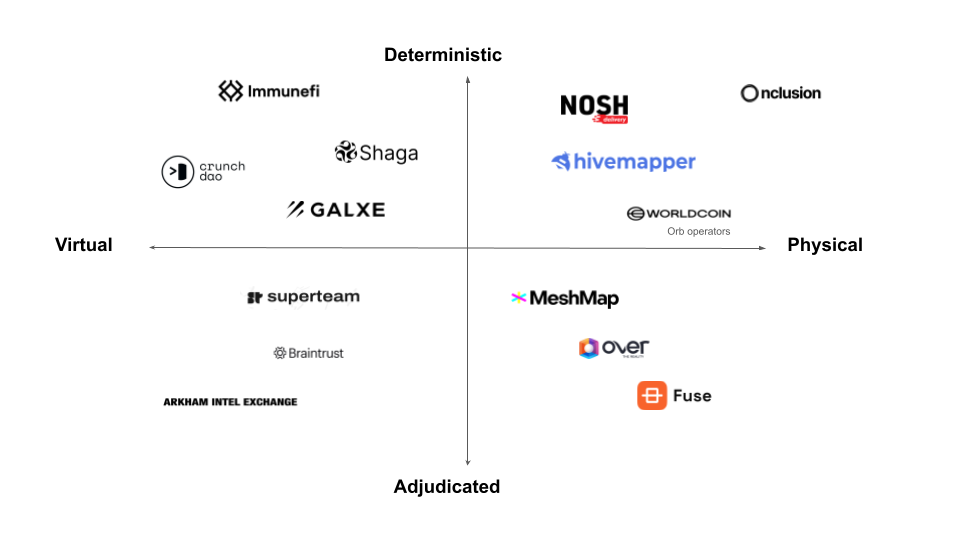
- Deterministic Verification: Used for tasks where correctness can be mathematically or algorithmically verified without human discretion (e.g., matching GPS traces against route algorithms, running code submissions against automated test suites, or scoring model outputs on a holdout test set).
- Bonded Verification (Slashing & Reviewer Networks): Pioneered by networks like Livepeer, this mechanism requires contributors and qualitative reviewers to post economic collateral. Accurate reviewers are rewarded, while bad actors attempting fraud face automated financial penalties (slashing).
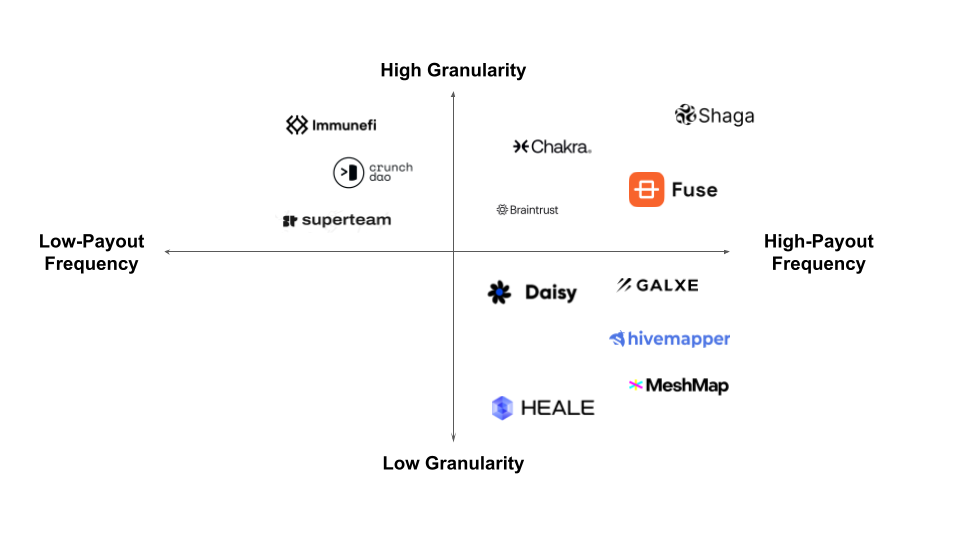
Analytically, the ILM design space can be mapped across three distinct dimensions:
- Task Granularity × Payout Frequency: Ranging from large, low-frequency bespoke contracts (high-context software integration) to high-frequency micro-evaluations and data validations that function like task exchanges.
- Verification Method × Work Domain: Spanning virtual/deterministic domains (low overhead, highly competitive) to physical/adjudicated domains (high barriers to entry, extreme defensibility, requiring boots-on-the-ground execution like Daylight or Nosh).
- Contributor Skill × Payout Frequency: Categorizing participants into believers (high-skill elite engineers or researchers who accept token upside and staking) versus wage earners (liquidity-constrained field installers or delivery operators requiring stablecoin-first, instant payouts).
Official Statements and Industry Insights
The convergence of artificial intelligence, organizational unbundling, and cryptographic labor infrastructure has drawn commentary from prominent macroeconomic researchers and venture capital thought leaders.
Economic data from regional Federal Reserve banks highlights a profound structural evolution in labor markets. As recent economic reviews suggest, AI is simultaneously aiding and replacing traditional workers, forcing a re-evaluation of how tasks are distributed and compensated. Rather than destroying human labor, industry specialists argue that AI radically expands individual leverage and the feasible economic problem set.
In a comprehensive analysis published by Multicoin Capital examining the structural architecture of internet capital markets and agent relationships, analysts emphasize that AI compresses the cost and latency of building software:
"The result is that companies can be started by fewer people, and can hit scale faster. These ‘thin’ organizations however still depend on non-software inputs—i.e., data, labeling, evaluation, integrations, distribution, physical deployment, domain expertise, edge-case handling. Across these functions, inputs are intermittent, global, and hard to hire for in a traditional way."
Furthermore, industry advocates underscore that while artificial intelligence can reason about the physical world, it fundamentally lacks the agency to act within it. Installations require physical completion, sensors demand deployment, and automated agents necessitate continuous supervision and exception handling.
By leveraging programmable crypto rails to source, verify, and settle marginal contributions instantly, organizations can scale their human contributor perimeter globally without inflating permanent overhead.
Future Outlook: The Convergence of Labor and Capital Markets
As we look toward the horizon, the macroeconomic implications of Internet Labor Markets are staggering. The prevailing societal consensus assumes that as artificial intelligence advances, human labor will inevitably depreciate in value. However, the emergence of ILMs suggests the exact opposite: human labor is poised to flourish precisely because AI increases the velocity of enterprise creation, multiplying the demand for edge-case coordination, domain expertise, physical execution, and high-judgment verification.
Within the next year, the corporate landscape will likely experience the widespread proliferation of internet-native organizations staffed by internet-native labor. Core corporate teams will shrink to hyper-efficient nuclei, while the peripheral network of on-demand, global contributors expands exponentially.
Crucially, this structural transformation completes a vital economic loop. When workers earn their primary income through frictionless, onchain labor markets, the historical barrier of the crypto "onramp" dissolves entirely. Earnings naturally transform into balances, balances mature into savings, and savings organically flow into decentralized financial primitives—yield generation, lending, collateralized borrowing, and Internet Capital Markets.
The next generation of crypto participants will not be defined by speculators purchasing tokens out of curiosity; they will be the global workforce, compensated fairly for verifiable work, seamlessly onboarded through the dignity of labor.