


Executive Overview
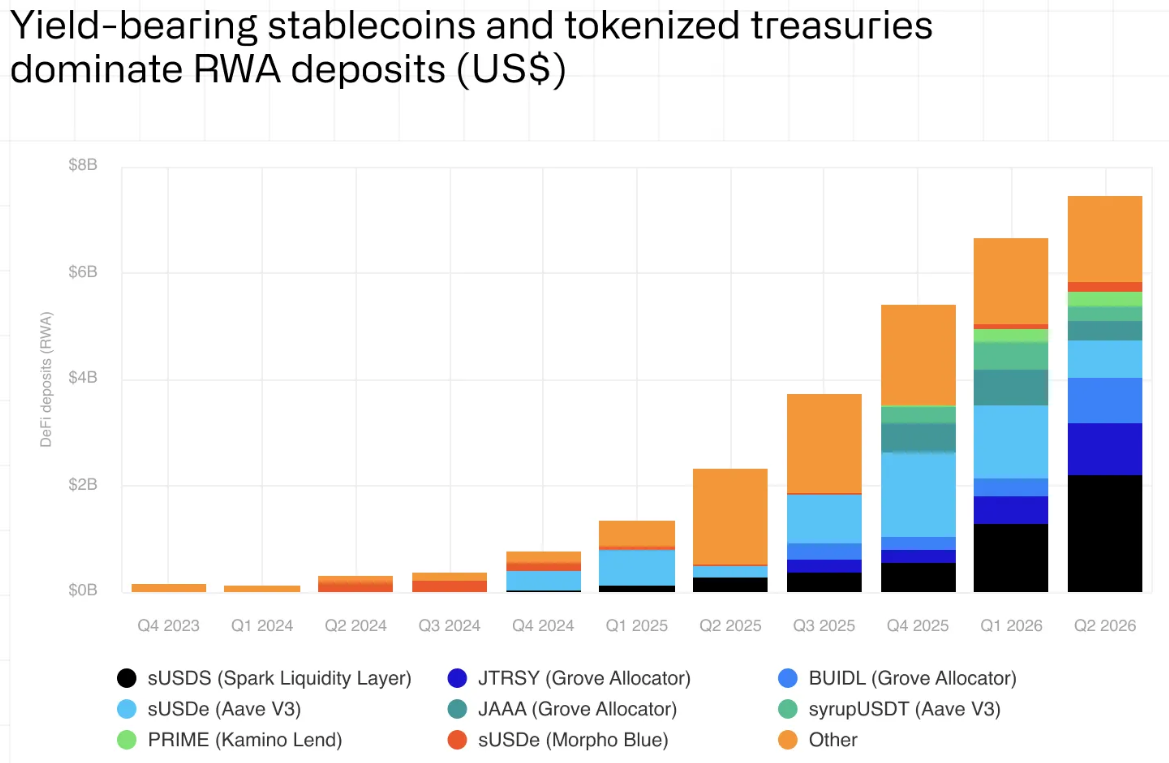
During the second quarter of 2026, total RWA deposits across various decentralized finance platforms more than tripled year-over-year, scaling an unprecedented peak of $7.4 billion. This explosive expansion stands in stark contrast to the broader DeFi ecosystem, which experienced a 15% contraction in total value locked (TVL) over the same timeframe. Similarly, decentralized exchange (DEX) volumes plummeted by roughly 70%, while RWA spot trading volumes surged upward by an astonishing 220%.
This structural divergence highlights a profound paradigm shift: tokenized traditional investments—such as United States Treasury bills, fiat-pegged stablecoins, commodities, and equities—are no longer merely experimental issuance mechanisms. Instead, they have transformed into deeply integrated, utility-driven pillars of onchain financial markets. Fuelled by a persistent demand for predictable yield, seamless cross-border collateralization, and 24/7 liquidity, RWAs are redefining what it means to participate in digital asset economies.
Detailed Chronology: The Evolution of RWAs into Onchain Powerhouses
To understand the current dominance of Real-World Assets, one must trace the trajectory of how traditional financial instruments found a home on distributed ledgers.
Phase 1: The Era of Static Issuance (2021–2023)
In the early days of tokenization, projects focused primarily on basic representation. Financial institutions and specialized fintech startups experimented with moving private credit, real estate deeds, and government bonds onto public and private blockchains. However, these assets were largely static. Once issued, they sat idly in digital wallets, serving as digital certificates of ownership with virtually no secondary market liquidity or utility within decentralized lending protocols.
Phase 2: Yield-Seeking and the Macro Environment (2024–2025)
As global central banks raised interest rates to combat post-pandemic inflation, traditional yields on sovereign debt climbed to levels not seen in over a decade. DeFi participants, facing compressed yields within native crypto markets, hungered for exposure to safe-haven assets. This macro backdrop triggered a rush toward tokenized Treasuries. Protocols began bridging traditional fixed-income products onchain, allowing users to mint yield-bearing stablecoins backed by short-term government debt.
Phase 3: Deep Market Integration and Utility (2026 and Beyond)
As outlined in the CoinShares-Token Terminal Q2 report, the RWA market has now entered its third and most mature phase. Assets are actively deployed as primary collateral in lending markets, utilized as margin in derivatives trading, and traded dynamically across secondary onchain venues. Rather than acting as a bridge for traditional investors entering crypto, RWAs have become indispensable native financial instruments that thrive independently of broader crypto bull or bear cycles.
Supporting Context & Metrics: Unpacking the Q2 2026 Data
The data compiled by CoinShares and Token Terminal paints a vivid picture of a market undergoing hyper-growth despite macroeconomic and sector-specific headwinds.

+---------------------------------------------------------------------------------+
|                         Q2 2026 RWA vs. DeFi Metrics                            |
+------------------------------------+--------------------------------------------+
| Metric                             | Year-Over-Year Change / Total Value        |
+------------------------------------+--------------------------------------------+
| RWA Deposits (DeFi Platforms)      | Tripled YoY to $7.4 Billion                |
| Broad DeFi Deposits (TVL)          | Decreased by ~15%                          |
| RWA Spot Trading Volumes (DEXs)    | Rose by ~220%                              |
| Broad DEX Volumes                  | Fell by ~70%                               |
| RWA Yield Range                    | 3.2% to 5.5% (Risk-adjusted)               |
+------------------------------------+--------------------------------------------+
Yield-Bearing Stablecoins and Treasuries Dominate Collateral Pools
The primary engine driving the $7.4 billion RWA deposit milestone is the proliferation of yield-bearing stablecoins and tokenized Treasury products. In the second quarter of 2026, Sky Protocol’s sUSDS took a commanding lead in this category. By granting holders direct, programmatic exposure to a yield-generating iteration of its native USDS stablecoin, Sky Protocol captured substantial market share.
Concurrently, institutional-grade tokenized Treasury funds—most notably BlackRock’s USD Institutional Digital Liquidity Fund (BUIDL)—cemented their status as foundational onchain collateral. Sophisticated market participants increasingly leverage these low-risk, income-producing assets within decentralized lending markets to borrow stablecoins, optimize capital efficiency, and execute complex delta-neutral trading strategies.
According to the report, RWA products currently offer a healthy and competitive yield range spanning approximately 3.2% to 5.5%. Conservative, low-risk Treasury-backed instruments anchor the bottom of this range, while more complex structured products and higher-yield strategies offer elevated returns in exchange for incremental smart contract and credit risk.
Precious Metals and Fiat Products Fuel Spot Volumes
Beyond fixed income, tokenized commodities and alternative dollar-denominated yield products have unlocked massive volumes on decentralized exchanges. CoinShares’ classification framework highlights gold-backed stablecoins—such as Tether Gold (XAUt) and Paxos Gold (PAXG)—as critical catalysts for spot activity.
During periods of heightened geopolitical tension and macroeconomic uncertainty, these digital gold products experienced massive surges in trading volume. Investors leveraged the 24/7 nature of decentralized exchanges to trade around rapid gold price fluctuations without dealing with the settlement friction of physical bullion markets.
Similarly, yield-bearing dollar products like Ethena’s sUSDe contributed significantly to RWA spot activity, demonstrating that traders increasingly prefer assets that combine liquidity with passive income generation. The 220% year-over-year surge in RWA spot trading volumes underscores a fundamental behavioral shift: investors are no longer content merely buying assets directly from primary issuers; they demand deep, liquid secondary markets to trade fractionalized ownership dynamically.
Expansion into Leveraged Derivatives and Perpetuals
The utility of RWAs has officially breached the boundaries of spot markets and lending protocols, making aggressive inroads into decentralized derivatives. Traders can now gain leveraged exposure to traditional asset classes without ever holding the underlying equities or commodities.
RWA perpetual futures trading has expanded aggressively, defying the broader cool-down observed across native crypto derivatives. Platforms tailored specifically to this niche are reaping the rewards. For instance, tradeXYZ—an RWA-focused perpetual futures platform constructed on the high-throughput Hyperliquid network—has witnessed its trading volume multiply roughly twentyfold since its initial launch.
Trading activity within these onchain derivatives markets is heavily concentrated around traditional commodities, major equity indexes (including the S&P 500 and Nasdaq-100), and prominent technology equities. As open interest continues its upward trajectory, it signals that global traders are voting with their capital, preferring the censorship-resistant, round-the-clock accessibility of blockchain rails over traditional brokerage accounts.
Official Statements and Industry Insights
The divergence between native crypto market contraction and RWA expansion has caught the attention of top-tier financial executives.
Jean-Marie Mognetti, CEO of CoinShares, offered pointed commentary on the underlying psychology and economic drivers fueling the sector’s resilience during the release of the Q2 report. Highlighting the significance of the data, Mognetti emphasized that the growth defies traditional market correlations:
"When an asset class grows through a downturn in its host ecosystem, demand is being driven by financial utility, not by market cycles."
Mognetti’s analysis cuts to the core of the tokenization thesis. In previous crypto market cycles, capital inflows were overwhelmingly speculative, rising and falling in tandem with Bitcoin’s price movements and retail sentiment. The maturation of the RWA sector introduces a radically different dynamic: institutional and retail participants are utilizing tokenized assets because they solve real-world financial friction—offering transparent yield, instant settlement, global accessibility, and composability within smart contracts.
Additional insights echoed by contributors to the CoinShares and Token Terminal report suggest that financial intermediaries are beginning to view tokenization not as a threat to legacy infrastructure, but as an upgrade path. By embedding traditional financial assets into programmable environments, issuers can automate compliance, streamline interest distributions, and drastically reduce administrative overhead.
Future Outlook: The Road Ahead for Real-World Assets
As the crypto industry looks past the mid-point of the decade, the trajectory of Real-World Assets points toward inevitable institutional convergence and technological expansion. Several key trends are poised to shape the next chapter of the RWA narrative:
- Regulatory Clarity and Compliance Integration: As tokenized funds scale into the tens of billions of dollars, regulatory frameworks across major jurisdictions (such as MiCA in the European Union and evolving SEC guidelines in the United States) will increasingly dictate how issuers handle KYC/AML compliance directly at the smart contract level. Protocols that successfully balance decentralization with institutional compliance will capture the lion’s share of future liquidity.
- Cross-Chain Interoperability: Currently, RWA liquidity is often fragmented across various layer-1 blockchains and layer-2 scaling networks. The development of secure, trust-minimized cross-chain bridge protocols and unified liquidity layers will allow tokenized Treasuries and commodities to flow freely between ecosystems, maximizing capital efficiency.
- Expansion into Private Credit and Real Estate: While short-term Treasuries and gold currently dominate RWA deposits, the sleeping giant remains private credit, small-business lending, and fractionalized real estate. As legal frameworks adapt to recognize onchain debt enforcement, trillions of dollars in illiquid traditional assets are expected to find their way onto public ledgers.
- Mainstream Retail Adoption: The boundary between "crypto-native" and "TradFi" users will continue to blur. Consumer-facing fintech applications are quietly integrating tokenized yield-bearing products into everyday savings accounts, offering retail users high-yield savings vehicles powered by underlying RWA infrastructure without requiring them to manage private keys or interact directly with complex DeFi interfaces.
Conclusion
The data from the Q2 2026 CoinShares and Token Terminal report serves as a definitive turning point for digital assets. The tripling of RWA deposits to $7.4 billion against a backdrop of broader DeFi contraction proves that tokenization is no longer a speculative fad. By bridging the stability and yield of traditional finance with the speed, transparency, and composability of decentralized ledgers, Real-World Assets have successfully embedded themselves into the permanent architecture of modern global finance.