
Executive Overview
According to public disclosures from Yuga Labs leadership, the intercepted assets, collectively valued at over $500,000, are currently held securely in the company’s custody. They are slated to be returned to their rightful owners once a comprehensive recovery and verification solution is finalized.
The security incident underscores the lingering systemic risks inherent in legacy Web3 infrastructure, particularly protocols that are actively winding down operations or experiencing transitions in management. Flooring Protocol, which had previously announced the sunsetting of its consumer-facing Web3 services, became a prime target due to a mix of unmanaged divisions, organizational restructuring, and lingering liquidity issues.
While the broader NFT market continues to trade at a fraction of its historic bull-market highs—bouncing around a $1.4 billion total market capitalization—blue-chip assets like CryptoPunks and Bored Apes continue to hold substantial intrinsic and monetary value. This high-stakes rescue operation not only prevented catastrophic losses for individual holders but also highlighted the close-knit, collaborative nature of core ecosystem participants when crisis strikes.
Detailed Chronology of the Exploit and Intervention
The Vulnerability and the Breach
The security crisis unfolded rapidly when malicious actors identified vulnerabilities within Flooring Protocol’s smart contracts and operational infrastructure. Flooring Protocol had historically allowed users to fractionalize their NFTs into standardized ERC-20 tokens, enabling liquid trading of traditionally illiquid digital assets. However, as the protocol began phasing out its consumer-facing services, parts of its infrastructure were left exposed or operating without active oversight.
As the exploit began draining assets from the protocol’s vaults, blue-chip NFTs—which had been deposited by users or left on the platform by former operators trying to maintain exit liquidity—were put directly in the crosshairs. The attackers sought to siphon off these high-value digital properties before alarms could be raised across the broader ecosystem.
The Swift Yuga Labs Response
Recognizing the imminent threat to foundational pillars of the NFT ecosystem, Yuga Labs-affiliated developers mobilized quickly. Leveraging advanced on-chain monitoring tools and white-hat intervention strategies, the team managed to outmaneuver the exploiters and secure 68 endangered NFTs before they could be laundered or sold off through decentralized or centralized exchanges.
Yuga Labs CEO Michael Figge took to social media platform X (formerly Twitter) on Monday to confirm the successful rescue operation. Figge assured the community that the rescued assets were safe under Yuga Labs’ multi-sig custody and reiterated that a secure mechanism for returning the tokens to their rightful owners is currently being engineered.
Adding technical clarity to the operation, Yuga’s pseudonymous vice president of blockchain, known within the community as 0xQuit, confirmed the financial scale of the intervention. In an official post, 0xQuit verified that the rescue operation successfully safeguarded more than $500,000 worth of elite NFTs from permanent loss.

Supporting Context & Metrics: The Vulnerable Protocol and Market Valuations
Flooring Protocol’s Extended Wind-Down
To fully understand how the exploit occurred, one must examine the operational trajectory of Flooring Protocol itself. The platform had not been operating at full capacity for quite some time. In September 2025, Flooring Protocol officially announced that its Web3 consumer services were entering "sunset mode."
During that announcement, project leadership explicitly advised FPv2 token holders to redeem their fractional positions, reclaim their underlying NFTs, and completely exit the platform ahead of an October 15, 2025 deadline. Despite these warnings, various users and legacy participants either missed the window or left assets trapped within fractionalized pools.
Former Flooring Protocol CEO FreeLunchCapital shed light on the organizational chaos that preceded the exploit. According to FreeLunchCapital, the platform had been plagued by persistent liquidity issues and sweeping internal organizational changes, which ultimately left crucial segments of the NFT division completely unmanaged.
In a candid statement, FreeLunchCapital revealed that they had personally continued providing liquidity and kept several of their own personal NFT assets locked within the platform to facilitate smooth user exits. Ironically, it was precisely these remaining assets—intended as a safety buffer for the community—that became the primary target for the malicious exploiters. FreeLunchCapital confirmed that discussions are currently underway with the parent group behind the management team in an effort to regain administrative control of the protocol and bring finality to the wind-down process.
Blue-Chip Resilience Amid Market Corrections
The incident serves as a stark reminder of the massive financial stakes still present in the digital collectible space, even as the broader market continues to operate far below its historical peak levels.
According to market aggregator CoinGecko, the total NFT market capitalization experienced a modest resurgence in late April and early May, climbing to roughly $2 billion before facing downward pressure and settling back toward $1.4 billion.
Despite this macroeconomic cool-down, premier collections command impressive individual floor prices:
- CryptoPunks: Maintained a resilient floor price of approximately 32.7 ETH (valued at roughly $54,612 per asset). Total market capitalization for the collection stands at an astonishing 339,400 ETH, or approximately $560 million.
- Bored Ape Yacht Club (BAYC): Sat comfortably around a floor price of 9.16 ETH, anchoring a total market capitalization of roughly 90,590 ETH (approximately $150 million).
Data from NFT Price Floor confirms that CryptoPunks and Bored Ape Yacht Club remain the indisputable titans of the digital artifact economy, accounting for the vast majority of blue-chip capital retention. Because these assets carry immense cultural and financial weight, their exposure to protocol exploits poses a systemic reputational and financial risk to the entire Web3 sector, making high-profile rescues like the one executed by Yuga Labs vital for maintaining investor confidence.
Official Statements and Industry Reactions
The crypto community reacted with a mixture of relief and critical introspection following the incident. While praise poured in for Yuga Labs and 0xQuit for their lightning-fast white-hat execution, severe questions were raised regarding the security standards of protocols undergoing sunset procedures.
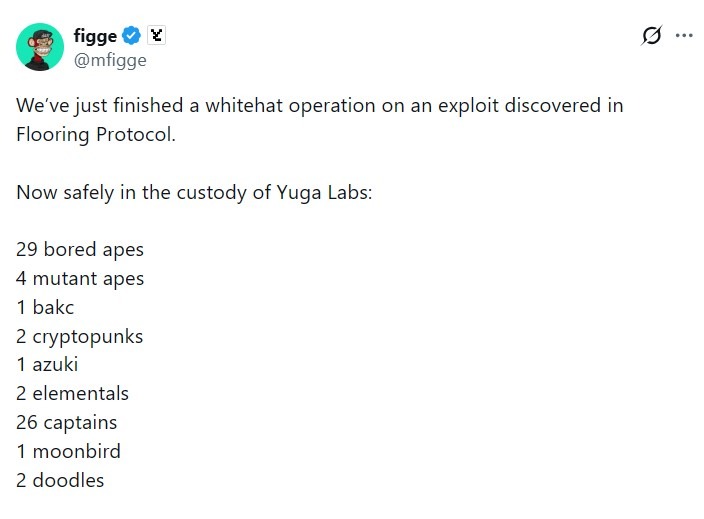
Yuga Labs CEO Michael Figge emphasized the company’s commitment to ecosystem safety:
"The recovered NFTs are safely in our custody and will be returned to their rightful owners once a secure, verified recovery solution is finalized. We remain vigilant in protecting the broader digital asset community from malicious actors."
Meanwhile, the candid disclosures from former CEO FreeLunchCapital provided a rare window into the administrative vulnerabilities that often accompany failing or sunsetting Web3 projects. FreeLunchCapital noted:
"We tried our best to keep liquidity flowing and left our own assets on the platform to help users exit safely. Unfortunately, those exact assets became the primary target of the exploit. We are currently in active talks with the parent management group to restore order and regain control."
Security analysts across the blockchain landscape have pointed out that sunsetting protocols represent an acute attack vector. When development teams disband, core maintainers leave, and user attention drifts away, smart contracts and fractionalized vaults often sit unmonitored—creating a fertile breeding ground for opportunistic hackers. Industry experts have called for standardized "sunsetting frameworks" to ensure that defunct protocols either fully migrate user funds to neutral smart contracts or maintain automated circuit breakers to prevent late-stage exploits.
Future Outlook: Lessons Learned and the Path Forward
The Flooring Protocol exploit and subsequent Yuga Labs rescue mission highlight several critical takeaways for the decentralized finance (DeFi) and non-fungible token (NFT) sectors moving forward:
- The Danger of Abandoned Infrastructure: Protocols in sunset mode are uniquely vulnerable. The Web3 industry must adopt more rigorous standards for winding down projects, ensuring that smart contract ownership is securely renounced or transferred to multi-sig disaster-recovery groups before teams disband.
- The Value of Ecosystem Solidarity: The swift intervention by Yuga Labs demonstrates the defensive capabilities inherent in a collaborative ecosystem. When foundational projects step in to rescue assets from failing third-party protocols, it reinforces the collective security posture of the entire asset class.
- Maturation of Market Valuation: Despite shifting market cycles and periodic liquidity contractions, blue-chip NFTs continue to command immense economic value. Protecting these foundational assets is paramount to preserving historical provenance and investor trust as the market matures toward its next cycle.
As Yuga Labs finalizes the verification procedures required to return the 68 rescued NFTs to their respective owners, the incident will undoubtedly serve as a case study in crisis management, white-hat intervention, and the ongoing necessity of robust on-chain security practices.