


Executive Overview
Blockaid’s telemetry tracked a staggering 212 distinct security incidents during H1 2026. More alarmingly, the platform verified a massive 3.4-fold year-over-year increase in high-threshold exploits compared to the entirety of 2025. While the aggregate financial damage of $1 billion is slightly tempered compared to the historic mega-hacks of prior years—such as the single-quarter anomaly in 2025 dominated by Bybit’s $1.5 billion exploit—the sheer volume and proliferation of attacks signal a systemic shift in how malicious actors target digital asset ecosystems.
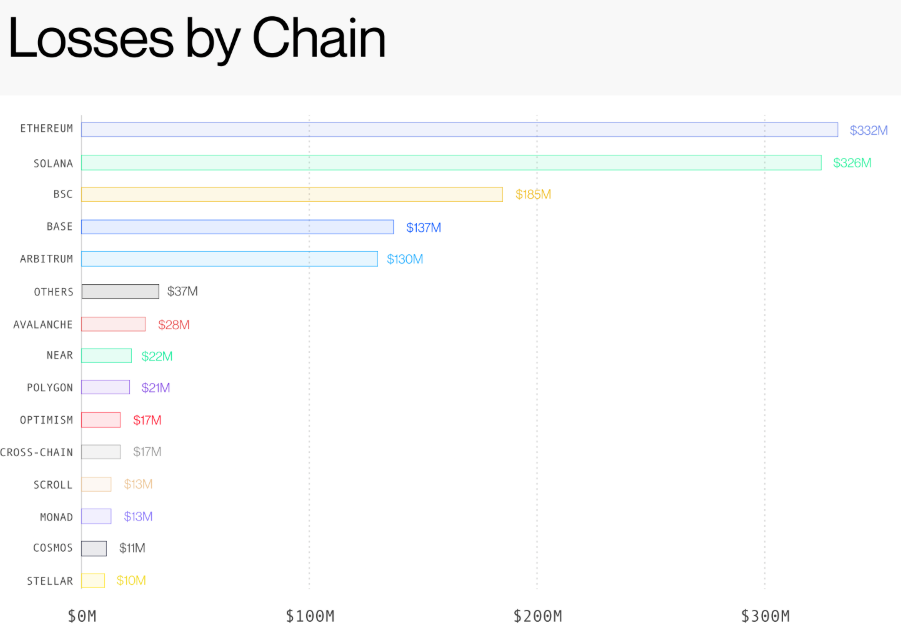
The geographic and architectural distribution of these losses highlights stark differences in how distinct blockchain networks are targeted. Ethereum and Solana emerged as the primary battlegrounds, bearing the brunt of the financial devastation. Ethereum recorded roughly $332 million in stolen funds, driven primarily by intricate code vulnerabilities and high-value smart contract exploits. Solana closely followed with approximately $326 million in losses, though its attack surface told a drastically different story: over 98% of Solana’s losses stemmed from compromised private keys, administrative key failures, and breaches of signing infrastructure, heavily linked by security researchers to state-sponsored actors.
As Web3 applications continue to secure billions of dollars in total value locked (TVL), the findings from Blockaid’s H1 2026 report serve as a stark wake-up call for developers, institutional allocators, and everyday users alike. The transition toward sophisticated, multi-vector attacks demands a complete re-evaluation of operational security (OpSec), decentralized governance resilience, and smart contract auditing standards.
Detailed Chronology and Major Incidents of H1 2026
The first half of 2026 was defined by a series of high-profile exploits that rapidly drained protocol liquidity pools and sent shockwaves through the broader digital asset economy. Blockaid’s verification of 212 security incidents underscores a relentless barrage against protocols across multiple chains, with single exploits routinely wiping out substantial portions of a platform’s collateral base.
The Defining Breaches: KelpDAO, Drift, and Beyond
The single largest exploit of the half-year period struck restaking platform KelpDAO, resulting in a devastating $292 million loss. The KelpDAO incident instantly highlighted the systemic risks inherent in the rapidly expanding liquid restaking sector, where complex, multi-layered smart contracts interact across various consensus layers and yield-generating protocols. The speed and scale of the KelpDAO drainage caught both developers and market makers off guard, establishing a bleak benchmark for H1 threat levels.
While KelpDAO represented the pinnacle of smart contract exploitation, the Solana ecosystem experienced its own catastrophic events, led by the Drift Protocol and Step Finance breaches. The Drift Protocol hack, which accounted for a significant portion of Solana’s $326 million in losses, raised intense community scrutiny regarding administrative account management and incident response protocols. Concurrently, Step Finance fell victim to structural security failures. According to telemetry and threat intelligence correlations cited by Blockaid, these Solana-centric key compromises bore the operational hallmarks of North Korea-linked cyber threat groups, such as the Lazarus Group, which have increasingly pivoted their advanced persistent threat (APT) campaigns toward Web3 infrastructure.
A Panorama of Vulnerabilities: From Humanity Protocol to StablR
Beyond the headline-grabbing mega-hacks, H1 2026 was characterized by a diverse array of vector-specific breaches spanning multiple networks:

- Humanity Protocol: Hit by operational security vulnerabilities that compromised internal signing frameworks, resulting in material losses and forcing the project to rapidly restructure its permissioned architecture.
- StablR: Suffered an exploit that directly contributed to localized depegging events across euro- and USD-denominated stablecoin pairings, illustrating the dangerous contagion effect when stable-asset issuers experience collateral or minting breaches.
- CoWSwap: Standing as a notable exception on the Ethereum ledger, CoWSwap was impacted by what Blockaid classified primarily as a user-side execution mistake rather than a foundational protocol code flaw, emphasizing the persistent danger of human error in complex transactional environments.
- Raydium and Volo: While Solana was largely dominated by key management failures, a targeted minority of code exploits on protocols like Raydium and Volo contributed to the remainder of the network’s financial drain.
These incidents collectively paint a picture of an industry under siege on multiple fronts, where no single vertical—whether decentralized exchanges, restaking hubs, or stablecoin issuers—is immune to targeted infiltration.
Supporting Context and Metrics: The Evolving Threat Landscape
To fully contextualize the $1 billion in losses recorded in the first half of 2026, industry analysts must examine how these figures compare to historical precedents and structural shifts in hacker methodology.
Comparative Analysis: H1 2026 vs. 2025
In the preceding year, 2025 closed with an aggregate of approximately $2.58 billion lost across 63 major incidents. However, that figure was heavily skewed by a single massive anomaly: the first quarter of 2025 saw Bybit suffer a monumental $1.5 billion breach, which single-handedly inflated the historical loss metrics for Ethereum and Layer-2 scaling network Arbitrum.
In contrast, the first half of 2026 was not defined by one singular black-swan exchange collapse, but rather by a high-frequency, distributed assault on decentralized applications and institutional signing infrastructure. Blockaid’s data revealing a 3.4-fold increase in high-threshold exploits emphasizes that while total losses may appear slightly normalized compared to historical mega-outliers, the underlying frequency and professionalization of attacks have intensified dramatically.
Ethereum vs. Solana: Two Distinct Attack Surfaces
The division of losses between Ethereum ($332 million) and Solana ($326 million) highlights a fascinating divergence in architectural vulnerabilities:
- The Ethereum Vector (Smart Contract Complexity): Ethereum continues to act as the primary crucible for experimental financial engineering. Because the network hosts the lion’s share of high-value DeFi protocols—including complex restaking loops, algorithmic stablecoins, and advanced automated market makers (AMMs)—attackers overwhelmingly targeted underlying application logic. Bugs in cross-chain bridges, logical flaws in smart contract code, and complex market manipulation schemes drove the majority of Ethereum-based incidents.
- The Solana Vector (Operational & Signer Infrastructure): Solana’s high throughput and surging total value locked made it an increasingly lucrative target in 2026, marking a sharp escalation from the roughly $127 million it lost across the entirety of 2025. Crucially, smart contract code flaws were secondary here; over 98% of Solana’s H1 losses were directly attributed to compromised private keys, leaked administrative credentials, and targeted breaches of signing infrastructure.
This dichotomy illustrates that while Ethereum developers must wage war against code complexity and mathematical vulnerabilities, Solana builders face an equally perilous battle regarding human factors, institutional key custody, and multi-sig operational security.
Official Statements and Industry Insights
The release of Blockaid’s H1 2026 report prompted immediate commentary from industry leaders, security researchers, and economic strategists regarding the state of Web3 defense mechanisms.
Reflecting on the macro-level data and the stark contrast between the current year and the anomalies of the past, Blockaid CEO Ido Ben-Natan shared vital context with Cointelegraph regarding the evolution of threat flows.
"2025 had $2.58 billion lost across 63 incidents, concentrated in Q1 by Bybit’s $1.5 billion, with Ethereum and Arbitrum the top chains by stolen-fund flow,"
Ben-Natan noted, emphasizing that the current year’s threat environment has matured into a persistent, high-volume campaign rather than relying on isolated catastrophic breaches.
Security architects interviewed in the wake of the report point out that the staggering concentration of attacks on key management—particularly within the Solana ecosystem—demonstrates that traditional cybersecurity hygiene has failed to keep pace with the rapid financialization of high-performance blockchains. Decentralized autonomous organizations (DAOs), foundation treasuries, and protocol core teams are increasingly being targeted via social engineering, supply-chain compromises of developer environments, and zero-day exploits targeting remote signing modules.
Furthermore, leading auditing firms have echoed Blockaid’s warnings, stressing that traditional, static code audits are no longer sufficient to protect protocols managing hundreds of millions of dollars. The rise of real-time on-chain security monitoring, automated circuit breakers, and institutional-grade hardware security modules (HSMs) are rapidly transitioning from "nice-to-have" features to absolute operational prerequisites.
Future Outlook: Securing the Next Phase of Web3 Growth
As the cryptocurrency industry looks toward the second half of 2026 and beyond, the milestone of $1 billion in losses within just six months serves as both a sobering warning and a catalyst for structural reform. If current trends persist, annual losses risk challenging historical highs, threatening institutional adoption, and eroding retail confidence.
The Imperative for Defensive Innovation
Mitigating this escalating threat level will require a multi-faceted approach across the entire Web3 stack:
- Upgrading Key Management Protocols: Given that over 98% of Solana’s massive losses stemmed from compromised keys and signing infrastructure, protocols must urgently adopt distributed key generation (DKG), multi-party computation (MPC) wallets, and hardware-enforced isolation to eliminate single points of failure.
- Formal Verification and Advanced Auditing: Ethereum’s persistent vulnerability to complex code exploits demands a deeper industry-wide commitment to formal verification—mathematically proving the correctness of smart contract logic rather than relying solely on manual code reviews.
- Runtime Protection and Circuit Breakers: Protocols must increasingly integrate automated runtime security solutions that can pause contracts, isolate compromised pools, and intercept malicious transactions before funds are permanently drained from liquidity pools.
- Cross-Chain Collaboration and Intelligence Sharing: As state-sponsored actors and sophisticated cybercriminal syndicates target bridge infrastructure and cross-chain messaging protocols, real-time threat intelligence sharing between security firms, validators, and centralized exchanges will be paramount.
The path forward for decentralized finance is clear: financial innovation can no longer outpace security architecture. For the Web3 ecosystem to safely scale toward mass institutional integration, the lessons of H1 2026 must be systematically addressed, transforming defensive resilience from an afterthought into the foundational bedrock of blockchain development.