


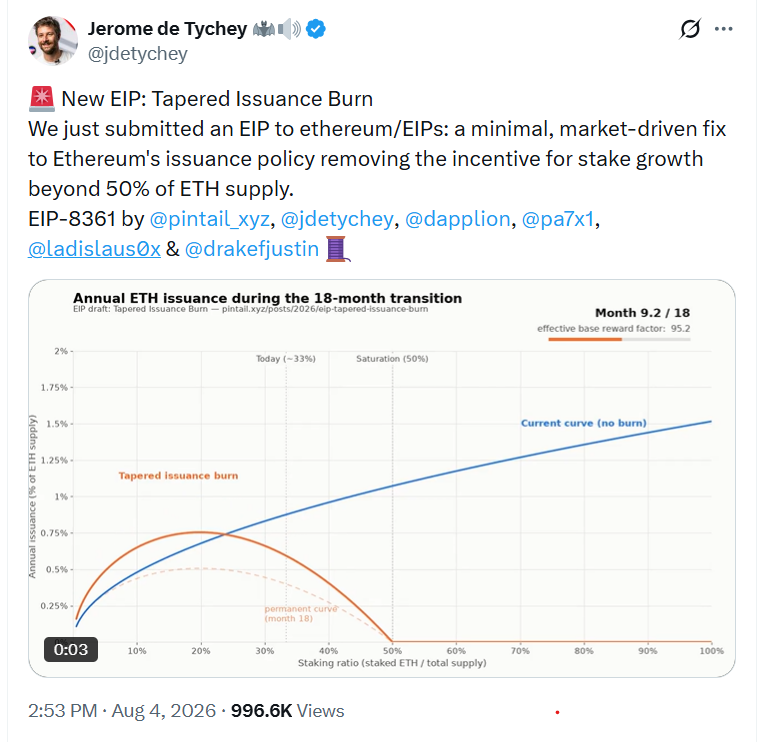
The core premise of EIP-8363 is deceptively straightforward: gradually throttle down staking rewards as more Ether (ETH) is locked up to secure the network, eventually driving new protocol issuance to absolute zero once 50% of the total ETH supply is staked. Proponents argue that Ethereum has reached a point of diminishing security returns, continuing to overpay for a level of security it no longer requires while inadvertently diluting non-staking holders. Critics, however, warn that the cure may be far more lethal than the disease, threatening to unravel DeFi, disenfranchise solo validators, and destabilize institutional confidence in Ethereum’s monetary policy.
Executive Overview
To understand the scale of the backlash, one must look at the blueprint of EIP-8363. Authored by prominent figures within the ecosystem—including Ethereum Foundation researcher Justin Drake and Ethereum Community Conference (ETHCC) co-founder Jerome de Tychey—the proposal targets the fundamental cost structure of network security.
- The Mechanism: EIP-8363 systematically scales back validator rewards relative to the percentage of total ETH staked, flattening protocol issuance entirely if the staked supply hits the 50% threshold.
- The Proponent Thesis: Ethereum is bleeding capital by paying excessive subsidies for security it already possesses in abundance. Furthermore, inflation driven by high staking rewards acts as a structural penalty for holders who prefer native liquidity.
- The Industry Backlash: A coalition of DeFi heavyweights, liquid staking protocol founders, and institutional allocators argue the policy will shatter lending markets, harm decentralization, and punish Ethereum for its own organic growth.
- The Governance Controversy: Beyond the code itself, critics have lambasted the abrupt, last-minute rollout of the proposal just days before a major upgrade deadline, sparking wider concerns over how major economic policy shifts are handled within the ecosystem.
Detailed Chronology: From Concept to Controvery
The controversy surrounding EIP-8363 erupted in mid-2026, catching much of the developer and investor community off guard.
The Spark (August 2026)
As Ethereum approached its late-summer upgrade proposal deadlines, Justin Drake, Jerome de Tychey, and fellow researchers published EIP-8363 on the Ethereum Magicians forum. Their timing—dropping a proposal with massive macroeconomic consequences just days before the August 6 consideration deadline for the network’s next scheduled upgrade—immediately drew fire.
Critics argued that a change of this magnitude required months of simulations, roundtables, and public feedback, rather than a rushed push toward inclusion.
The Immediate Schism
Within hours of publication, social channels lit up. Prominent builders in the DeFi and staking spaces took to X (formerly Twitter) to voice absolute rejection. Mike Silagadze, founder of liquid staking platform Ether.fi, categorized the proposal as “disappointing on every level,” warning that it would actively harm adoption, decentralization, and network credibility.
Concurrently, institutional representatives—who have spent years fighting for regulatory clarity and predictable yield profiles—signaled immediate alarm. Dr. Steve Berryman, head of client partnerships for Ethereum at Bitwise, pointed out that capital allocators prize regulatory and monetary certainty above all else. Altering issuance parameters dynamically introduces volatility to baseline returns, a scenario institutional desks actively try to avoid.

Supporting Context & Metrics: Is Ethereum Really Over-Staked?
To evaluate the validity of EIP-8363, one must examine the baseline health of Ethereum’s consensus layer.
Current Staking Statistics
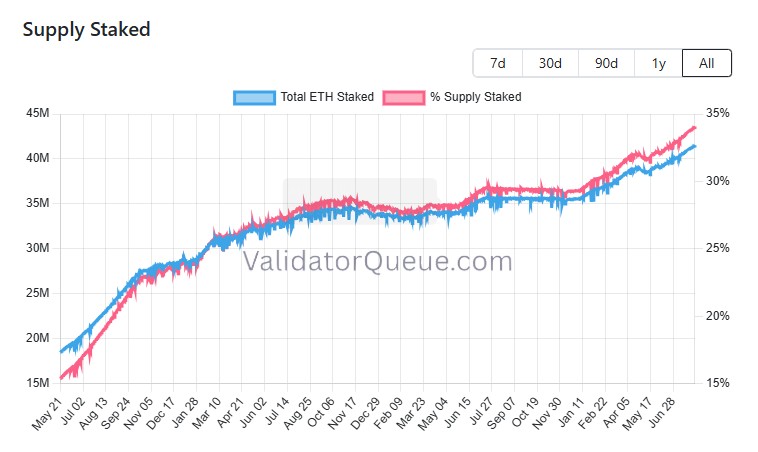
According to data from the Ethereum Validator Queue, the network currently boasts roughly 41.5 million ETH staked, yielding an annualized return of 2.67%. This accounts for 34.07% of the entire circulating supply.
[Total ETH Supply] ────────────────────────► 100%
[Staked ETH (~41.5M)] ─────────────────────► 34.07% (Yield: ~2.67%)
[Proposed Taper Cap] ──────────────────────► 50.00% (Issuance drops to 0%)
Proponents of the Tapered Issuance Burn argue that pushing past this 34% threshold provides negligible security gains. In their view, once a blockchain achieves a certain economic weight, adding tens of millions more staked coins yields diminishing returns against systemic 51% attacks, while continuously inflating the token supply.
The Natural Market Ceiling
Conversely, market-driven analysts argue that administrative intervention is entirely unnecessary because market forces are already moderating staking inflows.
Dr. Steve Berryman notes that Ethereum’s staking growth has faced a natural friction point as yields have compressed toward the 2% range. Because market participants require a degree of native liquidity to participate in commerce, trading, and collateralized borrowing, capital cannot—and will not—chase 2% yields indefinitely.
"We will come to a natural ceiling probably by the end of this year," Berryman observes, noting that institutional tranches from players like BlackRock and Bitmine are nearing their target allocations and will naturally plateau without algorithmic nudges from core developers.
Furthermore, commentator Leo Lanza argues that the conceptual framing of Ethereum issuance as a “stealth tax” on non-stakers is mathematically overblown. With Ethereum’s annualized inflation sitting comfortably below 1%—lower than the historical expansion rate of gold, which typically hovers between 1% and 2% annually—Lanza maintains that the free market is fully equipped to balance liquidity versus yield without developer intervention. "Let the market adjust," he urges.
Official Statements and Industry Perspectives
The divide over EIP-8363 exposes fundamental philosophical disagreements about what Ethereum actually is: is it a settlement layer optimized for ultrsound monetary purity, or is it a dynamic, multichain economic engine that powers a sprawling web of DeFi applications?
The DeFi View: Killing the Golden Goose
Greg Koumoutsos, technical research lead at the Lido Labs Foundation, argues that the authors of EIP-8363 fundamentally misunderstand the utility of Ethereum’s issuance. Issuance is not merely paying for raw slashed-ETH capital security; it is paying for a complex matrix of decentralization attributes.
"Ethereum is not only paying for slashable ETH; it is paying for decentralization, operator diversity, censorship resistance, and network resilience," Koumoutsos states.
Moreover, liquid staking tokens (LSTs) and liquid restaking tokens (LRTs) have become the bedrock liquidity layer of Ethereum DeFi. They serve as collateral in lending markets, liquidity pool pairs, and automated yield strategies across protocols like Aave, Maker, and Curve.
Stani Kulechov, founder of Aave, has warned that tampering with the underlying yield curve risks destabilizing the broader asset web built on top of ETH. If staking returns are artificially compressed, yield-seeking capital could easily migrate to alternative layer-1 ecosystems or riskier yielding assets, punishing Ethereum simply for scaling successfully.
The Centralization Paradox: Hurting Solo Validators
Ironically, while EIP-8363’s authors suggest the proposal helps decentralization by curbing massive validator bloat, critics argue it will achieve the exact opposite.
Large staking pools, centralized exchanges, and institutional custodians operate with massive economies of scale, low overhead, and diversified revenue streams. Conversely, independent solo validators bear real hardware, operational, and maintenance costs.
When rewards are compressed via tapered issuance:
- Solo stakers face immediate margin compression, making home-staking economically unviable.
- Institutional pools absorb the shock because staking serves secondary strategic goals, such as customer retention, product integration, and regulatory positioning.
- Delegated staking shifts further away from decentralized onchain protocols and toward centralized custodial alternatives that can abstract away complex upgrade costs.
Future Outlook: Monetary Policy and Governance Credibility
At its heart, the debate over EIP-8363 is not merely about yields or inflation rates; it is a referendum on governance stability.
For institutional allocators and macroeconomic investors evaluating crypto assets as treasury reserves, predictability is the single most valuable characteristic a network can offer. When protocol rulebooks are subject to recurring debates over monetary policy adjustments, it introduces policy risk.
As Bitwise’s Steve Berryman emphasizes: "Institutional adoption requires certainty and playing with the issuance at the margin would cause uncertainty, and institutions hate uncertainty. It’s not broken, why try and fix it?"
Mike Silagadze echoes this sentiment with a stark warning regarding global perception: "Any nation-state or large institution looking at this will justifiably have a dramatic loss of confidence in the governance and stability of Ethereum."
Where Does Ethereum Go From Here?
As the community reviews the fallout of the EIP-8363 debate, one reality is undeniable: modifying Ethereum’s monetary policy has become exponentially more difficult as the network matures. Every economic lever pulled creates immediate winners and losers across a multi-billion-dollar ecosystem of staking providers, lenders, solo operators, and institutional funds.
Whether EIP-8363 is ultimately shelved, heavily modified, or pushed through future upgrade cycles, the intense pushback has permanently shifted how core researchers must approach economic changes. In a mature, decentralized global settlement layer, technical ingenuity must always be weighed against the delicate, hard-won trust of the community that secures it.