
Executive Overview
At the core of the current market structure is a delicate tug-of-war between risk-on capital allocations and safe-haven preservation strategies. Domestically, the Thai stock market’s sluggish open—marred by substantial selling pressure—has introduced unique headwinds for the Thai Baht (THB), creating indirect support for the CHF/THB cross. Concurrently, international markets remain hyper-focused on upcoming U.S. macroeconomic data releases, which are poised to dictate the trajectory of the greenback and, by extension, the broader valuation of the Swiss currency.
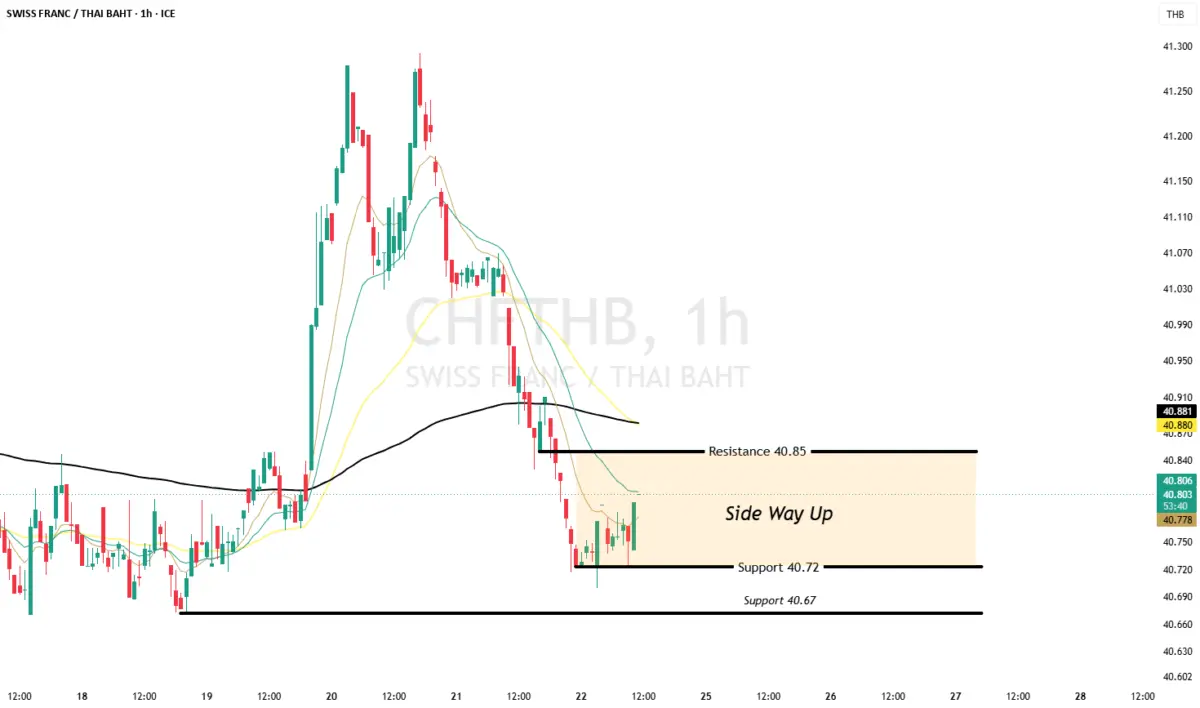
From a technical perspective, the pair maintains a tentative Sideway Up / Bullish bias following a decisive defense of the 40.72 support level. However, analysts caution that despite the sharp intraday rebound, the price action remains capped below key moving averages. This structural positioning suggests that current market movements reflect a corrective, range-bound rebound rather than an authenticated, long-term bullish reversal. As traders navigate the intersection of thinning macroeconomic data from Switzerland and high-impact data prints from the United States, risk management protocols—anchored by predefined support and resistance thresholds—remain paramount.
Detailed Chronology: Market Evolution and Intraday Dynamics
Friday’s Close and the Retreat from Intraday Highs
The final trading session of the week set a volatile tone for the CHF/THB currency pair. Opening with persistent bids driven by safe-haven flows, the Swiss Franc initially outperformed its regional peers, touching intraday peaks before encountering heavy profit-taking and selling resistance. By the close of the Thai market session, CHF/THB settled at 40.88.
Market participants noted that while the fundamental demand for defensive assets remained intact, the sheer velocity of the morning advance could not be sustained in the absence of fresh catalysts from Bern or Zurich. Consequently, the currency pair drifted away from its session highs, transitioning into a consolidation phase. This intraday retracement underscored a broader market truth: while safe-haven demand provides a reliable floor for the Swiss Franc, upside momentum is heavily contingent on external catalysts, principally the behavior of the U.S. Dollar and overarching global risk sentiment.
The Asian Open: Domestic Equities and Baht Vulnerability
As trading desks reopened for the new weekly cycle, attention immediately shifted to the domestic Thai financial landscape. The Stock Exchange of Thailand (SET) experienced a notably weak open, characterized by heavy domestic selling pressure across key sectors. In financial markets, localized equity sell-offs frequently translate into localized currency depreciation, as foreign institutional capital potentially weighs exit strategies or repatriates funds.
This domestic equity weakness directly influenced the dynamics of the Thai Baht. As selling pressure mounted in Bangkok, the Baht faced downward depreciation forces, which inadvertently acted as a tailwind for the CHF/THB cross. Even in scenarios where the Swiss Franc exhibits neutral movement against major global currencies, localized weakness in the Baht provides structural, cross-rate support for CHF/THB. Analysts monitoring the order books observed that if sustained equity outflows persist through the mid-session, the Baht’s susceptibility to domestic sentiment could cement the CHF/THB pair’s recent gains, insulating it from potential international retracements.
The Macroeconomic Vacuum from Switzerland
A critical variable in the current chronological timeline is the absolute absence of tier-one macroeconomic data releases originating from Switzerland. With the Swiss economic calendar remaining largely featureless for the session, the Swiss National Bank (SNB) has offered no fresh monetary policy signals or inflation updates to sway currency traders.
In the absence of domestic Swiss catalysts, the CHF has effectively transformed into a barometer for broader foreign exchange sentiment, trading primarily as a derivative of USD movements and global market sentiment. Without domestic economic prints to chart an independent course, CHF pairs are exceptionally vulnerable to external macroeconomic shocks, algorithmic trading loops, and cross-border capital reallocation.
Supporting Context & Metrics: Fundamentals, Flows, and Technicals
Fundamental Drivers: Risk-On vs. Risk-Off Environments
To comprehensively evaluate the trajectory of CHF/THB, analysts must dissect the dichotomy between global risk appetite and defensive hedging.
- The Risk-On Scenario: In an environment characterized by robust global growth, optimistic corporate earnings, and aggressive capital flows into high-beta risk assets (such as equities, emerging market currencies, and high-yield corporate debt), demand for traditional safe-haven currencies tends to evaporate. Under a sustained risk-on paradigm, the Swiss Franc faces institutional selling pressure as capital migrates toward higher-yielding alternatives. This dynamic would severely limit any meaningful recovery for the CHF against regional currencies like the Baht.
- The Risk-Off Scenario: Conversely, geopolitical tensions, trade frictions, or unexpected contractionary data from major economies can instantly trigger a risk-off rotation. In such market environments, the Swiss Franc reasserts its historical dominance as a premier safe-haven asset, buoyed by Switzerland’s stable political framework, robust institutional credibility, and historically low inflation profile. Should global sentiment tilt toward risk aversion, the resulting demand for CHF would provide immediate upside velocity to the CHF/THB cross.
U.S. Economic Data as the Catalyst
Given the light data docket in Switzerland, the evening trading session hinges entirely upon incoming macroeconomic indicators from the United States. Currency markets remain intensely sensitive to metrics concerning U.S. employment, inflation (CPI/PCE), and consumer sentiment, all of which directly shape Federal Reserve policy expectations.
- Stronger-Than-Expected U.S. Data: Should U.S. economic metrics print above consensus forecasts, reinforcing the narrative of a resilient American economy and potentially signaling "higher-for-longer" interest rates, the U.S. Dollar is positioned to strengthen aggressively. A surging USD typically exerts downward pressure on non-dollar majors and safe-havens alike, creating formidable headwinds for the Swiss Franc.
- Weaker-Than-Expected U.S. Data: Conversely, softer U.S. data points—suggesting economic cooling or labor market softening—would likely weigh on the greenback, diminishing Treasury yields and creating a vacuum into which alternative safe-havens, including the CHF, can appreciate. Such a scenario would open a clear runway for the CHF to mount a recovery against both the USD and regional crosses like the THB.
Technical Analysis and Price Action Breakdown
The technical architecture of CHF/THB reflects a nuanced battle between short-term momentum traders and macro-driven institutional players.
Technical Summary: CHF/THB
--------------------------------------------------
Current Market Bias    : Sideway Up / Bullish (Cautious)
Key Support Level      : 40.72
Key Resistance Level   : 40.85
Immediate Target       : 40.85
Invalidation / Cut Loss: 40.67- Price Structure and Moving Averages: The pair’s recent price action featured a sharp, aggressive decline followed by an equally decisive base formation around the 40.72 handle, leading to an energetic intraday rebound. Despite this recovery, analytical models highlight that the price continues to trade below key moving averages. This technical positioning confirms that the ongoing move is classified strictly as a range-bound rebound within a broader consolidation channel, rather than a confirmed, full-scale bullish reversal.
- Support Threshold (40.72): This level represents the immediate structural floor. Holding above 40.72 is imperative for maintaining the current Sideway Up market structure. As long as buyers continue to defend this zone, the bullish micro-trend remains viable.
- Resistance Threshold (40.85): Acting as the primary near-term barrier, a decisive, high-volume break above 40.85 would clear the path for further upside exploration, neutralizing the recent bearish impulses and inviting fresh momentum buying.
- Stop-Loss and Invalidation Level (40.67): Risk management frameworks designate 40.67 as the critical invalidation threshold. Should selling pressure breach the 40.72 support and subsequently penetrate 40.67, the Sideway Up structure is officially invalidated. Such a breakdown would expose the pair to accelerated downside momentum, likely triggering a technical retest of previous swing lows.
Official Statements and Institutional Commentary
While central bank interventions and direct ministerial statements regarding the CHF/THB exchange rate remain minimal, overarching commentary from monetary authorities in Bern, Bangkok, and Washington continues to shape trader psychology.
Swiss National Bank (SNB) Stance on Currency Valuation
The Swiss National Bank has maintained a pragmatic, watchful approach regarding the valuation of the Swiss Franc. Historically sensitive to excessive CHF strength—which threatens the export-driven sectors of the Swiss economy—the SNB has repeatedly emphasized its willingness to intervene in foreign exchange markets if deflationary pressures or unwarranted safe-haven surges threaten macroeconomic stability.
However, with global inflationary dynamics having shifted over recent reporting periods, market analysts note that the SNB’s tolerance threshold for Franc appreciation has evolved. Institutional commentary suggests that unless the CHF experiences a disorderly, panic-driven spike, the central bank is likely to allow market forces to dictate cross-rate valuations, focusing its primary energy on domestic interest rate calibration and price stability metrics.
Bank of Thailand (BOT) and Regional Perspectives
The Bank of Thailand continues to monitor the Baht’s performance against a basket of trade-weighted currencies, expressing persistent concern over speculative volatility driven by external geopolitical shocks and short-term capital flows. Official statements from Thai monetary authorities highlight the ongoing challenge of managing domestic currency fluctuations amid a backdrop of sluggish domestic equity performance and fluctuating foreign portfolio allocations.
While the BOT does not target specific cross-rates such as CHF/THB, central bank officials have reiterated their commitment to maintaining orderly conditions in the domestic foreign exchange market, stepping in with smoothing operations whenever capital flows threaten to induce disorderly exchange rate swings.
Future Outlook: Strategic Scenarios and Trading Roadmap
As institutional desks and retail market participants map out their strategies for the upcoming sessions, the trajectory of the CHF/THB currency pair will be dictated by the convergence of three primary vectors: U.S. macroeconomic data releases, domestic equity performance in Thailand, and the technical defense of critical chart thresholds.
Scenario A: The Bullish Continuation (Risk-Off & U.S. Softness)
In the event that upcoming U.S. economic data prints below consensus expectations, weakening the U.S. Dollar, and global geopolitical headlines prompt a shift toward a risk-off sentiment, the Swiss Franc is expected to regain its upward momentum.
- Action Path: Under this scenario, buyers are anticipated to defend the 40.72 support level vigorously. A subsequent push above the 40.85 resistance barrier would validate the Sideway Up thesis, opening the door for a measured extension toward higher psychological targets. Traders aligned with this view will look for confirmation via declining U.S. Treasury yields and sustained safe-haven inflows.
Scenario B: The Bearish Breakdown (Risk-On & Equity Recovery)
Conversely, should U.S. economic data exceed expectations—solidifying the greenback’s dominance—while the Stock Exchange of Thailand stages a robust recovery from its morning lows, the pressures supporting CHF/THB would dissipate.
- Action Path: An influx of global risk-on capital would diminish the allure of the Swiss Franc, while a strengthening Thai Baht (bolstered by domestic equity buying) would weigh heavily on the cross. If selling pressure overcomes the 40.72 support and breaches the critical 40.67 stop-loss threshold, the bullish structure collapses. This would signal a severe downside continuation, paving the way for a deeper structural retracement toward established multi-week lows.
Conclusion and Risk Management Summary
The CHF/THB currency pair remains a high-beta expression of global macro sentiment channeled through a regional exchange rate. While technical indicators point toward a cautiously optimistic Sideway Up bias anchored above 40.72, the lack of domestic Swiss catalysts means traders must remain exceptionally agile. By respecting predefined risk parameters—specifically utilizing 40.67 as an absolute invalidation point and 40.85 as the decisive breakout hurdle—market participants can effectively navigate the complex interplay of safe-haven flows, equity market volatility, and macroeconomic data prints.
Disclaimer: The information, analyses, and publications provided herein are for informational and educational purposes only. They do not constitute, and should not be construed as, financial, investment, trading, or professional advice or recommendations supplied, endorsed, or validated by financial publishers or market analysts. Trading foreign exchange and leveraged financial instruments carries a high level of risk and may not be suitable for all investors. Readers are strongly advised to conduct independent due diligence and consult with a licensed financial advisor before executing any trading or investment decisions.