
Executive Overview
SanDisk delivered a headline-grabbing, unmistakable earnings beat for the fourth quarter of fiscal 2026, blowing past consensus estimates across virtually every major financial metric. Revenue skyrocketed by 372% year-over-year to hit an astounding $8.965 billion, propelled forward by a relentless wave of enterprise artificial intelligence adoption. Non-GAAP earnings per share (EPS) printed at a massive $39.25, accompanied by a phenomenal gross margin of 84.6%. The data center segment emerged once again as the undisputed crown jewel of the enterprise, logging a 103% sequential revenue increase.
Despite these blowout figures, SanDisk’s equity refused to cooperate with the bullish narrative, remaining mired in a state of intense, white-knuckle volatility. The disconnect between stellar fundamental performance and erratic stock price behavior highlights a profound market anxiety: investors are deeply grappling with the concept of peak-cycle earnings. While the headline numbers captured a company operating at the absolute zenith of its operational capabilities, a closer examination of forward guidance revealed a slight compression in projected gross margins. This minor concession to reality was enough to spark fears that the company’s meteoric earnings trajectory may be approaching a near-term cyclical ceiling.
Wall Street’s consensus currently pegs fiscal 2027 and 2028 EPS at approximately $206.50 and $249.80, respectively. At first glance, these projections render SanDisk’s forward price-to-earnings (P/E) ratios a remarkably cheap 6.5 and 5.4 based on current share prices. However, institutional investors and sophisticated market participants are exercising extreme caution. Approximately two-thirds of SanDisk’s recent sequential revenue expansion was driven not by organic volume growth, but by aggressive pricing power amid tightening NAND supply. Consequently, the market is unwilling to apply traditional, high-multiple growth valuations to earnings that many perceive as cyclical highs.
This comprehensive report examines SanDisk’s financial performance, the macroeconomic and structural headwinds challenging its valuation, the technical landscape governing its daily chart, and actionable strategic setups for traders and long-term investors alike.
Detailed Chronology & Financial Breakdown: Fiscal Q4 2026
To understand the current market sentiment surrounding SanDisk, one must dissect the mechanics of its Fiscal Q4 2026 financial report. The numbers presented by management were, on paper, nothing short of historic.
The Top-Line Explosion and Margin Expansion
For the fourth fiscal quarter, SanDisk reported total revenue of $8.965 billion. This represented a staggering 372% increase compared to the same period in the previous fiscal year—a testament to the severe supply-demand imbalance plaguing the NAND flash market. Non-GAAP earnings per share reached $39.25, crushing most Wall Street consensus estimates, which had already been revised upward in anticipation of strong demand.
Equally impressive was the company’s profitability profile. Non-GAAP gross margins expanded to 84.6%, a level virtually unheard of in memory hardware manufacturing historically. This margin expansion was directly attributable to a favorable pricing environment, rich product mixes favoring high-capacity enterprise solid-state drives (SSDs), and operational efficiencies across fabrication facilities.
The Data Center Engine
The primary catalyst behind this historic performance remained the data center vertical. Enterprise customers, hyperscalers, and cloud service providers engaged in a frantic race to build out large-scale AI training and inference clusters, requiring massive amounts of high-speed, reliable storage to feed data-hungry language models and computational engines.
SanDisk’s data center revenue surged by an eye-popping 103% sequentially—not year-over-year, but quarter-over-quarter. This hyper-growth underscores the structural shift happening within enterprise IT architectures. Traditional hard disk drives are rapidly being phased out for high-density flash storage in workloads requiring ultra-low latency and massive input/output operations per second (IOPS). SanDisk positioned itself as a premier supplier of choice for these demanding applications, allowing the company to capture outsized market share and command premium pricing.
The Guidance Conundrum: Spotting the Peak
If the quarter was so overwhelmingly positive, why did the stock experience sharp selling pressure and ongoing volatility? The answer lies in forward-looking guidance and the subtle nuances of the earnings call.
While executive management provided an optimistic outlook for the upcoming quarter, forecasting continued EPS growth, a closer inspection of the margin projections revealed a crack in the facade. The midpoint of management’s forward gross-margin guidance was dialed in slightly below the record-shattering 84.6% achieved in Q4.
In the world of cyclical equities, a slight sequential decline in gross margin—even from all-time highs—is often interpreted as the canary in the coal mine. It signals that pricing power, while still robust, may be encountering resistance, or that input costs and production scaling are beginning to catch up with average selling prices (ASPs). For institutional investors whose models are predicated on infinite margin expansion, this forward guidance served as a warning bell that the velocity of earnings growth could be approaching a near-term inflection point, if not an absolute peak.
Supporting Context & Metrics: The Peak-Cycle Discount
The core debate among Wall Street analysts and institutional portfolio managers centers on how to value a cyclical semiconductor giant during a secular technological boom.
Decoding the Forward P/E Paradox
At the current share price, SanDisk trades at forward P/E multiples of approximately 6.5x for FY2027 (based on estimated EPS of $206.50) and 5.4x for FY2028 (based on estimated EPS of $249.80). In any other sector, a company growing revenues at over 300% with operating margins exceeding 80% would command a P/E multiple of 30x, 40x, or higher.
Why is SanDisk treated as a deeply discounted asset class? The market is applying what financial theorists call a "cyclical discount." Historically, memory and flash manufacturers experience brutal boom-and-bust cycles. Periods of acute shortage and soaring prices inevitably incentivize massive capital expenditure (CapEx) into new manufacturing capacity. Once those new fabs come online, supply floods the market, prices collapse, and companies swing from immense profitability to severe losses.
The Pricing-Driven Growth Dilemma
Compounding this historical skepticism is the composition of SanDisk’s recent growth. Detailed financial analysis reveals that approximately two-thirds of SanDisk’s sequential revenue growth during the quarter was driven entirely by higher pricing rather than volumetric shipment increases.
While rising average selling prices generate massive cash flows in the short term, they are notoriously ephemeral. Investors are acutely aware that when enterprise customers push back against skyrocketing storage costs, or when competing manufacturers ramp up production to capitalize on high market prices, ASPs can reverse violently. Because the earnings are perceived as "peak-cycle"—inflated by temporary pricing power rather than purely structural, recurring software-like revenue—the market refuses to value those earnings on par with conventional secular growth companies. Consequently, institutional money managers are hesitant to chase the stock aggressively, leaving it vulnerable to profit-taking and erratic trading swings.
Official Statements & Management Perspective
During the post-earnings conference call with analysts and investors, SanDisk’s executive leadership team sought to balance unbridled enthusiasm for the AI-driven structural shift with a pragmatic acknowledgment of manufacturing realities.
"We are witnessing a fundamental, structural re-rating of the role that enterprise flash storage plays in the modern data center," stated the Chief Executive Officer during opening remarks. "The explosion of generative artificial intelligence workloads, real-time data analytics, and hyper-scale cloud infrastructure has permanently elevated the baseline requirements for data throughput and storage density. Our record financial performance this quarter is not merely a byproduct of a cyclical upturn, but a direct reflection of our technological leadership in high-capacity enterprise solutions."
Addressing concerns regarding gross margin guidance and pricing sustainability, the Chief Financial Officer emphasized disciplined capital allocation and operational rigor:
"While our gross margins reached historic highs this quarter at 84.6%, driven by exceptional demand dynamics and tight industry supply, our forward outlook reflects prudent conservatism. As we scale production of our next-generation architecture to meet surging customer demand, we expect minor fluctuations in mix. However, our fundamental cost structure remains exceptionally strong. We remain committed to maximizing free cash flow generation, maintaining balance sheet strength, and returning capital to shareholders while strategically investing in the technologies that will define the next decade of data infrastructure."
Despite these authoritative assurances, the market’s reaction demonstrated that executive commentary alone cannot override the deep-seated historical trauma associated with semiconductor cycles. Institutional sentiment remains split between believers in a "super-cycle" powered by permanent AI demand and traditionalists who view the company through the lens of historical memory chip volatility.
Technical Outlook: A Former Momentum Leader Enters a High-Volatility Repair Phase
While the fundamental debate rages in boardrooms and research notes, the technical landscape paints a vivid picture of a former momentum darling undergoing a painful, complex structural repair phase.
[Record High: $2,354]
       │
       ▼ (Severe Selloff)
Breakdown below $2,000, $1,700, $1,500
       │
       ▼ (Late July Flush)
Temporary Low near $1,000 ──► Strong Buying Interest / Double Bottom Formation
       │
       ▼ (Current Phase)
Oversold Recovery & Short-Covering Rally (Facing Heavy Overhead Supply: $1,550 - $1,700)
The Breakdown of the Previous Uptrend
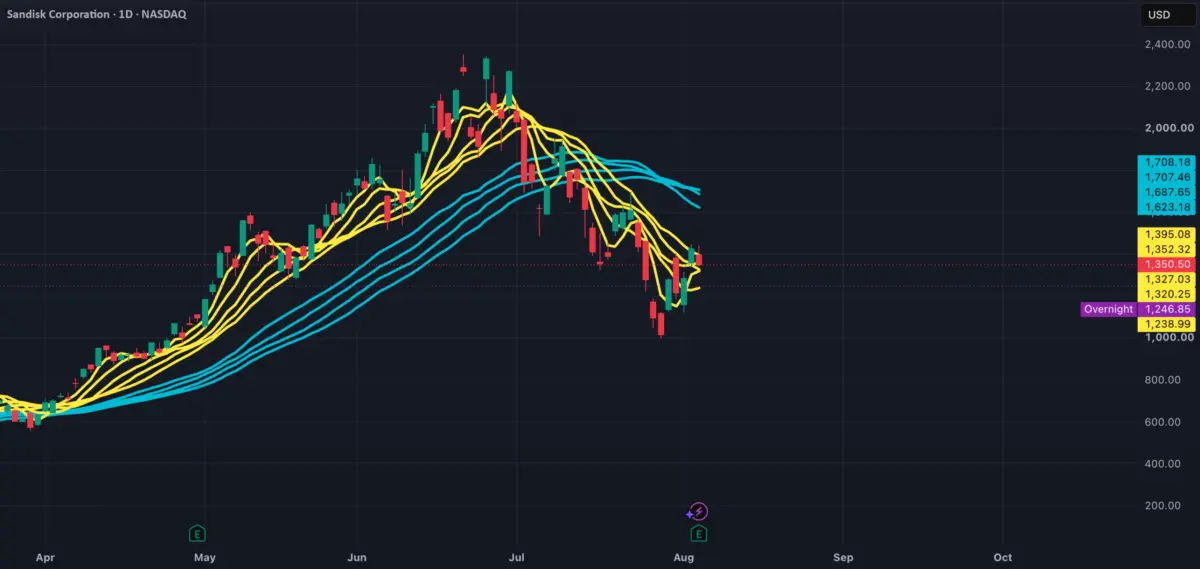
SanDisk’s equity (SNDK) was previously one of the market’s undisputed momentum leaders, capturing the imaginations of retail and institutional traders alike as it marched toward a record high of $2,354. However, the subsequent retreat was swift and unforgiving.
SNDK systematically sliced through major psychological and structural support levels at $2,000, $1,700, and $1,500. On the daily chart, a textbook sequence of lower highs and lower lows has formed, definitively confirming that the prior bullish uptrend has been broken. When the stock briefly plunged toward the $1,000 threshold in late July, it triggered a wave of panic liquidation, followed immediately by a sharp, aggressive rebound.
Despite this violent snap-back, the stock has failed to reclaim any of the major breakdown zones that previously acted as institutional floors. Therefore, market technicians view the current advance not as the birth of a new bull market, but rather as an oversold recovery and short-covering rally. For the medium-term market structure to materially improve, SNDK must decisively break above its previous rebound high and reclaim the vital trading platform situated around $1,600.
Identifying Genuine Demand Zones
Encouragingly, the post-earnings price action revealed robust institutional defense mechanisms. When SNDK dipped toward $1,198 in the wake of the earnings report, heavy buying interest materialized rapidly. This price action closely mirrors the previous swing low near $1,222, providing technical validation that the $1,200–$1,250 zone represents genuine, aggressive demand rather than a mere psychological round-number coincidence.
As long as this critical demand cluster holds, the stock has a viable foundation to carve out a short-term double-bottom pattern and mount another recovery attempt. Conversely, a decisive daily close below the $1,200 threshold would completely invalidate this bullish setup, opening the floodgates for a swift downward repricing toward the $1,050–$1,100 support shelf.
The Overhang of Trapped Overhead Supply
The single greatest obstacle facing any sustained recovery in SNDK is the massive concentration of trapped overhead supply. Because the stock fell so rapidly from levels above $1,600, a vast volume of shares was accumulated by retail traders and momentum funds who are now trapped underwater.
Between $1,550 and $1,700, the chart is congested with breakeven sellers. Any meaningful price advance into this zone is guaranteed to encounter heavy, persistent selling pressure from investors eager to exit their losing positions without taking a loss, alongside systematic liquidation from trend-following algorithmic funds.
Consequently, a modest push above $1,450 will only serve to strengthen the initial rebound thesis. A genuine, durable shift from a bearish to a neutral medium-term structure will require a high-volume, sustained breakout above the $1,600 resistance ceiling.
Key Price Levels & Strategic Trading Roadmaps
For market participants actively navigating SanDisk’s volatile price action, navigating the terrain requires strict adherence to predefined technical thresholds and risk management protocols.
Critical Price Levels to Monitor
- Immediate Support Zone ($1,200–$1,250): The linchpin for the current short-term recovery structure. Holding this zone is essential for maintaining bullish aspirations.
- First Recovery Target / Pivot ($1,300): Reclaiming this level signals stabilization and opens the path toward intermediate resistance.
- Intermediate Resistance ($1,350 & $1,450–$1,465): A break above $1,465 indicates that post-earnings selling pressure has successfully exhausted itself.
- Trend Reversal Zone ($1,550–$1,610): The heavyweight medium-term battleground. A sustained, high-volume close above $1,600 invalidates the broader downtrend and clears a path toward $1,695–$1,750, with potential extensions to $1,900–$2,050.
- Downside Breakdown Level (<$1,200): A decisive close below $1,200 invalidates the double-bottom thesis, shifting focus immediately to the $1,050–$1,100 support band, with ultimate downside vulnerability toward the psychological $1,000 floor.
Tailored Trading and Investment Setups
1. For Aggressive Traders (Short-Term Tactical)
Active traders should closely monitor price behavior and volume responses within the $1,200–$1,250 support zone. If the equity demonstrates clear stabilization, forms a consolidation base, and successfully reclaims $1,300, a tactical long position can be established.
- Primary Objective: Capture a momentum rebound targeting $1,350 and subsequently $1,450–$1,465.
- Risk Management: Implement a strict stop-loss discipline below $1,190. A breach of this level invalidates the trade setup immediately.
2. For Conservative Traders (Confirmation-Driven)
Risk-averse market participants should refrain from attempting to catch falling knives or trading volatile intraday swings. Instead, wait for a confirmed, high-volume break above the $1,465 pivot.
- Objective: Confirm that short-term selling pressure has dissipated before positioning for a run at the pivotal $1,600 resistance zone.
- Caveat: Recognize that even a move to $1,600 only neutralizes the technical structure; a true bull trend remains unconfirmed until $1,600 is decisively breached and held.
3. For Long-Term Investors (Fundamental Allocation)
Long-term institutional allocators should resist the temptation to build an oversized core position simply because the stock appears statistically "cheap" at 5x to 6x forward earnings. Because cyclical earnings are notoriously difficult to value at their apex, fundamental safety relies on technical confirmation.
- Optimal Strategy: Withhold major capital commitments until SNDK achieves a high-volume, sustained recovery above the $1,600 structural ceiling. Such a move would effectively shatter the current bearish channel, signaling that the market is willing to re-rate the stock, thereby creating a reliable foundation for a renewed, trend-following investment cycle.
Future Outlook
SanDisk stands at a fascinating crossroads of fundamental triumph and technical distress. The company’s ability to generate nearly $9 billion in quarterly revenue and expand gross margins past 84% demonstrates its indispensable role in the global artificial intelligence hardware ecosystem. The secular tailwinds of enterprise AI data storage are real, durable, and reshaping the technological landscape.
However, the stock market is a forward-looking discount mechanism that refuses to reward historical triumphs when cyclical uncertainties loom large. Until SanDisk can prove that its earnings power is not merely a transient byproduct of peak NAND pricing—or until the technical chart repairs the devastating damage inflicted during its descent from $2,354—SNDK will remain a battleground asset.
For astute investors, this high-volatility repair phase offers both significant risks and extraordinary opportunities. By respecting critical technical support zones, monitoring pricing sustainability, and demanding confirmation before committing large capital allocations, market participants can successfully navigate one of the most compelling and complex equity stories in the modern technology sector.