rifanmuazin is a reporter for DeBitcoin covering Ethereum & Altcoins. She/He is based in Indonesia.
25 August 2026 • 8 min read
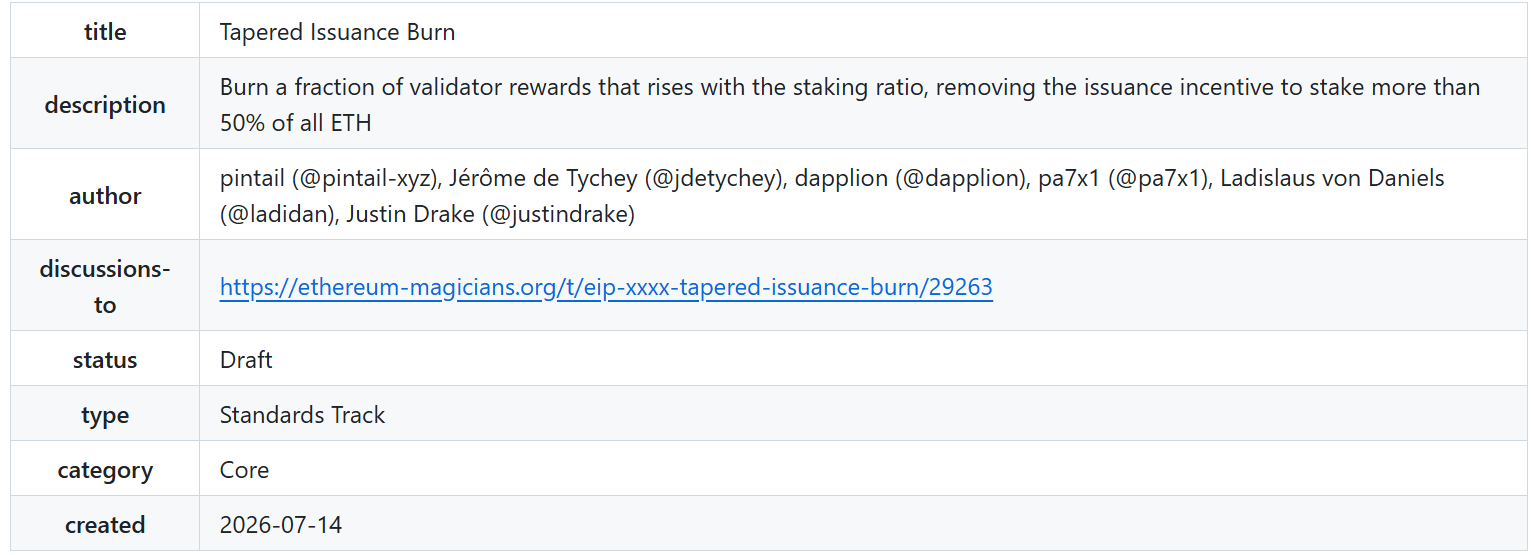
Ethereum, the world’s leading programmable blockchain, finds itself at the center of an intense ideological and economic debate. A collective of six prominent Ethereum researchers and developers—including Justin Drake of the Ethereum Foundation and Jérôme de Tychey—has introduced a draft proposal that could radically alter the network’s monetary policy. Designated provisionally as Ethereum Improvement Proposal (EIP-8363) and formally titled the Tapered Issuance Burn, the framework seeks to dynamically cut validator rewards as the total amount of staked Ether (ETH) scales upward.
Executive Overview
Under the proposed mechanics, the network would burn an increasing fraction of validator consensus rewards as staked ETH approaches a fixed ceiling of 60.25 million ETH—roughly 50% of the current circulating supply. At this threshold, the reward deduction hits 100%, effectively halting any net incentive to stake beyond that point. Phased in progressively over an 18-month timeline, the authors argue that this policy is necessary to protect Ethereum’s core attributes: decentralization, neutral store-of-value properties, and resistance to hyper-dilution.
However, the proposal has unleashed a wave of immediate backlash across the developer community, decentralized finance (DeFi) founders, and institutional stakers. Critics—ranging from Aave founder Stani Kulechov to Ether.Fi CEO Mike Silagadze—contend that drastically reducing staking yields will damage institutional demand for ETH, disrupt multi-billion-dollar DeFi lending protocols, and disproportionately penalize solo validators while handing a monopoly to centralized staking monoliths. Furthermore, the timing of the proposal’s release, coinciding with tight scheduling windows for upcoming network upgrades, has ignited broader governance friction regarding how rapidly fundamental monetary changes should be debated and implemented.
Detailed Chronology & Evolution of the Proposal
To understand the weight of EIP-8363, one must examine the timeline of its emergence and the structural pressures building within the Ethereum consensus layer.
The Staking Surge and the Impetus for Change
The conversation around Ethereum’s issuance curve intensified significantly in April, when the total amount of staked Ether officially surpassed 33% of the network’s total supply. As staking participation rates climbed past historic highs, developers began modeling long-term projections. Under Ethereum’s existing economic design, the annual issuance curve dictates that staking rewards never truly drop below 1.5%, even in a hypothetical scenario where 100% of all existing ETH is locked into validation.
This built-in dynamic—where the incentive to stake never shuts off—sparked alarm among core researchers. Jérôme de Tychey and his co-authors projected that without systemic intervention, more than 55% of the entire Ethereum supply could be locked into staking pools by 2028. This extreme centralization of tokens into the hands of a few large intermediaries threatened to compromise Ethereum’s foundational thesis as a neutral, trustless, and censorship-resistant settlement layer.
Drafting EIP-8363 and the "Hegotá" Upgrade Confusion
The formal draft of EIP-8363 was pushed to public GitHub repositories in late 2024, arriving mere days before a critical community deadline. This close proximity to scheduling cutoffs for Ethereum’s upcoming Hegotá upgrade triggered panic among community members, who feared a rushed governance process for a monetary policy shift of this magnitude.
Initial reports suggested that the proposal was facing an imminent inclusion deadline for Hegotá, prompting sharp criticism from independent researchers like Greg Koumoutsos, co-author of EIP-8148 and EIP-8205, who noted that the community lacked adequate time to digest its macroeconomic impacts.
However, subsequent clarifications from Ethereum community organizer Trent Van Epps helped de-escalate concerns regarding an immediate rush to judgment. Van Epps clarified that the near-term deadline was merely a cutoff for submitting initial pull requests for candidate EIPs under consideration for Hegotá, rather than a final gate for adoption. The comprehensive review and selection process for the upgrade is slated to run for months, with the Hegotá hard fork projected to target mainnet deployment in the second quarter of 2027. This leaves a lengthy runway for debate, simulation, and community consensus-building.
Supporting Context & Metrics: Decoding the Tokenomics
The mechanics of EIP-8363 are rooted in complex tokenomic philosophies that balance security budgets against macroeconomic inflation and asset neutrality.
The Mechanics of the Tapered Issuance Burn
At its core, EIP-8363 introduces a self-correcting deflationary pressure mechanism directly tied to network participation:
Staking Threshold Target: The model targets a fixed ceiling of 60.25 million staked ETH (approximately 50% of the current circulating supply).
Graduated Penalty (Burn): As the total amount of staked ETH scales upward toward this 50% threshold, the protocol progressively burns an increasing fraction of the consensus rewards allocated to validators.
The 100% Deduction Point: Once total staking hits the 60.25 million ETH mark, the deduction reaches 100%, effectively neutralizing new issuance rewards for additional stakers.
Phase-In Period: The structural changes are designed to phase in smoothly over an 18-month window to prevent sudden economic shocks to active validators.
Proponents point out that under this adjusted model, ETH issuance would peak at a maximum of 0.5% of total supply annually (occurring when roughly 20% of ETH is staked), before declining steadily toward zero as participation approaches the 60.25 million threshold. When combined with existing burn mechanisms like EIP-1559 (which burns base transaction fees) and the Blob burn introduced during scaling upgrades, Ethereum’s net circulating supply would enter a structural deflationary state more frequently.
The "Dilution Tax" Argument
Advocates for the proposal argue that maintaining the status quo imposes an unfair "dilution tax" on non-staked holders. In an ecosystem where over a third of all assets are actively earning yield, token holders are effectively penalized for holding native, liquid ETH rather than committing it to a validator.
Furthermore, high staking ratios drive the proliferation of Liquid Staking Tokens (LSTs) and restaking derivatives. The authors of EIP-8363 warn that these intermediated claims threaten to displace raw, base-layer ETH as the primary working money of the ecosystem, substituting the most neutral, trustless asset in crypto with wrapped, issuer-dependent financial claims.
Official Statements & Industry Divide
The publication of EIP-8363 has sharply polarized the Ethereum ecosystem, dividing institutional analysts from DeFi founders and independent validators.
Pro-EIP-8363 Perspective: Hardening the Store of Value
Proponents of the policy argue that long-term macroeconomic predictability is paramount for Ethereum to secure its status as global sound money.
Jérôme de Tychey defended the proposal publicly, emphasizing that a sustainable security budget must be balanced against runaway token supply growth:
"Maximal neutrality & minimal dilution: those are the two fundamentals of a store of value. This EIP not only hardens both, it sets a bar no other blockchain clears."
De Tychey further elaborated on the deflationary benefits, noting:
"ETH supply growth will be bounded and more predictable. Combined with the EIP-1559 and Blob burn, the supply will more often decrease. Ethereum, the most mature of all the protocols, with a sustainable security budget, will also be the least dilutive of all protocols."
Institutional backing has also emerged from traditional financial analysts tracking digital asset products. Zach Pandl, Head of Research at Grayscale, published an analysis noting that limiting runaway staking incentives would ultimately be "positive for the price of Ether over time" by tightening supply dynamics and reinforcing institutional confidence in the asset’s scarcity.
Anti-EIP-8363 Perspective: Punishing Growth and Solo Validators
Conversely, a vocal coalition of DeFi pioneers and infrastructure providers has pushed back hard against the initiative, arguing that artificial constraints on yield will backfire.
Stani Kulechov, founder of the decentralized liquidity protocol Aave, criticized the draft on social media, asserting that slashing rewards would actively suppress institutional demand for ETH and dampen borrowing and lending activity across the broader DeFi economy. Kulechov argued that the proposal "doesn’t achieve the outcome it tries to achieve and is actually hurtful for Ethereum."
Another major point of contention is the survival of solo validators. Critics argue that large-scale institutional stakers and centralized entities possess immense economies of scale and subsidized capital structures, whereas home stakers operating independent hardware face higher relative costs.
Mike Silagadze, CEO of liquid staking protocol Ether.Fi, warned of the centralization risks baked into the proposal:
"This will self-evidently push out solo stakers who aren’t subsidized by the EF or others. It will essentially guarantee that the only ones staking are large centralized entities with zero cost of capital where users passively hold their ETH."
In response to these criticisms, de Tychey countered that users of large, centralized staking providers are ultimately forced to pay ongoing service fees, which would render those platforms increasingly uncompetitive as baseline rewards decline. However, consensus on this economic outcome remains heavily contested within community forums.
Future Outlook & Path Forward
As the dust settles on the initial shockwaves of EIP-8363, the debate has shifted from an emotional flashpoint to a rigorous long-term research problem.
Governance and Simulation: Because the proposal is still in its infancy as a draft, it faces months of exhaustive simulation, economic modeling, and peer review across the Ethereum Magicians forums and developer sync calls.
The Hegotá Timeline: While initial fears of a rushed inclusion in the Hegotá upgrade have been quelled by community organizers clarifying submission deadlines, the conversation will undoubtedly shape the philosophical trajectory of subsequent hard forks leading toward 2027.
Balancing Security vs. Economics: The core dilemma facing Ethereum remains unresolved: how to maintain a sufficient economic security budget to protect the network from 51% attacks without inflating the token supply to a degree that alienates holders and distorts DeFi markets.
Whether EIP-8363 is ultimately adopted, modified beyond recognition, or shelved entirely, its introduction marks a watershed moment for Ethereum governance. It proves that as the network matures into a foundational layer of global finance, its stakeholders are willing to confront existential questions regarding monetary policy, centralization, and the true meaning of decentralized sound money.