
Executive Overview
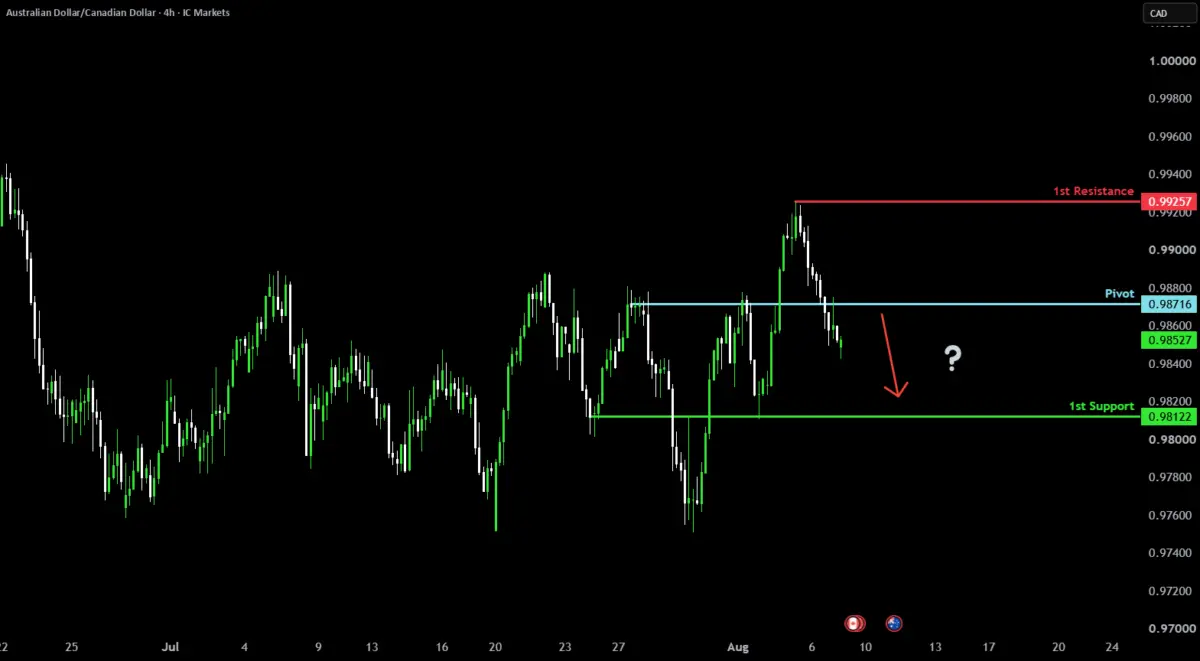
This upward trajectory, while demonstrating short-term bullish momentum, is colliding with a formidable structural ceiling. Analysts and technical traders view this pivot not merely as a milestone, but as an active pullback resistance barrier that has the potential to trigger a sharp bearish reversal. Should this resistance hold firm, the path of least resistance could point downward toward established pullback support levels, specifically targeting the 0.98122 mark (1st Support). Conversely, a decisive break above this zone would open the door for a test of higher technical hurdles, anchored around 0.99257 (1st Resistance).
To fully understand the weight of this technical formation, one must look beyond the raw numbers. The AUD/CAD pairing represents a fascinating macroeconomic juxtaposition: the "Aussie," heavily influenced by industrial metals, Chinese economic health, and the Reserve Bank of Australia’s (RBA) monetary stance, pitted against the "Loonie," which is inextricably tied to crude oil prices, North American trade dynamics, and Bank of Canada (BoC) policy decisions.
This comprehensive market analysis explores the current technical landscape of the AUD/CAD pair, dissects the underlying macroeconomic fundamentals driving both currencies, evaluates the quantitative metrics framing today’s trading session, and provides a forward-looking perspective for retail and institutional investors navigating these turbulent waters.
Detailed Chronology: Technical Progression and Price Action
The current movement of the AUD/CAD pair is best understood through a chronological lens of technical development. Over recent trading sessions, the currency cross has experienced a gradual recovery from localized lows, steadily grinding higher in a classic retracement pattern.
Phase 1: Finding a Base and Initiating the Recovery
Earlier in the current trading cycle, the AUD/CAD pair found itself under sustained downward pressure, dipping toward the lower boundaries of its medium-term range. This bearish phase culminated near the 0.98122 region, which has since been classified as the 1st Support level. At this juncture, selling momentum began to wane. Buyers stepped in to defend the psychological and technical floor, recognizing the area as an attractive value zone based on historical price reactions.
The successful defense of this support level sparked a corrective bounce. Rather than staging an aggressive, impulsive breakout, the currency pair adopted a measured, stair-step recovery. This methodical ascent indicated that while buying interest was present, the broader market lacked the aggressive conviction needed to spark an immediate trend reversal.
Phase 2: The Approach to the Pivot (0.98716)
As the week progressed, the bullish momentum carried AUD/CAD deeper into its recovery phase, bringing the pair within striking distance of the crucial 0.98716 pivot point. In technical analysis, a pivot acts as the fulcrum of market sentiment for the period. When price approaches a pivot from below, it frequently encounters selling pressure from traders who view the level as an optimal spot to initiate short positions in alignment with the broader prevailing trend.
Currently, price action is hovering directly beneath this critical threshold. Order books indicate a heavy concentration of resting limit sell orders clustered right around the 0.98716 mark. This density of supply creates a formidable wall of resistance. Traders are watching the tape closely to see whether the market will stall out—forming a classic topping pattern or bearish candlestick wick—or if aggressive buying volume will punch directly through the barrier.
Phase 3: Potential Scenarios at the Crossroads
Looking ahead across the intraday and swing-trading horizons, two primary technical scenarios dominate the narrative:
- The Bearish Rejection and Retracement: If the pullback resistance at 0.98716 holds, we can anticipate a swift loss of upward momentum. Sellers stepping in at this juncture could drive the pair lower, initiating a corrective pullback toward the initial support zone at 0.98122. This move would reinforce the prevailing range-bound structure, offering range-traders a clear risk-reward profile.
- The Bullish Continuation: Should macroeconomic catalysts or shifting sentiment empower buyers to absorb the sell orders at the pivot, a clean break above 0.98716 would change the near-term landscape. Such a breakout would likely trigger stop-loss orders from trapped short-sellers, accelerating the move toward the 1st Resistance level at 0.99257.
Supporting Context & Metrics: Decoding the AUD/CAD Ecosystem
To contextualize these technical levels, one must examine the macroeconomic machinery that powers the Australian and Canadian economies. Known universally as "commodity currencies," both the AUD and CAD derive a significant portion of their intrinsic value from natural resource exports. However, the nature of those commodities differs significantly, creating a dynamic spread between the two.
+--------------------------------------------------------------------------+
|                        AUD/CAD TECHNICAL MATRIX                          |
+--------------------------------------------------------------------------+
|  1st Resistance (Upper Boundary)  |  0.99257                             |
|  Pivot Point (Pullback Resistance)|  0.98716  <-- [Current Focus Zone]   |
|  1st Support (Pullback Floor)     |  0.98122                             |
+--------------------------------------------------------------------------+
The Australian Dollar: China Exposure and Metal Markets
The Australian Dollar is often used by global macro investors as a liquid proxy for Chinese economic growth and industrial demand. Australia is the world’s leading exporter of iron ore, and it holds massive reserves of coal, liquefied natural gas (LNG), and copper.
When economic data out of Beijing points toward infrastructure stimulus or manufacturing expansion, the AUD typically surges. Conversely, any cooling in China’s property sector or broader economic slowdown hits the Australian currency hard.
Furthermore, the Reserve Bank of Australia (RBA) has maintained a vigilant stance regarding domestic inflationary pressures. While major central banks globally have begun pivoting toward monetary easing cycles, the RBA has retained a relatively hawkish tone, emphasizing that core inflation remains too sticky to justify premature rate cuts. This policy divergence often provides underlying support for the Aussie against peers that face more aggressive dovish tilting.
The Canadian Dollar: Energy Dynamics and the U.S. Nexus
On the other side of the cross, the Canadian Dollar is fundamentally tethered to the energy sector. As one of the world’s largest oil producers, Canada’s trade balance and economic health fluctuate in tandem with West Texas Intermediate (WTI) and Brent crude oil prices. A robust energy market strengthens the Loonie, while oil price corrections apply downward pressure.
Geographically and economically, Canada’s fortunes are deeply intertwined with the United States. With the vast majority of Canadian exports crossing the southern border, U.S. macroeconomic indicators—such as non-farm payrolls, retail sales, and Federal Reserve policy decisions—exert a profound secondary influence on the CAD.
The Bank of Canada (BoC), meanwhile, has had to navigate a delicate economic balancing act. Elevated interest rates have successfully cooled housing markets and consumer spending, but they have also weighed on broader economic momentum. As the BoC weighs the timing and pace of its own monetary policy adjustments, the Loonie has experienced bouts of volatility, leaving it vulnerable when commodity prices stall.
Intermarket Correlation and Volatility
When combining these two economic engines into the AUD/CAD cross, traders must evaluate cross-asset correlations. The pair frequently exhibits sensitivity to global risk sentiment. During "risk-on" environments characterized by equity market rallies and growing global liquidity, the higher-yielding Australian Dollar often outperforms the Canadian Dollar. In contrast, "risk-off" periods characterized by geopolitical tension or growth fears can drive capital toward safe-haven flows, occasionally favoring the relative stability of the Canadian trade balance.
Official Statements and Market Commentary
While direct monetary policy statements from the RBA and BoC do not explicitly target the bilateral exchange rate of AUD/CAD, central bank communications provide the essential backdrop against which these currency valuations are priced.
In recent policy minutes, RBA officials reiterated their commitment to bringing inflation sustainably back within the 2–3% target band. The central bank noted:
"While recent data suggests that domestic demand is moderating in line with previous forecasts, labor market tightness and persistent service sector inflation mean that the Board cannot rule out further policy tightening should upside risks to inflation materialize."
This ongoing hawkish optionality helps explain why the Australian Dollar has demonstrated resilience against several counterparts, maintaining a firm floor even during broader risk-off corrections.
Conversely, Bank of Canada Governor and executive officials have increasingly turned their attention toward economic slack and the lagged impact of previous rate hikes. In recent public addresses, BoC leadership highlighted the necessity of monitoring consumer debt servicing costs and housing market adjustments:
"As the restrictive stance of monetary policy continues to work its way through the economy, our focus is shifting toward ensuring a smooth landing. We remain data-dependent, assessing whether the current level of restrictiveness is appropriately calibrated to maintain downward pressure on inflation without inducing undue economic contraction."
This nuanced divergence in central bank rhetoric forms the fundamental chess board upon which technical traders operate. While macro fundamentals establish the broad channel, technical levels like the 0.98716 pivot dictate the tactical execution of daily trades.
Future Outlook: Strategic Implications for Traders
As the AUD/CAD currency pair presses against its critical pivot resistance, market participants must adopt a disciplined, risk-managed approach. The convergence of technical boundaries and macroeconomic cross-currents suggests that the coming trading sessions could deliver decisive directional moves.
Short-Term Tactical Playbook
- For Range-Bound Traders: The setup offers a classic mean-reversion opportunity. If price action tests the 0.98716 pivot and displays clear rejection signals—such as long upper shadows on candlestick charts or declining volume—initiating short positions targeting the 0.98122 support level presents a favorable risk-to-reward ratio. Strict stop-losses should be maintained just above the pivot to protect against false breakouts.
- For Breakout Traders: Momentum players should exercise patience. A sustained, high-volume four-hour or daily close above the 0.98716 threshold invalidates the immediate bearish reversal thesis. Such a breakout would signal a shift in market control, opening a clear runway toward the 0.99257 resistance target.
Medium- to Long-Term Structural Outlook
Looking further out, the trajectory of AUD/CAD will ultimately be dictated by broader macroeconomic developments:
- The Commodity Super-Cycle: Any unexpected surge in industrial metal demand—driven by Chinese fiscal stimulus or global infrastructure spending—would likely provide the catalyst needed for the Australian Dollar to break out of its current technical ranges.
- Energy Market Trends: Conversely, a sustained rally in crude oil prices, fueled by supply constraints or geopolitical developments, would empower the Canadian Dollar, driving the AUD/CAD cross lower toward deeper structural supports.
Final Remarks
Market participants are advised to remain vigilant, keeping a close eye on incoming Tier-1 economic data releases from both Canberra and Ottawa, as well as broader shifts in global risk sentiment. Technical levels provide the map, but macroeconomic fundamentals supply the fuel. By respecting the defined pivot of 0.98716 and monitoring the support and resistance boundaries at 0.98122 and 0.99257, traders can successfully navigate one of the foreign exchange market’s most intriguing cross-currency pairs.
Disclaimer: The opinions, news, research, analyses, prices, and other information contained in this article constitute general market commentary and do not constitute investment advice, financial recommendations, or personal endorsements. Past performance is not a reliable indicator of future results. Readers should conduct their own thorough research and consult with a licensed financial advisor before making any trading or investment decisions.