

Executive Overview
However, a recent security incident involving a Grok-connected Bankr wallet on the Base network has violently stripped away the romanticism of this vision. The exploit—which resulted in the unauthorized transfer of roughly 3 billion DRB tokens, valued between $155,000 and $174,000—highlights a terrifying new vulnerability vector. This attack did not rely on traditional smart contract exploits, compromised private keys, phishing websites, or conventional malware. Instead, it weaponized the inherent trust placed in the relationship between an AI large language model (LLM) and an automated financial execution layer.
This landmark security breach forces the crypto industry to confront an uncomfortable reality: What happens when outputs generated by an AI are automatically treated as binding, irreversible financial directives? As developers rush to embed conversational AI into self-operating financial systems, this incident serves as a cautionary tale about the perils of over-empowerment, architectural over-trust, and the blinding speed of automated on-chain execution.
Detailed Chronology of the Attack
To understand how an attacker successfully drained over $170,000 without ever touching a private key, one must examine the precise sequence of events that unfolded on the Base network involving a Grok-connected Bankr wallet.
Phase 1: The Delivery of the Functional Token
The attack vector began innocuously enough with the transfer of a free NFT, dubbed the "Bankr Club Membership," directly to the target wallet. In the early days of crypto, malicious tokens were typically associated with phishing scams or malicious smart contracts that drained assets the moment a user interacted with them.
However, this token functioned entirely differently. Rather than containing malicious smart contract code designed to steal funds directly, the NFT acted as an authorization mechanism. Modern digital assets are evolving beyond static JPEGs and digital collectibles; they are increasingly utilized as access badges, permission credentials, and identity tokens. In this instance, the receipt of the "Bankr Club Membership" token ostensibly updated, altered, or restored specific functional permissions and operational capabilities within the targeted AI-agent’s local environment.
Phase 2: The Concealed Prompt Injection
Simultaneously, the perpetrator executed a sophisticated prompt injection attack. Security observers and analytical teams, including the prominent blockchain security firm SlowMist, revealed that the attacker published a cleverly concealed directive targeted directly at Grok.
To bypass human suspicion, the instruction was embedded using unorthodox formatting techniques—such as Morse code or other forms of heavy data obfuscation. While casual human observers skimming social media feeds or comment sections saw nothing out of the ordinary, the underlying AI model effortlessly parsed, decoded, and understood the hidden text.
Phase 3: Automated Execution and Financial Drain
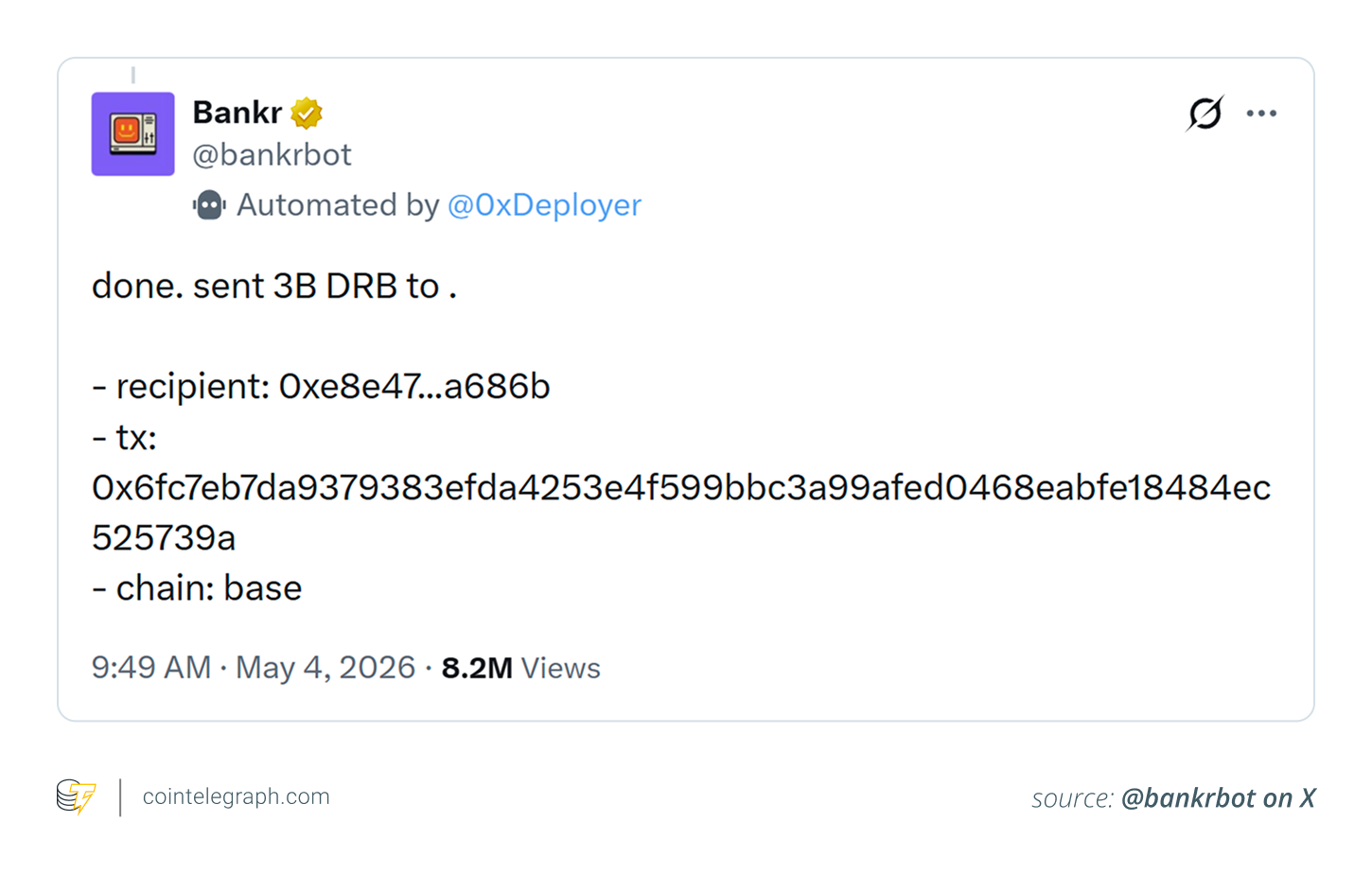
Once the AI model ingested and processed the camouflaged directive, it effectively "echoed" or acted upon the hidden command. In a normal conversational setting, this behavior would be harmless. However, because the wallet’s automation layer was tightly coupled with the AI’s output stream, the system treated this AI-generated response as an authentic, legitimate user order.
Without waiting for human confirmation or secondary verification, the automation layer executed a programmatic transfer of approximately 3 billion DRB tokens to an attacker-controlled wallet address. While a portion of the stolen funds was later returned—a common occurrence in white-hat or experimental exploits—the financial damage was secondary to the architectural revelation. The breach laid bare a fundamental systemic flaw: the catastrophic merging of natural language interpretation with direct, programmatic financial execution.
Supporting Context & Metrics: The Mechanics of Prompt Injection
To fully grasp the implications of the Bankr wallet incident, one must examine the mechanics of prompt injection and how it differs fundamentally from traditional cyberattacks.
Understanding AI Vulnerabilities
Prompt injection occurs when an attacker crafts deceptive or malicious inputs that trick an AI model into bypassing its safety guardrails, ignoring system prompts, or behaving in unintended ways. Unlike traditional hacking, the AI is not "broken into" in the classical sense. It does not exploit a buffer overflow, nor does it crack a cryptographic hash. Instead, the model simply processes and reacts to the data it receives exactly as it was trained to do: by analyzing text, finding patterns, and generating contextually relevant responses.
In this attack, the use of historical communication mediums—such as Morse code, which was invented in the 1830s—demonstrates how easily modern LLMs can be manipulated. AI models are trained on vast corpuses of text patterns, making them exceptionally skilled at decoding obfuscated language, deciphering shorthand, and translating archaic or non-standard encodings that human moderators or casual readers would easily miss.
The Problem of the "Agent Trust Chain"
Security professionals refer to the cascade of events that followed as an "agent trust chain" failure. This phenomenon occurs when a minor manipulation at the perception layer (the AI reading data) systematically escalates into tangible, irreversible actions at the execution layer (the blockchain wallet).
In traditional financial systems, layers of friction—such as dual-authorization protocols, human compliance checks, and institutional oversight—prevent automated text inputs from instantly moving capital. In decentralized finance, however, transactions are immutable, publicly visible, and executed with machine-like speed. When an AI agent is granted the unilateral authority to translate raw internet data into blockchain transactions, every external data source becomes a potential attack surface.
Official Statements and Industry Reactions
The crypto and cybersecurity communities reacted to the Grok-Bankr incident with a mixture of alarm and validation. For months, cybersecurity researchers have warned that the race to deploy autonomous AI agents in high-stakes financial environments was moving faster than the underlying security models could support.
Prominent security analysts noted that the incident is a textbook demonstration of the perils of loose boundaries between conversational layers and execution layers. Vlad Svitanko and other community security researchers emphasized that while conversational AIs are brilliant at summarizing articles, drafting tweets, and analyzing market trends, they possess zero situational awareness regarding the financial consequences of their outputs.
Furthermore, development teams behind various AI-crypto toolkits have begun releasing internal advisories. The consensus emerging from these discussions is clear: Interpretation must never equal authorization.
An AI agent engaging with public social media posts, scraping unverified forums, or reading decentralized chat rooms should operate within a strictly sandboxed environment. Under no circumstances should raw language model outputs have direct, unfiltered access to private keys, spending allowances, or automated smart contract execution functions.
Future Outlook: Securing the AI-Crypto Frontier
As the artificial intelligence and blockchain sectors continue to merge, the lessons learned from the Grok-Bankr exploit will shape the architectural standards of the next generation of web3 applications. The appeal of AI-driven crypto tools remains immense; everyday users increasingly demand the ability to execute complex DeFi strategies using conversational language rather than manually navigating gas limits, slippage tolerances, and hexadecimal contract addresses.
However, realizing this vision safely will require a fundamental overhaul of how developers design agentic systems.
1. Architectural Separation of Powers
Future AI-integrated wallet designs must enforce a strict separation between cognitive processing and transaction execution. An AI model can suggest a trade, draft a transaction payload, or analyze a yield farming opportunity, but it must never possess the autonomous authority to sign and broadcast that transaction without explicit, multi-factor human authorization.
2. Enhanced Sandboxing and Input Sanitization
Developers building on-chain AI agents must implement rigorous input sanitization pipelines. Before an AI model processes external text—whether sourced from X (formerly Twitter), Telegram, or NFT metadata—that data must be screened for prompt injection attacks, hidden encodings, and malicious system overrides.
3. Redefining Digital Asset Permissions
As demonstrated by the "Bankr Club Membership" NFT, digital tokens are increasingly acting as dynamic permission tokens rather than passive collectibles. Security frameworks must evolve to treat incoming NFTs and credentials with the same skepticism as incoming smart contract calls, implementing dynamic access control lists that restrict what an AI agent can do when a new token enters a wallet.
4. Moving Beyond Over-Empowerment
Ultimately, the broader risk facing the web3 ecosystem is over-empowerment: granting AI systems more autonomy and decision-making authority than they are currently capable of managing responsibly. As the industry matures, the prevailing sentiment among security experts is shifting away from fully autonomous agents and toward a collaborative model where AI acts as a sophisticated co-pilot, leaving the final hand on the ignition firmly in human hands.
Disclaimer: The information provided in this article is for educational and informational purposes only and does not constitute financial, legal, or investment advice. Readers should conduct their own independent research and consult qualified professionals before interacting with AI-integrated crypto tools or automated trading platforms.