


Executive Overview
Bridging the gap between decentralized finance (DeFi), randomized loot mechanics, and digital collectibles, FWAs allow users to pay a fee for the chance to spin an onchain machine, yielding randomly selected non-fungible tokens (NFTs) backed by Ether. Within days of its launch, the protocol achieved staggering metrics, briefly consuming more Ethereum gas than major stablecoin behemoths Tether and Circle combined.
While creators and crypto "degens" hail FWAs as a brilliant return to form for playful "money legos," venture capitalists and economists are split on whether this gamified commerce represents a legitimate structural innovation for retail crypto or merely another fleeting, incentive-driven fad built for short-term speculation. This report investigates the mechanics, metrics, behavioral economics, and future outlook of the Fake World Assets phenomenon.
Detailed Chronology: How FWAs Stormed the Ethereum Network
The speed at which Fake World Assets captured the attention—and capital—of the Ethereum ecosystem caught even seasoned industry veterans by surprise. Developed by TokenWorks, the protocol was designed to flip traditional real-world asset (RWA) tokenization narratives on their head. Instead of onboarding tokenized bonds, real estate, or industrial commodities onto the blockchain, TokenWorks introduced a digital playground where abstract digital ownership meets the visceral thrill of the arcade.
The Launch and Gas Consumption Spike
Within just four days of its public debut, FWAs sparked a frenzy of network activity. Users flooded the platform to spin the gacha mechanism, engaging in a speculative loop that dramatically outpaced broader network usage.
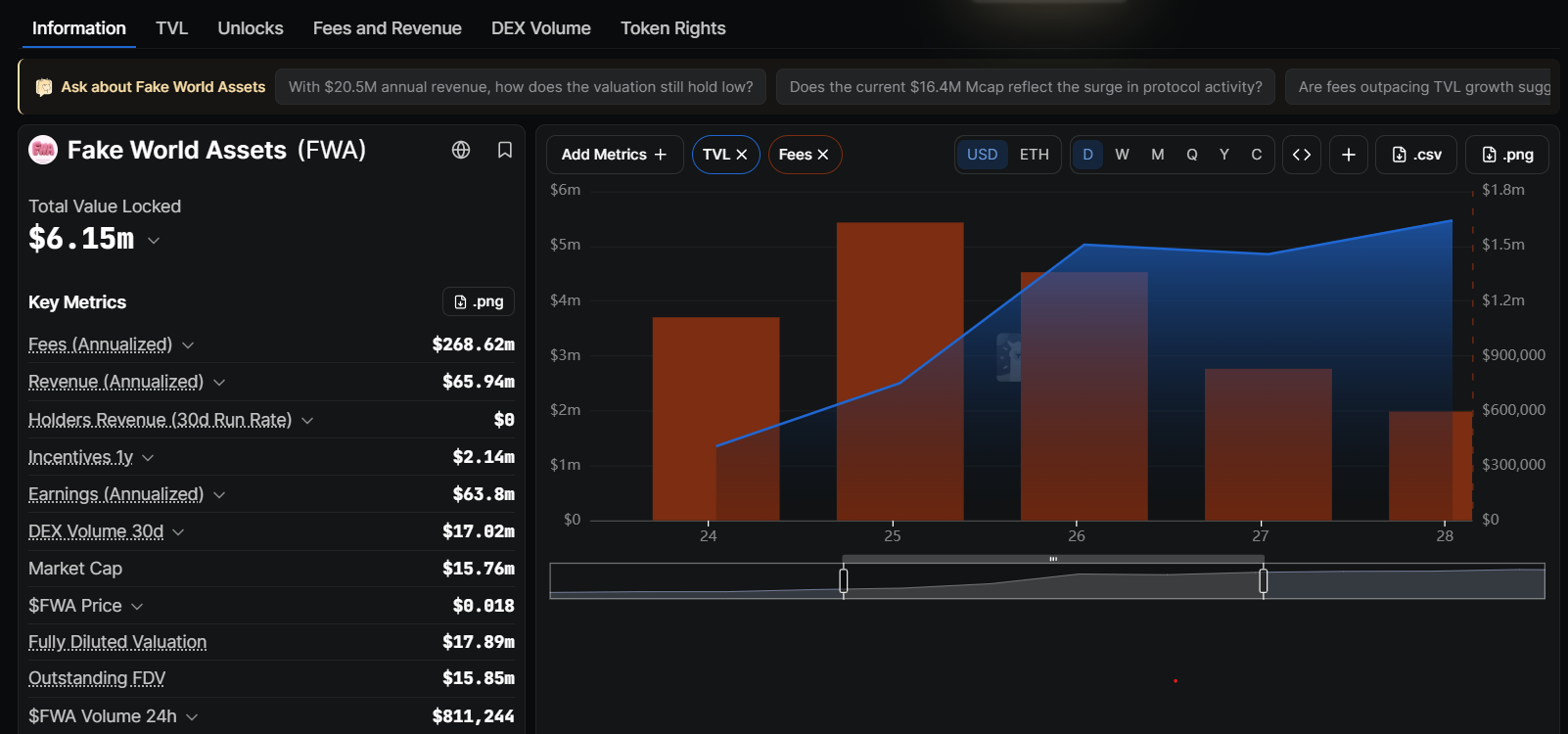
By July 25, FWAs had guzzled so much Ethereum gas that they briefly crowned themselves as the chain’s single largest gas consumer over a 24-hour period. At its absolute peak, the protocol generated approximately $1.53 million in daily fees, temporarily leapfrogging systemic heavyweights like Tether and Circle to dominate Ethereum blockspace utilization.
In a celebratory post on X (formerly Twitter), creators TokenWorks declared:

"4 days since launch. Fake World Assets are the next big thing."
Scaling Totals and Volume Milestones
While TokenWorks’ self-congratulatory post was obviously far from impartial, the underlying financial metrics corroborated the initial hype. By July 31, Total Value Locked (TVL) in the protocol surged past $6.15 million.
Although daily fee generation eventually stabilized to around $350,000 per day—still translating to a staggering annualized run rate of roughly $268 million—volume continued to climb. By August 1, the FWA ecosystem crossed the milestone of 10,000 ETH in total volume backed by over 100,000 individual purchases. While early token incentives undoubtedly played a heavy role in seeding this liquidity, analysts noted genuine organic interest in the underlying gamified mechanic.
Supporting Context & Metrics: Decoding the Onchain Gacha Machine
To understand Fake World Assets, one must trace the lineage of the "gacha" mechanic and its recent migration into the decentralized web.
What is an Onchain Gacha?
The term "gacha" is an abbreviation of gachapon or gashapon, referring to Japanese capsule-toy vending machines invented in the 1960s that dispense random toys in plastic capsules. Over the decades, this psychology migrated into digital spaces—most notably via mobile and browser-based video games like Dragon Collection in 2010—before merging with the physical collectibles market via randomized trading card "booster packs" (such as Pokémon cards).
Recently, projects like Collector Crypt, Beezie, and Courtyard began tokenizing physical graded trading cards onchain. According to industry data, this hybrid sector of tokenized physical assets and onchain gacha saw a record $324 million in volume in June alone. Many of these tokenized cards have now been wrapped for direct integration into the FWA ecosystem.
[Traditional Gacha / Booster Pack]
        ↓ (Tokenization & Wrapping)
[Onchain RWA Collectibles (e.g., Courtyard, Collector Crypt)]
        ↓ (TokenWorks Protocol Integration)
[Fake World Assets (FWAs) - Onchain Gacha Pools]
The Dual Architecture: Players vs. Liquidity Providers
The operational mechanics of FWA rely on a dual-sided marketplace that blends decentralized liquidity provision with gamified retail speculation:
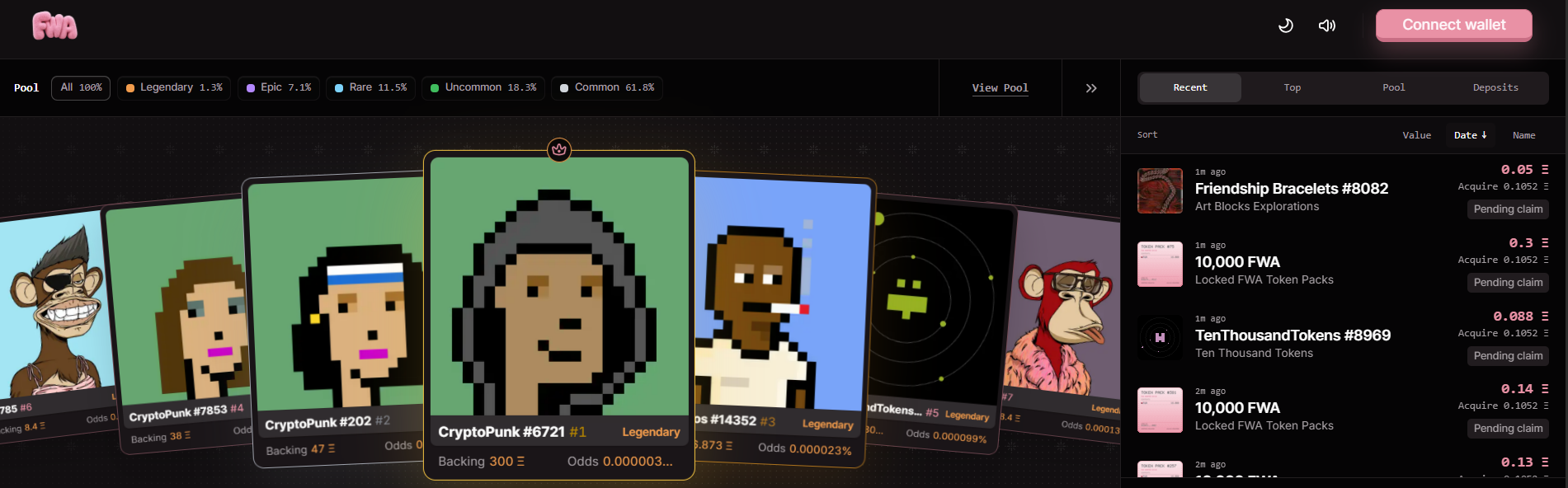
- The Liquidity Providers (LPs): NFT holders deposit their blue-chip or mid-tier collectibles (ranging from CryptoPunks and Azuki to Lil Pudgys and Art Blocks) alongside ETH into pooled smart contracts. While their assets remain in the pool, LPs earn a proportional share of protocol fees. Their underlying hope is that their NFT will remain in the pool long enough to generate yield before being randomly claimed by a player.
- The Players (Speculators): Users pay a set fee to pull the gacha lever. Upon receiving a randomly selected NFT, they face a choice: keep the digital collectible, or immediately redeem a vast percentage of its attached ETH value back out of the protocol. According to data from Blockworks Research, roughly 70% of purchasers currently choose to convert their winnings back into protocol tokens or underlying ETH value.
As pseudonymous crypto commentator 2Lambroz aptly summarized, from a player’s perspective, "you’re buying a lottery ticket on the pool." Meanwhile, a prominent Ethereum advocate known as Materkel hailed the protocol as:
"The most fun NFT/casino primitive in over a decade of crypto, where users actually get to be both players and the house at the same time […] Money legos on Ethereum are back!"
Official Statements & Behavioral Insights
While market participants celebrated the dopamine hits, industry leaders and academic researchers offered deeper psychological context regarding why onchain gacha resonates so powerfully with human behavior.
The Psychology of Playful Speculation
Simon Dedic, founder of venture capital firm Moonrock Capital and an early backer of onchain collectible platforms, expressed measured skepticism regarding the FWA phenomenon specifically, even while maintaining broader optimism for the sector.
"I’m very bullish on gamified commerce… my skepticism on FWA is specific," Dedic tells Magazine. He argues that a significant portion of current activity is artificially stimulated by generous token incentives rather than long-term organic demand:
"The whole thing is purely aimed at crypto degens so they can gamble and speculate."
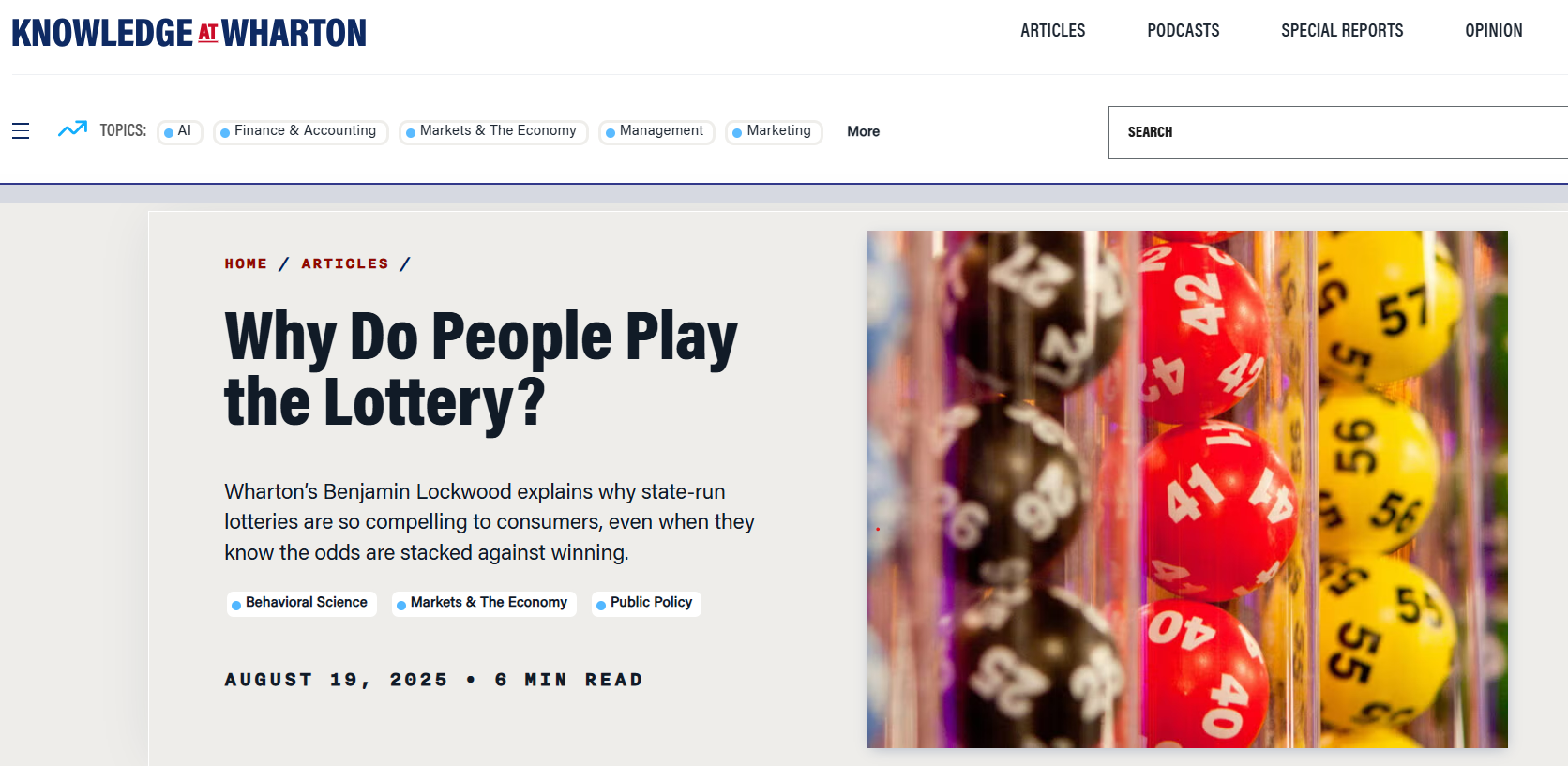
However, behavioral finance experts suggest that dismissing these systems purely as reckless gambling ignores foundational human desires. Benjamin Lockwood, a Wharton economist whose research into state-run lotteries explored why people play the lottery, emphasized that participants heavily value the experience and the emotional narrative of the gamble, not merely the mathematical probability of a payout.
Meir Statman, a behavioral finance pioneer, professor at Santa Clara University, and author of A Wealth of Well-Being, drew a direct historical parallel to the FWA mechanic:
"There is a parallel to ‘onchain gacha’ in people bidding on the contents of abandoned storage units. Most find items worth placing in the trash, but some find items they can sell on eBay. One found a painting worth hundreds of thousands of dollars. These combine hope for riches with playfulness. This is what lotteries offer."
AzFlin, founder of DAO launchpad daos.world and a former Uniswap engineer, echoed the sentiment of continuous innovation within the sector:
"Just when you think everything in crypto has been invented, something new springs up."
Future Outlook: Is Onchain Gacha Here to Stay?
The ultimate fate of Fake World Assets and the broader onchain gacha trend hinges on a singular threshold: What happens when the speculative token incentives dry up?
The Generational Shift Toward Gamified Commerce
Despite his short-term reservations about FWA’s token-incentivized loops, Simon Dedic remains decidedly bullish on the marriage of commerce and gaming for generational reasons:
"The further Gen Z moves into being the generation with the strongest buying power, the more shopping is going to be gamified and come with a dopamine kick attached."
Rather than recycling speculative digital art from past market cycles, Dedic believes the underlying infrastructure is far better suited for asset classes that consumers inherently desire in physical life—such as high-end watches, rare whiskey, and premium trading cards.
"I see enormous potential in selling much-demanded assets in a gamified way," he notes. "I see very little in building Ponzi schemes to create demand for assets nobody wanted in the first place."
Conclusion: A Permanent Primitive or a Fading Flop?
Fake World Assets has successfully pushed the boundaries of how liquidity and digital collectibles can interact on Ethereum. By turning asset ownership into a high-stakes, gamified lottery, TokenWorks and its imitators have tapped into a primal psychological vein that traditional DeFi interfaces often fail to reach.
The upcoming months will serve as the true proving ground. If communities continue to spin, trade, and pool assets long after the initial hype cycle subsides, onchain gacha may have successfully unlocked the elusive retail use case the cryptocurrency industry has chased for years. If not, FWAs will inevitably join the long graveyard of brilliant, brightly burning experiments that illuminated the crypto timeline before fading into obscurity.