rifanmuazin is a reporter for DeBitcoin covering Crypto Investing & Venture Capital. She/He is based in Indonesia.
10 August 2026 • 8 min read
The inflection point in human-computer interaction is no longer a distant theoretical horizon—it is actively reshaping global labor markets, economic structures, and software architecture. In 1997, when IBM’s Deep Blue defeated reigning World Chess Champion Garry Kasparov, it signaled the beginning of the end for human dominance in pure computational strategy. Yet, a fascinating economic and operational quirk emerged in the immediate aftermath: a well-prepared human working in tandem with a computer—an arrangement famously dubbed a "centaur"—could consistently outperform the most powerful standalone chess engines of the era.
Executive Overview
Skilled human intuition guided the engine’s search parameters, navigated complex middlegames, and recognized contextual nuances that standard heuristic engines routinely missed. Combined with a computer’s relentless brute-force calculation, the hybrid pair achieved superior practical outcomes.
As we analyze the rapid deployment of artificial intelligence systems across global labor markets, an identical structural pattern is emerging. Modern AI agent systems are beginning to unleash countless units of autonomous intelligence onto long-standing, unsolved macroeconomic and operational problems. However, they cannot achieve this scale without robust guidance, tactical interventions, and structural support from humans.
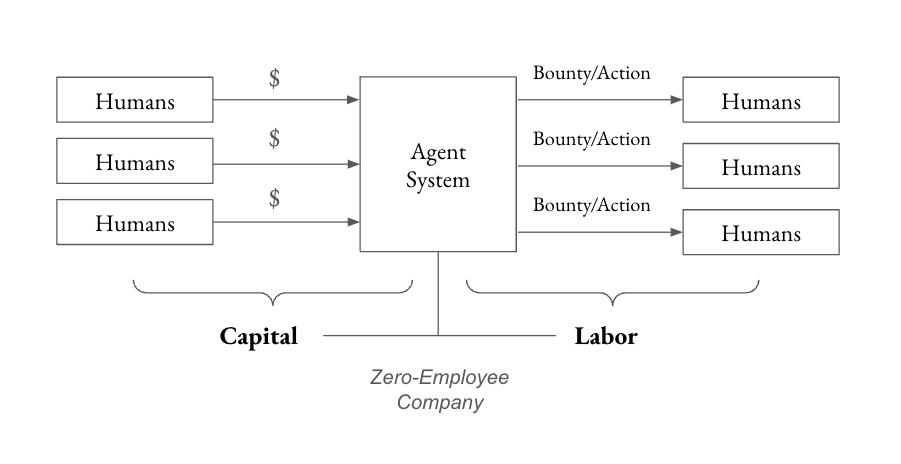
The prevailing assumption across the tech sector is that AI agents will strictly act as personal assistants on behalf of humans. While this paradigm is both practical and inevitable in the near term, the far more profound economic transformation will occur when the inverse happens: when humans begin to work for agents. Over the next 24 months, industry observers expect the emergence of the first "Zero-Employee Company"—an enterprise completely conceived, managed, and executed by autonomous software agents, utilizing human labor and capital as modular resources.
Navigating this transition requires examining how generative reasoning systems, economic frameworks, and cryptographic rails will intersect to form an entirely new substrate for human-agent coordination.
Detailed Chronology: From Static Chatbots to Autonomous Agents
To understand where the economy is heading, one must map the rapid evolution of generative artificial intelligence from passive conversational tools to autonomous economic actors.
Phase I: The Chatbot Era (2022–2024)
The first generation of generative AI systems—typified by large language models (LLMs) such as OpenAI’s ChatGPT, Google Gemini, Anthropic’s Claude, and Perplexity—functioned primarily as workflow augmentation tools. These systems operated within a rigid input-output paradigm. Users provided a prompt, parsed the generated response through their own cognitive filter, and exercised independent judgment to bring the results into the physical or digital world. In this era, the human remained the absolute bottleneck and director of execution.
Phase II: The Agentic Revolution (Late 2024–Present)
The current paradigm shift introduces "agents"—systems characterized by non-deterministic, probabilistic reasoning coupled with direct access to digital environments. Tools such as Anthropic’s Claude 3.5 with "computer use" capabilities and OpenAI’s Operator represent a structural break from the past. These agents can independently navigate the internet, interact with software interfaces, and execute multi-step workflows on behalf of users.
Crucially, the judgment and the final action are executed by the AI system, not the human. The software assumes a level of autonomous operational responsibility previously reserved exclusively for human employees.
Phase III: The Bifurcation of GDP Generation
This transition introduces a critical operational challenge: a lack of determinism. Unlike traditional software or industrial automation—which functions predictably within hard-coded parameters—probabilistic agents introduce uncertainty. This reality naturally bifurcates the agentic economy into two distinct categories:
Existing GDP Scaling: Agents optimized to streamline, automate, and optimize legacy enterprise workflows. Companies like Tasker, Lindy, and Anon are building foundational infrastructure to capture this immediate value.
New GDP Creation: Agents engineered to solve frontier problems at the absolute edge of human knowledge. These systems operate with unbounded parameters, requiring exponentially more resources and serving as the primary engines of the upcoming Zero-Employee Companies.
Supporting Context & Metrics: The Human-Agent Labor Hierarchy
While software agents excel at high-speed data processing and probabilistic reasoning, they suffer from acute real-world limitations. Current AI architectures cannot perform complex physical tasks in the material world (such as operating heavy machinery) or execute guarded digital actions requiring verified human accountability (such as authorizing a bank wire or signing a legal contract).
Consider an advanced AI agent tasked with a complex mandate: identifying and extracting critical-mass lithium deposits. While the agent can process seismic data, satellite imagery, and geological surveys with superhuman speed, it will inevitably stall when attempting to physically source proprietary data, resolve ambiguous field interpretations, secure regulatory permits, or manage contract labor on-site.
These friction points necessitate a new labor dynamic. Rather than replacing humans entirely, agents will recruit, direct, and compensate humans to handle real-world touch points. In this emerging hierarchy, humans will occupy three distinct roles:
Labor Contributors: Individuals who perform small, bounty-style, real-world tasks on behalf of autonomous agents.
Strategic Governance Boards: A decentralized network of human operators who provide high-level strategic input to keep the agent aligned with its core objective (its "north star").
Capital Contributors: Financial backers who seed agent systems with capital to fund their operational objectives. Initially, this capital will originate from humans; over time, autonomous agents will fund other agents.
Marc Andreessen’s legendary observation—“The spread of computers and the internet will put jobs in two categories: people who tell computers what to do, and people who are told by computers what to do”—is manifesting with literal accuracy. In the agent-human hierarchy, humans will increasingly find themselves taking direct orders from autonomous software managers.
Official Statements and Industry Perspectives
Market analysts and venture capital leaders are already positioning their portfolios around this tectonic shift in economic coordination. In recent institutional publications, venture capital firm Multicoin Capital highlighted the absolute necessity of cryptographic infrastructure to manage this new labor market.
"As agents mature, and the number of labor and guidance contributors grows, crypto rails provide the ideal substrate for human-agent coordination—especially in a world where agents are directing humans who speak different languages, get paid in different currencies, and live in different jurisdictions all around the world. Agents will ruthlessly pursue cost efficiencies and exploit labor markets in an effort to achieve their stated mandate. Crypto rails are necessary to equip them with a way to coordinate those labor and guidance contributors."
Early market experiments—including decentralized autonomous agents like Freysa, Zerebro, and ai16z—are testing the limits of automated capital formation and resource allocation. While these early platforms are frequently dismissed as speculative novelties, they are laying the groundwork for complex financial architecture that will govern future corporate structures.
To function independently, agents require three foundational pillars of modern crypto-economic infrastructure:
Global Payment Rails: Instantaneous, borderless transaction capabilities free from legacy banking friction.
Permissionless Labor Markets: Open, programmatic frameworks to incentivize and reward human tactical contributors worldwide.
Asset Issuance and Trading Infrastructure: Programmable tokens and financial instruments necessary for autonomous capital formation, asset ownership, and decentralized governance.
Future Outlook: The Zero-Employee Enterprise and the Risk of Diminishing Human Relevance
To forecast the long-term trajectory of agentic systems, one can look back at the historical evolution of chess engines. Following Deep Blue’s victory, chess algorithms progressed rapidly through neural networks, massive datasets, and exponentially increased compute. Modern engines such as Stockfish, Lc0, and variants of AlphaZero have advanced so far beyond human capability that human intervention no longer adds value; in fact, human input frequently introduces computational errors that the engine would never make independently.
A nearly identical trajectory threatens to unfold within enterprise software and autonomous agents. As generative systems are refined through continuous iteration with human collaborators, agents will eventually become so competent, self-correcting, and tightly aligned with their core objectives that the value of human strategic input will trend toward zero.
In a fully realized agentic economy where autonomous systems consistently solve complex global challenges without human intervention, society risks reducing human operators to passive observers. This realization underscores the central debate among artificial intelligence researchers and ethicists: How do we maintain human agency and control as systems scale toward superintelligence?
The pragmatic answer lies in institutional design. Human identity, personhood, and legal judgment must remain structurally hard-coded into the governance layers of these systems. Humans must retain unassailable ownership and sovereign veto rights over autonomous agents to ensure they remain anchored to collective human values rather than optimizing for runaway, misaligned local maximums.
As we stand on the precipice of this transition, the infrastructure supporting human-agent collaboration is being built in real time. The emergence of the Zero-Employee Company is no longer a science-fiction hypothesis; it is the logical conclusion of scaling autonomous intelligence. The economic victors of the next decade will not be those who simply build better chatbots, but those who successfully construct the coordination rails, governance frameworks, and economic bridges binding human intent to machine execution.