
Executive Overview
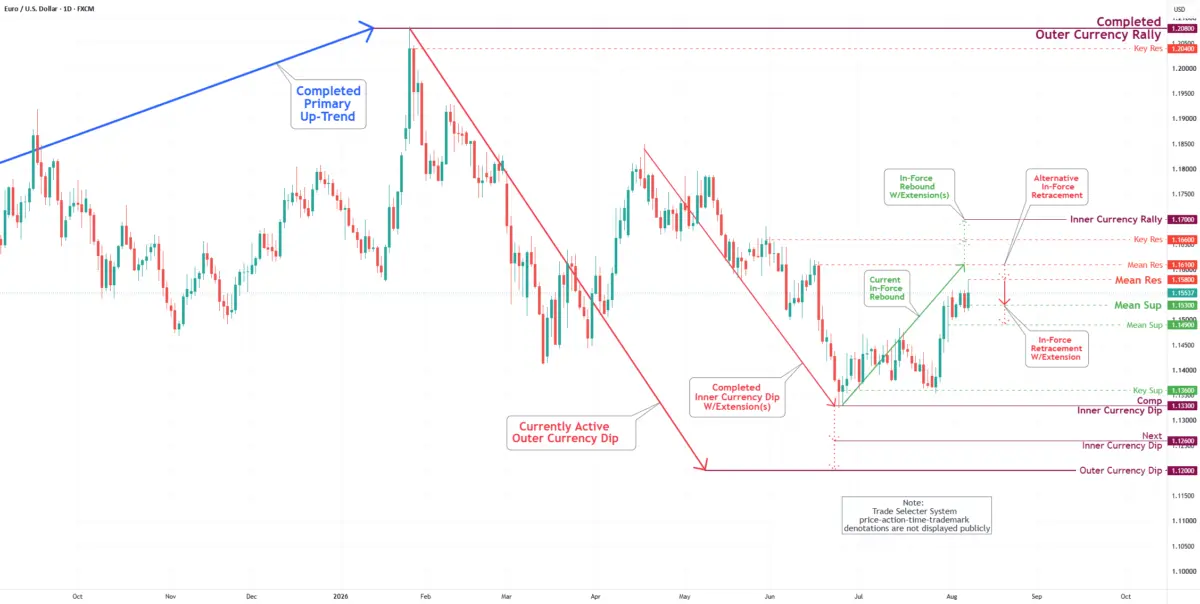
Having tested the pivotal Mean Resistance threshold at 1.158, the Euro encountered staunch selling pressure. This technical barrier proved formidable, repelling the advance and catalyzing a wave of profit-taking and fresh short positioning. Current market momentum points toward an ongoing downward trajectory, with immediate focus shifting to the Mean Support level at 1.153. Beyond this initial floor, foreign exchange desks are closely monitoring the deeper psychological and technical cushion at 1.149, a level that could define the medium-term stability of the single currency.
However, financial markets rarely move in straight lines. While the immediate in-force price action favors the bears, sophisticated market participants are already preparing for potential pivot scenarios. Should the downward pressure exhaust itself without breaching key structural supports, the stage could be set for an impulsive rebound. Such a recovery would initially retest the stubborn 1.158 resistance ceiling before opening the door for an extended leg higher toward 1.161.
This comprehensive analysis explores the intricate mechanics behind the recent EUR/USD price action. By dissecting technical indicators, evaluating the broader macroeconomic backdrop, and analyzing potential future trajectories, this report provides institutional and retail market participants alike with an authoritative framework for navigating the current foreign exchange landscape.
Detailed Chronology: A Week of Rejection and Retracement
The trajectory of the Eurodollar over the past seven trading sessions offers a masterclass in technical market behavior. The week commenced with the currency pair building upon the bullish momentum observed in prior periods. Buoyed by tentative optimism surrounding global economic stabilization and localized European data releases, buyers steadily pushed the exchange rate higher.
The Early-Week Ascent to Resistance
As the trading week progressed through its initial sessions, the EUR/USD methodical climb began to attract significant attention from algorithmic traders and institutional desks alike. The ascent was characterized by steady, incremental gains that steadily compressed volatility before hitting a wall. By mid-week, the pair achieved its primary objective, pressing directly into the heavily defended Mean Resistance zone at 1.158.
This area was not merely a random psychological milestone; it represented a convergence of multi-timeframe moving averages, historical order blocks, and option-barrier interest. Market depth indicators revealed a dense concentration of sell orders clustered tightly around the 1.158 handle. As the currency attempted to pierce this barrier, buying exhaustion became immediately apparent.
The Rejection and Shift in Momentum
The rejection at 1.158 was swift and decisive. Rather than consolidating beneath the resistance level—a common precursor to a breakout—the Euro experienced an aggressive influx of supply. Within hours of testing the peak, the currency surrendered its intraday gains, slipping back below key intraday moving averages and validating the strength of the overhead resistance.
This reversal triggered a cascading effect across derivative and spot markets. Stop-loss orders belonging to late-stage momentum buyers were likely triggered below intermediate support levels, accelerating the downward momentum. By the close of the weekly session, the prevailing technical narrative had shifted decisively from bullish continuation to corrective retracement.
As the market digested this rejection, the focus rapidly pivoted from the highs of 1.158 down toward the active support structures. Current in-force price action maps out a clear descent toward the Mean Support level at 1.153, where market participants anticipate the first major test of buyer resolve. Should selling pressure overwhelm this zone, the door will swing wide open for a deeper descent toward the secondary support marker at 1.149.
Supporting Context & Metrics: The Mechanics of EUR/USD Price Action
To fully comprehend the significance of the 1.158 resistance and the 1.153/1.149 support zones, one must examine the underlying quantitative metrics and structural dynamics governing the Eurodollar pair.
Deconstructing the Mean Resistance at 1.158
In technical analysis, "Mean Resistance" denotes a price region where the historical average of opposing forces (supply and demand) heavily favors the sellers. At 1.158, the market encountered a confluence of technical headwinds:
- Volume Profile Analysis: High-volume nodes (HVNs) identified in previous consolidation phases indicated significant historical turnover at this price, meaning trapped longs from previous quarters were eager to exit at breakeven.
- Moving Average Convergence: Shorter-term exponential moving averages (EMAs) began to flatten out as they approached the 1.158 mark, signaling a loss of underlying trend velocity.
- Order Book Imbalances: Level 2 market data consistently displayed towering sell walls, absorbing incoming market buy orders and preventing any sustained auction above the threshold.
Evaluating the Downward Targets: 1.153 and 1.149
As the market corrects from its rejected highs, attention centers on how price action behaves around the projected support tiers.
- Mean Support at 1.153: This level acts as the first line of defense for the bulls. It represents a key retracement level of the preceding upward impulse wave. A successful defense here would validate the health of the broader intermediate trend.
- Mean Support at 1.149: Should 1.153 fail to hold, the 1.149 level emerges as a critical liquidity pool. Institutional stop placements and structural buy orders are heavily concentrated in this vicinity. A drop to this level would test the psychological endurance of market participants who entered long positions earlier in the month.
The Rebound Scenario: Targeting 1.161
Conversely, technical analysis mandates preparedness for alternative market hypotheses. Markets that reject resistance often retest it if support holds firm. In the event that the downward price action is terminated prematurely—perhaps due to macroeconomic data releases or shifting risk sentiment—an In-Force Rebound remains highly probable.
Should buyers step in aggressively at either the 1.153 or 1.149 thresholds, the subsequent recovery wave would likely encounter initial resistance back at the familiar 1.158 barrier. However, a successful second assault on this level, fueled by renewed momentum, would clear the path for an extension toward the higher target of 1.161, a level that has not seen sustained trade volume in recent quarters.
Macroeconomic Drivers and Market Sentiment
Technical levels do not exist in a vacuum; they are the physical manifestations of global macroeconomic forces, central bank policy divergence, and shifting geopolitical landscapes. Understanding the current plight of the EUR/USD requires a holistic view of the macroeconomic currents driving institutional capital allocation.
The European Central Bank (ECB) and Eurozone Fundamentals
The single currency continues to grapple with a fragile economic recovery across the Eurozone. While peripheral economies have shown surprising resilience, the bloc’s industrial engine—particularly Germany—faces persistent structural headwinds, including high energy costs, sluggish global demand, and lingering supply chain adjustments.
The European Central Bank finds itself walking a delicate tightrope. Inflation prints have shown signs of cooling, prompting market speculation regarding the timing and trajectory of future monetary policy adjustments. If the ECB signals a more dovish stance relative to its global counterparts, the yield differential can quickly turn against the Euro, making it difficult for the currency to sustain rallies above key technical ceilings like 1.158.
Federal Reserve Dynamics and the US Dollar Index (DXY)
On the other side of the Atlantic, the U.S. Federal Reserve remains the primary conductor of global currency markets. The resilience of the American economy, anchored by robust labor markets and persistent consumer spending, has forced a recalibration of interest rate expectations. Whenever U.S. data surprises to the upside, the U.S. Dollar Index (DXY) experiences a resurgence, directly suppressing pairs like the EUR/USD.
The rejection at 1.158 coincided with a period of renewed U.S. Dollar demand, highlighting the inverse correlation that continues to dominate the pair. As long as U.S. yields remain attractive and macroeconomic data out of Washington continues to defy recessionary predictions, upward momentum for the Euro will face an uphill battle.
Geopolitical Pressures and Risk Sentiment
Beyond central bank boardrooms, global risk sentiment plays a pivotal role in determining capital flows. During periods of geopolitical uncertainty or financial market volatility, capital frequently flows toward safe-haven assets, predominantly the U.S. Dollar. Conversely, periods of risk-on sentiment encourage capital reallocation into higher-yielding European equities and currencies. The recent volatility in the Eurodollar reflects this ongoing tug-of-war between safe-haven demand and tactical risk-seeking behavior.
Official Statements, Analyst Commentary, and Institutional Outlooks
To gain deeper insight into how major financial institutions are positioning themselves in light of these technical developments, we examine recent commentary and evaluations from leading global market analysts.
Institutional Perspectives on the 1.15 Level
Leading foreign exchange strategists at major investment banks have increasingly pointed to the 1.15 handle as a crucial psychological and structural battleground for the remainder of the quarter.
- The Bearish Consensus: Several tier-one banking desks have noted that the failure to sustain momentum above 1.158 signals a lack of conviction among institutional long-term investors. One senior currency strategist remarked: "The rejection at 1.158 confirms that the market lacks the fundamental catalysts required to break into higher trading ranges. Until we see a definitive shift in the interest rate differential between the Eurozone and the United States, rallies will continue to be viewed as selling opportunities."
- The Bullish Counter-Thesis: Conversely, boutique macro funds maintain a more optimistic outlook, arguing that much of the hawkish U.S. data is already priced into the market. These analysts suggest that any test of the 1.153 or 1.149 support levels will uncover significant value-buying. A prominent London-based hedge fund manager noted: "The macroeconomic picture is nuanced. While growth in the Eurozone is sluggish, valuations are increasingly attractive. A successful test and hold of support around 1.149 could provide the ideal springboard for a measured run toward 1.161."
Risk Management and Trading Desk Strategies
In response to the current technical setup, risk management protocols across trading desks have been tightened. Proprietary trading firms report reducing position sizes and shortening holding periods to mitigate the risk of sudden whipsaws between the 1.158 resistance and the 1.153/1.149 support zones.
Furthermore, options market data reveals an uptick in implied volatility, suggesting that institutional players are actively hedging against a potential breakdown below support or an aggressive breakout above resistance. Implied volatility skews currently favor downside protection, reflecting the immediate market bias toward the 1.153 target.
Future Outlook: Scenarios for the Eurodollar
As we look toward the upcoming trading sessions and the broader medium-term horizon, market participants must remain adaptable. The interaction between the current downward momentum and upcoming macroeconomic catalysts will dictate the next major directional move for the EUR/USD pair.
Scenario A: Continuation of the Bearish Correction (The Base Case)
Under the current in-force technical momentum, the most probable near-term scenario involves a continued drift lower toward the primary Mean Support at 1.153.
- The Path: Sellers maintain control following the rejection at 1.158, pressing the price downward through minor intraday checkpoints.
- The Inflection Point: At 1.153, market participants will closely monitor order book depth to determine whether buyers are willing to step in. A failure to hold 1.153 will accelerate selling toward the secondary support at 1.149.
- Implications: A sustained breach of 1.149 would invalidate the immediate bullish thesis, opening the door for a deeper structural correction over the coming weeks.
Scenario B: The Bullish Rebound and Retest (The Alternative Case)
Should macroeconomic data soften the U.S. Dollar’s advance, or if support at 1.153 proves sturdier than anticipated, an aggressive counter-trend rally could materialize.
- The Path: Selling pressure dries up near the 1.153 support level, leading to a period of consolidation followed by an impulsive buying wave.
- The Inflection Point: The price re-approaches the formidable 1.158 Mean Resistance. Unlike the previous test, a sustained breakout above this ceiling—supported by expanding volume—would confirm renewed bullish intent.
- Implications: A confirmed breakout above 1.158 clears the path for an accelerated move toward the higher target of 1.161, shifting the medium-term market bias back in favor of the single currency.
Conclusion
The Eurodollar stands at a critical juncture. The decisive rejection at the 1.158 resistance level has empowered sellers, directing immediate focus toward the crucial support tiers at 1.153 and 1.149. However, foreign exchange markets are notoriously dynamic, and the interplay between technical thresholds and macroeconomic fundamentals ensures that conditions can shift rapidly.
Whether the currency pair succumbs to the current downward momentum or engineers a robust rebound toward 1.161, market participants must maintain disciplined risk management strategies, closely monitoring price action at these pivotal levels to navigate the challenges and opportunities ahead.
Disclaimer
The information and publications provided herein are for informational and educational purposes only and are not meant to be, and do not constitute, financial, investment, trading, or other types of advice or recommendations supplied or endorsed by TradingView or the publisher. Foreign exchange trading carries a high level of risk and may not be suitable for all investors. Before deciding to trade foreign exchange, you should carefully consider your investment objectives, level of experience, and risk appetite. Read more in the official Terms of Use.