
===================================================================
                  24-HOUR PERFORMANCE COMPARISON
===================================================================
  Asset / Metric              24h Change         Key Level
-------------------------------------------------------------------
  Pi Network (PI)              +2.80%            $0.0914
  Bitcoin (BTC)                +0.21%            $65,000
  Total Crypto Market Cap      +0.46%            --
  PI 24h Trading Volume       -17.59%            $9.42 Million
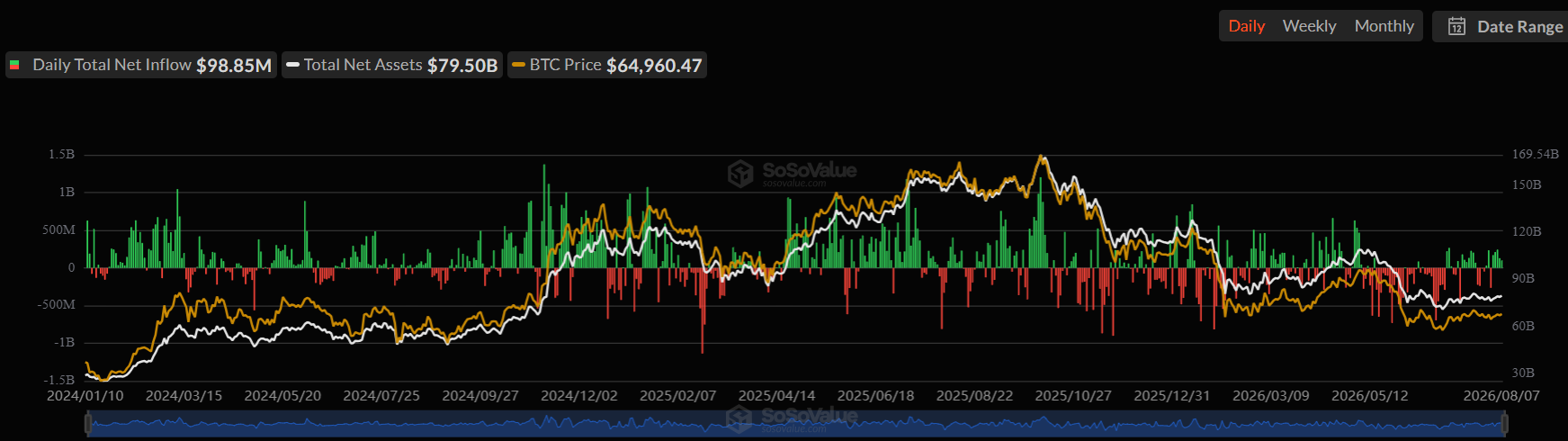
  Spot BTC ETF Net Inflows     +5-Day Streak     $98.85 Million (Aug 7)
===================================================================
The asset’s upward trajectory is driven by a convergence of network-specific upgrades, emerging ecosystem integrations, and a favorable macroeconomic backdrop. Key highlights include:
- Protocol 26 Mainnet Migration: Mainnet node validators face a strict August 11 deadline to complete infrastructure upgrades designed to enhance smart contract security, cryptographic capabilities, and state management.
- Robotic Utility Integration: Speculation surrounding a partnership between Pi Network and the Fabric Foundation’s RoboPay platform has fueled market discussion regarding machine-to-machine microtransactions.
- Macroeconomic Tailwinds: Softer U.S. labor market data has amplified expectations of monetary policy easing, benefiting risk assets globally. Furthermore, institutional demand remains steady, evidenced by $98.85 million in net inflows into U.S. spot Bitcoin ETFs on August 7—marking the fifth consecutive day of net positive institutional capital commitment.
Despite these constructive drivers, PI’s 24-hour trading volume experienced a 17.59% contraction to $9.42 million. This volume compression suggests that while spot buyers are absorbing floating supply above key support levels, a broader breakout toward the psychological $0.10 resistance will require participation from higher-volume institutional trading desks.
Detailed Chronology of Market Events
The recent volatility and subsequent price appreciation across the Pi Network ecosystem are the result of several sequential developments over recent weeks:
+-------------------------------------------------------------------------+
|                         CHRONOLOGY OF EVENTS                            |
+-------------------------------------------------------------------------+
| [August 4]  : Fabric Foundation announces RoboPay integration rumor.   |
| [August 7]  : U.S. Spot BTC ETFs log 5th consecutive inflow ($98.85M).  |
| [August 8]  : PI defends $0.090 support, surging to $0.0914 (+2.80%).   |
| [August 11] : Protocol 26 Validator compliance deadline for Mainnet.    |
+-------------------------------------------------------------------------+
August 4: Fabric Foundation Signals Machine Economy Integration
The Fabric Foundation issued a public statement via social media alleging that the Pi Core Team had joined its autonomous payment protocol, RoboPay. The protocol aims to facilitate machine-to-machine settlements, allowing AI software agents to discover, hire, and pay physical robotics infrastructure on-chain. While unconfirmed by the Pi Core Team, the announcement triggered immediate speculative interest across secondary trading venues.
August 7: Institutional Accumulation Anchors Market Sentiment
Institutional inflows into digital asset products intensified as U.S. spot Bitcoin ETFs recorded $98.85 million in single-day net inflows. This marked the fifth consecutive trading session of positive net flows, establishing a supportive floor under major crypto assets and encouraging risk-on positioning among altcoin traders.
August 8: Technical Defense of $0.090 Support
Following a brief market-wide pullback, PI coin successfully retested and held the crucial $0.090 horizontal support level. Supported by positive technical divergences on lower timeframes, the price rallied to $0.0914, breaking out of a short-term consolidation pattern and establishing temporary outperformance against benchmark digital assets.
August 11 Deadline: Protocol 26 Infrastructure Transition
Pi Network mainnet validators reached the final preparation window for the implementation of Protocol 26. Designed to optimize state execution, enhance system throughput, and refine cross-chain cryptographic primitives, the upgrade serves as a critical operational hurdle prior to further mainnet expansion initiatives.
Macroeconomic Context & Core On-Chain Metrics
The underlying dynamics driving Pi Network’s price movement are closely tied to both broader macroeconomic conditions and asset-specific market structures.

+-------------------------------------------------------------------------+
|                  MACROECONOMIC & LIQUIDITY MATRIX                       |
+-------------------------------------------------------------------------+
| Factor                     Data Point          Market Impact            |
+-------------------------------------------------------------------------+
| U.S. Employment Data       Slowing Growth      Doves expect Rate Cuts   |
| Spot BTC ETF Flow (Aug 7)  +$98.85M            Sustained BTC floor      |
| PI 24h Trading Volume      $9.42M (-17.59%)   Requires fresh buy-side   |
| RSI Indicator (4-Hour)     60.80               Moderate Bullish Control |
| MACD Line vs. Signal       0.00130 / 0.00122   Positive Momentum Cross  |
+-------------------------------------------------------------------------+
Macroeconomic Factors and Bitcoin Anchoring
The broader digital asset sector benefited from macroeconomic adjustments in the United States, where cooler-than-expected non-farm payroll and employment reports pointed to a softening labor market. Financial markets swiftly priced in a higher probability of Federal Reserve interest rate cuts, driving capital down the risk curve.
As the market leader, Bitcoin briefly pushed toward $65,400 before establishing a stable range around $65,000. This stabilization created a supportive environment for altcoins. With lower capital volatility in BTC, speculative capital migrated toward specialized tokens exhibiting pending network catalysts, directly benefiting Pi Network.
Trading Volume Anomalies and Market Depth
While price action remains bullish, a detailed inspection of market depth reveals structural nuances. PI’s 24-hour trading volume dropped 17.59% to $9.42 million. In technical analysis, price gains accompanied by declining volume can indicate a lack of immediate selling pressure rather than aggressive, high-volume buying.
For PI to sustain a prolonged rally toward higher technical targets, trading volume must expand significantly. Without a surge in volume, order book liquidity remains thin, raising the risk of rapid pullbacks if large market participants decide to take profits near key resistance levels.
Protocol 26 Technical Infrastructure
At the blockchain protocol layer, the transition to Protocol 26 represents an architectural upgrade for the Pi network. The core modifications focus on four main operational pillars:
- State Management Optimization: Streamlining how ledger states are stored and indexed across validation nodes, reducing hardware computational overhead.
- Smart Contract Logic Security: Upgrading the runtime environment to mitigate reentrancy vulnerabilities and improve execution speed for decentralized applications (dApps).
- Cryptographic Primitives: Updating encryption libraries to facilitate secure, high-throughput transaction verification and signature batching.
- Interoperability Frameworks: Establishing standardized data structures to streamline communication with external blockchain networks and layer-2 solutions.
Network validators who fail to update their node configurations ahead of the August 11 deadline risk synchronization failures, making compliant node migration vital for maintaining consensus stability.
Ecosystem Advancements & Exchange Listing Dynamics
Beyond fundamental protocol updates, market participant sentiment around Pi Network is strongly influenced by ecosystem utility announcements and continuous speculation regarding tier-1 exchange listings.
+-------------------------------------------------------------------------+
|                   EXCHANGE LISTING STATUS & HISTORY                     |
+-------------------------------------------------------------------------+
| Exchange Platform       Current Status        Historical Context        |
+-------------------------------------------------------------------------+
| OKX, Kraken, Gate.io    Active Secondary      Trading via specific      |
| MEXC Global             Listings              market pairs              |
+-------------------------------------------------------------------------+
| Binance                 Not Listed            86.8% favorable vote in   |
|                                               February 2025 community   |
|                                               initiative; pending       |
+-------------------------------------------------------------------------+
| Coinbase                Not Listed            Under evaluation; no      |
|                                               formal path disclosed     |
+-------------------------------------------------------------------------+
The RoboPay Partnership and the AI Micro-Economy
A major source of recent market interest stems from disclosures regarding RoboPay, a specialized payment protocol constructed on the Fabric Network. According to claims released by the Fabric Foundation, Pi Network has been integrated as an official settlement asset designed to facilitate automated, on-chain payments for robotic services.
   [ AI Software Agents ]
             │
             │ (Autonomous Job Request)
             ▼
   [ RoboPay Protocol ]
             │
             │ (Microtransaction Settlement in PI Token)
             ▼
   [ Robotic Hardware / Infrastructure ]
Under this framework, autonomous software agents can dynamically hire and pay physical machinery for task execution using PI tokens. This use case addresses a growing segment of Web3 development: machine-to-machine (M2M) microtransactions, where low operational fees and accessible settlement tokens are necessary to facilitate automated operations without human intervention.
However, market analysts note that the Pi Core Team has not issued an official verification confirming the scope of this partnership. This lack of dual verification introduces an element of uncertainty. Traders are monitoring official project communication channels for formal confirmation before pricing in long-term fundamental adoption.
Tier-1 Exchange Listing Dynamics
Speculation regarding additional exchange listings remains a key driver of retail market sentiment. Currently, PI trades on several secondary digital asset platforms, including OKX, Kraken, Gate.io, and MEXC. However, the token remains unlisted on two of the industry’s largest centralized venues: Binance and Coinbase.
The historical precedent for a major venue expansion remains established:
- February 2025 Binance Community Poll: A formal community survey resulted in an 86.8% affirmative vote supporting the integration and listing of PI.
- Listing Requirements: Despite strong community backing, major exchanges enforce rigorous compliance standards prior to spot listing, including verified circulating supply metrics, robust decentralized node infrastructure, fully open mainnet operations, and strict adherence to global regulatory frameworks.
A listing on a major tier-1 exchange would dramatically increase global fiat onboarding channels, significantly expand available order-book depth, and likely reduce the bid-ask spreads currently observed across secondary venues.
Technical Analysis & Future Price Trajectories
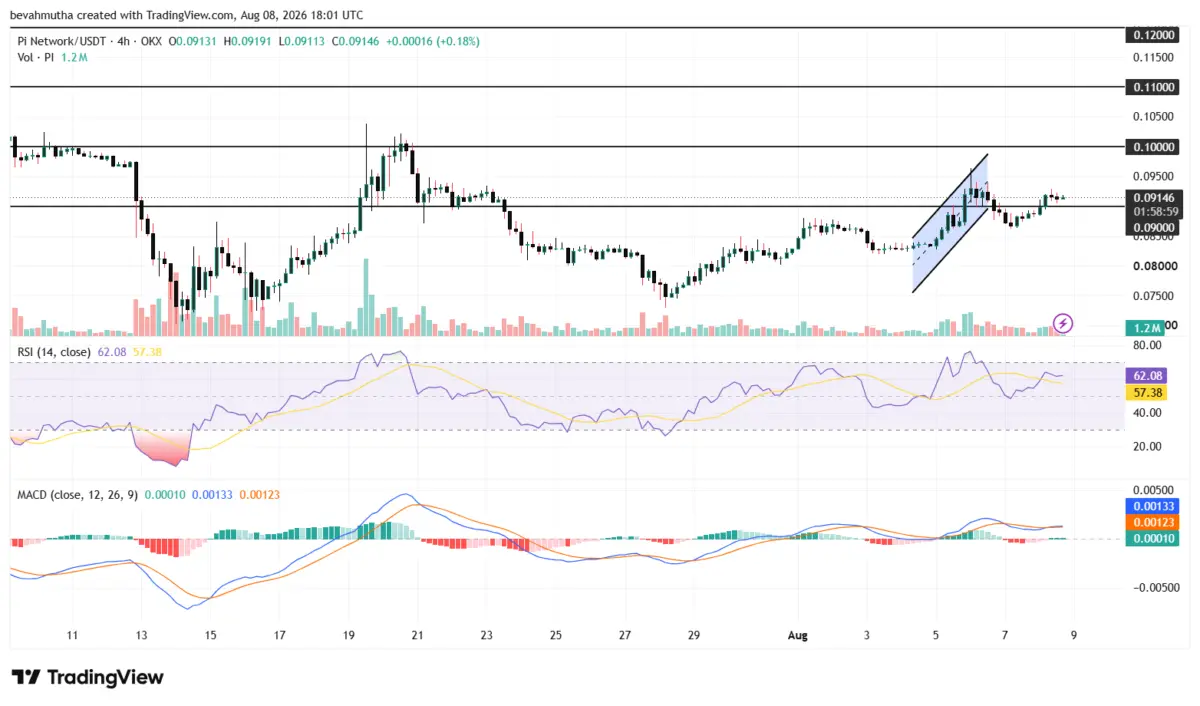
An evaluation of the 4-hour PI/USDT chart highlights a market attempting to construct a stable bullish market structure above key horizontal support levels.
                      PI/USDT 4-HOUR TECHNICAL CHART
===================================================================
 Resistance Level 4:  $0.120 ────────────────────────────────────── [Macro Target]
 Resistance Level 3:  $0.110 ────────────────────────────────────── [Breakout Target]
 Resistance Level 2:  $0.100 ────────────────────────────────────── [Psychological]
 Resistance Level 1:  $0.095 ────────────────────────────────────── [Immediate Supply]

 CURRENT PRICE:       $0.0914 ▲ (+2.80%)

 Support Level 1:     $0.0900 ────────────────────────────────────── [Primary Floor]
 Support Level 2:     $0.0850 ────────────────────────────────────── [Invalidation]
===================================================================
 Indicator Analysis:
   • Relative Strength Index (RSI): 60.80 (Bullish Control, Non-Overbought)
   • MACD Line: 0.00130 | Signal Line: 0.00122 | Divergence: Positive
===================================================================
Oscillator Metrics and Moving Averages
- Relative Strength Index (RSI): The 4-hour RSI currently prints at 60.80. Moving above the neutral 50 threshold into bullish territory, the indicator demonstrates firming buying interest without entering overbought territory (>70). This leaves adequate technical room for further upward price expansion before momentum becomes exhausted.
- Moving Average Convergence Divergence (MACD): The MACD indicator displays a constructive bullish alignment. The MACD line sits at 0.00130, hovering above the signal line at 0.00122. The expanding positive histogram bars signal accelerating upward momentum on lower timeframes, providing structural support for a continued recovery effort.
Bullish Path: Key Resistance Objectives
If buyers successfully maintain structural support above $0.0900, the technical path points toward a multi-stage recovery scenario:
- Immediate Resistance ($0.0950): The primary obstacle for bulls is the localized supply zone at $0.0950. A decisive breakout above this level with expanding volume would confirm a continuation pattern.
- Psychological Barrier ($0.1000): Clearing $0.0950 opens the door for a test of the psychological $0.1000 mark. Reclaiming this level would likely trigger algorithmic momentum buying and trigger short-covering across secondary derivatives exchanges.
- Extended Targets ($0.1100 – $0.1200): Should macro tailwinds remain favorable and the Protocol 26 upgrade conclude without technical issues, secondary breakout targets lie at $0.1100, with a major macro target established at $0.1200.
Bearish Path: Support Invalidation Risk
Conversely, failure to sustain structural demand exposes PI to downside risks:
- Primary Floor ($0.0900): A loss of the immediate $0.0900 support level on a 4-hour closing basis would invalidate the current short-term bullish thesis, signaling that buying enthusiasm surrounding the Protocol 26 upgrade has waned.
- Secondary Support ($0.0850): A breakdown below $0.0900 would likely push prices toward the secondary support cluster at $0.0850. Breaking this key level would erode broader market confidence, leaving the asset vulnerable to a full retracement of its recent gains and forcing market participants to re-evaluate long-term valuation metrics.
Technical Assessment Summary
Pi Network sits at a critical technical pivot point. While momentum indicators favor further near-term upside toward $0.0950 and $0.1000, market participants must monitor trading volume expansion alongside the successful execution of the August 11 Protocol 26 upgrade to gauge the ultimate sustainability of this rally.