


Executive Overview
At the forefront of the technical discourse is a jarring revelation from Glassnode: nearly 10% of the entire circulating Bitcoin supply remains fundamentally exposed to theoretical quantum computing breakthroughs due to legacy output design choices. Simultaneously, the broader altcoin and layer-1 landscape exhibits severe divergence. Ethereum (ETH) has experienced a sharp correction—dipping to the $2,100 threshold—prompting widespread analysis that market bears have temporarily seized control. However, this dip has provided a fertile hunting ground for corporate treasuries, notably Bitmine Immersion Technologies, which aggressively expanded its ETH reserves.
Beyond Bitcoin and Ethereum, market observers are weighing conflicting signals. In the XRP ecosystem, technical analysts point to "quiet accumulation" phases that could catalyze a massive multi-fold rally mirroring prior cycle breakouts. Concurrently, traditional financial infrastructure inches closer to integrating alternative tier-1 assets, evidenced by renewed regulatory filings from heavyweights like Grayscale and VanEck for spot BNB exchange-traded funds (ETFs).
This comprehensive intelligence report breaks down these developments through meticulous chronology, quantitative metrics, official statements, and forward-looking market projections.
Detailed Chronology of Market Events
To fully understand the current pulse of the digital asset economy, it is essential to trace how recent events have unfolded across technical, institutional, and trading domains.
Early-to-Mid May 2026: The Ethereum Correction and Derivative Spikes
- May 6: Ethereum hits a local peak, reaching $2,420 on major spot exchanges before meeting stiff technical resistance.
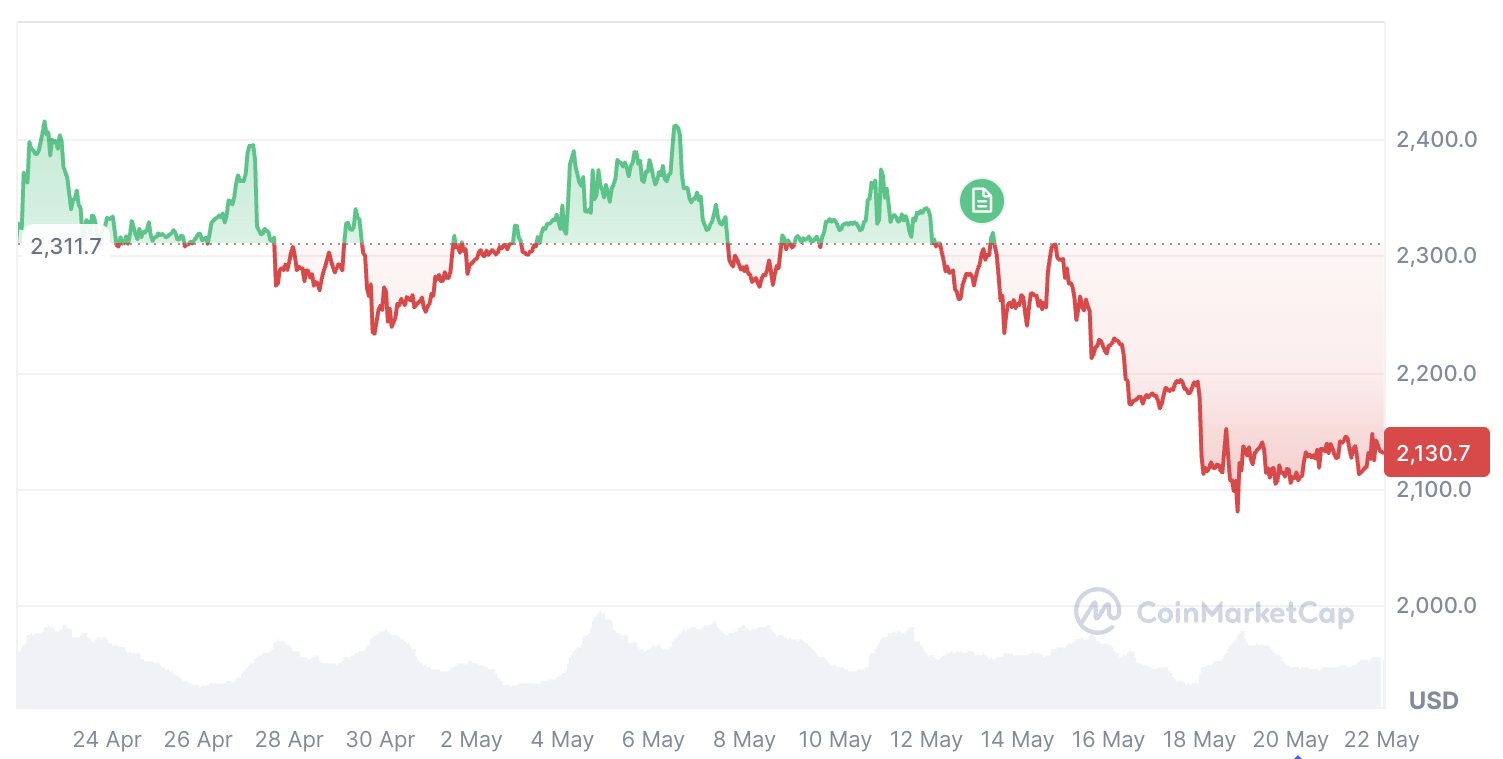
- Mid-May: Sellers systematically overwhelm buyer order books. After a decisive rejection at the $2,400 price band, ETH experiences persistent downward pressure, sliding below crucial psychological and technical supports.
- Sunday: The downward cascade accelerates sharply. On Bitstamp, the ETH/USD pair tumbles to $2,900—marking its lowest valuation since April 17. Concurrently, Binance futures data reveals a massive surge in aggressive sell orders, with taker buy/sell volumes crossing $1.1 billion within a single hour as the asset tests sub-$2,100 territory.
- Monday: Bitmine Immersion Technologies chairman Tom Lee confirms that the firm actively capitalized on the sub-$2,200 pullback, executing a massive acquisition of 71,672 ETH to fortify its corporate balance sheet.
Mid-May 2026: Structural Security and Regulatory Filings
- Wednesday: Blockchain data analytics platform Glassnode releases an urgent structural assessment via social media channels, warning that nearly 10% of Bitcoin’s total supply is "structurally unsafe" in the face of future quantum computing advancements.
- Friday: Asset management giants Grayscale and VanEck demonstrate renewed commitment to expanding US crypto ETF product lines. Grayscale submits its second amendment for a spot BNB ETF, while VanEck files its fifth S-1 registration statement with the United States Securities and Exchange Commission (SEC). This flurry of regulatory paperwork signals active dialogue with federal regulators and raises market speculation regarding the next approved asset class in the US.
- Throughout the Week: Analysts like Crypto Patel highlight sustained, low-volume accumulation phases for alternative assets like XRP, arguing that lack of retail exuberance often serves as the precursor to parabolic cycle expansions.
Supporting Context & Quantitative Metrics
The underlying data paints a vivid picture of vulnerability, institutional conviction, and derivative market positioning.

The Quantum Threat: 1.92 Million Vulnerable Bitcoins
Glassnode’s quantitative breakdown of Bitcoin’s supply dynamics introduces a sobering reality regarding cryptographic longevity. Approximately 1.92 million BTC—representing nearly 10% of the maximum 21 million supply cap—exposes its public key directly on-chain by design. This structural vulnerability persists irrespective of how carefully individual holders manage their address hygiene.
- Satoshi Nakamoto’s Holdings: Accounting for the lion’s share of vulnerable coins, wallets attributed to Bitcoin creator Satoshi Nakamoto hold roughly 1.1 million BTC (about 5.5% of the total supply). These early Pay-to-Public-Key (P2PK) outputs explicitly reveal the public key in the transaction history.
- Early Era Legacies: An additional 620,000 Satoshi-era coins (3.1% of supply) utilize legacy multi-signature structures, specifically Pay-to-Multisig (P2MS) formats that similarly compromise public key data.
- Modern Taproot Outputs: Roughly 200,000 coins (1% of supply) reside within modern Pay-to-Taproot (P2TR) addresses. Due to the inherent architectural design of Taproot script paths and key aggregations, these outputs also expose public key equivalents, leaving them susceptible to theoretical Shor’s algorithm attacks should quantum computing mature sufficiently.
Ethereum Derivatives and Market Liquidity
Ethereum’s drop to $2,131—down approximately 12% from its May 6 high and sitting down 8.44% over a rolling 30-day window—was not merely a spot market phenomenon; it was validated by derivatives behavior.
[Ethereum Price Action & Metric Breakdown]
--------------------------------------------------
Local High (May 6)        : $2,420
Swing Low (Sunday)        : $2,090 (Bitstamp)
Current Trading Range     : ~$2,131
30-Day Performance        : -8.44%
Binance Taker Sell Surge  : >$1.1 billion in 1 hour
The spike in Binance taker volume above $1.1 billion during the depth of the Sunday sell-off indicates that institutional and high-net-worth derivatives traders were aggressively crossing the spread to dump inventory. This supply-side dominance shifted market sentiment firmly into "fear" territory, convincing short-term market participants that bears had firmly recaptured market momentum.
Corporate Treasury Accumulation: The Bitmine Model
Despite retail panic and derivative liquidations, institutional treasury strategies continue to validate digital asset dips. Bitmine Immersion Technologies has solidified its position as the premier institutional holder of Ether. With its latest acquisition of 71,672 ETH, the firm’s total treasury stash marches steadily toward its stated milestone of controlling 5% of the total Ethereum supply by 2026. This mirrors the aggressive accumulation playbooks pioneered by corporate Bitcoin treasuries like Michael Saylor’s Strategy, proving that institutional heavyweights view deep price corrections as strategic liquidity events rather than structural exit signals.
Official Statements and Analyst Insights
Industry leaders, quantitative researchers, and market analysts have weighed in extensively on the week’s converging narratives.
Tom Lee on Corporate Accumulation
Addressing the rationale behind Bitmine’s aggressive buying spree during the sub-$2,200 market flush, Bitmine chairman Tom Lee stated:
"Over the past week, we acquired 71,672 ETH. We view the recent pullback of ETH to below $2,200 as an attractive opportunity. Bitmine is expected to reach the alchemy of 5% [of total ETH supply] sometime in 2026."
James Seyffart on SEC Filings and BNB ETFs
Commenting on the rapid succession of S-1 amendments filed by Grayscale and VanEck for spot BNB exchange-traded funds, Bloomberg intelligence ETF analyst James Seyffart noted via social media:
"Another amended S-1 from [Grayscale] on the BNB ETF… have to guess they are going off feedback from SEC and trying to launch in near future? Could be the next crypto asset to get a spot ETF in the US."
Crypto Patel on XRP’s Accumulation Phase
Contrasting the short-term bearish pressure on Ethereum, analyst Crypto Patel emphasized that older altcoins are displaying classic pre-breakout indicators:
"The $1.00–$0.70 range serves as a potential long-term accumulation zone. XRP’s muted sentiment and lack of retail hype could precede a larger upside move… projecting upside targets at $5, $10, and $15, implying roughly 10x–15x potential from the lower end of the accumulation range if XRP repeats its 2022–2024 cycle-style expansion."
Future Outlook & Strategic Implications
As the market digests these multifaceted developments, several key themes will dictate trajectory across the remainder of 2026 and beyond.
1. The Quantum Horizon for Bitcoin
While the 1.92 million "structurally unsafe" Bitcoins represent a significant long-term cryptographic hurdle, core developers and cryptographers maintain that the timeline for quantum computers to break 256-bit elliptic curve cryptography (ECDSA) remains distant. However, as quantum capabilities scale, community consensus around soft- or hard-fork upgrades to transition legacy P2PK and vulnerable Taproot/Multisig outputs to post-quantum cryptographic standards will transition from theoretical debate to urgent roadmap execution.
2. Ethereum’s Institutional Floor vs. Retail Sentiment
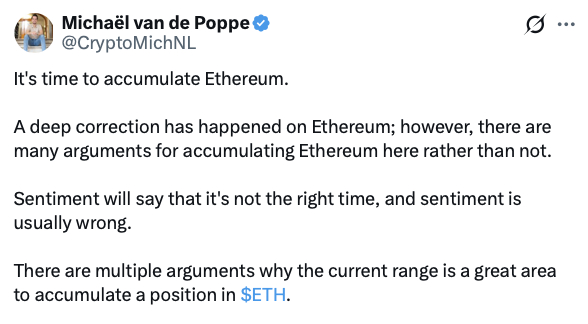
Ethereum’s drop below $2,100 has tested the resolve of leveraged traders, but the aggressive absorption of supply by entities like Bitmine Immersion Technologies establishes a formidable institutional floor. As long as corporate treasuries continue to treat sub-$2,200 valuations as generational accumulation zones, downside volatility will likely face stiff macro-buy walls.
3. Regulatory Expansion into Alternative Assets
The ongoing refinement of spot BNB ETF applications by Grayscale and VanEck suggests that the US regulatory perimeter is steadily expanding beyond Bitcoin and Ethereum. Approval of a spot BNB product would unlock fresh institutional capital flows, broadening the scope of regulated crypto financial products and setting a precedent for other leading layer-1 ecosystems.
4. Macro Consolidation and Altcoin Rotation
With analysts monitoring quiet accumulation zones in assets like XRP, the broader market appears to be consolidating within defined ranges. If historical market cycles repeat, periods of muted retail enthusiasm and quiet accumulation often precede violent volatility expansions. Investors and institutional market makers alike must balance short-term technical weakness against long-term structural milestones.
Disclaimer: Cointelegraph publishes long-form journalism, analysis, and narrative reporting produced by its in-house editorial team. All articles are edited and reviewed in line with strict editorial standards. Content published herein does not constitute financial, legal, or investment advice. Readers should conduct their own research and consult qualified professionals before making financial commitments.