rifanmuazin is a reporter for DeBitcoin covering Crypto Market Analysis. She/He is based in Indonesia.
9 August 2026 • 9 min read
The landscape of American digital asset regulation stands at a critical juncture as Senate Majority Leader John Thune’s filing of cloture on the Clear Legal and Regulatory Integration for Technology (CLARITY) Act sets the stage for a high-stakes legislative showdown. Filed on August 8, the motion schedules a pivotal procedural vote for September 15—immediately following the Senate’s return from its annual summer recess. If successful, the vote would cap floor debate and advance the landmark bill toward a final vote, positioning it for potential enactment into federal law.
Executive Overview
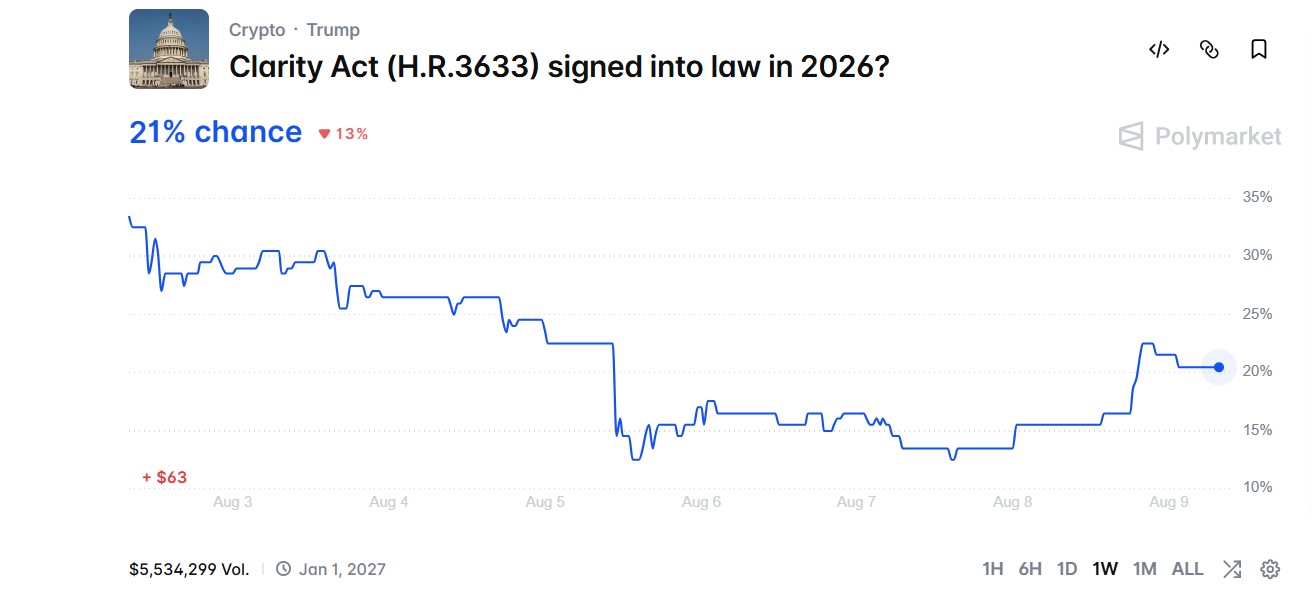
However, the path forward is beset by intense political friction. A stalemate between congressional factions—centered primarily on stringent executive branch ethics provisions pushed by Democratic lawmakers—has introduced significant uncertainty. These contested measures seek to prohibit federal officials, including President Donald Trump, from issuing or holding digital assets, raising the prospect of mandatory asset divestments. Consequently, decentralized prediction platforms such as Polymarket have seen the odds of the bill passing in 2026 drop to 22%.
Despite the legislative gridlock in Washington, equity markets for US-listed digital asset firms have displayed surprising resilience. Key sector bellwethers, including Coinbase Global Inc. (NASDAQ: COIN) and Circle (NYSE: CRCL), have decoupled from the falling legislative odds, driven instead by macroeconomic shifts, Federal Reserve interest rate expectations, and favorable technical chart patterns. Institutional analysts, alongside asset management titans such as Grayscale Investments, contend that while legislative clarity remains a long-term catalyst, the underlying digital asset ecosystem and its associated public equities possess sufficient structural autonomy to thrive under existing administrative framework regimes.
Detailed Chronology and Political Dynamics
+-----------------------------------------------------------------------------------+
|                            LEGISLATIVE TIMELINE                                   |
+-----------------------------------------------------------------------------------+
|  August 8:          Senate Majority Leader John Thune files Cloture on the        |
|                     CLARITY Act prior to summer recess.                           |
|                                                                                   |
|  August Recess:     Congressional recess; bipartisan negotiation on ethics       |
|                     provisions continues off the floor.                           |
|                                                                                   |
|  Polymarket Shift:  Approval odds for 2026 enactment slide to 22% amid executive  |
|                     branch conflict-of-interest gridlock.                         |
|                                                                                   |
|  September 14:      U.S. Senate officially reconvenes from summer recess.          |
|                                                                                   |
|  September 15:      Scheduled Senate Cloture Vote (60-vote threshold required).   |
+-----------------------------------------------------------------------------------+
The Procedural Gambit: Senate Cloture Motion
The formal legislative machinery was set in motion on August 8 when Senate Majority Leader John Thune invoked Senate Rule XXII, filing a petition for cloture on the CLARITY Act. In Senate practice, invoking cloture is a procedural mechanism designed to end extended debate and prevent filibusters, requiring a three-fifths majority (typically 60 votes) to succeed.
By filing cloture immediately prior to the congressional summer adjournment, Senate leadership strategically locked in a procedural timeline. The Senate is scheduled to reconvene on September 14, making September 15 the primary window for the decisive vote. A successful cloture vote would limit further debate on the bill to 30 hours, clearing the final procedural hurdle before a vote on passage and sending the legislation to the White House.
The Ethics Standoff and Presidential Disclosures
Despite procedural progress, the CLARITY Act faces substantive hurdles stemming from partisan disputes over ethics provisions. Democratic senators have united around demands for strict ethics mandates targeting executive branch officials.
Core Democratic Ethics Demands:
Token Issuance Prohibition: Outright prohibition against the President, Vice President, Cabinet Secretaries, and immediate family members issuing proprietary digital assets or commercial tokens during their tenure.
Mandatory Portfolio Divestment: Mandatory liquidation of existing executive cryptocurrency holdings to eliminate potential conflicts of interest surrounding federal monetary policy and digital asset oversight.
Ethics Oversight Mechanics: Integration of third-party compliance auditing mechanisms within the Office of Government Ethics (OGE) to monitor real-time blockchain wallet interactions.
President Trump’s hesitation to agree to these broad divestment parameters has created a legislative stalemate. Because the proposed amendments could force the President to sell his personal digital asset holdings, negotiations between White House counsel and Senate leadership remain deadlocked.
This legislative friction is reflected in decentralized prediction markets. On Polymarket, the consensus probability of the CLARITY Act successfully passing into law within the 2026 calendar year fell to 22% in mid-August. Investors on prediction markets are increasingly pricing in the likelihood that election-year politics and ethics disputes could push the bill’s resolution beyond the current legislative session.
While political analysts focus on the legislative friction in Washington, Wall Street has evaluated crypto equities through a broader lens that balances political headlines against technical analysis and macroeconomic developments.
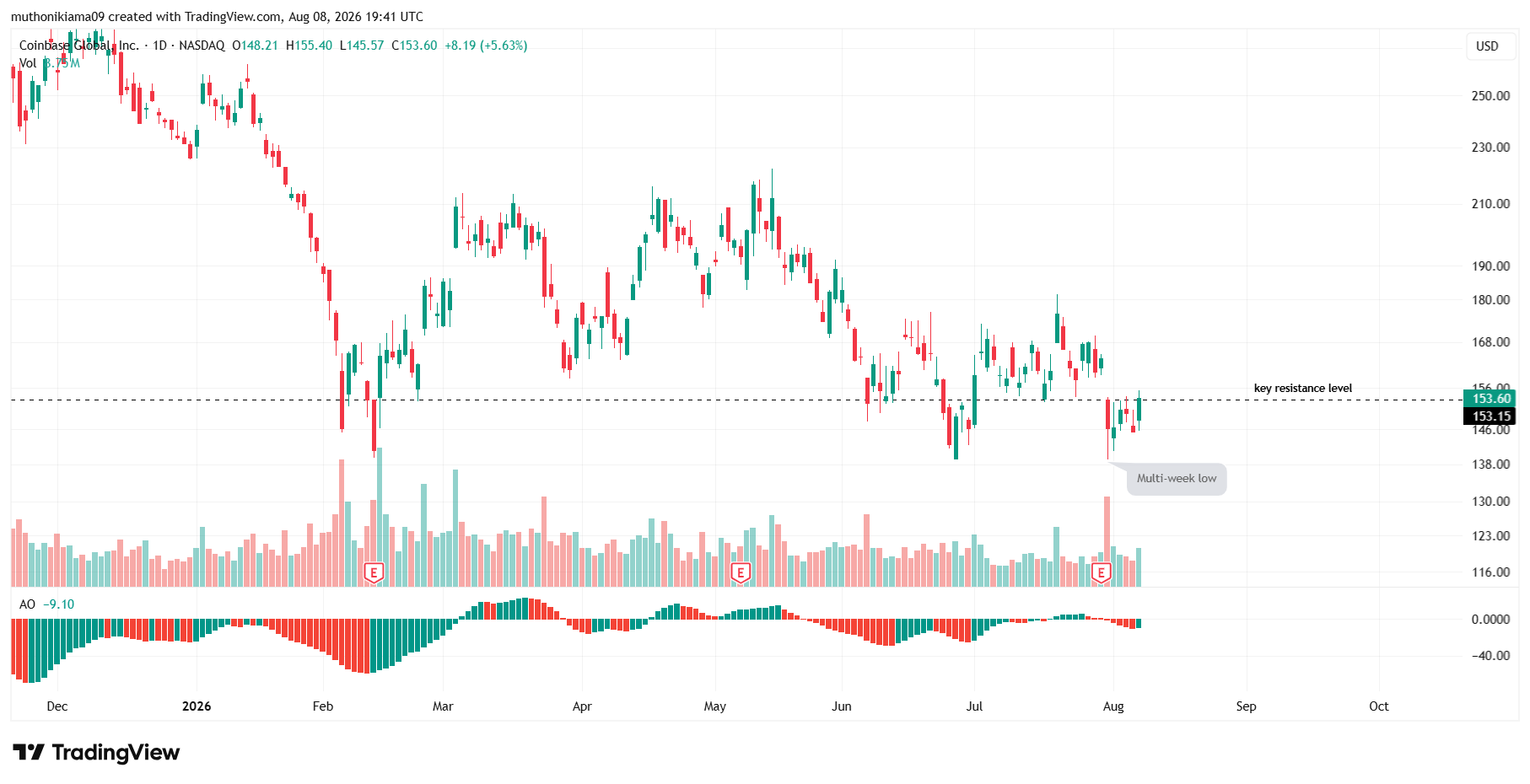
Coinbase has served as a primary gauge of market sentiment surrounding US regulatory developments. On August 7, COIN stock surged 5.63%, closing above the technical resistance level of $153.
Price Level: Closed at $153.00, successfully breaking through immediate horizontal resistance.
Awesome Oscillator (AO): The daily chart shows green histogram bars, indicating that short-term momentum is outpacing long-term momentum and that selling pressure is abating.
Macro Driver Correlation: Sensitivity to broader economic indicators, notably the July 2026 Non-Farm Payrolls and labor market data. Weak employment numbers have altered interest rate expectations for the September Federal Open Market Committee (FOMC) meeting, creating a tailwind for growth and tech equities that offsets legislative delays in Congress.
Circle Financial (NYSE: CRCL)
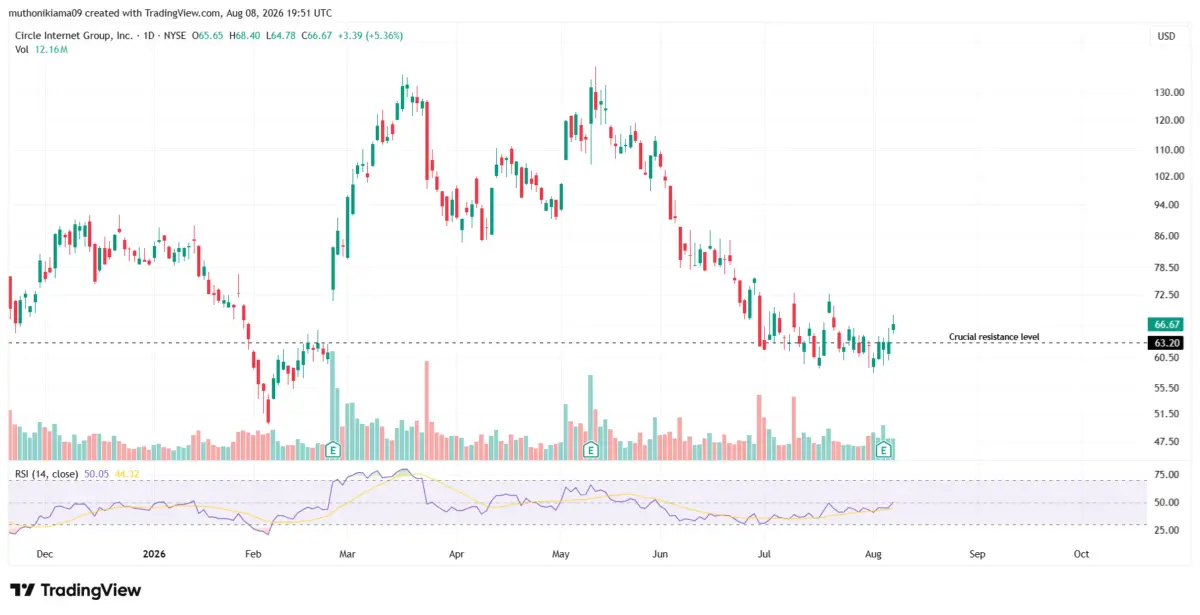
Circle, issuer of the USDC stablecoin, has demonstrated notable price appreciation despite the lower legislative odds for the CLARITY Act. Between early August and August 8, CRCL climbed from $57 to close at $66.
Circle Financial (NYSE: CRCL) Accumulation Curve
$80 +--------------------------------------------------[ Potential Target ]-+
    |                                                                       |
$70 |-----------------------------------------------------------------------|
    |                                                 * (Aug 8: $66)        |
$60 |--------------------------------*---------------/                      |
    |                                              /                       |
$50 +----------------------------------*-----------/------------------------+
    | RSI Indicator: Neutral at 50, building a sequence of Higher Lows      |
    +-----------------------------------------------------------------------+
Technical Profile:
Price Level: Advanced from $57.00 to a close of $66.00 on August 8.
Relative Strength Index (RSI): Rests near the neutral 50 level, but the formation of higher lows signals underlying accumulation by institutional buyers.
Target Resistance: Analysts identify $80.00 as the next major psychological resistance level. A successful cloture vote on September 15 could serve as the fundamental catalyst needed to push CRCL toward this threshold, supported by expectations that structural clarity will accelerate institutional stablecoin integration into settlement infrastructure.
Official Statements and Institutional Perspectives
The debate surrounding the CLARITY Act’s delayed path has drawn varied responses from asset managers, regulatory analysts, and institutional market commentators.
The Institutional Autonomy Argument: Grayscale Investments
Asset manager Grayscale Investments released an analytical brief downplaying the market impact of potential legislative delays. Grayscale emphasized that digital asset markets operate independently of single-jurisdiction legislative schedules:
"The digital asset market has operated, expanded, and developed institutional-grade infrastructure across international borders for over 17 years without the presence of the CLARITY Act. While comprehensive legislative frameworks provide welcomed certainty, the absence of immediate Congressional action does not impair the operational fundamentals or growth trajectory of underlying digital assets and publicly traded market operators."
— Grayscale Investments Research Division
Regulatory Continuity via Administrative Rulemaking
Financial analysts emphasize that legislative delays do not mean a regulatory vacuum. Shanaka Anslem, a market analyst, noted on social platform X that administrative agencies continue to build regulatory frameworks through existing powers:
"Every week that Congress stalls on codifying statutory definitions, the CFTC and the SEC continue to build regulatory precedence through administrative rules, enforcement actions, and exemptive relief orders. Institutional capital flows into publicly traded digital asset stocks are guided by macroeconomic reality, yield expectations, and custodial safety—factors that persist regardless of Capitol Hill’s legislative cadence."
— Shanaka Anslem, Market Analyst
This perspective highlights a core market reality: institutional investors view statutory legislation as an accelerator rather than a prerequisite. Public firms continue to secure market share, expand institutional prime services, and deepen liquidity networks under the supervision of existing regulatory authorities.
Future Outlook: September Scenarios and Strategic Fallout
As the Senate’s September 14 return date approaches, market participants are preparing for two primary legislative outcomes, each carrying distinct implications for digital asset equities and market structures.
+------------------------------------------------------------------------------------+
|                         POST-SEPTEMBER 15 SCENARIO ANALYSIS                        |
+------------------------------------------------------------------------------------+
| SCENARIO A: CLOTURE SUCCEEDS (60+ VOTES)                                           |
| - Impact: Senate proceeds to final passage; legislation moves to White House.       |
| - Market Response: Immediate expansion in valuation multiples for COIN, CRCL, etc. |
| - Sector Catalyst: Institutional tailwinds for stablecoin integration and custody.  |
+------------------------------------------------------------------------------------+
| SCENARIO B: CLOTURE FAILS / LEGISLATIVE STALEMATE                                  |
| - Impact: Bill stalls; oversight remains split between SEC and CFTC guidance.      |
| - Market Response: Short-term headline volatility; equities re-anchor to macro.    |
| - Sector Catalyst: Continued state-level adoption and foreign market expansion.    |
+------------------------------------------------------------------------------------+
If Majority Leader Thune successfully secures 60 votes on September 15:
Accelerated Final Passage: The Senate would move toward a final simple-majority vote within 30 hours of debate, sending the bill to the executive branch.
Multiple Expansion: Crypto equities would likely experience expansion in valuation multiples as market participants price in reduced regulatory risk premiums.
Institutional Capital Deployment: Clear statutory definitions dividing jurisdiction between the CFTC and SEC would unlock sidelined institutional capital, directly benefiting exchange operators like Coinbase and stablecoin issuers like Circle.
If procedural motions fail to overcome partisan opposition and ethics disputes:
Administrative Oversight Mandate: Regulatory oversight would remain reliant on administrative guidance, rulemaking, and judicial precedent from the SEC and CFTC.
Macroeconomic Drivers Take Precedence: Equity movements for COIN and CRCL would likely return to tracking broader macroeconomic factors, including Federal Reserve interest rate policy, global liquidity conditions, and traditional market earnings performance.
Jurisdictional Arbitrage: Capital deployment may increasingly favor foreign jurisdictions that have finalized digital asset frameworks, accelerating international expansion strategies for US-based public digital asset institutions.
Regardless of the immediate outcome on Capitol Hill on September 15, institutional integration of digital asset markets continues. While the CLARITY Act represents an important milestone for US statutory policy, price action across public equities suggests that financial markets have largely decoupled from legislative delays, anchoring their long-term outlook to broader macroeconomic trends and market infrastructure adoption.