
Executive Overview
The native asset’s rally was driven by a combination of fundamental project milestones and macroeconomic developments. On the fundamental side, excitement mounted following the announcement of a strategic integration with Fabric Foundation’s RoboPay framework—a payment protocol engineered for autonomous robotics and artificial intelligence infrastructure. Concurrently, node operators began preparing for the mandatory Protocol 26.1 Mainnet upgrade set for August 11, viewed as a crucial step toward broader network scalability and smart contract capabilities.
These project-specific catalysts unfolded against a backdrop of macro speculation in the United States, where digital asset markets reacted to congressional debates surrounding the CLARITY Act. Together, these factors generated a influx of capital into PI, pushing momentum indicators into bullish territory and setting up a potential test of key psychological resistance levels.
===================================================================================
                       PI NETWORK (PI) MARKET SNAPSHOT
===================================================================================
 Metric                       Value / Level           Context / Description
-----------------------------------------------------------------------------------
 Current Price                ~$0.0910                +6% in 24-Hour Trading Session
 Intraday Range               $0.0857 – $0.0953       Volatile Upside Expansion
 Relative Strength (RSI)      64.35                   Bullish Momentum (MA: 60.36)
 Chaikin Money Flow (CMF)     +0.10                   Positive Capital Inflow
 Primary Resistance           $0.0950                 Multi-touch Rejection Level
 Secondary Resistance         $0.1000 / $0.1100       Psychological & Target Zone
 Key Support Levels           $0.0880 / $0.0850       Channel Base & Breakdown Zone
 Protocol Upgrade Deadline    August 11, 2026         Protocol 26.1 Node Requirement
 RoboPay Milestone Deadline   August 21, 2026         48 Integration Tasks Pending
===================================================================================
Detailed Chronology of Events
The convergence of technological updates, strategic partnerships, and regulatory developments unfolded across several pivotal moments during the recent trading session:
Phase 1: Mainnet Infrastructure Mandate Issued
The initial momentum began when the Pi Core Team issued a formal technical directive to network node operators, mandating an upgrade to Protocol 26.1 prior to August 11. This directive signaled that the network was transitioning out of its interim configuration following the earlier deployment of Protocol 25’s cryptographic standards. Node operators quickly began updating their setups to ensure uninterrupted consensus validation.
Phase 2: Announcement of the RoboPay Partnership
Market sentiment received a substantial boost following public confirmation that Fabric Foundation had designated Pi Network as an official payment partner for its RoboPay payment gateway. The announcement outlined an integration roadmap linking PI to physical AI devices operating on OpenMind’s physical intelligence stack. The proposal introduced an incentive structure comprising 1 million ROBO tokens and set a firm integration deadline of August 21, triggering immediate accumulation across spot markets.
Phase 3: Macro Volatility and the CLARITY Act Deliberations
As PI climbed toward $0.0950, broader financial markets turned their focus to Washington, D.C. Reports circulated that the U.S. Senate was scheduled to conduct a high-stakes vote on the CLARITY Act—a legislative framework designed to establish definitive regulatory boundaries for digital commodities and decentralized trading platforms.
   [Protocol 26.1 Mandate] ──► [RoboPay Partnership] ──► [US Senate CLARITY Act Vote]
            │                           │                            │
   (Node Prep: Aug 11)        (AI-Robotics Integration)     (Macro Crypto Sentiment)
            │                           │                            │
            └───────────────────────────┴────────────────────────────┘
                                        │
                                        ▼
                   PI Network Price Surge to $0.0953 High
Anticipation surrounding the vote drove short-term positioning across major crypto assets, including Bitcoin, Ether, and XRP. This tide of capital further fueled risk appetite, propelling PI through local resistance levels and pushing its intraday high to $0.0953 before profit-taking brought a brief consolidation phase.
Supporting Context & Market Metrics
The recent price appreciation in PI cannot be isolated from the broader crypto market context, which experienced a general lift as top-tier assets recovered key technical levels.
===================================================================================
                  BROADER CRYPTO MARKET LANDSCAPE ANALYSIS
===================================================================================
 Asset / Index           Current Value        24h Change      Market Context
-----------------------------------------------------------------------------------
 Total Crypto MarketCap  $2.21 Trillion       +1.00%          Broad-based Recovery
 Bitcoin (BTC)           $64,700              Positive        Leading Risk Appetite
 Ethereum (ETH)          >$1,900              Stable          Consolidating Above Support
 XRP (XRP)               $1.04                Positive        Regulatory Sentiment Sensitive
 Pi Network (PI)         $0.0910              +6.00%          Outperforming Large-Caps
===================================================================================
While top-tier assets exhibited modest gains, Pi Network generated superior alpha due to its combined micro-level catalysts. Market depth analysis revealed that buy-side liquidity expanded significantly as price crossed $0.0880, supported by institutional and retail traders pricing in the fundamental utility promised by the machine-to-machine (M2M) payment framework.
Concurrently, the legislative drama surrounding the CLARITY Act highlighted the sensitivity of digital asset markets to regulatory policy. The proposed bill aims to grant regulatory clarity over digital commodities, potentially transferring significant oversight responsibilities to the Commodity Futures Trading Commission (CFTC).
Social sentiment indicators surged during Senate floor debates, where vote tallies hovered around 44 in favor and 56 against, against a 60-vote threshold required to overcome procedural filibusters ahead of congressional recess. Despite the legislative uncertainty, speculative volume flowed heavily into alternative assets like PI, as market participants sought high-beta exposure outside standard mega-cap tokens.
Strategic Alliances: Deep-Dive into the RoboPay Integration
The core driver behind Pi Network’s real-world payment utility thesis is its partnership with Fabric Foundation’s RoboPay system.

The Technical Foundation of RoboPay
RoboPay is engineered to serve as a specialized financial settlement layer for autonomous systems, operating on top of OpenMind’s physical intelligence stack. Unlike traditional human-centric payment gateways, RoboPay is tailored for low-latency, micro-fractional transactions executed directly between autonomous hardware units, such as delivery drones, automated manufacturing equipment, and AI computing nodes.
+---------------------------------------------------------------------------------+
|                       ROBOPAY UTILITY INTEGRATION ARCHITECTURE                   |
+---------------------------------------------------------------------------------+
|                                                                                 |
|   [ OpenMind Physical Intelligence Stack ]                                       |
|      └── Governs Autonomous Hardware (Robots, Drones, AI Compute Nodes)         |
|                                                                                 |
|   [ Fabric Foundation RoboPay Engine ]                                          |
|      └── Machine-to-Machine (M2M) Payment Gateway & Micro-Settlements          |
|                                                                                 |
|   [ Pi Network Native Asset (PI) ]                                              |
|      └── Transactional Currency for Real-World Autonomous Services              |
|                                                                                 |
+---------------------------------------------------------------------------------+
Strategic Objectives and Development Milestones
By securing designation as an official payment partner, Pi Network moves into an emerging sector of machine-to-machine commerce. Key details of the integration framework include:
- Incentive Program: A allocation pool of 1 million ROBO tokens has been established to reward developers and ecosystem partners completing technical integrations.
- Enterprise Participation: 12 commercial robotics firms are actively integrating the system into their operational workflows, with 8 firms having already listed their configurations.
- Integration Benchmarks: The development roadmap requires the completion of 48 technical tasks leading up to an August 21 deadline.
If fully realized, this partnership expands PI’s utility beyond traditional peer-to-peer (P2P) transfers and speculative trading on exchanges. It enables PI to function as a settlement token for automated services—such as paying for autonomous vehicle charging sessions, purchasing real-time computing power from robotic nodes, or executing micro-contracts for automated supply chain logistics.
However, market analysts emphasize that long-term price sustainability will depend on merchant adoption, actual transaction volume generated by machine economies, and the technical stability of the bridge connecting Pi’s core ledger with external physical hardware systems.
Core Infrastructure Evolution: Protocol 26.1 Mainnet Upgrade
Parallel to its ecosystem expansion, Pi Network’s core developers are executing significant infrastructure upgrades to optimize security and network performance.
===================================================================================
                    PROTOCOL 26.1 TECHNICAL UPGRADE ROADMAP
===================================================================================
 Feature Upgrade             Technical Mechanism               Strategic Value
-----------------------------------------------------------------------------------
 Cryptographic Primitives   BN254 Elliptic Curves             Enhanced ZK Privacy & Security
 Hash Function Optimization Poseidon Hashing                  Reduced Compute Overhead
 Smart Contract Execution   Enhanced State Management          Safer Multi-step Logic
 Data Synchronization       Upgraded Database Migrations      Faster Node Sync Speeds
 Cross-Chain Readiness     Interoperability Framework        Foundation for Protocol 27
 Mandatory Deadline         August 11, 2026                   Consensus Compliance Cutoff
===================================================================================
Enhanced State Management and Smart Contract Security
The transition to Protocol 26.1 introduces refined state management algorithms designed to streamline ledger serialization and reduce memory overhead for full node operators. The upgrade strengthens smart contract execution environments by implementing stricter validation bounds, mitigating risks associated with reentrancy vulnerabilities, and optimizing execution gas models.
Advanced Cryptographic Primitives
Protocol 26 builds upon cryptographic features introduced in Protocol 25, leveraging BN254 elliptic curve pairings alongside Poseidon hash functions. Poseidon hashing is optimized for zero-knowledge (ZK) proof systems, significantly lowering computational overhead for cryptographic verification relative to traditional SHA-256 or Keccak algorithms.
Interoperability and Database Migrations
To ensure seamless node synchronization during high-throughput events, Protocol 26.1 incorporates updated database migration routines. These performance gains are expected to prevent ledger state divergence across globally distributed nodes.
Crucially, the Pi Core Team explicitly identified Protocol 26 as an architectural prerequisite for Protocol 27. Protocol 27 is planned to introduce advanced cross-chain interoperability standards, enabling decentralized asset bridges between Pi Network and major Layer-1 smart contract platforms.
Technical Analysis & Future Outlook
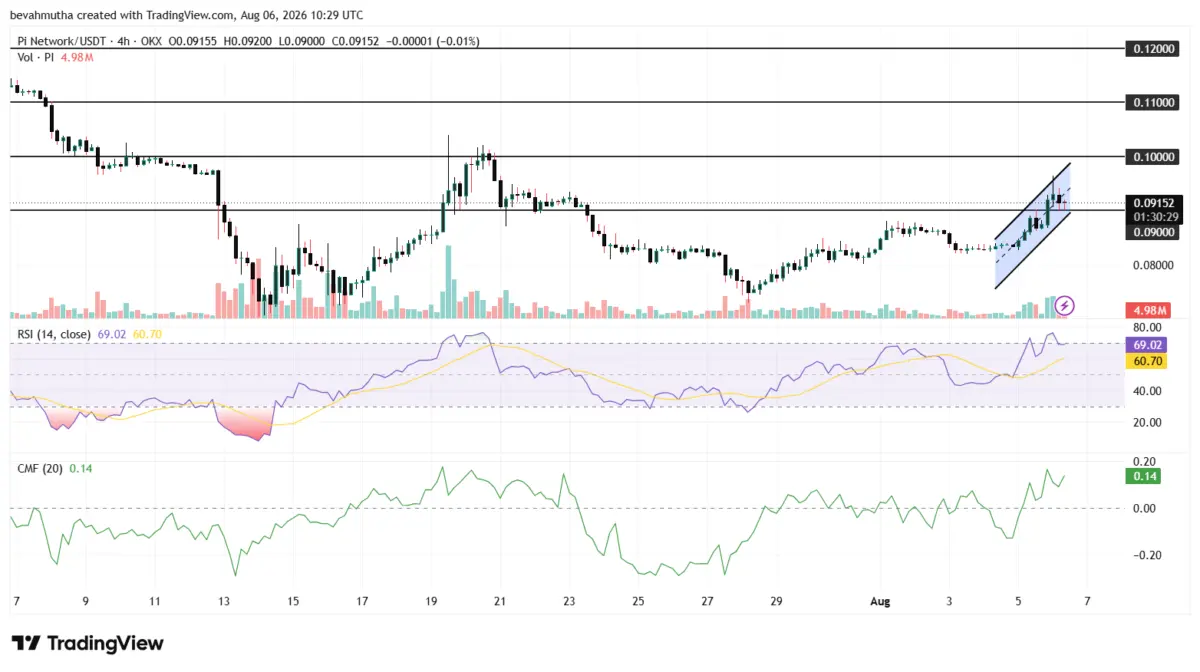
From a technical perspective, PI’s recent price action confirms a bullish structure within a well-defined ascending parallel channel on the 4-hour chart.
  PI/USDT 4-Hour Price Action Chart

  $0.1100 ─────────────────────────────────────────── Target 3 (Extended Target)

  $0.1000 ─────────────────────────────────────────── Target 2 (Psychological Resistance)
                                  /
  $0.0950 ────────────────────── / ────────────────── Target 1 (Channel Upper Boundary / Rejection)
                                /
  $0.0910 ──────────── *───────/  (Current Price: $0.0910)
                      /      /
  $0.0880 ───────────/───*───/    Channel Support (Ascending Support Line)
                    /      /
  $0.0850 ─────────/───────*      Secondary Support Level
                  /
  $0.0800 ───────/                Consolidation Floor
Bullish Breakout Scenario
- Immediate Resistance: The primary hurdle for bulls sits at $0.0950, a level that halted the recent rally and marks the upper boundary of the current ascending channel.
- Psychological Target: A sustained 4-hour candle close above $0.0950 would validate a channel breakout, opening the path toward the $0.100 psychological threshold.
- Medium-Term Target: Beyond $0.100, measured move projections point toward $0.1100, representing a potential 21% upside from current price levels.
Bearish Correction Scenario
- Immediate Support: If sellers defend $0.0950, PI may pull back toward the rising channel support baseline at $0.0880.
- Invalidation Point: A 4-hour close below $0.0880 would weaken the short-term bullish structure, exposing the secondary support zone at $0.0850.
- Critical Consolidation Floor: Deeper selling pressure could drag PI down to $0.0800, where previous multi-week consolidation built a robust demand zone.
Technical Indicators
- Relative Strength Index (RSI): The 4-hour RSI stands at 64.35, comfortably above its moving average of 60.36. This indicates strong momentum without entering overbought territory (above 70), leaving room for additional upside.
- Chaikin Money Flow (CMF): Floating at +0.10, the CMF confirms positive net capital inflow, signaling institutional accumulation rather than purely speculative retail action.
===================================================================================
                       PI NETWORK TECHNICAL INDICATORS
===================================================================================
 Technical Metric        Value            Market Interpretation
-----------------------------------------------------------------------------------
 RSI (4-Hour)            64.35            Bullish Control; Room Below Overbought (70)
 RSI Moving Average      60.36            Upward Sloping; Supporting Bullish Trend
 Chaikin Money Flow      +0.10            Net Accumulation; Buyers Dominating
 Chart Pattern           Ascending Channel Intact Upward Trend Structure
 Breakout Trigger        >$0.0950         Confirms Path to $0.100 / $0.110
 Breakdown Trigger       <$0.0880         Risk of Retest to $0.0850 / $0.0800
===================================================================================
Summary & Institutional Risk Evaluation
Pi Network’s market performance highlights a growing alignment between technological infrastructure updates and real-world commercial use cases. The strategic integration into Fabric Foundation’s RoboPay framework establishes a novel footprint in the machine economy, while the Protocol 26.1 mandate secures the network’s foundational state ahead of future cross-chain functionality.
However, investors and market participants should maintain a balanced risk perspective:
- Execution Risk: The success of the RoboPay initiative depends on meeting the August 21 technical integration milestones and securing long-term participation from commercial robotics vendors.
- Node Compliance Risk: Failure of node operators to update to Protocol 26.1 prior to August 11 could cause temporary network fragmentation or delayed block confirmations.
- Macro Regulatory Exposure: Broader market volatility remains closely tied to legislative developments in major jurisdictions, such as the US Senate’s deliberations over the CLARITY Act.
If Pi Network successfully executes its upcoming technical upgrades and meets its integration deadlines, its ecosystem may continue to attract sustained utility and liquidity—positioning the asset to challenge higher resistance levels throughout the remainder of the quarter.